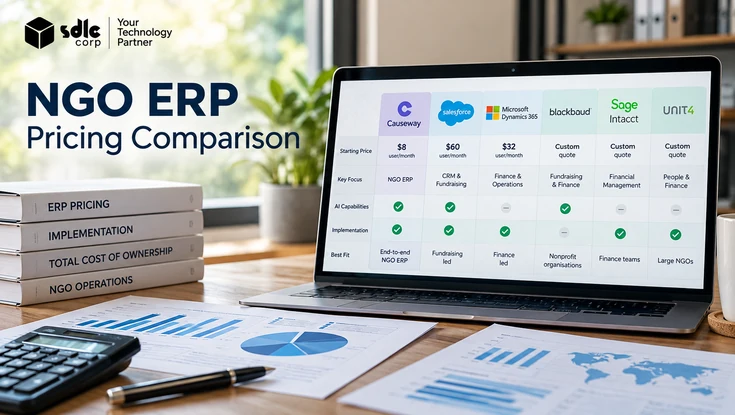
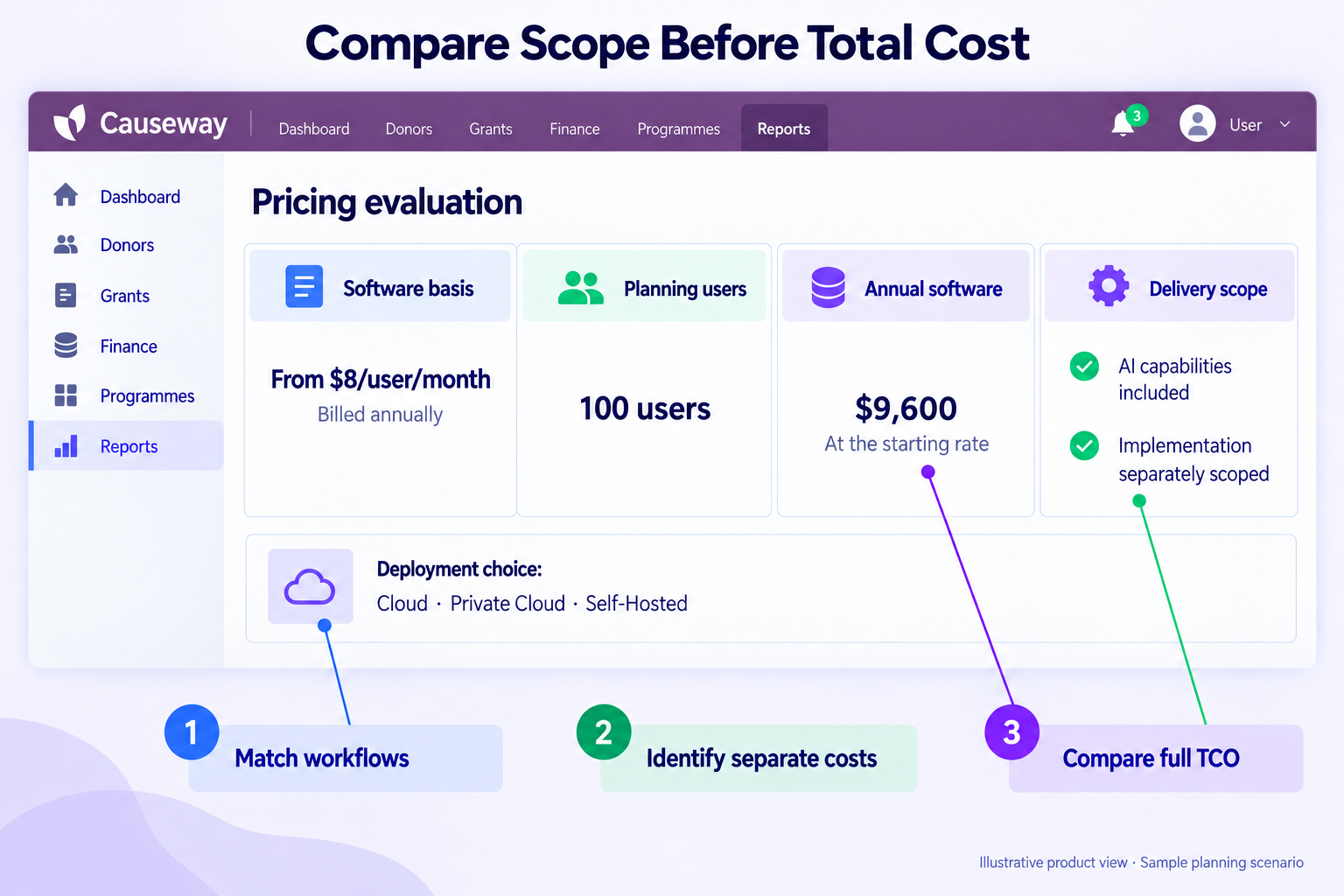
NGO ERP pricing should be compared on equivalent workflows, users, entities and operating responsibilities. Causeway starts at $8/user/month, billed annually, with AI capabilities included and implementation separately scoped. Other suppliers may publish a per-user rate, price a combination of products or require a tailored proposal.
A useful comparison separates CRM-first, finance-first and ERP-first architectures before calculating cost. A lower licence price answers only part of the question. Identify what the NGO must buy, implement and operate to connect its funding, finance and delivery records.
Public prices and quote-based offers
Pricing checked: 19 September 2026.
A public rate is an initial input; the final proposal must specify eligibility, region, term, product scope and services.
| Offering | Public Pricing Basis | Scope To Establish |
|---|---|---|
| Causeway | From $8/user/month, billed annually | Connected NGO ERP; AI included; implementation separately scoped |
| Salesforce Nonprofit Cloud | Enterprise $60; Unlimited $100 per user/month, billed annually | CRM, fundraising and programme scope; ledger and integration architecture |
| Microsoft Dynamics 365 Business Central nonprofit offer | $32 per user/month for eligible nonprofits on the referenced page | Exact edition, partner solution, NGO configuration and service terms |
| Blackbaud | Tailored proposal | Which fundraising, finance and other products are included |
| Sage Intacct | Request pricing | Finance modules, entity scope, integrations and delivery services |
| Unit4 | Proposal for the required scope | ERP, grants, operations and implementation boundaries |
Salesforce's pricing page also lists Agentforce editions at $135 per user/month, billed annually, and an eligibility-based ten-licence donation programme. AI entitlements and usage differ by edition; compare the specific offer.
The Microsoft nonprofit page lists several separate Dynamics and Power Platform offers. Its Business Central rate is not the price of every application in that ecosystem. Confirm which applications and partner extensions the NGO needs.
Use Blackbaud's pricing entry point, Sage's nonprofit offering and Unit4's nonprofit ERP information to obtain a dated, scope-specific response. Do not assign an invented universal licence price to a quote-based offer.
The architecture behind the subscription
A CRM-first solution can be appropriate where donor relationships and fundraising are the main change and an effective financial system remains in place. A finance-first solution can fit an organisation whose central problem is fund accounting or group reporting. An ERP-first proposal is relevant when procurement, grants, programmes and finance need shared operational records.
| Operating Need | Evidence That Makes Offers Comparable |
|---|---|
| Donor-to-ledger flow | Gift, payment, fee, designation and reconciliation remain traceable |
| Grant-funded purchase | Restriction, available budget, approval, receipt and actual expenditure agree |
| Programme reporting | Delivery evidence links to cost without multiplying or losing records |
| Group operation | Entity ownership, currencies, consolidation and local mappings are defined |
| People and volunteers | Required records and payroll or scheduling interfaces have named owners |
Causeway's competitive proposition combines NGO-specific breadth, AI, global operations, multi-currency and multi-entity finance with cloud, private-cloud and self-hosted choice. Test those strengths using the same operating scenario as the other proposals.
The CRM, grant-management and ERP comparison helps determine which product boundary is appropriate. A specialist system may remain part of the final design if its interface and exception handling are dependable.
AI and deployment belong in the comparison
Causeway includes AI capabilities. Record the selected workflow, source access, review action and applicable usage or infrastructure boundaries. Compare this with each competitor's exact AI edition, add-on and consumption terms.
For deployment, Causeway supports Causeway Cloud, Private Cloud and Self-Hosted / Customer-Managed Deployment. Supplier cloud region, dedicated infrastructure and customer operational control are different questions. A statement about one does not establish the others.
Use a proposal matrix with columns for supported deployment, infrastructure operator, application upgrade owner, recovery evidence and separate charge. For competitors, mark an unsupported or unanswered request as such; do not infer self-hosting from a generic statement about cloud flexibility. The deployment guide explains the operating responsibilities behind these choices.
A good result is a written answer for the exact product and version. A vague “flexible deployment” claim cannot settle the NGO's mandatory hosting boundary.
Subscription arithmetic at the same team size
For 100 users at Causeway's starting rate, annual software is 100 × $8 × 12 = $9,600. For 100 fully paid Salesforce Enterprise users at the referenced $60 rate, the arithmetic is $72,000 annually. Eligibility-based licences and negotiated terms can change the second figure.
These calculations compare starting licence inputs, not identical features or complete implementations. Retain that distinction when presenting a business case. Causeway's lower starting rate is useful pricing transparency; a lower complete TCO conclusion requires the rest of the cost schedule.
At the referenced Microsoft Business Central nonprofit rate, 100 users would be 100 × $32 × 12 = $38,400 annually if the offer and term apply. Additional applications, delivery work and eligibility must be resolved in the proposal rather than assumed from the calculation.
Which commercial unit changes the quote?
Suppliers may charge by named user, user role, module, legal entity, transaction volume or consumption. Record the unit before comparing prices. An occasional approver licence may differ from a full finance-user licence. A donor CRM licence also does not automatically include a general ledger.
| Quote Element | Supplier Response Needed | Comparison Treatment |
|---|---|---|
| Users and roles | Included rights, minimum quantities and external-user terms | Apply the same role mix to each offer |
| Modules | Required core, optional modules and dependencies | Mark omitted mandatory workflows as gaps |
| AI | Included edition, credits, consumption and infrastructure terms | Compare the same accepted task and volume |
| Entities | Included entities and expansion charges | Use the same country/entity operating scope |
| Deployment | Available hosting model and responsible operator | Separate a hosting constraint from a price preference |
| Contract period | Term, renewal basis and promotion end date | Keep introductory and ongoing rates distinct |
The 100-user arithmetic above is a common starting input, not a declaration of functional equivalence. For each vendor, add a short scope statement: which workflows are included, which need another product, and which remain unproven. A low visible licence rate should not conceal a missing mandatory capability.
A comparable proposal preserves both price and fit
Take a restricted gift, an institutional award and a grant-funded purchase through each proposed architecture. Record the products involved, the authoritative records and the interfaces needed. The same scenario makes the distinction between an integrated workflow and a collection of separately priced components observable.
Keep quote-only suppliers in the comparison without inventing a rate. Record the quote date, currency, legal entity, offer scope and unresolved commercial questions. If a vendor requires discovery before quoting, mark the price as pending. A market-average figure is not that vendor's offer.
Deployment can be a mandatory gate. If the NGO requires customer-managed hosting, a lower SaaS price does not compensate for an unavailable deployment model. Ask for a written response for the exact product and version. Do not infer self-hosting availability from a broad ecosystem or partner claim.
Once the proposals have comparable scope, carry their accepted inputs into the NGO ERP cost and TCO model. That guide owns implementation, migration, integrations, support, infrastructure and three-/five-year ownership calculations. This comparison resolves how the suppliers price and package the required work.
The business case keeps expected operational benefits separate from supplier charges. A forecast reduction in reporting effort is not a discount on an invoice, and it must retain its own measurement assumptions.
Conclusion
Compare the operating architecture before comparing the subscription totals. Price the same users, entities, workflows and operating responsibilities over the same period. Causeway's $8/user/month starting software price, billed annually, belongs alongside its separately scoped implementation and other costs. Keep quote-based alternatives marked as pending until you have a scoped offer. Select on the complete cost and demonstrated fit; a low headline price cannot explain an excluded module or an unstaffed operating duty.
Request a comparable Causeway proposal
Evaluate Causeway against your users, entities, countries and required workflows. Ask for a proposal that separates annual software, implementation, integrations, localisation and applicable provider costs. Include deployment responsibilities and AI usage boundaries. Attach acceptance evidence to each mandatory requirement so the comparison covers the system your organisation will operate.
Frequently asked questions
Can donated licences change the ranking?
Yes. Apply eligibility-based offers only when the organisation qualifies and the included product meets the requirement. Implementation, integration and operating costs still belong in the comparison.
How should an unanswered deployment requirement be scored?
Keep it unresolved and outside the passing set if it is mandatory. A lower subscription does not compensate for an unproven hosting or operational-control requirement.