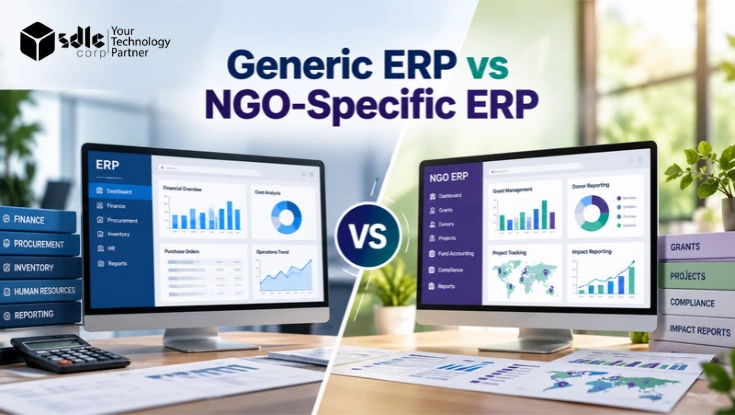
The choice between generic ERP and NGO-specific ERP is a fit-gap decision, not a contest between labels. A general platform may offer strong finance and integration capabilities but require significant work around awards and donor reporting. A specialist product may align with NGO terminology while still needing development for your entity structure or local requirements.
Compare the workflows that matter, the effort needed to close gaps and the responsibility for maintaining the result. The best option is the one whose demonstrated capabilities and delivery model fit the organisation's needs at an acceptable cost and risk.
Fund and grant dimensions reveal workflow fit
Where a mandatory NGO workflow requires an extension beyond configuration, separately scope custom ERP development. Record the gap, upgrade responsibility and acceptance test so a bespoke extension does not become an unpriced dependency.
First decide whether you need ERP, accounting, CRM or grant management software. If ERP is the right category, examine how each candidate represents donors, awards, funds, projects and entities.
Test restricted-fund controls by following an approved purchase into a partial invoice and verifying that commitments and actuals are not double-counted. Ask how the system applies eligibility periods, permitted costs and authorised amendments.
A configurable dimension can be useful, but it does not establish that all required controls exist around it. Conversely, a screen labelled “grant” should not receive extra credit unless it supports the actual decisions and evidence your team needs.
Test donor conditions and programme evidence
Ask both types of supplier to produce a donor report from the same test records. Check the period, currency, budget mapping and reconciliation. Then trace a programme result to its definition and evidence.
Determine whether programme data is managed in the ERP or connected from another application. Either approach can be valid, but the scope should identify ownership, aggregation rules and privacy boundaries. A generic dashboard connector is not automatically a complete monitoring and evaluation workflow.
| Need | Fit Question |
|---|---|
| Award amendment | Can the previous approved version be reconstructed? |
| Donor report | Can its totals be reconciled to source records? |
| Programme result | Are definitions and counting rules preserved? |
| Sensitive records | Do access restrictions survive reports and exports? |
Use observed evidence to classify the fit rather than assuming that a specialist product always needs less work.
Compare architectures with named examples
Product categories overlap. Salesforce's nonprofit offering lists fundraising and programme capabilities; a buyer still needs to establish the financial ledger and integration boundary. Unit4's grant management offering describes pre-award and sub-award processes within its ERP-oriented proposition. These are vendor descriptions, not independent acceptance-test results.
Blackbaud presents a portfolio of nonprofit products. The Microsoft nonprofit and Dynamics ecosystem offers finance and constituent-service applications with separate product boundaries. Compare the exact proposed combination, versions and implementation responsibilities.
Ask all candidates to demonstrate the same restricted-award transaction and reporting exception. Then price the missing configuration, integrations and support. Fundraising, grants and ERP record ownership helps expose differences that a generic feature checklist can hide.
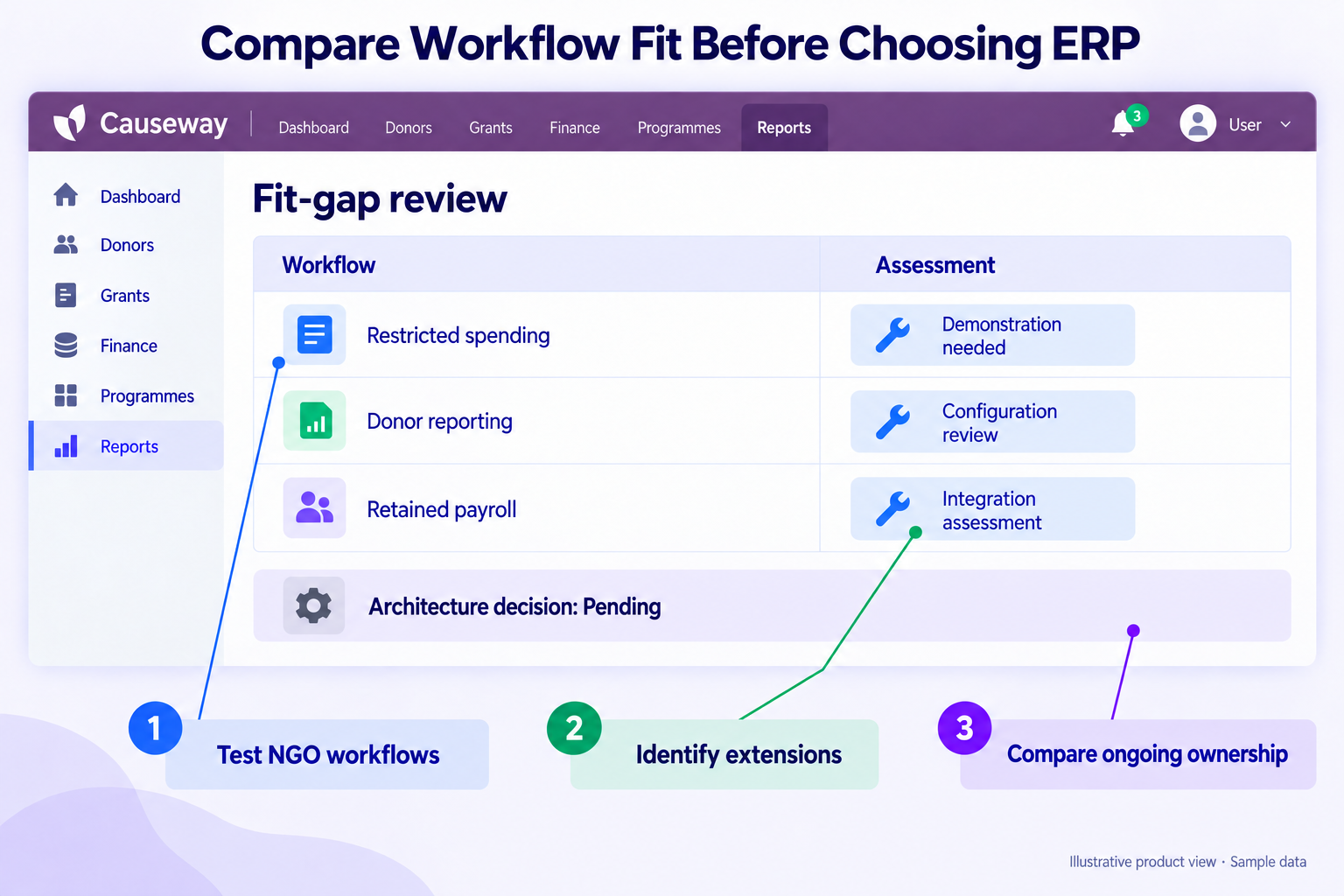
Configuration and custom development have different costs
Configuration uses supported settings or extension mechanisms to express the required process. Custom development introduces additional logic or components. The practical distinction depends on the platform, so ask the supplier to explain how each proposed change is built, tested and maintained.
For every gap, record the proposed solution, dependency, owner, acceptance evidence and upgrade implications. A small custom component may be manageable; a collection of undocumented changes can become difficult to support. The number of changes alone is less informative than their complexity and ownership.
Test what happens when a policy changes. If adding a budget category or approval threshold requires developer intervention, include that operating burden in the evaluation. A configuration demo should show the change and its effect, not merely the final screen.
Check integrations, security and local needs
Assess retained systems and country requirements on their own evidence. Neither a global ERP brand nor an NGO-specific label proves that a particular bank connector, local report or privacy workflow is ready for use.
Ask for the proposed security and service model, including privileged access, exports, audit evidence and recovery. Identify external parties and conditions that must be satisfied before an interface or local output can be accepted.
Use a neutral fit classification: demonstrated, configurable, dependent on another product, custom or unsupported. Avoid competitor tables filled with assumptions. Where evidence is unavailable, record the uncertainty rather than assigning a convenient score.
Who maintains the result and supports exit?
The vendor scorecard should include delivery and operating responsibilities, not only functionality. Ask who maintains configurations, integrations and custom work after launch. Confirm how upgrades are tested and how the organisation retains knowledge of its own processes.
Compare total cost over the same period, including internal effort and retained applications. An apparently lower implementation cost may leave more ongoing manual work; a broader platform may introduce complexity the organisation does not need.
Finally, test the ability to retrieve data and documentation in usable forms. Identify the records, attachments, relationships and audit evidence required for transition. An export of isolated tables may not preserve the meaning needed to operate or review the records elsewhere.
Compare a proposed architecture with implementation references such as the multi-function nonprofit ERP implementation. Look for the boundary between standard product behaviour, configured processes and additional work before drawing conclusions about repeatability.
Three organisations can reach different decisions
| Organisation | Architecture Worth Evaluating | Evidence That Determines Fit |
|---|---|---|
| One entity with effective fundraising tools | Finance core plus controlled donor interface | Gifts, fees, refunds and restrictions reconcile |
| Grant-funded network with partner advances | NGO-specific shared operating platform | Amendments, commitments, accepted partner spend and reports stay linked |
| Large federation with established local services | Global core with justified country interfaces | Consolidation, local reporting and recovery responsibilities are demonstrable |
In a fit-gap worksheet, give every requirement a current fit, missing behaviour, proposed resolution, cost, owner and upgrade responsibility. For example, a working ledger plus an unbuilt partner-advance workflow is a partial fit with delivery work, not a passed grant-management requirement. Re-evaluate the architecture if closing several central gaps requires disconnected custom systems.
Conclusion
Compare workflow fit and ownership rather than assuming one ERP category is inherently better. Test the same scenarios, classify gaps consistently and include maintenance and exit requirements. A suitable choice should remain explainable after the product labels and presentation style are removed from the comparison.
Assess Causeway against your operating model
Evaluate Causeway against the same fit-gap criteria used for other options. Bring representative grant, procurement and reporting scenarios, along with your local and integration requirements.
Ask for a clear distinction between demonstrated capability, configuration and future work. Review the proposed delivery approach alongside the scope evidence and the responsibilities needed to maintain the proposed solution.
Frequently asked questions
Is NGO-specific ERP always better?
No. It may align well with some NGO workflows, but actual fit depends on the product and configuration. Test essential controls, local needs and integrations. A specialist label should not replace evidence or a realistic delivery plan.
When is configuring generic ERP reasonable?
When the platform can support the required workflows through manageable, documented configuration and the organisation can operate the result. Assess the work, dependencies and upgrade effects. Compare that full responsibility with the specialist alternatives.
How can we compare customisation risk?
Record each change's purpose, complexity, owner, test coverage and maintenance approach. Ask how it behaves through upgrades and policy changes. Consider the consequences if its original implementer is unavailable, not only the initial development estimate.