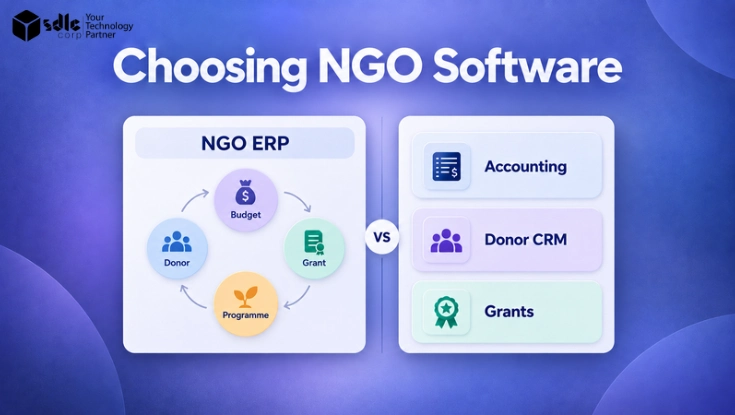
Accounting software owns the ledger; donor CRM manages supporter relationships; grant software manages award conditions; NGO ERP connects those responsibilities to purchasing, programmes and other operations. The right choice depends on which records and decisions need to move between teams, and whether the organisation can operate those interfaces reliably.
Compare categories by the decisions they are designed to support. Then test the handoffs where funding, purchasing, delivery and reporting cross between them. The right architecture may be a connected set of specialist tools, a shared ERP, or a combination with clearly assigned responsibilities.
What each category is designed to own
Accounting software centres on financial transactions and reporting. A donor CRM usually supports relationships, communications and fundraising activity. Grant management software may focus on applications, awards, conditions and reporting. ERP can connect a broader set of operational and financial workflows, although actual scope varies by product.
Check the scope of the proposed NGO ERP operating model against actual workflows: a particular accounting product may support sophisticated fund dimensions, while a product called ERP may still depend on separate programme or donor systems.
| Category | Typical Starting Responsibility | Boundary To Check |
|---|---|---|
| Accounting | Ledger and financial reporting | Commitments, award restrictions and operational approvals |
| Donor CRM | Relationships and fundraising | Whether an opportunity is an actual award or receipt |
| Grant Management | Award conditions and reporting | Connection to posted expenditure and commitments |
| ERP | Cross-functional transactions | Depth of specialist donor and programme functions |
Ask suppliers to demonstrate the responsibilities and handoffs relevant to your organisation before scoring their products.
Where capabilities overlap
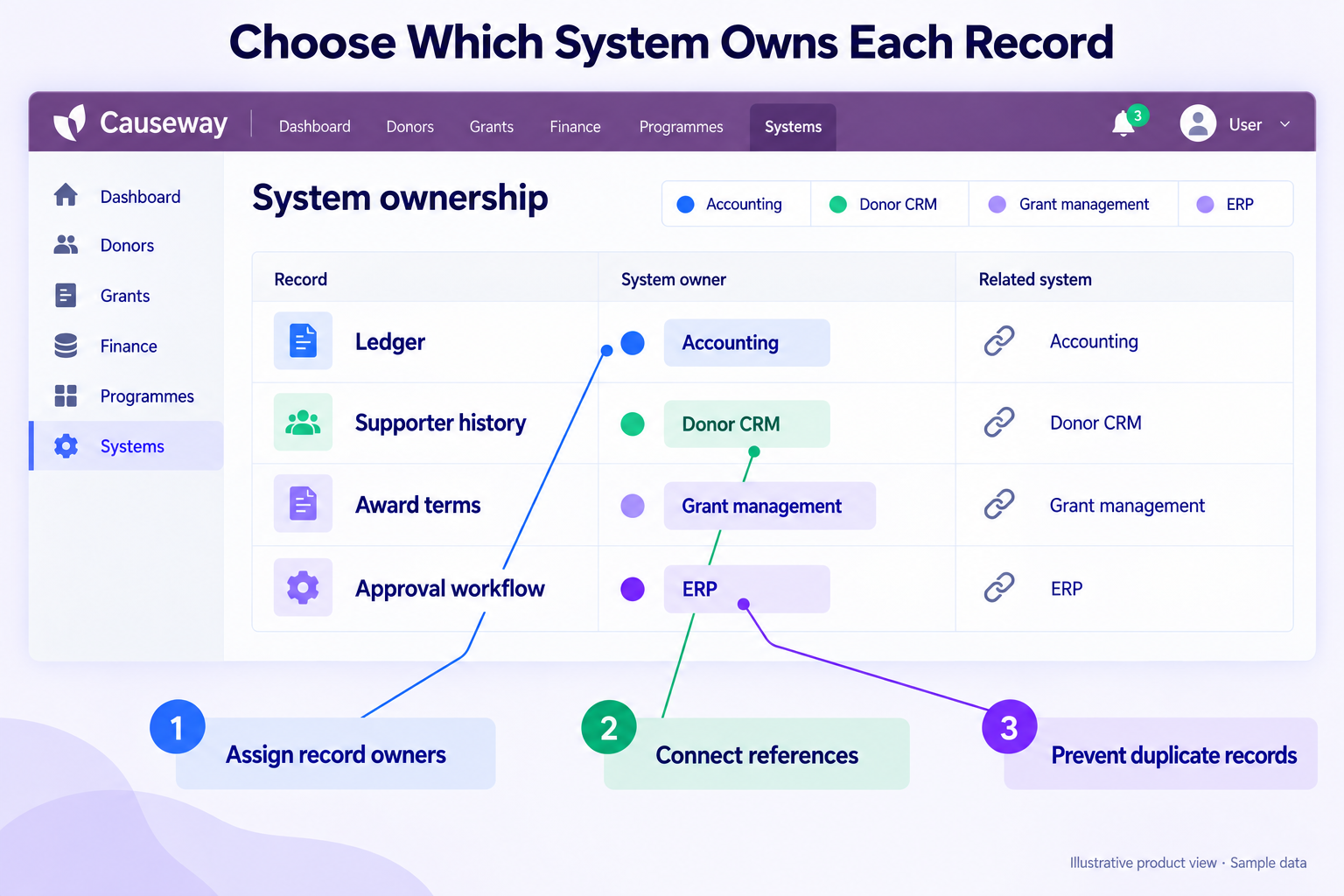
Two systems may both store donor names, projects or budgets. Decide which record is authoritative and which is a controlled copy. A donor's address might belong in CRM, while a posted financial transaction belongs in accounting. An award identifier should connect them without allowing uncontrolled edits from both sides.
Distinguish a fundraising opportunity from an accepted grant, a pledge from cash received and an activity budget from a financial posting. Synchronising similarly named fields without matching their meaning can create records that appear consistent while representing different events.
Create an ownership map covering creation, updates, approval and retirement. If both applications can change the same field, define conflict handling and audit responsibility. Otherwise users will eventually resolve differences through manual edits that are difficult to reproduce.
What breaks between separate systems
Consider an award approved in a grant application while its budget is entered separately in accounting. Procurement staff see only the accounting balance. If the award's eligibility period changes, the grant team may update its application while purchases continue against the old assumptions.
The gap is not simply duplicate entry. It is a decision made using incomplete or stale information. Similar problems occur when a donor report combines financial totals with programme measures that use different periods or project codes.
Measure these handoffs before selecting new software. Record the frequency of corrections, time spent reconciling and consequences of missed updates. Separate issues caused by unclear ownership from those caused by missing technical capability; replacing software will not automatically resolve both.
When integration is enough
Integration can be appropriate when existing tools perform their specialist roles well and the shared records have clear boundaries. Define the required timeliness, allowed changes and recovery process. A nightly reporting export has different requirements from an authorised payment instruction.
Specify interfaces, retries and reconciliation in the NGO ERP integration design. Include monitoring and support responsibilities in the comparison. Someone needs to investigate a rejected record and establish whether it was processed before a retry.
Test a representative failure, not only a successful transfer. Ask what happens when an award code is unknown, an external system is unavailable or a record is corrected after synchronisation. The architecture is viable only if the organisation can operate those exceptions.
When a shared ERP is worth evaluating
Evaluate a shared platform when the same cross-functional decisions repeatedly depend on reconstructed data or disconnected approvals. The potential benefit is a more coherent operating workflow, but implementation introduces its own work: data definitions, configuration, role design, testing and adoption.
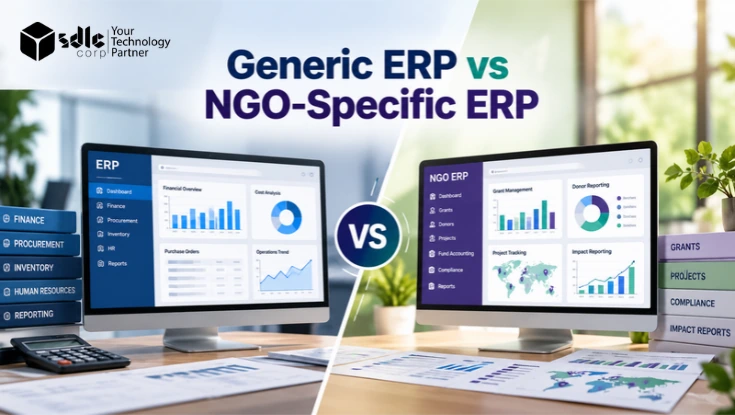
The generic versus NGO-specific ERP comparison addresses fit within the ERP category. It is a different question from whether CRM or accounting should remain separate. Avoid assuming that a specialist label guarantees better fit or that a broad ERP eliminates every external application.
Use a structured selection process to compare realistic architectures. Include the cost of retained applications, interfaces and internal ownership. A smaller connected solution can be preferable when it satisfies the required controls without creating disproportionate complexity.
A donation and an award need different handoffs
A fundraising appeal needs supporter relationships, communication preferences and gift attribution. An institutional award needs conditions, approved budgets, reporting dates and amendments. The ledger needs recognised transactions and reconciliation. One platform can connect these records, but their owners and approval rules still differ.
Use the fundraising-to-finance ownership comparison when deciding which specialist tools to retain. Keep donor relationship work visible in the scope rather than assuming an ERP contact list provides the entire fundraising process.
Three different software boundaries
| Organisation | Sensible Starting Architecture | Condition To Test |
|---|---|---|
| One entity with simple grants and an effective donor CRM | Retain accounting and CRM with a controlled gift reconciliation | The same receipt is not posted twice and corrections reconcile |
| Grant-funded network with procurement and partner advances | Evaluate a shared ERP and retain specialist monitoring tools | Award changes reach budget checks and partner reports |
| Established multi-country group with local payroll | Shared finance and controls with country payroll interfaces | Local payroll owns calculation; approved journals and exceptions reach finance |
The decision tree is short: can existing tools satisfy the mandatory controls? If yes, test interface ownership and failure recovery. If no, identify whether configuration, one specialist addition or a shared ERP resolves the gap. Reject an architecture whose exception workload has no funded owner.
Causeway reports programme reporting moving from quarterly to weekly across its multi-customer implementation experience. For a connected NGO architecture, measure that cadence together with which country records are included and whether their review is complete. Faster delivery of an incomplete group report is a different result.
Conclusion
Choose software boundaries around records and decisions, not category names. Establish which application owns each event, measure the difficult handoffs and test how failures are resolved. Compare integration with a shared platform using the complete operating responsibility. This creates a stronger basis for selection than counting overlapping features.
Review your NGO application boundaries
Discuss where Causeway global NGO ERP could fit within your current accounting, donor and grant systems. Bring a record-ownership map and examples of the handoffs creating the most reconciliation work.
Ask for a scope that distinguishes replacement, retained applications and required integrations. Demonstrate the relevant workflow across those boundaries and confirm who owns exceptions. The evaluation should establish practical fit for your architecture rather than assume that every existing tool needs to be removed.
Frequently asked questions
Can accounting software manage restricted funds?
Some products support suitable dimensions and controls, while others require additional configuration or applications. Check the exact requirement, including commitments, amendments and reporting. Do not infer operational control from the ability to add a fund code to a transaction.
Does ERP mean replacing every existing tool?
No. Specialist applications may remain where they serve a useful role. Define system ownership, interfaces and reconciliation responsibilities so the combined architecture stays manageable. Include retained applications and their operating costs in the evaluation.