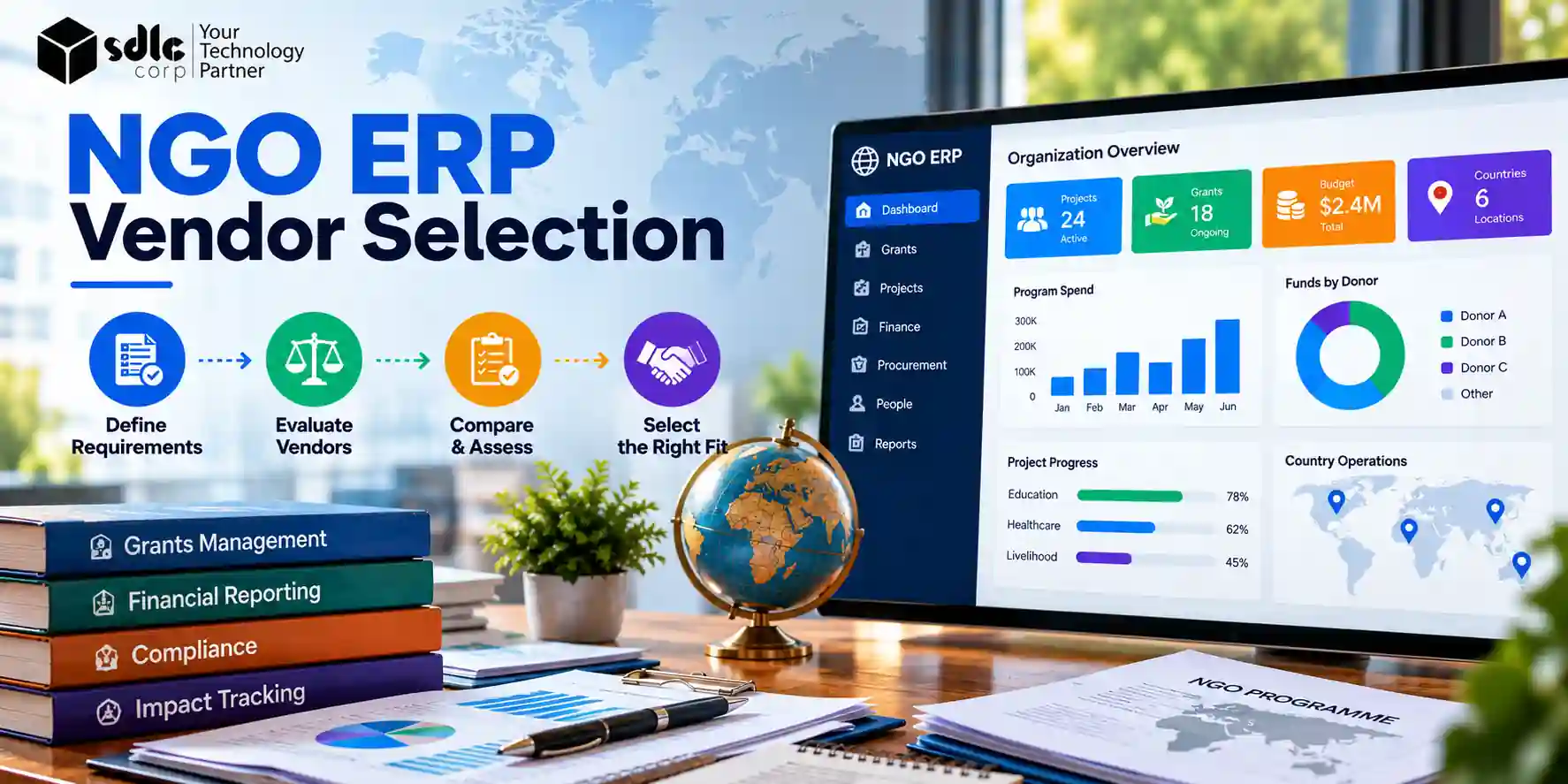
Choosing NGO ERP is a decision about operating fit, delivery risk and long-term responsibility. A polished demonstration can make several products look suitable while leaving the difficult questions unanswered: can the system protect restricted spending, reconcile donor reports and support the organisation's actual country structure?
Use a selection process that separates essential conditions from preferences and demonstrated evidence from promises. Agree the decision method before comparing suppliers. This makes the final choice explainable and reduces the chance that presentation quality or a headline price overwhelms a critical requirement.
Which decisions must the system support?
For broader context, see general ERP selection framework. An NGO evaluation then needs evidence for restricted funds, grants, donor conditions, field operations and country-specific reporting.
Identify the people who will rely on the system and the decisions they make. Finance may need a reconciled award balance; programme teams need delivery information; procurement needs authority and budget checks; governance teams need evidence and access control.
Trace several recent workflows and record the points where information was missing, duplicated or disputed. Define the improvement in practical terms. “Better reporting” is less useful than “a reviewer can reconcile the donor statement to its source transactions without recoding the export.”
Include local users and system owners early. A central requirement list can miss country workflows, external interfaces or responsibilities retained by partners. Selection should test the operating model the organisation actually needs.
The NGO ERP operating model connects the award, spending decision and delivery record. Use those handoffs to define NGO ERP feature requirements before scoring suppliers.
Mandatory gates come before scores
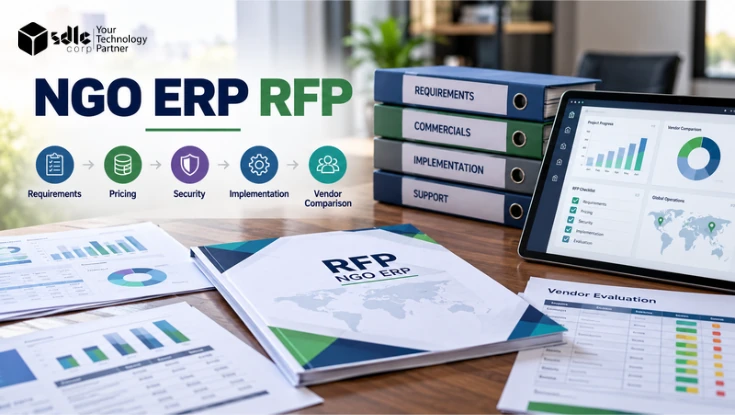
Use the ERP requirements checklist to identify conditions that must be satisfied before a supplier remains eligible. These may concern financial controls, data protection, reporting or delivery dependencies. Give each gate an owner and explicit evidence.
Do not label every preference mandatory. A genuine gate describes a condition the organisation cannot reasonably proceed without. If an essential need can be met through a compensating process, document that process, its cost and the authority accepting the risk.
Set a rule for roadmap features. A future commitment is not current functionality. Decide whether the dependency is acceptable and what contractual and acceptance conditions would be required before relying on it.
Choose the right vendor category
Compare the proposed architecture before comparing brands. A fundraising platform may need a separate ledger. A general ERP may need nonprofit extensions. A specialist nonprofit finance system may retain programme tools. An integrated NGO suite may still depend on local payroll and payment providers.
Assess the product's maturity in the functions you will actually use: current release evidence, relevant references, support capacity and tested integrations. A future roadmap item should not satisfy a mandatory first-phase need. Review security and vendor trust evidence early enough to avoid investing in a long demo for an unacceptable service boundary.
Ask for the charging model at shortlist stage. Per-user, module, usage and service-based prices expose different growth costs. Use public pricing and commercial model comparisons as orientation, then obtain a proposal for the agreed scope.
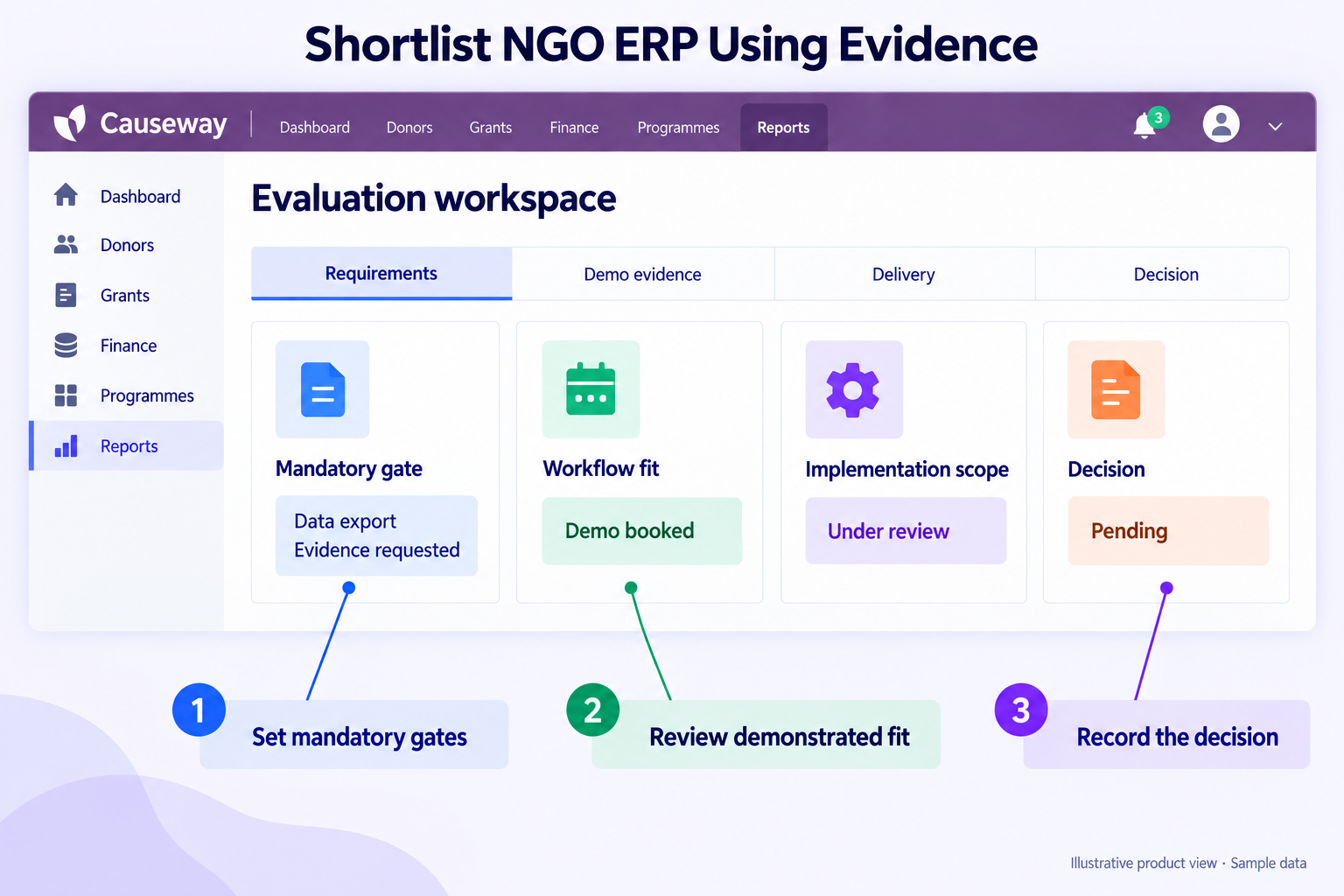
Shortlist against real workflows
Send shortlisted suppliers a small, coherent test dataset and selected scenarios. Ask them to follow an award through budget approval, purchase, partial invoice and reporting. Include a rejected action and a correction, not only a successful sequence.
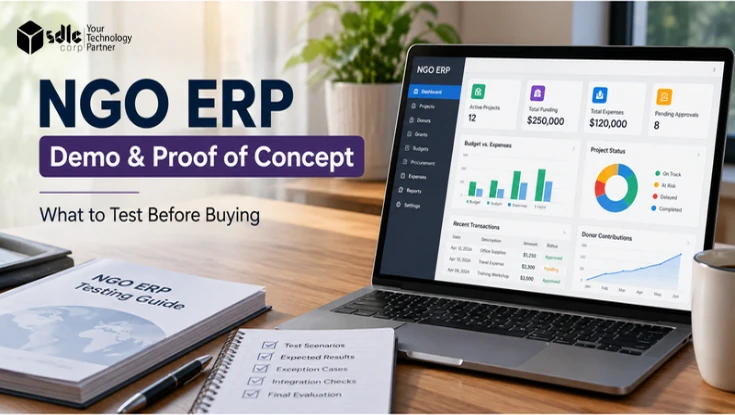
The live demonstration checklist helps record prerequisites, expected results and observations. Let users who own the workflow participate. A finance scenario should not be assessed solely by someone evaluating navigation and screen appearance.
Capture unanswered questions immediately. Request the evidence needed to close each gap, with a date and owner. Avoid converting “we can do that” into a pass unless the agreed evidence has actually been supplied.
Evidence and cost must describe the same scope
Apply a transparent vendor scorecard after mandatory gates. Separate workflow fit, evidence quality, implementation responsibilities and ongoing support. Test whether reasonable changes to weights alter the ranking; a fragile result deserves discussion.
Compare total cost over the same scope and period. Include retained software, integrations, internal staff effort and likely operating responsibilities. A low initial licence figure can coexist with significant implementation or support requirements.
| Comparison Question | Decision Evidence |
|---|---|
| Does the essential workflow work? | Observed scenario and retained result |
| What remains to be delivered? | Gap register and acceptance conditions |
| Who operates exceptions? | Named business and technical responsibilities |
| What will it cost? | Comparable quote assumptions and exclusions |
Who owns delivery and ongoing support?
Clarify who configures the system, prepares data, obtains third-party access, writes reports and trains users. A supplier may estimate its own work accurately while assuming substantial effort from the NGO. Include those assumptions in the plan.
Review support boundaries and escalation. Identify how urgent payment, access or reporting failures are handled and which parties own connected systems. Ask how upgrades affect customisations and how records can be exported if the organisation later changes platforms.
Where references are available, ask questions relevant to scope and complexity. A successful deployment in a different operating context is useful background, but it does not prove that your particular controls or local requirements are supported.
Use implementation references, including the nonprofit ERP transformation, to ask about comparable scope, delivery responsibilities and evidence of acceptance. Check those details before treating a reference as support for your shortlist.
Agree a decision and remaining conditions
Prepare a decision record explaining the selected option, alternatives considered, material gaps and accepted assumptions. Assign an owner to each condition that must be resolved before contracting or go-live. Preserve the evaluation evidence for later scope discussions.
If no supplier meets an essential requirement, revisit the architecture or scope openly. Do not quietly lower the gate after scoring because the preferred supplier failed it. A changed requirement needs the same authority and reasoning as the original decision.
A selection decision that can be reconstructed
In a worked evaluation, Vendor A scores 82 but fails the mandatory export test; Vendor B scores 76 and passes all mandatory gates; Vendor C scores 79 with recovery evidence pending. Only B is currently in the passing set. A price or feature score cannot erase A's failed gate, and C's unresolved test is not a pass.
| Decision Record Field | Example Entry |
|---|---|
| Scope version | NGO-ERP requirements v3, two entities |
| Passing option | Vendor B, subject to the agreed commercial conditions |
| Unresolved issue | Clarify ongoing interface maintenance price |
| Evidence | Scenario results, dated quote and service schedule |
| Decision owner | Procurement committee under delegated authority |
| Revisit trigger | Material scope, price or delivery-assumption change |
Red flags include an untested mandatory control, blank cost exclusions, a reference deployment with a different scope and future development presented as current functionality. Preserve the explanation for rejecting or conditionally accepting each option.
Score mandatory gates before weighted criteria in the Vendor Evaluation Scorecard. A strong total cannot compensate for a failed mandatory requirement.
Check whether each rollout dependency has an owner and accepted evidence in the ERP Readiness Assessment.
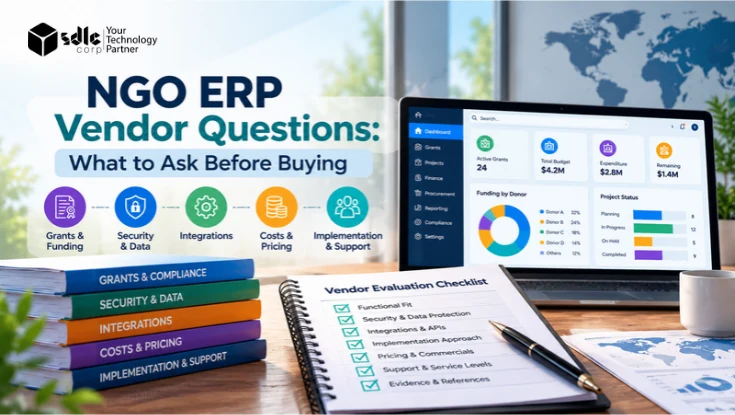
Use the unresolved gaps to choose questions for the NGO ERP vendor. For each answer, record the evidence and the person responsible for resolving any condition.
Causeway reports among outcomes from multiple customers. During selection, connect that result to the process being purchased: which reconciliation and approval tasks are in scope, and how the current team defines a completed close.
Conclusion
Select the vendor that passes the mandatory workflow tests and can deliver the agreed scope at an understood operating cost. A high weighted score cannot compensate for a failed funding restriction or an unowned integration. Before signing, turn every conditional result into a named commitment with a deadline and acceptance evidence. If two vendors remain close, use the unresolved operational difference to choose the next demonstration rather than adding more generic criteria.
Evaluate Causeway against your shortlist
If Causeway is on your shortlist, contact SDLC Corp with your mandatory requirements and demonstration scenarios. Ask for an ERP consulting assessment that separates available capability, configuration, integrations and proposed development.
Review the proposed delivery approach and request evidence against your own operating needs. A structured consultation should make the scope, responsibilities and unresolved questions easier to compare with other options.
Frequently asked questions
Which stakeholders should join selection?
Include the owners of finance, grants, programmes, procurement, technology and relevant country operations. Add privacy, security or legal specialists where the requirements need them. Give each participant clear evaluation responsibilities rather than asking everyone to score every feature.
Should the highest score always win?
No. Mandatory gates and material risks must be considered before the weighted total. Review sensitivity, evidence gaps and delivery conditions. A numerical ranking supports judgement but should not hide an essential failure or an unsupported assumption.
How many vendors should reach a demonstration?
Choose a manageable shortlist based on evidence of plausible fit and the team's evaluation capacity. There is no universally correct number. Allow enough time to test each serious option consistently rather than inviting many shallow presentations.