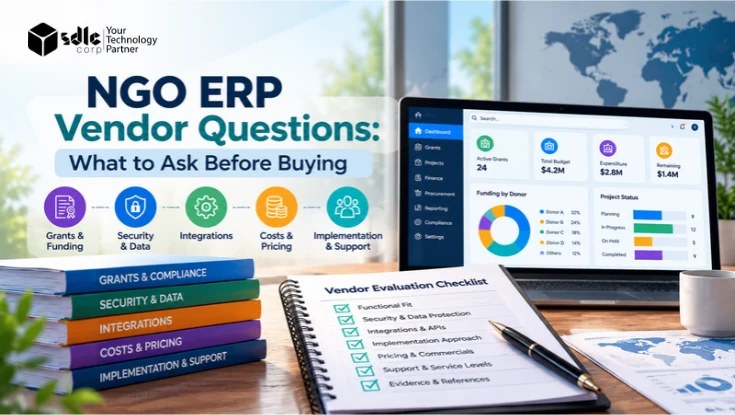
A useful vendor question asks for evidence, not reassurance. “Can your ERP manage grants?” invites a broad yes. “Show how a partial invoice changes the remaining commitment against this award” reveals the workflow, the data and the limits of what has been implemented.
Organise questions around the decisions your NGO needs to make before buying. Ask the same core questions of each supplier, record the answers and turn unresolved claims into demonstrations or written scope conditions. This keeps the conversation focused on fit rather than allowing the supplier's standard presentation to define the evaluation.
What happens when a grant restriction is breached?
Begin with the award conditions and financial states that matter to your organisation. Ask which dimensions represent donor, award, fund, project and entity. Request an example showing that these are connected without being interchangeable.
- At what point does a request reserve budget, and what happens when another request competes for the remaining amount?
- How does a partial invoice reduce the outstanding commitment without double-counting expenditure?
- What happens when a purchase falls outside the eligible period or permitted cost category?
- Who can amend an approved budget, and can a reviewer reconstruct the previous version?
A strong answer identifies the configured behaviour, authority and evidence. An answer limited to available fields does not establish control. Record whether the demonstrated rule is standard, configurable or dependent on development.
Country and currency boundaries need specific answers
Ask the supplier to distinguish country offices, legal entities and reporting units. Request a scenario with different entity and donor currencies if that reflects your needs. Check how rates, dates and policies remain visible in the reports.
Use security questions to examine whether country boundaries apply consistently to direct records, searches and exports. Ask what happens after a role is revoked or a temporary delegation expires. A screen with one country selected does not prove that another country's data is inaccessible.
Ask which country-specific outputs are actually available and which require local configuration or external advisers. A global product description is not evidence that every statutory or donor requirement in your operating countries has been implemented.
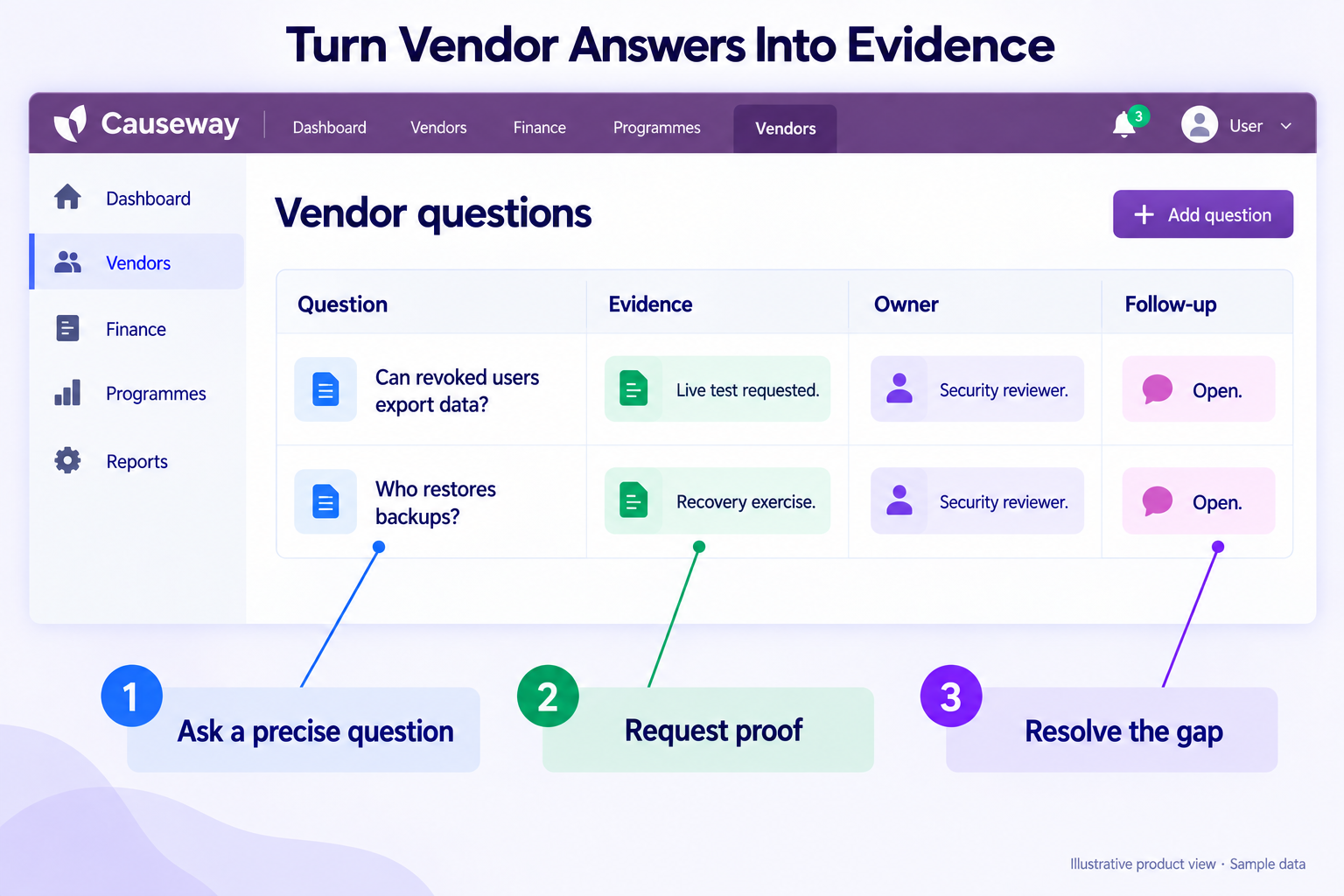
Which security and interface behaviours can be demonstrated?
Request a clear description of access governance, audit evidence, data handling and recovery testing. Where the supplier provides certificates or assessments, check their scope and relevance to the proposed service. Avoid treating a badge as an answer to every security requirement.
Evaluate integration reliability through the business transactions it must support. Ask which party owns mappings, credentials, monitoring, reconciliation and recovery. Request a failed-transfer scenario and inspect the authorised replay process.
| Question | Weak Answer | Follow-Up Evidence |
|---|---|---|
| How are duplicate requests handled? | We have an API | Timeout and retry test with stable references |
| Can restricted records be exported? | Users have roles | Export test for an unauthorised role |
| How is recovery verified? | We take backups | Recorded restore exercise and measured results |
Ask where product responsibility ends
Which legal entity provides the service, which subprocessors handle data, and where can support staff access it? Which assurance document covers that exact service? Ask the vendor to identify exclusions and customer responsibilities in the trust evidence, rather than offering a list of logos.
For payments, ask who executes transfers, verifies changed payees and resolves an uncertain settlement. For partners, ask who records sub-award amendments and reconciles outstanding advances. For field teams, ask what remains available offline and how conflicting updates are reviewed.
Finally, distinguish a shipped capability from a partner add-on, proposed development or roadmap item. Obtain the responsible supplier, additional cost and acceptance condition for each dependency. A feature promised for a later release needs a commercial decision; it should not silently become a passed requirement.
Implementation and support need named owners
Ask who prepares data, makes policy decisions, obtains third-party access, configures reports and trains local users. Require a responsibility matrix that includes the NGO's work as well as the supplier's deliverables.
Explore the difficult service boundary: if a bank interface fails during a payment run, who investigates first and who confirms the final business result? Ask how urgent incidents are escalated and how responsibilities change after implementation support ends.
For custom work, ask how upgrades are tested and what happens if the original developer is unavailable. Confirm documentation, source or configuration access as relevant, and the practical process for exporting records if the organisation later changes systems.
Which assumptions can change the price?
Include implementation, subscription, integration, support and internal effort in the total-cost estimate. Ask what triggers additional charges and what the quote excludes. Separate a fixed scope from an estimate dependent on discovery.
Clarify the treatment of additional entities, countries, users, storage, environments and reporting changes where those factors affect the proposal. Do not assume a pricing model from another vendor applies. Request comparable costs over the same period and currency basis.
Ask how acceptance relates to payment and how unresolved defects or delayed dependencies are handled. Commercial review should connect to the actual delivery conditions rather than sit in a separate document that refers only to broad milestones.
Turn answers into demonstration tests
Select the claims with the greatest consequence if wrong and convert them into live demo scenarios. Provide test starting records and expected outcomes. Record the environment, version, observer and evidence.
When a supplier cannot demonstrate a requirement, ask whether it is unsupported, requires configuration, depends on another party or is future work. Those answers lead to different decisions. Keep them visible in the gap register instead of converting all of them into “yes, with implementation.”
Finish each discussion with an evidence list and follow-up owners. This prevents the evaluation from becoming a sequence of repeated conversations in which the same unanswered questions appear to have been resolved.
A reference call with specific follow-up
Ask the reference organisation which entities, countries and workflows actually went live; which systems remained; who prepared and reconciled the migration; and which material exceptions appeared after launch. Then ask for the original and actual scope of support, the upgrade process and the work their own team still performs.
If the reference reports faster close or reporting, preserve its definition, baseline, period and scope. A result from one deployment is not a universal guarantee. A reference whose delivery model differs from yours can still be useful, but the differences belong in the decision record.
| Contract Clarification | Acceptable Recorded Answer |
|---|---|
| AI scope | Named workflow, included capability, usage boundaries and human approval |
| Deployment | Cloud, private cloud or self-hosted arrangement with named operators |
| Acceptance | Observable results, evidence and remediation process |
| Recurring costs | User basis, renewal, provider charges and included services |
| Exit | Usable records, attachments, identifiers and agreed assistance |
Causeway starts at $8/user/month, billed annually, with AI capabilities included. Carry implementation, integration and applicable infrastructure scope into the same clarification schedule.
Score mandatory gates before weighted criteria in the Vendor Evaluation Scorecard. A strong total cannot compensate for a failed mandatory requirement.
Give suppliers the same scope and evidence fields through the NGO ERP RFP Builder.
Conclusion
The best vendor questions lead to observable evidence and clearer scope. Ask about exceptions, boundaries and ownership, then turn important answers into tests. Preserve unanswered items and commercial assumptions. This makes the eventual buying decision more defensible than a collection of reassuring but unverified responses.
Bring your vendor questions to sdlc corp
If you are considering Causeway, contact SDLC Corp with these questions and your highest-priority scenarios. Ask for clear answers about current capability, configuration, integration dependencies and proposed development.
Explore the proposed delivery approach, then use the consultation to obtain evidence for your own requirements and an explicit scope, including responsibilities that remain with your team or third parties.
Frequently asked questions
What if a vendor says a feature is on the roadmap?
Treat it as future work, not current functionality. Ask about scope, dependencies, acceptance conditions and consequences of delay. Decide whether the organisation can proceed without it or whether delivery is a condition of commitment.
Which answers need contractual detail?
Material scope, responsibilities, service commitments, costs, acceptance and future deliverables should be reflected appropriately in the agreement. Have the relevant commercial or legal reviewer assess the wording. A meeting note is not a substitute for an agreed obligation.
How can we verify a similar customer reference?
Ask about operating scope, implementation responsibilities, difficult workflows and ongoing support, with permission to contact the reference where available. Similar organisation size alone is insufficient. Compare the reference's complexity with your own requirements and avoid assuming identical results.