The right NGO ERP feature set depends on how the organisation raises money, funds partners and delivers services. A fundraising charity, a grantmaking network and a field-based programme can share a ledger while needing very different operational capabilities. Start with those differences before comparing module lists.
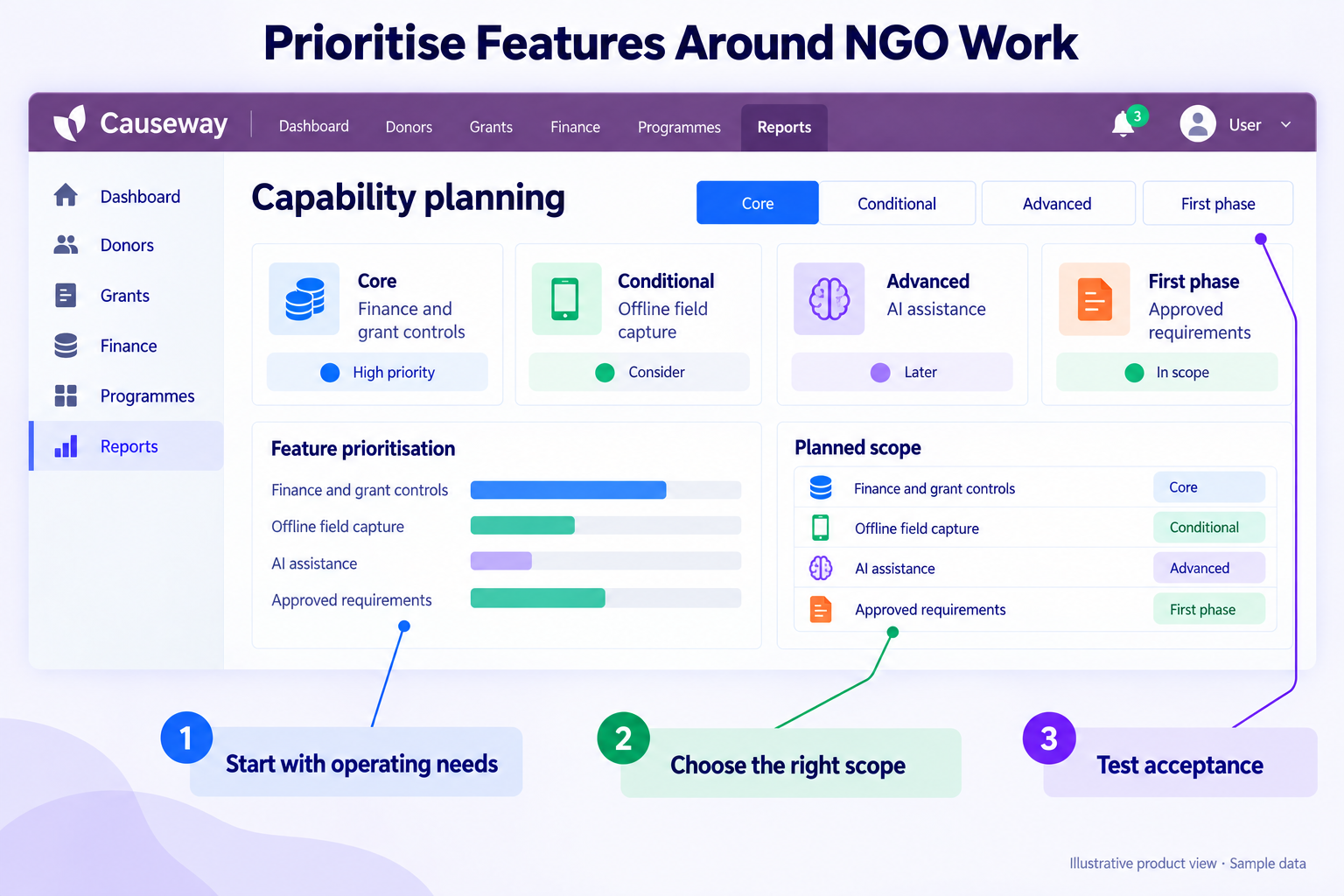
Prioritise features by the decisions and handoffs they must support. A capability is essential when its absence creates an unacceptable first-phase risk or prevents the organisation from operating. Other useful functions can remain in existing tools or enter a later phase with clear integration responsibilities.
Different NGO profiles need different workflows
For broader context, see ERP modules guide. NGO requirements add fund restrictions, institutional awards, donor relationships, beneficiary records and programme outcomes to these common functions.
| NGO Profile | Likely Priority | Workflow To Demonstrate |
|---|---|---|
| Public fundraising | Donor relationships and donation reconciliation | Gift, preference change, settlement and refund |
| Institutional grant delivery | Award conditions and restricted budgets | Approved award through expenditure and donor report |
| Partner-funded network | Sub-awards and monitoring | Advance, accepted report, next release and closeout |
| Multi-country group | Entity and currency controls | Local close, counterparty matching and group report |
| Field-based service delivery | Offline records and safe sharing | Disconnected capture through central acceptance |
| Supply-intensive programme | Inventory and custody | Receipt, issue, transfer and reviewed count difference |
Many NGOs combine several profiles. Rank the workflows by volume, risk and current failure points rather than choosing only one label. Use the NGO ERP operating model to identify the records shared between them.
Shared records support the operating core
Finance needs the approved chart and dimensions, controlled posting, reconciliation and reporting. Grants teams need conditions, budgets, amendments and reporting obligations. Procurement needs authority, supplier records, commitments and receipt evidence. Access and audit history should follow those records across screens, exports and interfaces.
The core also needs common identities for entities, donors, awards, projects and counterparties. A field called project cannot safely stand in for all five. Agree the definitions and ownership before importing data from several systems.
Reporting depends on these foundations. An attractive dashboard cannot compensate for duplicate donors, inconsistent project codes or unsupported partner expenditure. Require a traceable route from a reported number to its source and approved adjustments.
Separate required outcomes from preferred interfaces
An NGO may require timely reconciliation, but not necessarily a particular dashboard layout. It may require field capture without connectivity, but not every desktop function on a phone. State the necessary outcome first, then allow providers to explain how their proposed architecture achieves it.
Translate shortlisted capabilities into the testable requirements checklist. That document should specify starting records, actions, expected results and acceptance evidence rather than simply repeating feature names.
Where operations include stores or equipment, inventory and asset controls should carry purchase references through receipt, custody changes and funded-asset closeout.
When should a specialist tool remain?
A mature fundraising platform may be worth retaining if it handles supporter relationships well. The ERP then needs a reliable gift and settlement interface. Similarly, a specialist field tool may remain the capture layer while central finance and reporting use ERP records.
Define the authoritative system for each record and the direction of updates. Fundraising CRM, grant management and ERP have different responsibilities even when one supplier offers several of them. Make a deliberate choice about duplication, latency and exception ownership.
Retaining tools also changes cost and support. Include subscriptions, integration maintenance and the staff effort needed to resolve mismatches in the total cost estimate. Replacing a tool should have a clear operational reason, not merely reduce the application count.
AI value depends on the decision it supports
Causeway AI spans Finance Intelligence, Grant Intelligence, Donor Intelligence, Programme Intelligence, Procurement Intelligence, Beneficiary / Case Assistance, Compliance Intelligence, Executive Analytics and Workflow Agents. Prioritise these areas by the operational problem and the review capacity of the team.
Use the AI use-case and control matrix to specify the input, proposed output, evidence and human decision. For finance intelligence, require coding, matching and budget exceptions to stay connected to the underlying records. For an agent, define which actions it may execute and which require approval. Record those boundaries in the requirement and test them during the demo.
What belongs in phase one?
For volunteer-led programmes, volunteer management should connect role readiness, assignments, attendance and expenses before the release is accepted.
| Priority | Example Requirement | When It Belongs In Scope |
|---|---|---|
| Mandatory core | GL, AP, AR, banking, reconciliations, budgeting, fund dimensions and audit | Needed for the chosen financial operating model |
| Conditional operations | Warehouses, assets, advances, expenses and sub-awards | The NGO operates these workflows |
| Conditional people | Recruitment, onboarding, attendance, leave, consultants, volunteers and payroll interfaces | People processes or finance handoffs are in the release |
| Global requirements | Multi-country, multi-entity, currencies, consolidation and local reporting | The operating structure requires them |
| Platform requirements | APIs, webhooks, SSO, MFA, roles and reporting | Defined integration and access architecture |
| Advanced assistance | Forecasts, recommendations and workflow agents | Inputs, evidence and accountable actions are ready |
The decision tree begins with the operating model: does the workflow exist in phase one? If no, retain or defer it with an owner. If yes, does failure prevent operation or breach a mandatory control? If yes, it is a gate. Otherwise rank its value and dependency against delivery capacity. AI capability is included in Causeway, but introducing a particular workflow still requires usable data and agreed responsibilities.
Causeway supports cloud, private cloud and self-hosted deployment, with starting software pricing of $8/user/month, billed annually. An accessible software rate should be evaluated alongside implementation, localisation and integration scope rather than used to justify an incomplete first release.
Turn the operating needs above into testable requirements with Global NGO ERP Requirements Builder. Keep mandatory requirements separate from preferences.
Causeway reports 100+ Enterprise Clients & NGOs and 50+ Modules, with AI included. Map the required workflows to the first release rather than treating module count as proof that each local process is ready.
A workflow must be complete end to end
Choose an end-to-end slice that can operate with controlled dependencies. For a grant-funded office, that might be award setup, procurement, expenditure and donor reporting. For a fundraising organisation, it might be donor records, payments and financial reconciliation. Include the exceptions needed to make that slice dependable.
Classify remaining requirements as retained, deferred or excluded with an owner and reason. A deferred capability that still supports daily work needs an interim process. Otherwise the project can go live technically while staff maintain unplanned spreadsheets to fill the gap.
Use demonstration scenarios to test the boundary. A partial invoice, failed payment or delayed field submission often reveals dependencies that a module-by-module presentation conceals.
Causeway is a global NGO operating platform with seven years of product implementation and operating experience. Its connected model brings funding, finance, grants, procurement, programmes, donors, people, beneficiaries, outcomes and reporting into one operating context.
Conclusion
Prioritise NGO ERP features around the organisation's actual operating model and the consequences of missing capability. Establish the shared records, retain specialist tools where they work and define a complete first-phase workflow. The strongest scope is the one teams can operate and verify, not the longest feature list.
Prioritise your Causeway delivery scope
Causeway connects finance, grants, donors, programmes, procurement, people and reporting as a global NGO operating platform. Software starts at $8/user/month, billed annually, with AI capabilities included and cloud, private-cloud or self-hosted deployment. Evaluate a complete first-phase workflow against your operating profile, with implementation, localisation and integration work separately scoped and accepted through observable results.
Frequently asked questions
Should every NGO buy a full ERP suite?
No. Scope should follow operating needs, risk and available delivery capacity. Some organisations can retain effective specialist tools and connect them to a smaller core, provided record ownership, reconciliation and support responsibilities remain clear.
Which features belong in the first phase?
Choose a complete workflow that addresses a material operational need and can run with controlled dependencies. Include its important exceptions and reporting outputs. Defer other capabilities only when an owned interim process can support the remaining work.
How can a feature claim be verified?
Translate it into a scenario with starting data, user actions and expected evidence. Ask the supplier to demonstrate the relevant version and proposed configuration, then record any dependency, manual step or future development that affects acceptance.