
NGO inventory and asset management explains what the organisation holds, where it is, who is responsible for it and how it supports delivery. Procurement records how an item was bought. Inventory tracks quantities and movements. An asset register tracks individual items, custody and the accounting treatment approved for them.
The distinctions matter when supplies pass through stores and field teams, or when a donor funds equipment that remains in use after a project closes. A paid invoice cannot show whether goods reached the intended location or whether a laptop was returned by its previous custodian.
Stock quantities and individual assets need different records
Classify items using operational needs and the applicable accounting policy. Consumable supplies often need quantity and batch controls. Individually tracked equipment may need a serial number, custodian, maintenance record and disposal approval. Capitalisation thresholds and depreciation rules require a separate finance decision.
| Record | Typical Operational Question | Useful Identifier |
|---|---|---|
| Stock item | How many usable units are available? | Item code and unit of measure |
| Batch | Which receipts or expiry conditions apply? | Batch or lot reference |
| Asset | Where is this specific item and who holds it? | Asset tag and serial number |
| Movement | How did custody or location change? | Authorised transfer reference |
Avoid using purchase value as the only reason to track an item. A low-value device can still hold sensitive information, and a donor may impose custody or disposal conditions on particular equipment. Connect those conditions to the award record.
Receipt and issue explain where goods went
Record what was received, its condition, quantity, location and source purchase or donation. Resolve differences before treating all ordered goods as available. A partial delivery should leave the remaining order visible without inflating stock.
When supplies are issued, identify the destination, purpose and authorised recipient. Preserve the unit of measure. Converting boxes into individual units without an agreed conversion can create apparent losses or overstatements.
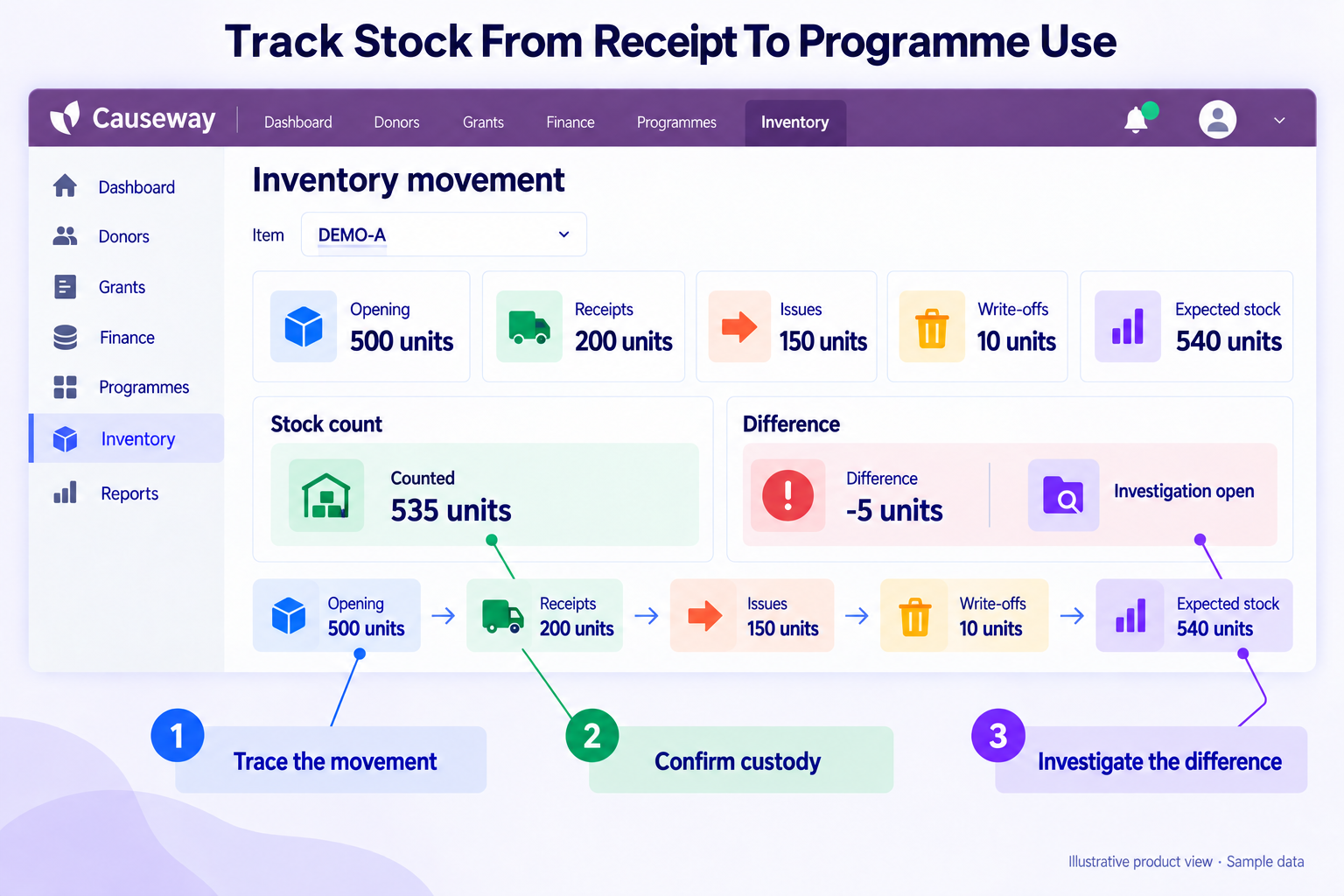
In an example store, opening usable stock of 500 units plus receipts of 200, less issues of 150 and approved write-offs of 10, leaves 540 units. If a physical count finds 535, the five-unit difference needs investigation and an authorised adjustment. Changing the system balance without a reason would remove the evidence needed to understand the loss.
Connect receipts to procurement matching and programme issues to the appropriate activity. Stock held centrally is not automatically programme consumption, even if it was bought with programme funds.
Goods in transit need an accountable custodian
A transfer should show dispatch and receipt separately, with goods in transit visible between them. Record who released the items and who confirmed their arrival. A missing receipt then becomes an operational exception instead of disappearing inside a net location balance.
For individual assets, preserve the custodian history and condition at handover. Reassignment, repair, loss and disposal are different events. Include the relevant approval and supporting evidence for each rather than overwriting the current location field.
Field teams may need offline movement capture. Test how late submissions and duplicate transfer references are reconciled. A temporary paper handover should be marked as entered once it reaches the central record.
A grant-funded asset with a transfer in progress
Example asset LAP-01 is a laptop record with serial DEMO-01, award EDU-01, custodian Team A, location Store A and an approved acquisition reference. It moves through received, assigned, transferred, maintained and disposed states, retaining the authority and evidence for each change.
Transfer TR-01 dispatches LAP-01 from Store A to Site B on 10 March; Site B confirms receipt on 12 March. During the interval, the register shows in transit with a responsible sender and expected recipient. It does not show the asset as simultaneously available at both locations.
At closeout, the owner checks the award's asset conditions, the physical item and its financial record. Any transfer of ownership or disposal needs the required approval. Keep the current custodian after the programme closes so the item does not disappear with the project's reporting code.
Compare donor conditions with internal buying rules in the Procurement Threshold Builder. A lower competition threshold can apply without resolving every policy conflict.
Reconcile stock counts
Set a count approach proportionate to item value, movement and risk. Separate the physical observation from the decision to adjust records. Recount unexplained differences and review recent receipts, issues and transfers before approving a correction.
Record damaged, expired or unusable stock distinctly from usable quantities. Where specialist goods have additional storage or handling requirements, include the relevant subject-matter owner in the process design. A generic inventory screen does not establish suitability for every medical or regulated supply chain.
At project closeout, check ownership and donor conditions before transferring or disposing of equipment. Reconcile the physical register, financial records and any report to the donor. Keep retained equipment under an identified custodian after the original project team disbands.
Close funded assets properly
Example: a donor-funded laptop is due to transfer to a partner at grant closeout. The asset owner checks the award terms and obtains the required approval before handover. The handover record names the item, recipient, condition, date and evidence of receipt. For a device, include the approved data-removal step before custody changes.
Finance then reviews the asset reference, carrying value and approved treatment. It records the journal or other disposition required by that policy and links it to the handover. An operational status of “transferred” is not proof that finance has cleared the item. Close the task only when the physical register, accounting record and donor schedule agree, or a named owner has accepted and documented the remaining difference.
| Closeout route | Evidence before the register is closed |
|---|---|
| Retained by the NGO | Award permission, continuing custodian and accounting treatment |
| Moved to another programme or location | Approved reassignment, destination and receipt |
| Transferred to a partner | Required donor approval, ownership terms and signed handover |
| Returned | Recipient confirmation and any remaining charges or obligations |
| Sold or disposed of, where permitted | Authorisation, method, proceeds or disposal evidence and finance review |
The route follows the award and approved asset policy. Preserve the grant reference after custody or ownership changes. A donor schedule should reconcile to both the physical register and the accounting handoff, including any item whose disposition remains open.
Conclusion
Inventory control should explain where goods went; asset control should explain who remains responsible for each item. Reconcile receipts, transit, custody and counts before making corrections. At grant closeout, follow the permitted retention, transfer, return or disposal route and complete the accounting handoff. The task is finished when the physical register, donor evidence and finance record agree, with any remaining difference explicitly owned.
Connect your stock and asset records
Discuss inventory and asset requirements around Causeway. Bring examples of stores, item units, field transfers, donor conditions and the asset records currently maintained by finance or programme teams.
Ask for a scoped demonstration of partial receipts, transfers in transit, count differences and custodian changes. Confirm any specialist handling requirements and integration dependencies separately. The consultation should establish what can be configured, what needs another system and which acceptance evidence would show that the proposed workflow matches actual operations.
Frequently asked questions
Does purchasing stock mean a programme has used it?
No. Goods may remain in a store or in transit after purchase. Preserve receipt and issue records so finance and programme teams can apply the appropriate accounting and reporting treatment to what actually happened.
Should every count difference be written off immediately?
No. First review the physical count and recent transactions for timing, unit or recording errors. Any remaining adjustment needs the reason and approval required by the NGO's policy, with the original count evidence retained.