
The NGO grant management lifecycle runs from opportunity assessment and proposal through award acceptance, budgeting, controlled spending, reporting and closeout. Each stage should preserve the agreement, current authority and supporting evidence so the next team can act without reconstructing earlier decisions.
At each handoff, name the next owner and show what has been approved, what remains unresolved and which action is now permitted.
What must be known before accepting the award?
Grant management starts before an award is signed. Record the opportunity, eligibility conditions, submission deadline, proposed delivery partners and decision owner. A bid budget should include the organisation's contribution, indirect costs, foreign exchange exposure and reporting effort. A promising award can still create an unfunded obligation if these costs are omitted.
Keep proposal versions separate from approved awards. If a donor reduces funding or changes outputs, the accepted delivery plan must reflect that decision. Preserve the accepted agreement and identify the conditions that remain unresolved before spending can begin.
Decide how indirect costs will be recovered
Record the agreed rate, eligible cost base, exclusions and ceiling for indirect cost recovery. A percentage without its denominator is incomplete. The proposal budget, accounting allocation and donor claim may use different bases, so finance should approve the reconciliation before reporting starts.
For an example award allowing 10% on USD 80,000 of eligible direct costs, the calculated indirect amount is USD 8,000 before any applicable ceiling or adjustment. Applying the same percentage to a USD 100,000 total that contains excluded costs would produce the wrong claim. Store the applicable agreement version beside the calculation.
Award conditions become operating rules
Create a stable award record before expenditure begins. Include the signed agreement, donor, recipient entity, award currency, delivery period, eligible activities and reporting obligations. Distinguish committed funding from instalments expected and cash actually received. These fields answer different questions.
Summarise operational conditions in a reviewed register. Link each summary to the relevant agreement provision rather than replacing the original document. If a condition is unclear, assign an owner and resolution date. An unanswered eligibility question should not become an assumed permission because the project is ready to start.
Identify dependencies such as partner agreements, local approvals or required co-funding. The grant manager coordinates the record, but finance, programme and procurement teams need to validate the conditions affecting their work. Keep evidence of that review.
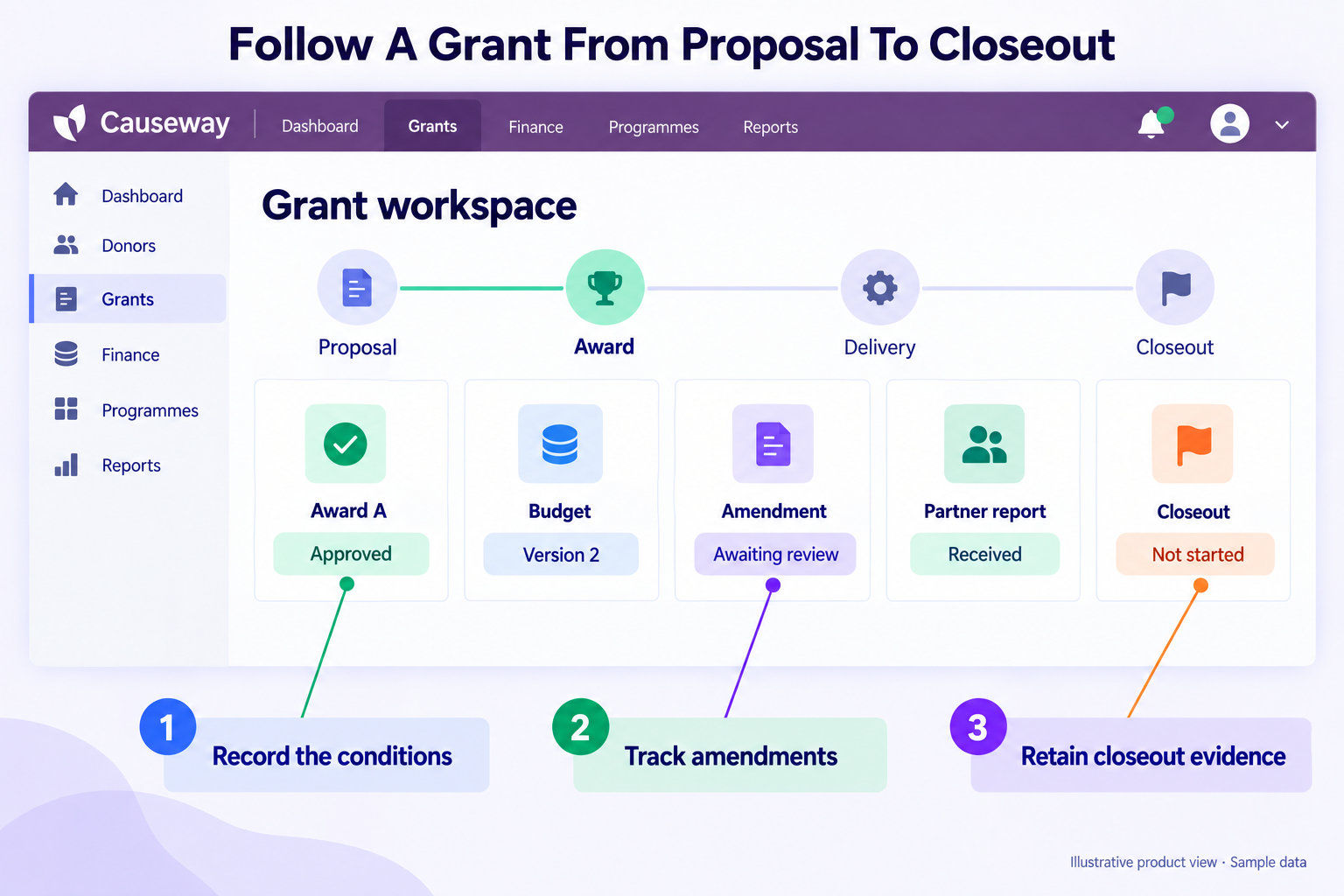
The budget connects funding to delivery
Connect the award to a budget with identifiable lines, periods and responsibilities. A delivery plan explains which activities will use those resources and how progress will be measured. Neither document should be approved in isolation if the activity assumptions determine the costs.
For a training award, map facilitator costs, venue hire and materials to planned sessions. Decide how shared staff costs will be allocated and which evidence supports the allocation. Avoid making an activity name serve simultaneously as a donor code, fund and ledger account. Separate those dimensions in the fund accounting structure so each cost retains its funding and reporting context.
Set the initial approved budget as a version that can be reconstructed. A later change should create an authorised amendment with an effective date, reason and approval evidence. Overwriting the original makes it difficult to explain whether a historical purchase was within the rules then in force.
A grant record and amendment in practice
Use this compact worked record to test the model: award EDU-01; recipient Entity A; donor Institution A; currency USD; approved budget 100,000; eligibility 1 January to 31 December; reporting quarterly; agreement version 1; owner Grant Manager. The linked project contains activities and indicators, while the award contains the funding conditions.
On 1 July, amendment A-02 moves USD 5,000 from materials to training after written donor approval. Total funding remains USD 100,000. Version 2 applies from the approved effective date; earlier purchases retain version 1 as their decision context. A request that exceeded the old materials line must not become retrospectively authorised merely because the current screen shows a new budget.
Partner sub-award SA-01 has a USD 30,000 ceiling and a USD 10,000 advance. If reviewed partner expenditure is USD 7,000, USD 3,000 remains unliquidated. Preserve the partner report and acceptance decision separately from the bank transfer. Country and partner responsibilities identify who approves that evidence before a further release.
Control commitments and expenditure
Budget control begins before an invoice arrives. An approved purchase can consume spending capacity while cash remains in the bank. The ERP design for restricted funds should track outstanding commitments and remove the invoiced portion as expenditure is recognised in the operational report.
Test the conditions most likely to cause disagreement: a purchase after the eligible period, a cost against an excluded line, an order split across awards and an emergency exception. Each needs an explicit response. Some requests should be blocked; others may require escalation under an agreed authority policy.
| Event | Evidence To Preserve | Next Decision |
|---|---|---|
| Purchase requested | Scope, coding and estimated amount | Is it eligible and affordable? |
| Order approved | Authoriser and applicable budget version | May the supplier be engaged? |
| Partial delivery received | Receipt and outstanding quantity | What can be invoiced or accepted? |
| Cost allocated | Basis and supporting records | Is the donor report classification correct? |
The operational record should show who made each decision and whether its conditions were met. An approval timestamp alone cannot explain an exception if the reason and authority are missing.
Amendments change the active obligations
Changes in delivery often affect budget, timing and reporting together. Extending an activity does not necessarily extend spending eligibility or a donor submission deadline. Treat an amendment as a controlled change affecting several records, with owners responsible for confirming each consequence.
Build the reporting calendar from the award requirements. Assign preparation, review and submission responsibilities separately. The donor reporting process should reconcile spending, explain variances and connect programme statements to evidence, with unresolved gaps visible before sign-off.
Maintain an issues log for missing receipts, disputed allocations, delayed partner reports and pending donor clarifications. A due date without an owner is not an effective follow-up mechanism. Review the log alongside the financial forecast, particularly when a delay could prevent eligible delivery before the award ends.
Follow amendments through partner agreements
A donor amendment can change dates, deliverables or allowable costs after partner agreements are signed. Identify every affected sub-award and obtain the required approval before assuming the revised parent terms apply downstream. Preserve both agreement versions and the reconciliation of old and new budgets.
Track sub-award advances, accepted expenditure and unspent balances separately. Before closing the parent award, confirm that partner reports, unresolved findings, asset obligations and return-of-funds decisions are complete. A zero parent bank balance is not sufficient evidence of partner closeout.
Close the grant and retain evidence
Closeout should confirm that delivery, finances and obligations have been addressed. Review open orders, unpaid invoices, outstanding advances, asset conditions, partner balances and any funds requiring treatment under the agreement. Do not close a grant solely because the reporting deadline has passed.
Use a final reconciliation and document remaining exceptions. Preserve the submitted reports, approvals and correspondence alongside the transaction evidence they rely on. Apply the relevant retention requirements by record category instead of deleting everything on a single grant-end date.
Before buying software, turn the difficult closeout situations into live demonstration scenarios. Ask the supplier to show an unresolved commitment and a later correction, not only a clean grant with no remaining activity. That reveals whether the system supports the actual end of the lifecycle.
Reconcile approved budget, actuals and open commitments in the Restricted Fund Tracker.
Record the disposition of each remaining award obligation in the Grant Closeout Checklist.
Conclusion
A controlled grant lifecycle preserves the agreement through every operational decision. Start with reviewed conditions, connect the budget to delivery, track commitments and govern amendments. Close only when the remaining obligations and evidence are understood. Clear handoffs between grant, finance and programme teams make reporting more reliable long before the final report is due.
Map your grant lifecycle to Causeway
Contact SDLC Corp to explore how your grant lifecycle could be supported by Causeway grant management platform. Bring an award with a real amendment, a reporting calendar and a typical closeout problem so the consultation can examine the connections between teams.
Request a scope discussion covering responsibilities, controlled changes, budget checks and the evidence needed at closeout. Confirm which workflows can be demonstrated and which depend on configuration or external systems. This gives your team a concrete basis for judging whether the proposed approach addresses its grant-management gaps.
Frequently asked questions
How should budget amendments be recorded?
Keep the previous approved version and create a traceable amendment with its reason, effective date and approval evidence. Record any donor approval required by the agreement. Review whether the change affects procurement, delivery milestones, reporting or cash forecasts.
What must be checked before closeout?
Review delivery completion, expenditure, outstanding commitments, unpaid obligations, advances, partner balances and reporting acceptance. Address asset or remaining-fund conditions where applicable. Record unresolved items with owners rather than assuming that a final report makes every obligation disappear.