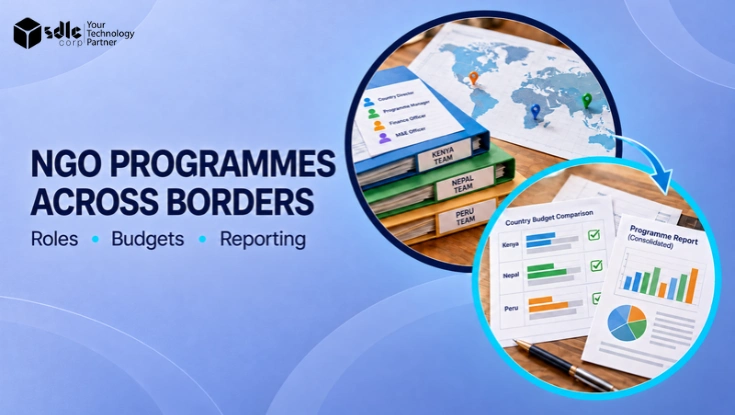
Managing an NGO programme across countries means coordinating decisions that happen at different levels. Headquarters may agree donor commitments, country teams organise delivery, and separate legal entities keep their own financial records. A consolidated dashboard becomes misleading when those responsibilities are treated as if they were the same organisational structure.
Start by distinguishing who delivers the work, who holds the obligation and who needs the report. Then define common information and controlled local differences. Offices can operate differently within a global programme. They still need shared definitions, clear decision rights and a reliable way to resolve exceptions.
Offices, entities and programmes are different structures
A country office describes an operating location or team. A legal entity has its own legal and accounting responsibilities. A programme organises work toward an objective and may cross several offices or entities. These structures should be connected without being forced into one hierarchy.
For example, an education programme could operate in two countries through one legal entity and a local partner. A report grouped by programme would not be equivalent to a report grouped by entity. Before designing the system, draw each structure and identify where transactions, approvals and obligations belong.
Reflect the legal structure in multi-entity accounting and consolidation. Operational leaders should first agree which units need independent budgets, who can commit funds and how partner activity enters the reporting process.
Which decisions belong to HQ and country teams?
Use a decision matrix rather than a general instruction to “centralise approvals.” State who prepares, reviews, approves and executes each decision. These roles may differ for an ordinary purchase, a budget amendment and a change to beneficiary-data access.
| Decision | Local Responsibility | Shared Or Central Responsibility |
|---|---|---|
| Routine eligible purchase | Confirm need and receipt | Maintain policy and monitor exceptions |
| Award amendment | Explain delivery implications | Coordinate donor approval and financial review |
| Indicator definition | Check practical collection | Approve a comparable definition |
| Access change | Confirm job responsibility | Enforce system-wide security controls |
Avoid approval chains that become unusable across time zones. Define delegation, absence cover and emergency escalation, including when an exception must receive retrospective review. Delegation should have a scope and expiry rather than becoming a permanent workaround.
Shared definitions make country results comparable
Common data is valuable only when teams use it consistently. Agree programme identifiers, reporting periods, indicator definitions and the meaning of financial statuses. “Active project” might otherwise mean approved in one office, funded in another and currently delivering in a third.
Local differences may be necessary for language, statutory reporting, employment arrangements or donor conditions. Record why a difference exists and who owns it. The shared-core and country-rule design provides a way to govern these differences without assuming that every country needs a separate system.
Distinguish a legal requirement from a team preference. Both deserve consideration, but their change authority differs. When a local workflow is retained, document how its output maps into common reporting and which checks confirm that the mapping remains valid.
Country budgets need explicit transfer authority
An example programme might allocate 120,000 units across two delivery offices. That allocation is not necessarily permission for either office to transfer funds between activities. Each award's conditions and delegated authority still apply.
Agree the reporting currency, budget versions and treatment of commitments. Schedule budget reviews around actual decision needs: delivery changes, upcoming purchases and funding instalments. A report that arrives after purchase commitments have been made cannot act as a preventive control.
For a new system, use a phased multi-country implementation to test these handoffs. Select a pilot that includes genuine cross-office work, not merely the easiest local process. Confirm that the receiving team can interpret the information without additional spreadsheets or informal explanations.
A country budget and responsibility example
Example: a USD 120,000 programme allocates USD 70,000 to Country A and USD 50,000 to Country B. Both use one approved reporting currency and budget version. Moving USD 5,000 from A to B requires approval under the award. Until that approval is recorded, neither country's available amount changes.
| Decision | HQ | Country Team | Independent Partner |
|---|---|---|---|
| Approve programme budget | Accountable under delegated authority | Proposes country needs | Supplies delivery estimate |
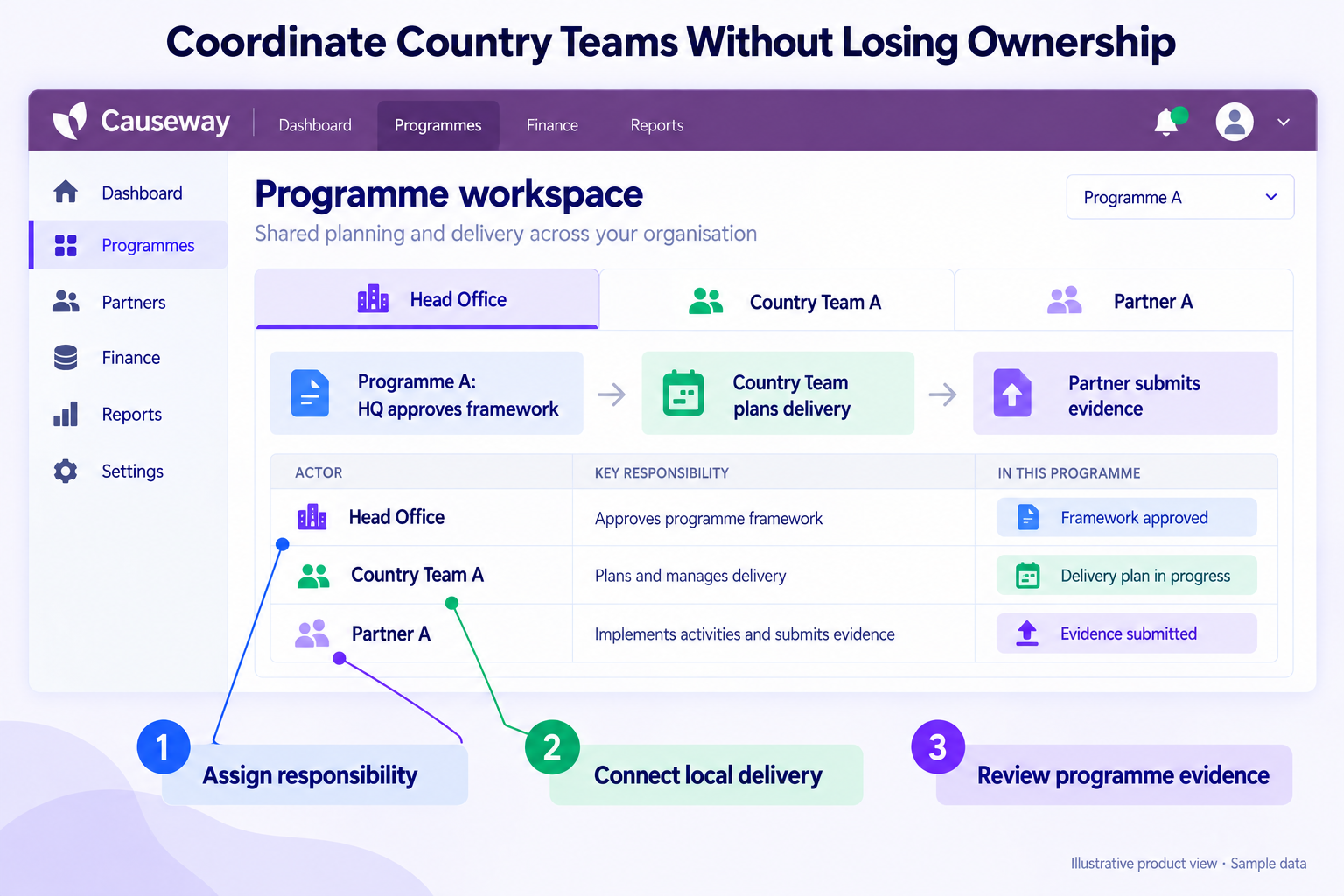
| Confirm local delivery | Reviews consolidated exception report | Accepts activity evidence | Records delivery and submits evidence |
| Accept partner expenditure | Resolves escalated donor questions | Reviews eligibility and authorises acceptance within delegation | Supplies ledger, receipts and explanation |
| Submit donor report | Signs the consolidated submission | Reconciles and signs country schedules | Resolves partner queries |
The partner sends a dated expenditure schedule and activity report to the country reviewer. Once accepted, those records feed the HQ consolidation and retain their source references. A missing partner report remains an exception with an owner, not a zero-spend submission. Changes to the award and reporting calendar must reach every participant in this flow.
Distinguish partner delivery from group operations
A country programme may include a branch, a controlled entity and an independent delivery partner. These relationships need different records. A branch allocation is not automatically a sub-award. Funding an independent partner also does not automatically bring its accounts into group consolidation. Finance should document the reporting boundary before designing transfers.
For each arrangement, identify the agreement signatory and bank-account holder. Name the employer, safeguarding lead and report approver as separate responsibilities. Link partner advances and sub-award conditions to the parent programme while preserving the partner's own responsibilities. Agree how unsupported expenditure, unspent funds and late reports affect further releases.
An inter-entity flow also needs counterparty references and matching periods. Headquarters may record money sent before the country entity records receipt. Preserve that timing difference for reconciliation instead of forcing balances to agree through unexplained adjustments. For field delivery, offline capture and synchronisation should follow the same ownership rules when records arrive after the reporting cutoff.
Review comparable programme results
Comparable reporting requires both shared definitions and context. Ten completed sessions in two locations may involve different durations, participant groups and delivery conditions. Combine standard indicator fields with explanatory notes where the context affects interpretation.
When connecting programme costs and results, retain separate evidence for expenditure, delivery and outcomes. Watch for duplicate participants appearing in several activities and for shared costs allocated inconsistently between locations.
At each review, examine missing submissions and changes in definitions alongside reported performance. Assign owners to anomalies. A regional total should not conceal an office whose data is incomplete, and an absent value should not silently become zero.
Match counterparties before eliminating inter-entity balances in the Multi-Entity Consolidation Workbook. Keep local ledgers separate from group adjustments.
Causeway reports programme reporting moving from quarterly to weekly across multiple customers. For a country rollout, measure the time from the reporting cutoff to an approved consolidated view. Record which offices and partner submissions are included so a faster report does not conceal a narrower reporting boundary.
Conclusion
A useful global programme report lets HQ compare results without hiding how each country delivered them. Start with separate office, entity and programme structures, then agree the shared definitions and decision rights. Resolve missing country or partner submissions before drawing conclusions from totals. Local variation can remain where it has a clear reason and a controlled reporting route; an unexplained spreadsheet adjustment is a sign that the handoff still needs work.
Coordinate your country operations
Evaluate your office, entity and programme structure against Causeway. Bring a responsibility matrix, a cross-country report and examples of local variations that cannot be removed.
Use the discussion to distinguish shared configuration, country-specific needs and integration dependencies. Ask how a proposed workflow would handle delegated approvals, inconsistent reporting periods and missing country submissions. A useful scope should identify what requires demonstration or further local review before a rollout decision.
Frequently asked questions
Which decisions should stay local?
Keep decisions close to the people with the information and authority to make them, subject to award conditions and governance requirements. Routine delivery decisions may differ from changes to donor commitments. Document the scope, escalation route and evidence for each decision type.
How can HQ compare different programmes?
Use consistent definitions, periods and counting methods, then include the context needed to interpret differences. Compare like with like and show missing data explicitly. A single aggregate score is rarely sufficient when activities, populations and intended outcomes differ.