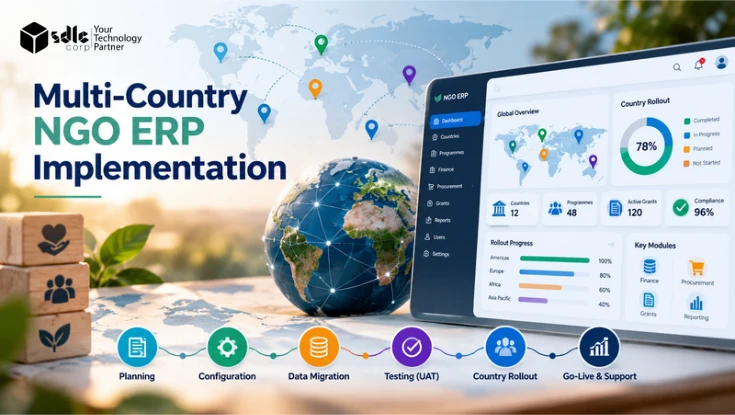
A multi-country NGO ERP implementation is an operating-model change as well as a software project. Teams need common definitions and a record of justified local differences. They must also test approvals, reports and interfaces in the environments staff will use.
Plan the rollout around dependencies and evidence rather than a universal week count. Give each phase a clear exit decision. Depending on the phase, this means an agreed scope, passed configuration tests, reconciled data or a country team ready to run the service. A calendar is useful only when those conditions are realistic.
Scope and decision ownership precede configuration
For broader context, see phased ERP implementation approaches. For a global NGO, each wave also needs country ownership, localisation, grant balances and donor-reporting continuity.
Name the sponsor, process owners, country representatives and people authorised to accept scope changes. Separate implementation decisions from accounting, legal and privacy decisions that require specialist authority. Escalation should be clear before a difficult local requirement appears.
Use testable requirements as the baseline. Identify essential workflows, retained systems, integrations, reporting outputs and exclusions. Record assumptions such as availability of local advisers or access to external test environments.
Agree how decisions are documented. A workshop comment should not become an approved requirement simply because it appears in meeting notes. Preserve the decision, owner, rationale and effect on scope, cost or timing.
The ERP data migration planning guide covers migration controls. Country waves must additionally reconcile opening fund and grant balances, preserve donor restrictions and assign owners to unresolved source records.
The NGO ERP operating model gives country teams a shared starting point: funding, spending, delivery and reporting must retain their connections across each rollout wave.
A shared template can preserve local requirements
Establish common records, controls and reporting definitions, then document necessary variations. The multi-entity design should distinguish legal entities from offices and programmes before country configurations are created.
Select a pilot that represents meaningful complexity. The easiest office may produce a quick demonstration while leaving cross-entity reporting, currencies or partner data untested. Balance manageable scope with the need to expose design weaknesses early.
Maintain a variation register. For each difference, state whether it is required by law, donor terms, operational circumstances or preference. Decide which variations belong in configuration and which indicate that the shared process needs improvement.
Data and interfaces determine the critical dependencies
Assign owners to source-data quality, mapping, cleansing and reconciliation. Migration is a controlled workstream with selection rules, trial loads and expected totals. Loading every historical field does not necessarily improve the new operating model.
The integration plan should identify external approvals, credentials, test environments and support responsibilities. Track those dependencies explicitly because they may sit outside the implementation supplier's authority.
Use repeated rehearsals with representative records. Reconcile counts, balances and key relationships after each load. Retain exception decisions so the final conversion does not repeat manual judgement that was never documented. Protect personal data throughout test and training environments.
Country teams need end-to-end acceptance evidence
User acceptance testing should follow real responsibilities and expected results. Include normal work, exceptions and corrections. A country representative should verify that the output is understandable and usable, not merely confirm that a screen opens.
| Test Area | Example Evidence |
|---|---|
| Restricted purchasing | Eligible request, overspend response and partial invoice |
| Country reporting | Local mapping and reconciled output |
| Access | Correct scope before and after a role change |
| Integration | Failure detection and authorised recovery |
| Group reporting | Entity submissions and explained adjustments |
Record defects with severity, owner and acceptance criteria for resolution. Distinguish a training question from a configuration defect or missing requirement. Repeating a demonstration without recording the expected result does not establish acceptance.
Include partners and field connectivity in readiness
A country office can pass a headquarters-based test while its field teams remain unable to submit records. Rehearse offline collection and synchronisation using representative devices, connectivity gaps and languages. Confirm that delayed records are visible, recoverable and reviewed before reporting deadlines.
Partners may operate different systems and close their accounts on a different timetable. Agree opening advance balances, outstanding reports, accepted file formats and support contacts for sub-award workflows. A central go-live date cannot erase those dependencies.
Include an operational fallback with an owner and reconciliation plan. If a partner submits an approved temporary file during cutover, record whether and when that file has been imported. Otherwise the same expenditure can enter twice when the normal integration resumes.
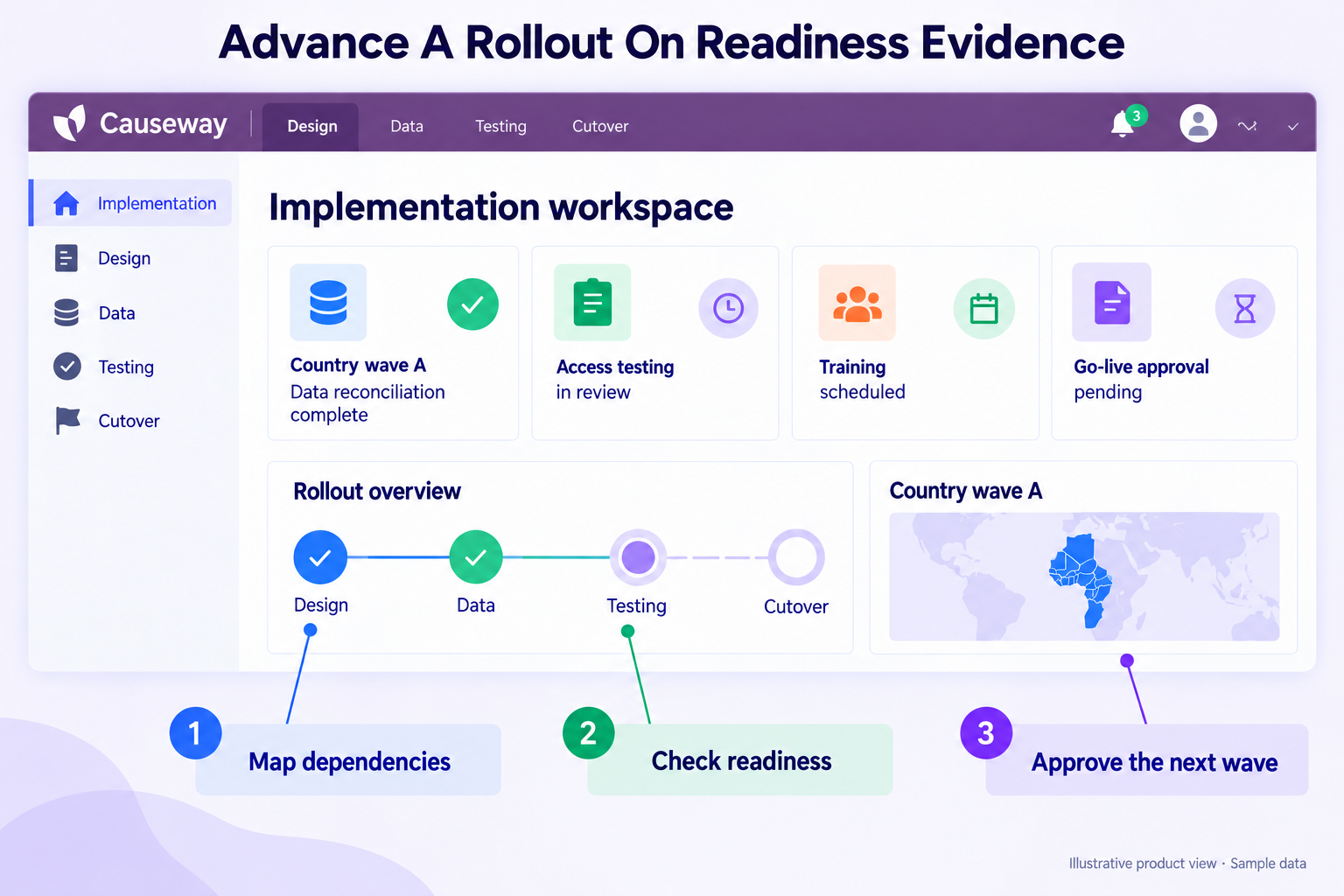
Sequence a country wave by dependencies
Agreed operating model → approved global/local design → reconciled trial migration and working interfaces → country user acceptance → cutover rehearsal → go/no-go decision → supported operation. Training preparation runs alongside configuration, but the final role-based rehearsal uses the accepted workflow.
| Readiness Item | Required Evidence | Decision If Missing |
|---|---|---|
| Country rule mapping | Local owner signs the applicable configuration | Hold affected workflow |
| Opening records | Counts, balances and relationships reconcile | Resolve differences before final load |
| External interfaces | End-to-end test and support owner confirmed | Defer dependent workflow or approve a tested fallback |
| User capability | Local team completes normal and exception scenarios | Complete targeted training and retest |
| Recovery | Rehearsed rollback or recovery with transaction reconciliation | Do not pass the cutover gate |
| Support | Named contacts, coverage and escalation route active | Assign service ownership before launch |
For Country B, payroll test access may be the critical dependency even after its finance configuration passes. Put that dependency on the wave plan with its external owner and required date. Move the wave only after the agreed exit evidence exists; adding countries to a calendar does not remove the dependency.
Rehearse cutover and recovery
Create a cutover sequence with dependencies, owners, decision times and evidence. Include final data extraction, reconciliation, access activation, interface readiness and communication to users. Define which business activities pause and how urgent work is handled during the transition.
Set go/no-go conditions before the rehearsal. Examples include unresolved critical defects, unreconciled opening balances or an unavailable payment interface. The decision authority should understand the consequences of proceeding with any accepted limitation.
Plan recovery from a failed cutover. Identify the latest safe decision point, records created during the transition and how they would be reconciled if operations return to an earlier system. A backup alone does not answer those business questions.
Country waves depend on readiness and support
Use pilot findings to revise training, configuration and readiness criteria before adding more countries. Avoid copying an unresolved workaround into every wave. Give local teams a clear support route and distinguish urgent operational incidents from enhancement requests.
The ERP business case should assign owners to the benefits expected after rollout. Measure reporting effort, exception resolution or other relevant baselines using consistent definitions. Do not count benefits automatically from the date the system becomes available.
Review adoption through actual completed workflows and error patterns. Low usage may reflect a process that does not fit local responsibilities, not simply resistance to change. Close the implementation only when ongoing service ownership, documentation and review responsibilities are established.
When assessing a delivery reference such as the Causeway implementation example, compare the documented starting systems, responsibilities and rollout conditions with your own. Similar module names alone do not establish similar implementation effort.
Check whether each rollout dependency has an owner and accepted evidence in the ERP Readiness Assessment.
Specify starting records, actions and expected results using the NGO ERP UAT Library.
Sequence country waves around accepted dependencies with the NGO ERP Implementation Planner.
The outcomes reported from Causeway’s work with multiple customers include month-end close moving from 12 days to 4 days. A rollout plan should retain the starting close process and the agreed completion milestone so the team can measure the result after each country wave.
Conclusion
Successful rollout depends on decisions that can be demonstrated, not milestones marked complete without evidence. Establish ownership, validate the shared design, reconcile data and rehearse cutover. Use each wave to improve the next, and retain responsibility for adoption and benefits after launch. Timing should follow those dependencies rather than a fixed promise applied to every NGO.
Plan your Causeway rollout
Scope ERP implementation services around the agreed rollout, responsibilities and acceptance evidence.
Discuss a phased implementation assessment for Causeway global NGO ERP. Bring your entity map, local variations, integration dependencies and the evidence you need before each country can go live.
Ask for clear responsibilities across configuration, data preparation, testing, cutover and support. You can also review the proposed delivery approach as part of your evaluation. Set the proposed rollout sequence and timing against your own readiness conditions.
Frequently asked questions
Should every country go live together?
Not necessarily. Compare dependencies, support capacity and the risk of operating mixed systems. A phased rollout can expose issues earlier, but it also needs interim reporting and integration arrangements. Choose the sequence based on the organisation's operating constraints.
What must be ready before cutover?
Essential workflows should pass acceptance, data should reconcile, access and interfaces should be ready, and support responsibilities should be active. Define explicit go/no-go criteria and a recovery approach. Record accepted limitations and the authority approving them.
How long does a multi-country rollout take?
It depends on scope, local differences, data quality, integrations, decision speed and team capacity. Build an estimate from dependencies and rehearsals rather than treating a supplier's indicative schedule as a guarantee. Review the estimate when material assumptions change.