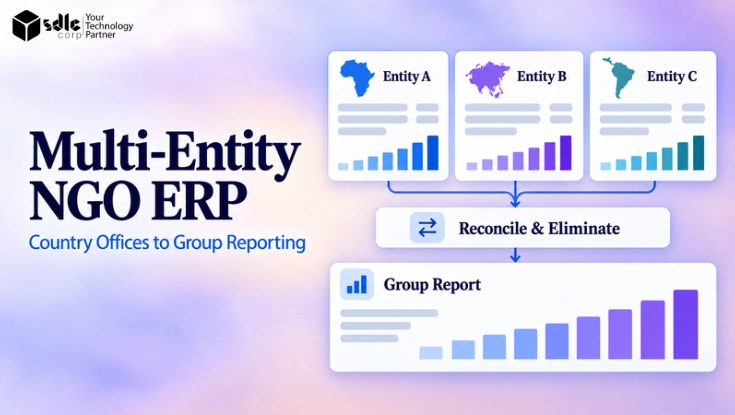
Multi-entity NGO ERP must preserve each legal entity's records while supporting an understandable group view. Adding country totals together is not necessarily consolidation. Inter-entity balances, different reporting policies, local requirements and currency treatment can all affect the result.
Begin with the legal and reporting structure, not a list of office locations. Establish which entities are included, how they transact with one another and who owns the close. Then design mappings, reconciliations and controlled adjustments that allow the group report to be explained from the underlying records.
Legal entities and reporting units are different boundaries
List legal entities separately from country offices, programmes, branches and management reporting units. Record the relationships and the basis for inclusion in each report. The appropriate accounting treatment depends on the relevant framework and organisational circumstances; an ERP hierarchy should implement that decision rather than make it implicitly.
In multi-country programme management, a programme may span entities, while one entity may run several programmes. Keep those dimensions distinct so a project report does not accidentally become a legal-entity report.
Document which entity enters agreements, employs staff, owns assets and settles suppliers. These responsibilities determine where transactions belong. A user's physical location is an unreliable substitute for that analysis.
Draw the reporting boundary explicitly
In a worked structure, Parent A controls Entity B, operates Branch C within A and funds independent Partner D under a sub-award. Subject to the approved accounting assessment, the group pack combines A and B; Branch C remains part of A's ledger; Partner D submits award evidence and is not consolidated merely because it receives funding. Programme P can span all four units without changing those boundaries.
After A and B resolve the example USD 500 dispute, each confirms a USD 10,000 inter-entity balance. A group-only elimination debits the inter-entity payable and credits the inter-entity receivable by USD 10,000. It clears those matched internal balances in consolidation while leaving both local ledgers intact. Other income, expense and currency adjustments require their own policy and evidence.
Local and group reports can use different currencies
Each entity needs an approved accounting policy, while the group needs a consistent presentation approach. Keep transaction, entity, donor and group reporting amounts distinct in the currency design. A group currency setting does not remove the need to retain local amounts and conversion evidence.
Define rate sources, relevant dates, rounding and review authority. Preserve the original records and controlled translation adjustments. If a local ledger is reopened after a group close, identify the affected reporting version rather than silently refreshing the group's historical totals.
Test with entities that differ in currency or reporting requirements. A demonstration using only identical entities in one currency cannot establish that the more complex design works.
Inter-entity transactions need matching counterparties
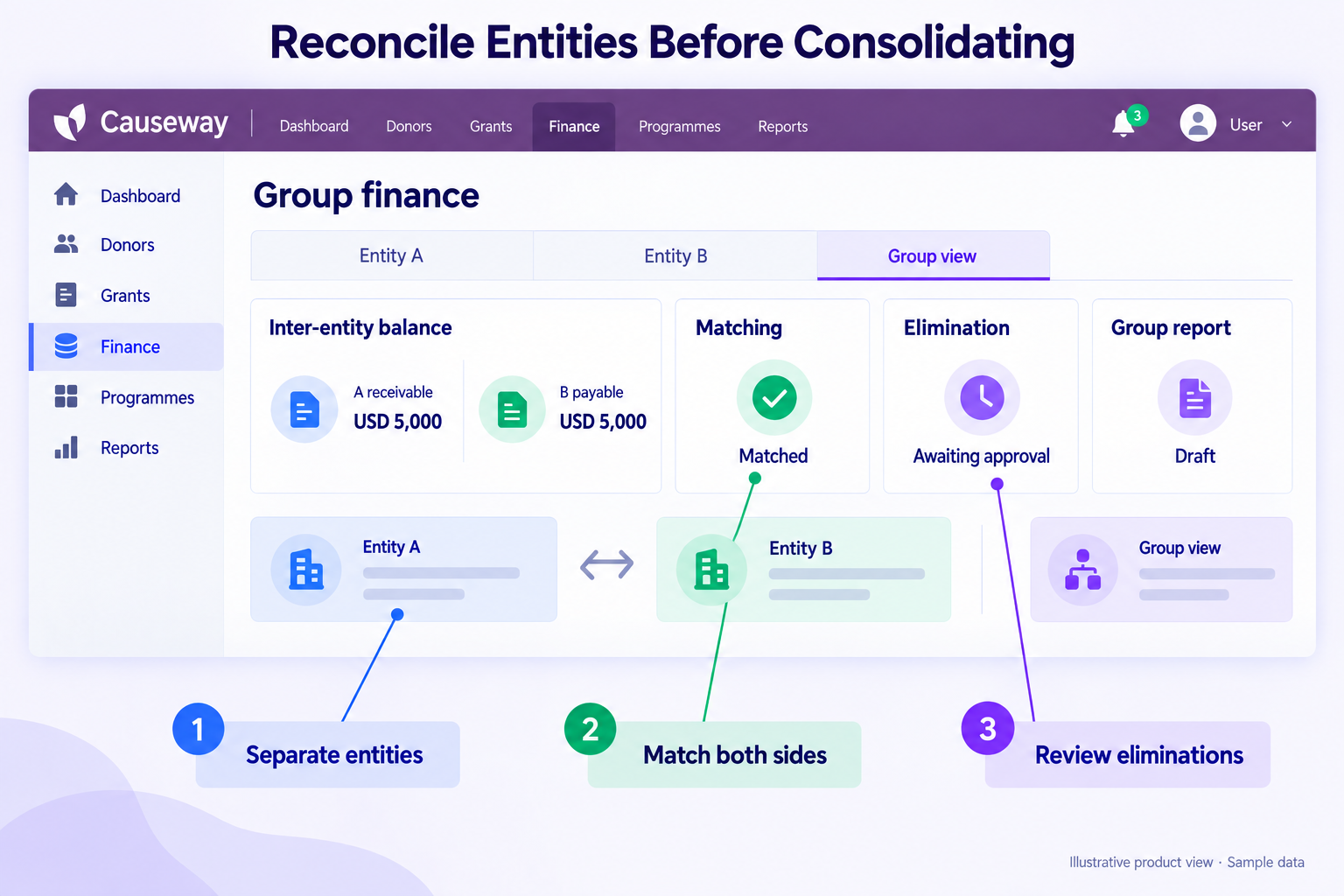
Use a shared reference for transactions between entities. The sending and receiving sides should identify counterparties, amounts, currencies and relevant dates. Differences may arise from timing, exchange treatment or coding, so reconciliation needs more information than two account balances.
In an example example, Entity A records a receivable of 10,000 units from Entity B, while Entity B records only 9,500 units payable because a charge is disputed. Eliminating 10,000 on both sides would conceal the unresolved difference. Assign an owner, establish the correct treatment and preserve the evidence before the group adjustment is approved.
Define who may create, match, correct and approve these records. A shared user account makes it harder to distinguish an entity's preparation from the group's review. Include access boundaries in the operating model.
Reconcile and eliminate shared balances
Reconciliation establishes why records agree or differ. Elimination removes relevant internal effects from the group presentation under the approved accounting approach. These are related but separate steps; a balanced elimination does not prove that the underlying transaction is correct.
| Close Step | Evidence To Preserve |
|---|---|
| Entity submission | Approved period, version and completeness checks |
| Inter-entity matching | Counterparty references and explained differences |
| Group adjustments | Basis, preparer, reviewer and affected records |
| Final consolidation | Reconciled output and sign-off |
Keep adjustments separate from source records where the design requires them. A reviewer should be able to move from the group figure to the entity contribution and then to the transaction. Avoid unexplained balancing entries that exist only to force totals to agree.
Group reporting does not replace local requirements
A shared chart of accounts can support comparability, but local reporting may require different classifications or additional records. Maintain governed mappings between local and group structures rather than assuming one account list serves every purpose.
The country-specific compliance design separates common controls from justified local configuration. Record mapping ownership and effective dates. When a local account is added, require classification and review before it appears in the group report as an unidentified amount.
Preserve access to local evidence and the ability to reproduce required outputs. Group reporting should not make a local team dependent on an undocumented export controlled by another office.
Test a group close
Specify a close scenario in the ERP requirements. Include at least two entities, an inter-entity difference, a currency conversion where relevant, a local-to-group mapping and a post-submission correction. Use test but coherent records with expected results.
Observe the full workflow: preparation, exception resolution, review and final output. Check whether a change invalidates earlier approvals and whether the previous report remains reproducible. Record unresolved gaps as delivery conditions rather than accepting a visually correct consolidated dashboard as sufficient evidence.
Keep local reporting and group eliminations traceable
A country entity's statutory ledger may use classifications or adjustments that differ from the group reporting pack. Maintain an approved mapping and separate consolidation adjustments from local postings. The group view should be reproducible without erasing the entity's original accounts.
Match inter-entity receivables, payables, income and expenditure using counterparties and periods. Investigate timing, currency and classification differences before posting eliminations under the applicable group policy. An external partner balance is not automatically an inter-entity balance. Confirm the reporting boundary and preserve that decision with the sub-award or partner agreement.
Track reconciliation, exception resolution and sign-off with the Month-End Close Checklist.
Match counterparties before eliminating inter-entity balances in the Multi-Entity Consolidation Workbook. Keep local ledgers separate from group adjustments.
Conclusion
Multi-entity design starts with legal and reporting boundaries. Preserve local records, govern mappings and reconcile inter-entity differences before applying group adjustments. Test a complete close with an exception and a correction. The group view is trustworthy when the path from each underlying record to the final report remains explainable.
Plan your entity and consolidation model
Consult SDLC Corp through an ERP scope assessment about evaluating your entity structure and consolidation needs against Causeway global NGO ERP. Provide the reporting hierarchy, local and group account mappings and an example inter-entity reconciliation.
Ask which parts can be demonstrated, which require configuration and which depend on external finance systems or specialist policy decisions. A useful scope should cover local reporting, group adjustments, access boundaries and close responsibilities. Confirm those requirements before treating a multi-country demonstration as evidence of multi-entity consolidation fit.
Frequently asked questions
How do inter-entity eliminations work?
They remove relevant internal effects from the group presentation under the approved accounting approach. First reconcile the underlying counterparties and differences. Keep the adjustment basis and review trail so elimination does not conceal an unresolved transaction problem.
Can local and group charts of accounts differ?
Yes, where the design and reporting requirements justify it. Maintain controlled mappings with owners, effective dates and checks for unmapped accounts. Test whether both local and group reports can be reproduced after mapping changes.