Multi-currency NGO accounting records each transaction in its original currency and applies documented rates to entity accounts, donor reports and group reporting. Keep the amount, rate direction, rate date and reporting basis together so finance can reconcile the different views of the same transaction.
Multi-currency accounting needs explicit currency roles and reproducible conversions. Before configuring software, agree which figures support local accounts, donor reporting, budget control and group reporting. They may use different policies, but finance should be able to reconcile the differences rather than overwrite one number until the reports match.
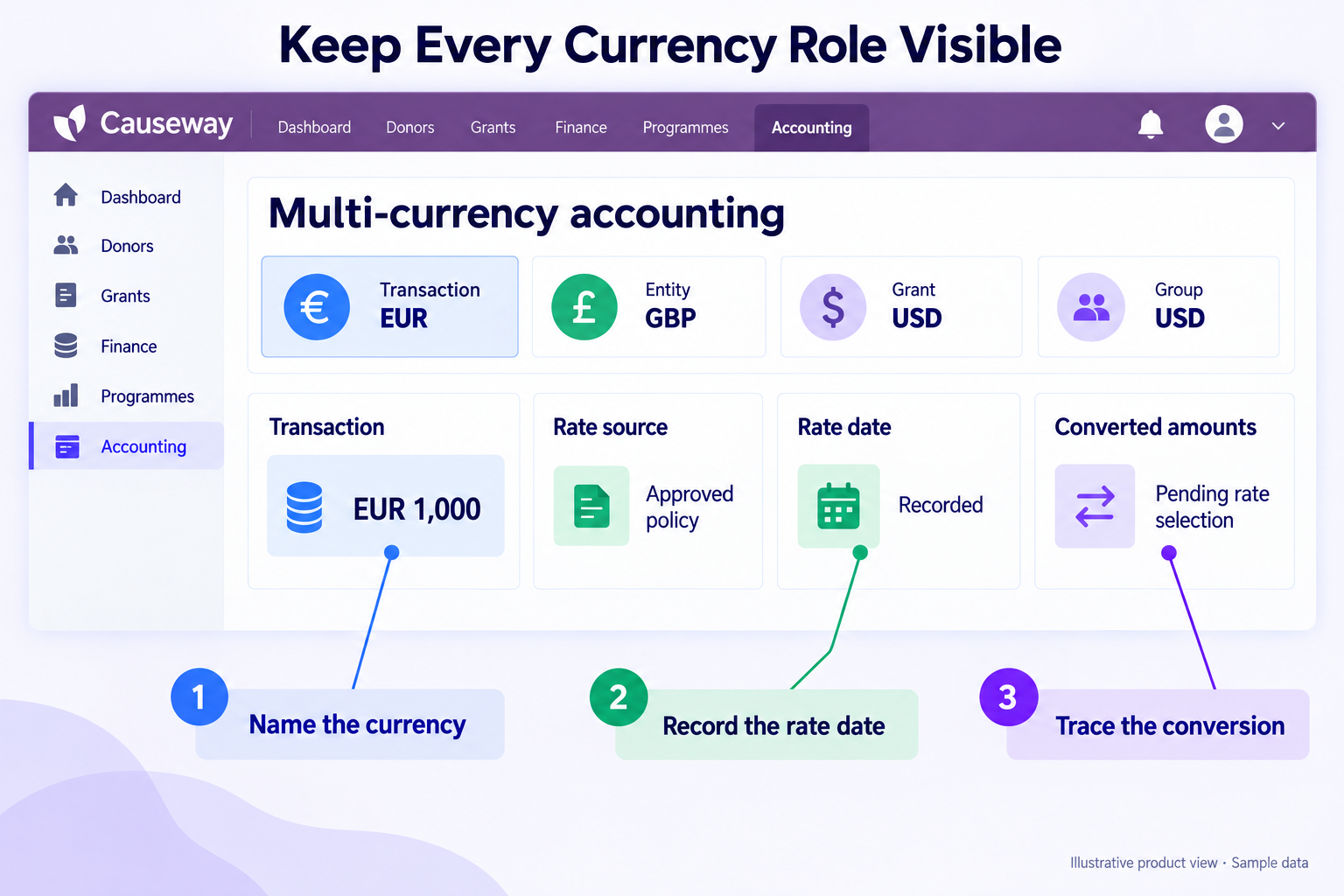
Four currency roles can describe one transaction
The transaction currency is the currency of the invoice, payment or other event. An entity's accounting currency supports its books under the applicable framework. A donor may request reports in the award currency, while a group may use another presentation currency for consolidated reporting.
Under International Financial Reporting Standards, IAS 21 addresses foreign-currency transactions and translation, including functional and presentation currencies. It should not be assumed that every NGO uses that framework or that an ERP's “base currency” setting automatically establishes the correct accounting policy.
| Currency Role | example Choice | Decision Owner |
|---|---|---|
| Supplier transaction | EUR | Purchase agreement |
| Entity accounting | GBP | Finance policy under the applicable framework |
| Donor reporting | USD | Award reporting requirements |
| Group presentation | USD | Group reporting policy |
The multi-entity ERP design should keep these roles separate from the country where a user works. An office location does not, by itself, determine a legal entity or its reporting currency.
Which rate and date apply to each view?
For every conversion, retain the source amount, source currency, target currency, rate direction, relevant date and policy. “Rate 0.85” is incomplete. “0.85 GBP per EUR” allows a reviewer to understand the calculation. Record the rate source and whether the rate was entered, imported or approved as a planning assumption.
In an example example, a EUR 2,000 invoice converted at 0.85 GBP per EUR produces GBP 1,700. If a donor's permitted reporting method uses 1.10 USD per EUR for that example, the reported equivalent is USD 2,200. These are example rates, not current exchange quotations or recommended accounting rates.
Do not silently replace a posted transaction's historical rate when a new rate arrives. Specify which records may be recalculated, who approves adjustments and how the original treatment remains traceable. Retain sufficient precision during calculation and apply an agreed rounding policy at the correct stage.
Budget and exchange-rate variances explain different effects
Budget variance can arise because quantities, prices or delivery plans changed. Foreign exchange, or FX, variance arises from the currency assumptions used in comparison. Combining them can make a programme look more expensive even when its local-currency activity has not changed.
Suppose an example EUR 10,000 activity was budgeted at 1.10 USD per EUR, giving a USD 11,000 planning amount. It ultimately costs EUR 11,000 and is compared at 1.08 USD per EUR, giving USD 11,880. Using the budget rate to separate the effects, the local-cost change is USD 1,100 and the rate effect is negative USD 220. Together they explain the USD 880 difference.
That bridge is a management-analysis method, not a universal journal-entry prescription. Label the method consistently so reports do not mix different decompositions. Restricted-fund budget controls also need to specify which currency is checked when a purchase is authorised and how a later FX change is handled.
Preserve the rate-date timeline
In this worked example, EUR is the supplier currency, GBP the entity currency and USD the donor currency. The rates are chosen solely to explain the calculation.
| Event | Rate And Calculation | Evidence To Retain |
|---|---|---|
| Budget approved, 1 March | EUR 2,000 × 1.10 USD/EUR = USD 2,200 | Approved planning rate and budget version |
| Invoice posted, 15 March | EUR 2,000 × 0.85 GBP/EUR = GBP 1,700 | Invoice date and approved accounting rate |
| Invoice settled, 31 March | EUR 2,000 × 0.86 GBP/EUR = GBP 1,720 before fees | Bank confirmation and settlement rate |
| Donor report prepared | EUR 2,000 × 1.10 USD/EUR = USD 2,200 under the assumed donor rule | Donor instruction and report version |
The GBP 20 difference between the liability and settlement is separate from any bank fee; finance applies the relevant accounting treatment. Compare the approved planning assumptions and software scope in the pricing and TCO review, including rate imports and donor reporting, rather than treating a currency selector as the whole requirement.
Settlement and reporting can use different dates
The invoice date, settlement date and reporting date can require different treatment under the selected accounting policy. Bank charges create an additional expense or adjustment that should not disappear inside an unexplained exchange difference. A partial payment needs a clear relationship to the invoice balance it settles.
Define the workflow for a missing rate. A controlled exception queue is usually more informative than accepting a default value without warning. Record who supplies the missing rate and whether reports containing the affected transaction must be rerun.
Include these behaviours in NGO ERP requirements. A practical acceptance test should cover an invoice, a partial payment, a later settlement and the relevant reporting output. Check both the financial result and the audit trail explaining it.
Currency accounting does not move the money
Recording an invoice in one currency and translating it into another is an accounting function. Executing a transfer requires a bank or payment provider, verified recipient details, authorised release and a settlement result. Keep the accounting rate, provider conversion rate, fees and recipient amount separately identifiable.
For example, an approved USD transfer can settle after a reporting cutoff or arrive net of intermediary charges. The accounting record and the payment status will then explain different parts of the same event. Cross-border disbursement controls establish that connection; multi-entity consolidation addresses the separate question of how balances appear in group reporting.
Reconcile donor and group reports
Start with a common transaction population and explain differences in period, eligibility, currency policy and presentation. A donor report can exclude a cost that remains a valid entity expense. A group report can include consolidation adjustments that do not belong in an individual award report.
Maintain a reconciliation bridge rather than editing one export to resemble the other. The donor reporting workflow should preserve the submitted report, its assumptions and subsequent corrections. Finance should be able to reproduce the report from retained records even after current exchange-rate tables change.
Explain rate differences and settlement charges with the Multi-Currency Grant Calculator.
Conclusion
Multi-currency reporting becomes understandable when each amount carries a clear role, rate and date. Establish those definitions before comparing balances. Use a worked transaction to test the conversion trail, then reconcile donor and group views through explicit adjustments. This makes currency differences explainable without hiding changes in the underlying programme cost.
Scope multi-currency reporting with Causeway
Discuss evaluating your currency and reporting requirements against Causeway finance and fund-management platform. Bring one award, an example foreign-currency invoice, the relevant reporting instructions and the rate policies your finance team has approved.
Ask for a demonstration showing the original amount, conversion history, partial settlement and reconciliation between entity and donor reports. Confirm any country, accounting or integration dependencies in the proposed scope. The consultation should help identify what can be demonstrated and what requires additional configuration or specialist accounting input.
Frequently asked questions
Which rate should a donor report use?
Check the award agreement and reporting instructions, then have finance resolve any ambiguity. Do not assume the latest market rate or the ledger's transaction rate is acceptable. Retain the chosen policy and its application so the report can be reproduced.
Does every exchange difference affect the same report?
No. Settlement, accounting translation and management-budget comparisons can serve different purposes. Their treatment depends on the applicable policies and report scope. A reconciliation should explain which differences appear in each view instead of combining them into an unexplained adjustment.