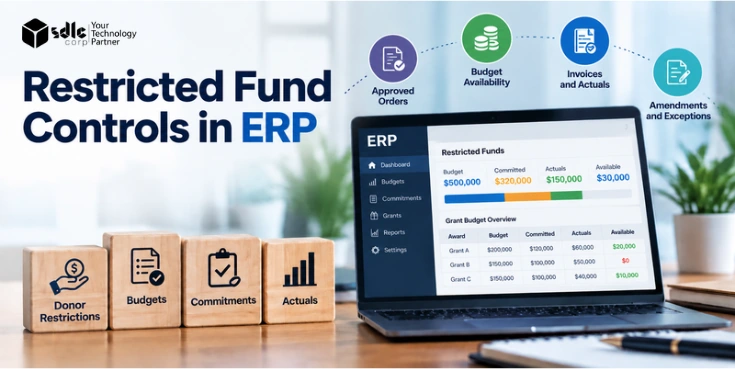
Restricted-fund controls in ERP need to answer a question before money is committed: is this proposed cost permitted, authorised and within the relevant budget? Recording a grant code after an invoice arrives provides useful classification, but it may not prevent an obligation that should never have been approved.
Design the control around transaction states. A request, approved order, partial invoice and cancellation affect the budget differently. The system should preserve those transitions, calculate availability consistently and show the authority behind any exception or amendment.
Awards, funds and budgets need separate identifiers
Start with the distinction between funds, awards and projects. Define the dimensions used for eligibility and reporting, such as entity, award, activity, cost category and period. Avoid treating a donor name as a complete control rule.
Record restrictions in a reviewed form that the workflow can use. Some conditions can be validated directly, such as an eligible period or permitted budget line. Others need judgement and supporting documents. Decide which checks are automatic, which require review and how unresolved conditions are escalated.
An award amendment should not silently change the meaning of past approvals. Preserve the approved budget version and effective dates. A reviewer needs to know what rules applied when the organisation made the commitment.
What is available before a new commitment?
Define the budget-check point and the records included in the calculation. If several requests arrive at the same time, the design must prevent each from being approved against the same remaining capacity without accounting for the others. This requires more than refreshing a dashboard periodically.
The procurement workflow should connect approval to commitment creation. Specify how estimates, taxes, delivery charges and currency assumptions are treated when the final invoice value is not yet known. A later increase may need additional approval.
Use a clear insufficient-budget response. Depending on policy, the request may be blocked, returned for amendment or routed to an authorised exception process. The audit trail should show the result and its basis, not merely that someone clicked approve.
An invoice transfers commitment into actual expenditure
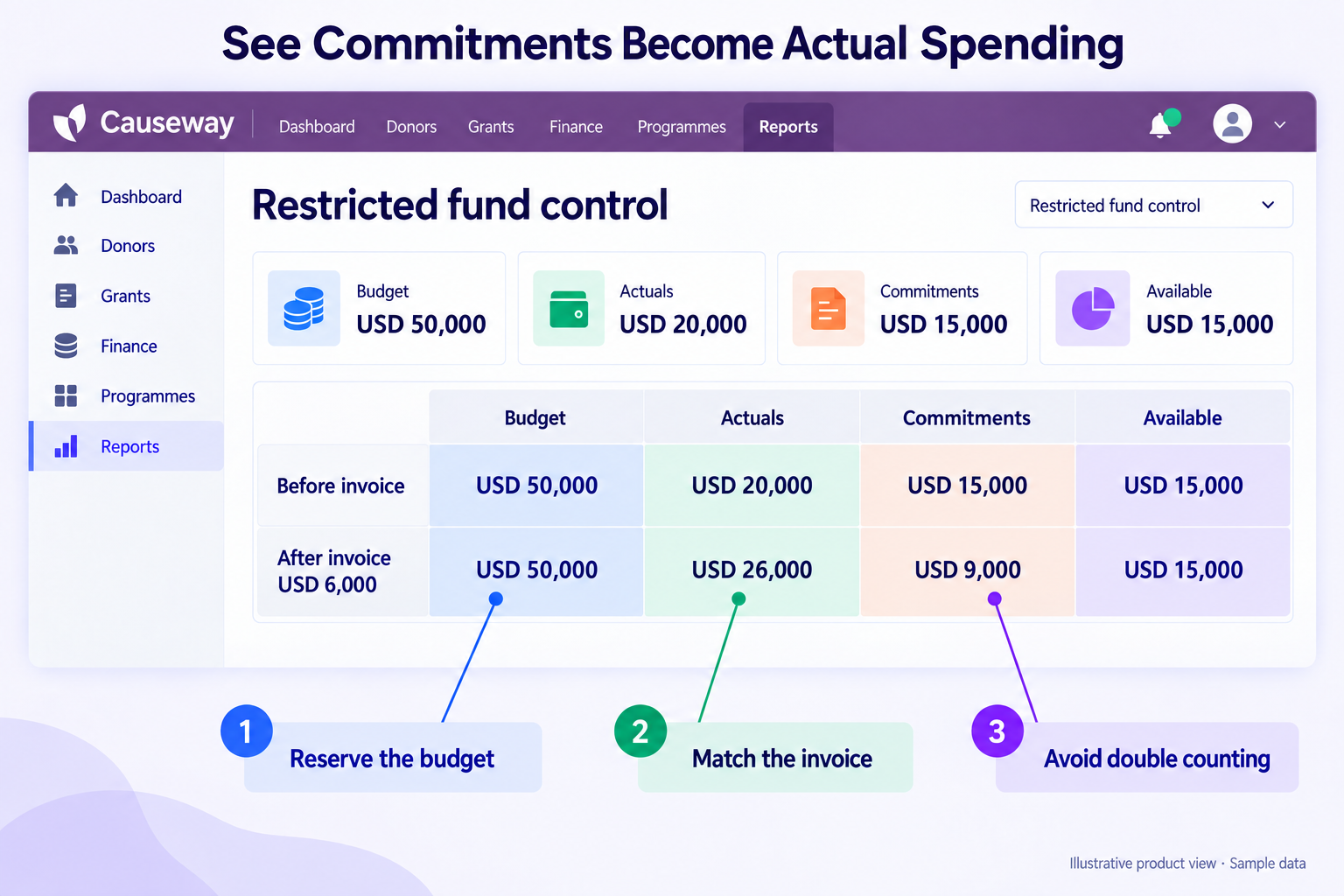
For an example budget of 50,000 units, actual expenditure of 20,000 and outstanding commitments of 15,000 leave 15,000 available. If 6,000 of an existing commitment becomes an invoice, actuals rise to 26,000 and outstanding commitments fall to 9,000. Availability remains 15,000.
| State | Actuals | Outstanding Commitments | Available |
|---|---|---|---|
| Before partial invoice | 20,000 | 15,000 | 15,000 |
| After 6,000 is invoiced | 26,000 | 9,000 | 15,000 |
| After 2,000 of the remainder is cancelled | 26,000 | 7,000 | 17,000 |
The example assumes unchanged approved budget, currency and scope. It illustrates operational budget availability, not a financial-statement balance. If an invoice includes a variance, the difference needs its own treatment rather than being hidden inside the commitment reduction.
Maintain stable references between the order, receipt and invoice lines. A total-level match can conceal a cost moved to an ineligible category. Partial allocations and cancellations should update the correct line without releasing unrelated commitments.
Transfers and amendments change the approved version
Moving budget between activities can require internal or donor approval. The grant lifecycle should define the amendment process, including the request, rationale, approval, effective date and downstream updates. A user's ability to edit a budget should not be mistaken for authority to change it.
Consider an order split between two awards. If one award's share becomes ineligible, moving the amount to the other award needs a valid allocation basis and sufficient authority. A balancing transfer made solely to remove a warning can create a reporting problem elsewhere.
Define how amendments affect pending requests and approved obligations. Some changes may require revalidation or reapproval. Preserve the previous version so a historical report can still explain the decisions made before the change.
Record an exception without rewriting the restriction
For the 50,000-unit example, request PR-09 seeks an excluded equipment item. The system response is “eligibility review required,” with no new commitment. A budget holder can confirm funding but cannot waive the donor restriction. The grant owner either supplies an approved donor amendment with an effective date, changes the request to an eligible item, or rejects it. Retain the original request, reason, reviewer and final decision.
A shared 2,000-unit service cost allocated 75% to this award contributes 1,500 units only if the agreed allocation basis and eligibility support it. The other 500 belongs to its actual funding source; moving it merely to remove a warning is not a valid allocation.
Reconcile exceptions and donor balances
Reconcile budget-control totals to the underlying transaction population. Check posted versus unposted items, cancelled orders, partially invoiced commitments, date cutoffs and currency treatment. Unmatched or failed transitions should appear in an exception queue with an owner.
Use live demonstration tests for an overspend attempt, simultaneous requests, partial invoicing, cancellation and a changed award period. Observe whether the system prevents or routes the action as specified and whether the resulting balance is reproducible.
Do not rely only on the happy path. A failed invoice import followed by a retry can duplicate actuals if the transaction identity is not handled correctly. A correction to a closed period may affect a donor report already submitted. Define review responsibilities for both situations.
Separate budget control from accounting recognition
A commitment reserve supports spending decisions. It does not by itself determine when expenditure, a liability or grant income is recognised. Configure those accounting events under the entity's approved framework, while preserving the operational balance used by budget holders.
Donor restrictions and internally designated funds also need distinct classifications. The Charity Commission's reserves guidance explains this distinction for its context. Apply the relevant local framework rather than treating a UK fund label as a global rule. A transaction can affect an operational budget today and enter a statutory report on a different basis, provided the reconciliation is explicit.
Reconcile approved budget, actuals and open commitments in the Restricted Fund Tracker.
Conclusion
Restricted-fund control depends on consistent transaction states and explicit authority. Reserve budget at the agreed point, remove commitments as they become actuals and release only genuinely cancelled amounts. Preserve amendments and reconcile exceptions. A small sequence with known results is the clearest way to test whether the design protects available funds.
Discuss restricted-fund controls
Discuss mapping your restriction and commitment rules into a proposed Causeway grant management platform scope. Bring an approved budget, its amendment policy and a transaction example involving partial invoicing or cancellation.
Ask for a demonstration with expected balances calculated in advance. Confirm the point at which budget is reserved, the handling of exceptions and the authority required for changes. This makes the evaluation about observable control behaviour rather than a general claim that the system supports grants.
Frequently asked questions
Can an approver override a restriction?
Only where the relevant rules and authority permit an exception. Internal approval cannot automatically waive a donor condition or legal requirement. Record the basis, scope and evidence of any authorised exception, and block changes outside that authority.
How should a cancelled order restore budget?
Release the remaining valid commitment associated with the cancelled portion. Do not reverse expenditure already incurred or release another line's reservation. Preserve cancellation evidence and check whether fees or other obligations remain.