Fund accounting helps an NGO explain what resources it holds, what they may be used for and how they have been applied. A positive bank balance does not answer those questions. Some money may be restricted to a programme, some may already be committed to suppliers, and some may need to support obligations outside the report being reviewed.
The practical task is to preserve the relationship between the funding agreement, the approved budget and the transactions charged to it. Accounting treatment depends on the organisation's applicable framework and award terms. Operational reports should make those choices visible rather than trying to infer restrictions from a bank account or a donor name.
Funds, grants, projects and donors are different
A donor is a funding source. A grant or award is an agreement with conditions, dates and obligations. A project organises delivery work. A fund identifies resources whose use or reporting needs to be tracked under the organisation's accounting structure. These concepts can overlap without being identical.
Imagine one donor provides a learning grant and a separate unrestricted contribution. Combining both under the donor's name would hide their different permitted uses. Similarly, a project funded by two awards needs to preserve each award's conditions even if the activities look similar.
Design reports around these relationships. Every expense should have the dimensions required to explain its treatment, but staff should not be forced to guess a fund code from a long list. Use controlled defaults where appropriate, validation for incompatible combinations and a documented route for corrections.
Restricted and unrestricted resources
A donor restriction comes from the terms governing the contribution. An internal designation reflects a decision made within the organisation, such as setting aside otherwise unrestricted resources for a future initiative. The authority to change each arrangement is different. An internal budget transfer does not automatically remove a donor's restriction.
For England and Wales, the Charity Commission's reserves guidance illustrates this distinction: an internal designation does not itself create a donor restriction. Use the terminology and presentation required by your own applicable framework when implementing that distinction in the accounts.
Before spending, establish what the relevant agreement permits. Restrictions can concern purpose, timing, location, eligible costs or another condition. An agreement may also distinguish approved funding from income recognition or cash received. Those are separate questions and should not be collapsed into one “grant balance.”
| Question | Evidence To Examine |
|---|---|
| What may the resources support? | Agreement and approved amendments |
| Which period is relevant? | Eligibility dates and reporting instructions |
| Who can approve a change? | Donor terms and internal delegated authority |
| How should the amount be accounted for? | Applicable accounting policy and reviewed treatment |
Use a qualified finance reviewer for uncertain classifications. The purpose of the system is to retain the decision and supporting evidence consistently, not to decide unfamiliar accounting questions from a label.
Match the fund model to the reporting framework
Fund labels are not universal accounting rules. Identify the legal entity, jurisdiction and accounting framework before configuring income recognition, restrictions or fund presentation. An internal project budget can remain useful even when the statutory statements group the same transactions differently.
For England and Wales, the Charity Commission's accounts guidance distinguishes reporting requirements and points to the applicable SORP. A US organisation preparing Form 990 needs a separate mapping to the IRS return instructions; the return is not itself a universal accounting framework. Retain the approved accounting policy behind each mapping rather than copying another country's fund structure.
A practical design can hold one transaction with several reporting dimensions: legal entity, fund, award and project. Each report then selects the dimensions and recognition basis it needs. Review reconciling differences instead of changing the underlying classification solely to make two reports look identical.
Six dimensions explain one transaction
Fund, grant, donor, programme, project and GL account answer different questions. Preserve them as separate dimensions when the operating model needs them. A single long account code that combines every meaning becomes difficult to maintain when one relationship changes.
| Dimension | Meaning | Example |
|---|---|---|
| Fund | Resources grouped by permitted use or reporting treatment | Restricted education resources |
| Grant | Award agreement and its conditions | Education award G-24 |
| Donor | The funding relationship | Foundation D-08 |
| Programme | The broader intervention | Access to education |
| Project | A defined delivery effort within the programme | District learning centres |
| GL account | The accounting nature of the transaction | Learning materials expense |
The same donor can support several grants. A programme can draw on several funds, and a project can incur several types of expense. Conversely, a single grant may support several projects. Store those relationships explicitly rather than assuming one-to-one matches.
Consider a learning-materials expense charged to G-24. Its GL account describes the expense, while its fund and grant dimensions explain the restrictions and award. Moving the delivery project to another programme does not, by itself, change either the donor's conditions or the accounting nature of that expense. The correction needs to affect only the relationship that actually changed.
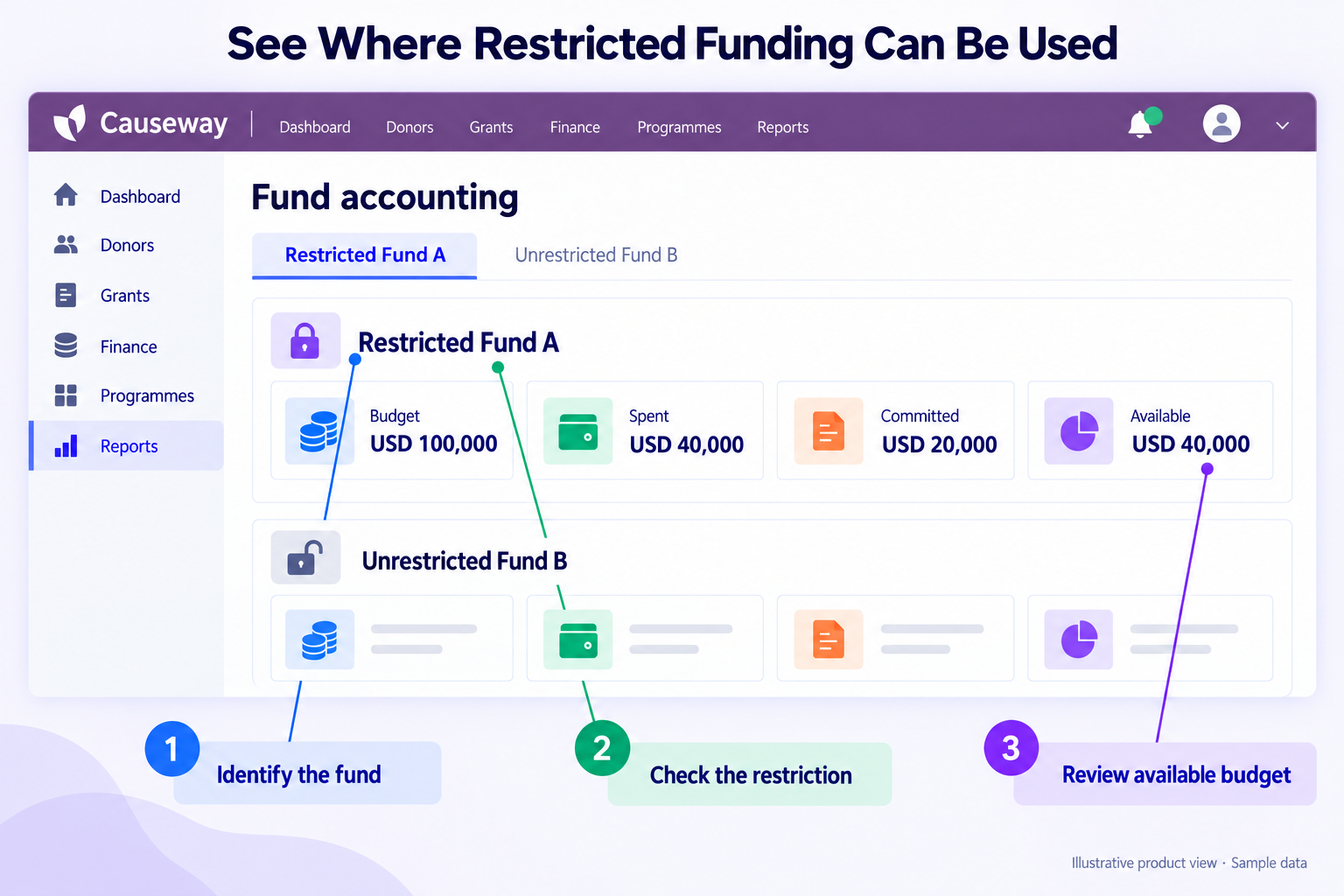
The operating budget and financial-statement fund balance also serve different purposes. A budget can reserve capacity for an order before the accounting policy recognises an expense. The transaction-level availability calculation belongs in the restricted-fund control workflow, with its own date, currency and status definitions.
One expense, several reporting dimensions
The following worked record describes one EUR 600 materials invoice; it is not a measured customer result.
| Field | Example | Purpose |
|---|---|---|
| Ledger account | Training materials expense | Nature of the cost |
| Fund | Restricted education | Resource restriction |
| Grant | EDU-01 | Agreement and reporting conditions |
| Programme / activity | Learning / Session A | Delivery purpose |
| Entity / location | Entity A / Site 1 | Responsible books and delivery location |
| Posting | Debit materials expense EUR 600; credit supplier payable EUR 600 | Balanced entry before settlement |
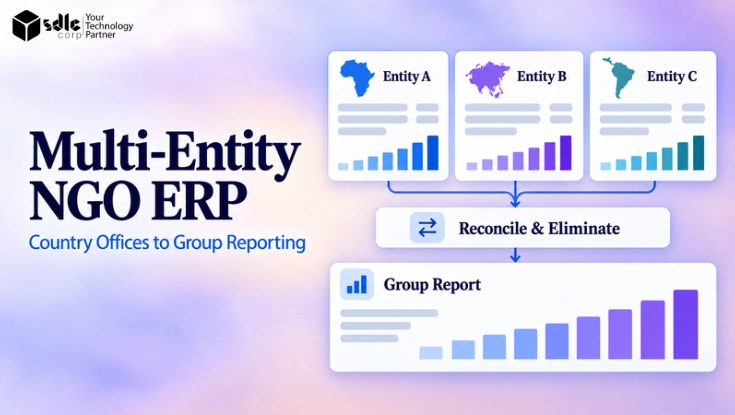
The grant code does not replace the expense account, and the fund does not replace the legal entity. Retain those distinctions in group consolidation, where local and group reports can use different mappings.
If a shared EUR 1,000 venue cost is allocated 60% to EDU-01 and 40% to EDU-02, the grant amounts are EUR 600 and EUR 400. Use an approved basis such as documented room usage, and check each agreement's eligibility. The split must sum to the source invoice; the allocation is not permission to move a restricted cost to another award.
Why cash and available budget differ
Cash, receivables, obligations and permitted expenditure move on different timelines. An advance can arrive before spending is eligible. An allowable invoice can be due before the next donor payment. A budget may have headroom while the organisation lacks cash to settle a purchase this week.
Review at least two perspectives: whether the cost is allowed within the approved budget and whether sufficient liquidity exists when payment is due. Neither perspective replaces the other. A useful report labels its basis and includes outstanding commitments explicitly.
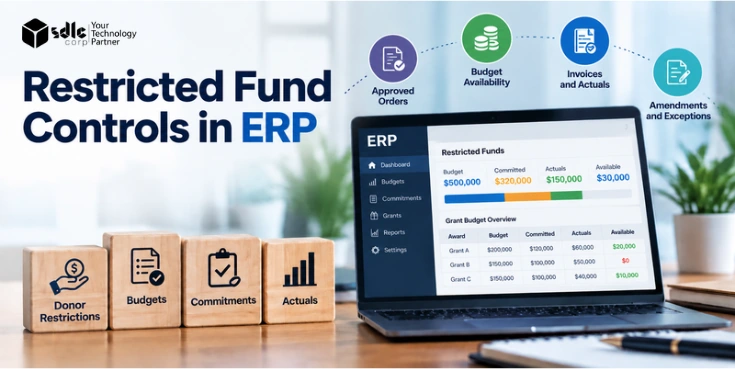
For software design, restricted-fund controls in ERP should specify how commitments become actuals, how cancellations restore availability and who can authorise amendments. Avoid a single balance field whose meaning changes between screens.
Reconciling fund reports
At each close, reconcile the operational report to the underlying financial records using a documented bridge. Check reporting period, posting status, currency, included accounts and treatment of outstanding commitments. A donor report may intentionally use a different presentation from management accounts, but the difference should be explainable.
Foreign-currency awards add another dimension. Keep transaction, entity and reporting currencies distinct in multi-currency accounting. A remaining amount translated using a budget rate should not be compared with a ledger total at another rate without explaining the difference.
Finally, connect the financial reconciliation to donor reporting requirements. A report should identify who prepared it, who reviewed it and which approved version was submitted. Correcting an underlying transaction should trigger consideration of affected reports rather than silently changing the historical submission.
Reconcile approved budget, actuals and open commitments in the Restricted Fund Tracker.
Track reconciliation, exception resolution and sign-off with the Month-End Close Checklist.
Causeway reports month-end close moving from 12 days to 4 days among its multi-customer implementation outcomes. For a fund-accounting evaluation, keep the close boundary explicit: posting completion, reconciliations, adjustments and final review are distinct milestones.
Conclusion
Reliable fund reporting starts with clear definitions. Keep donors, awards, projects, budgets and accounting balances distinct, then connect them through controlled transactions. Before trusting an “available” amount, identify its period, currency and treatment of commitments. A small, reconciled example is the best place to verify that everyone means the same thing by the report.
Discuss your fund accounting model
Evaluate how your award conditions, fund dimensions and budget checks could be represented in Causeway finance and fund-management platform. Share a representative agreement and a reconciled example showing expenditure, outstanding commitments and available budget.
A useful consultation should clarify which rules can be configured, where finance-policy decisions are still needed and how exceptions would be tested. Request a demonstration of a partial invoice, a cancelled purchase and an approved budget amendment. Those scenarios provide a more meaningful basis for assessing fit than a screen showing a single balance.
Frequently asked questions
Are board-designated funds donor-restricted?
A board designation and a donor restriction have different sources of authority. Record who imposed the condition and who may change it. Finance should confirm the appropriate presentation under the applicable accounting framework rather than treating the two labels as interchangeable.
Why can cash exceed the amount available to spend?
Cash may include resources restricted to another purpose, amounts already committed or funding intended for a later period. Available spending also depends on the approved budget and applicable conditions. Review cash forecasts alongside budget-control reports instead of using either one as a substitute for the other.