
A donor report has to connect several versions of the same programme: what was agreed, what was spent and what was delivered. Problems appear when the financial export uses one period, programme records use another, and the narrative describes results that cannot be traced to supporting evidence.
Reliable donor reporting begins with a reporting specification agreed before the deadline. It defines the population of transactions, budget mapping, currency treatment, result definitions and review responsibilities. The report can then be assembled from controlled records instead of being reconstructed through last-minute adjustments.
The award defines the reporting specification
Create a requirement record for each submission. Capture the recipient, reporting period, due date, format, currency, budget categories and required attachments. Name the preparer, financial reviewer, programme reviewer and final signatory. Keep the agreement or donor instruction linked to the requirement.
Some submissions need more than an expenditure statement: explanations of variations, procurement evidence, activity results or partner information. Identify these dependencies early enough to collect them. The grant management lifecycle places reporting obligations alongside award setup and delivery planning rather than treating them as a final administrative task.
Check amendments before starting a report. A revised budget or extended activity period may change the reporting basis, but only if the relevant approval and effective date support that treatment. Record which version the submission uses.
Institutional reporting and donor relationships serve different needs
An institutional donor report accounts for an award's use and results. Fundraising communication manages a relationship: acknowledgements, preferences, appeals and future support. A supporter may appear in both workflows, but an approved expenditure report should not be replaced by a campaign dashboard.
Connect donor CRM records to awards where appropriate and retain separate approval routes for external financial reports. The handoff between fundraising, grant management and ERP becomes especially important when a restricted campaign gift later funds several activities.
A report needs consistent periods, currencies and mappings
Start with a defined transaction population. Specify whether the report includes posted expenses, payments or another basis required by the award. Decide how accruals, advances and later corrections are handled under the applicable instructions. A payment export is not automatically an expenditure report.
Use a mapping table between internal account or cost codes and donor budget lines. Give the mapping an owner and version. An unmapped transaction should appear as an exception, not disappear from the total or default to a convenient category.
Currency differences need their own reconciliation. In multi-currency reporting, transaction, entity and donor amounts can differ because their conversion policies or dates differ. Keep rates, dates and assumptions with the report so a later reviewer can reproduce the conversion.
Financial and delivery evidence meet at shared references
Financial and programme records should meet at stable identifiers such as award, project, activity and period. They do not need to expose confidential participant details in a donor-facing report. Use aggregate results where appropriate and keep access to the underlying evidence controlled.
| Report Statement | Evidence Needed | Review Question |
|---|---|---|
| Training materials were purchased | Purchase, receipt and expenditure records | Was the cost eligible and correctly allocated? |
| Sessions were delivered | Dated activity records | Does the reporting period match? |
| Participants completed the programme | Defined completion and counting method | Are duplicate or incomplete records excluded? |
| Outcomes improved | Suitable outcome evidence and interpretation | Does the evidence support the claimed change? |
The connection between programme costs and results should preserve these distinctions. Expenditure can explain resources used; it cannot, on its own, establish an outcome or attribute a change to the programme.
What explains the variance and what is still missing?
An example report may show 80,000 units of expenditure against a 100,000-unit approved budget. The 20,000-unit difference is only the starting point. Part may relate to delayed delivery, part to outstanding purchases and part to a revised activity that has not yet been approved.
Separate those explanations. Outstanding commitments are not the same as posted expenditure, and a forecast should not silently replace actual results. Restricted-fund control records can help trace the approved budget, spend and remaining obligations behind the narrative.
Where evidence is incomplete, state what is missing, its effect on the report and the action owner. Avoid replacing an unknown result with zero or presenting a provisional figure as final. The signatory needs to understand the limitation before approving submission.
What goes into a reconciled reporting pack
Use this worked example to connect the narrative to a small reporting schedule. All amounts are USD for the same quarter and approved award version.
| Budget Line | Budget | Posted Expenditure | Outstanding Commitment | Available |
|---|---|---|---|---|
| Training | 60,000 | 50,000 | 5,000 | 5,000 |
| Materials | 40,000 | 30,000 | 5,000 | 5,000 |
| Total | 100,000 | 80,000 | 10,000 | 10,000 |
The programme schedule records eight completed sessions against ten planned, with dated activity records and an agreed completion definition. A suitable explanation is: “Two sessions moved into the next quarter following venue delays. USD 10,000 remains committed and USD 10,000 is uncommitted. The programme owner will confirm revised dates before the next forecast.” This explains timing without claiming an unmeasured outcome.
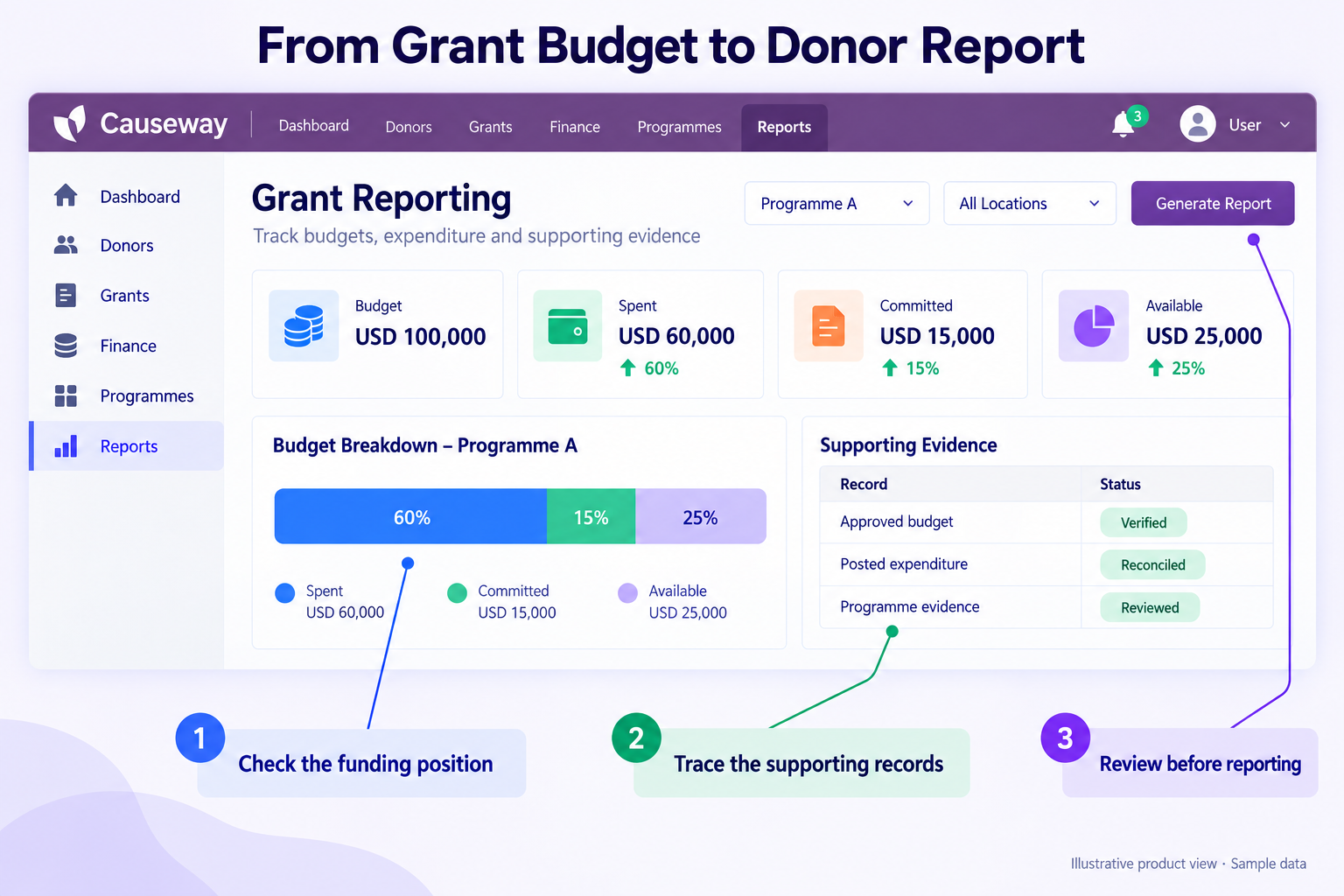
The pack contains the financial schedule, ledger reconciliation, activity/indicator schedule, variance narrative, supporting-document index and approval record. Name each file by award, period and version. The product illustration elsewhere on this page is a separate sample screen; the table above is the worked report scenario.
Review, sign off and retain the report
Perform a financial reconciliation and a programme-evidence review before final approval. Check totals, line mappings, rates, periods, attachments and consistency between tables and narrative. A reviewer should be able to follow a selected figure back to its underlying records.
Save the exact submitted version, submission evidence and approval trail. If a later correction affects a submitted figure, assess whether the donor needs an amended report or explanation. Do not quietly replace the retained submission with a refreshed export.
Use recurring exceptions to improve the next cycle. If a partner report repeatedly arrives late, adjust the collection workflow. If a budget category requires manual recoding every month, review the mapping and transaction-entry controls. Reporting quality improves when these problems are resolved upstream.
AI-assisted reporting can help draft explanations from approved records, with source references and finance and programme review before release.
Trace funding through activities, costs and results with the Grant-to-Impact Data Model.
Bring financial schedules and programme evidence into the Donor Reporting Pack.
Causeway reports programme reporting moving from quarterly to weekly among its customer outcomes. A faster cadence is useful only when each issue still has an agreed period, reconciled figures and approved programme evidence. The operational result concerns reporting frequency; it does not remove those review steps.
Conclusion
A defensible donor report has a reproducible financial basis and evidence for its programme statements. Agree the specification early, reconcile the numbers and keep uncertainty visible. Preserve the submitted version and its approval trail. These practices reduce the need for last-minute interpretation and make later questions easier to answer.
Discuss reconciled donor reporting
Discuss connecting your financial and programme reporting needs through Causeway donor and fundraising platform. Bring one donor template, its reporting instructions and the reconciliations your team currently prepares manually.
Ask for an evaluation of source records, budget mappings, currency assumptions and review steps. A demonstration should show how a selected figure reaches the report and how an exception remains visible. Confirm any external programme-data dependencies before assuming that a financial integration can supply the full reporting pack.
Frequently asked questions
Can expenditure prove programme impact?
No. Expenditure shows resources used, subject to correct accounting and allocation. Programme outputs and outcomes require their own evidence and definitions. Even a measured outcome does not automatically establish that the programme caused the change.
How should late transactions be handled?
Follow the applicable accounting and donor-reporting instructions. Record the transaction and its effect on the relevant period, then assess whether a submitted report requires correction. Keep the original submission and the decision about any amendment traceable.




