
Sub-grant management connects a donor-funded award to the independent organisations delivering part of the work. It covers partner selection, agreements, budgets, advances, reporting, monitoring and closeout. The parent NGO needs to know what it has committed, what it has paid and what expenditure it has actually accepted.
Those amounts are different. Paying an advance does not prove that a partner has spent it on eligible activity. Equally, a late report does not automatically establish misuse. A well-designed process keeps the evidence and decisions visible so the next release follows the agreement rather than an unexplained spreadsheet balance.
The partner relationship determines the conditions
Begin by identifying the legal parties and the nature of the arrangement. An independent subrecipient, a supplier and a controlled entity can all receive funds, but they do not necessarily carry the same obligations. Have the responsible grants and legal owners approve the classification before configuring the workflow.
For covered US federal awards, OMB's federal assistance guidance addresses pass-through responsibilities, including subrecipient risk and monitoring. Apply the current requirements for the actual award. A donor-funded partnership outside that regime still needs a documented agreement, but should not be labelled subject to US rules without an applicability decision.
Record the parent award, partner agreement, approved budget, delivery period, permitted costs, reporting dates and authorised contacts. Preserve the terms that flow down from the parent award and any partner-specific conditions. The grant lifecycle should show how those records remain connected when either agreement changes.
Partner risk determines the monitoring work
Review the partner's capacity to deliver and account for the work. Depending on the agreement and applicable requirements, this may include governance, financial processes, safeguarding, previous findings, delivery experience and bank-detail verification. Record evidence and the decision rather than only a high, medium or low label.
Use the assessment to choose monitoring actions. A partner with a new finance team may need an early reporting review and training. A recurring documentation problem may justify closer checks on the affected costs. Assign an owner and review date to each action so the assessment changes the operating process.
Keep sensitive diligence records accessible only to appropriate reviewers. Programme staff may need to know that a release is on hold without seeing confidential personnel or investigation details.
An advance is not accepted partner expenditure
| Balance | What It Represents | Evidence |
|---|---|---|
| Agreement ceiling | Maximum commitment under the current agreement | Signed terms and amendments |
| Advance paid | Funds transferred to the partner | Authorised payment and receipt reference |
| Expenditure submitted | Costs the partner has reported | Statement and supporting records |
| Expenditure accepted | Costs approved through the review process | Review result and adjustments |
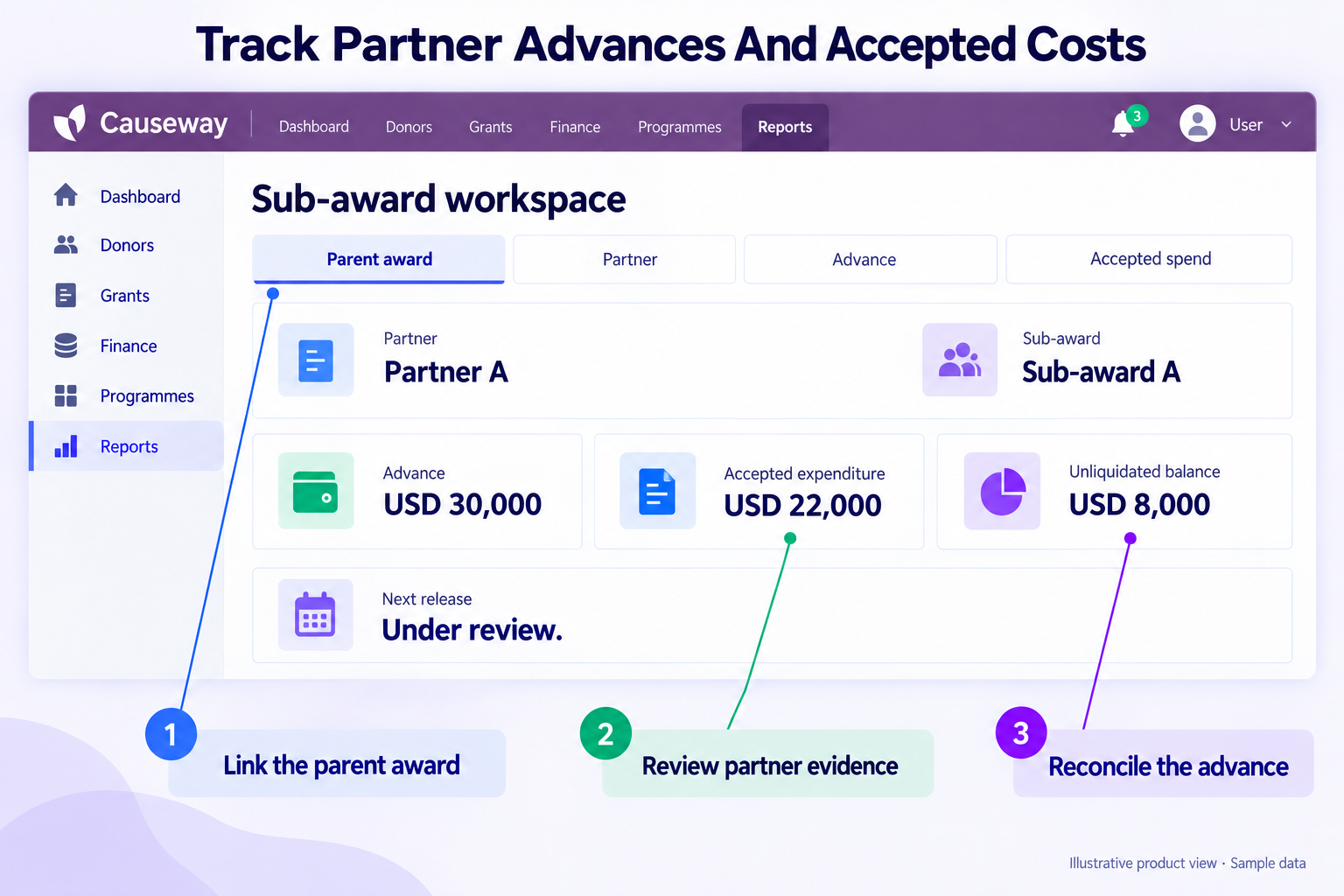
| Unliquidated advance | Advance not yet supported by accepted expenditure | Reconciliation and outstanding items |
For an example USD 100,000 agreement, an initial USD 30,000 advance and USD 22,000 of accepted expenditure leave USD 8,000 unliquidated. If the partner submitted USD 25,000, the additional USD 3,000 remains under review or rejected according to the actual decision. It should not silently become accepted expenditure to make the balances agree.
These operational balances need mapping to the applicable accounting policy. The design should preserve the distinctions even where financial statement presentation differs. Track cross-border transfer fees and recipient amounts when payment currency or charges affect the partner's available cash.
Release the next instalment against agreed conditions
Define whether another release depends on an accepted report, cash forecast, milestone, budget utilisation or other condition. Show the reviewer the evidence relevant to that condition. Keep an authorised exception route for situations where delivery would otherwise stop, with reasons and limits recorded.
A release condition should not be implemented as an unexplained lock. Staff need to see the missing evidence, responsible owner and action needed to resolve it. Payment approval then follows the normal treasury controls after the grant condition is satisfied.
Expenditure does not prove delivery
Compare spending with the activity and results expected under the agreement. A low spend may reflect delayed procurement, a timing difference or a delivery problem. A high spend does not establish that the intended output occurred. Ask for the relevant explanation and evidence rather than interpreting a percentage alone.
Connect the partner's definitions to the NGO's monitoring and evaluation measures. Retain the source, reporting period and validation history. Where beneficiary information is shared, define the minimum necessary data and the parties' privacy responsibilities before transmission.
Record findings, agreed actions, due dates and closure evidence. A finding marked closed should point to the action that resolved it, not merely a changed status. Repeated issues can inform the next risk review and monitoring plan.
Carry amendments through to closeout
A changed parent award may require a partner amendment, revised budget and updated reporting dates. Preserve the earlier version and identify which pending requests or expenditure periods are affected. Obtain the required approvals before applying new terms to existing records.
At closeout, reconcile advances, accepted costs, questioned amounts, unspent funds and outstanding commitments. Resolve any asset-transfer or retention obligations. Agree how late adjustments will be handled and retain the final approved statement with supporting correspondence.
The parent award may have several partners finishing at different times. Track each partner's closeout separately so one completed report does not make the whole network appear closed. The donor report should use reconciled partner figures and disclose unresolved items through the approved process.
Record the disposition of each remaining award obligation in the Grant Closeout Checklist.
Conclusion
Sub-award control depends on a clear agreement and a traceable progression from commitment to advance, accepted expenditure and closeout. Link risk assessment to actual monitoring, preserve amendment history and make release conditions understandable. This gives programme and finance teams a shared view of both delivery progress and outstanding obligations.
Plan your partner and sub-award workflow
Evaluate partner-award requirements for Causeway grant management platform. Bring sample agreements, advance reconciliations, reporting formats and the exceptions that currently delay releases or closeout.
Request a demonstration or proposed design that keeps parent awards, partner budgets, accepted expenditure and remaining advances distinct. Confirm which elements are available and which require configuration, integrations or development. The consultation should identify evidence and acceptance conditions for each handoff, including responsibilities retained by your grants team, partners and payment providers.
Frequently asked questions
Does paying an advance count as accepted partner expenditure?
No. The transfer establishes that funds were advanced; acceptance depends on the agreed expenditure review. Preserve both balances and apply the appropriate accounting policy so the organisation can explain the outstanding amount without assuming delivery is complete.
What happens when a partner report is late?
Follow the agreement and approved escalation process. Identify the missing evidence, assess delivery consequences and record whether the next release is held or exceptionally authorised. A documented decision is more useful than an automatic status change with no owner.