
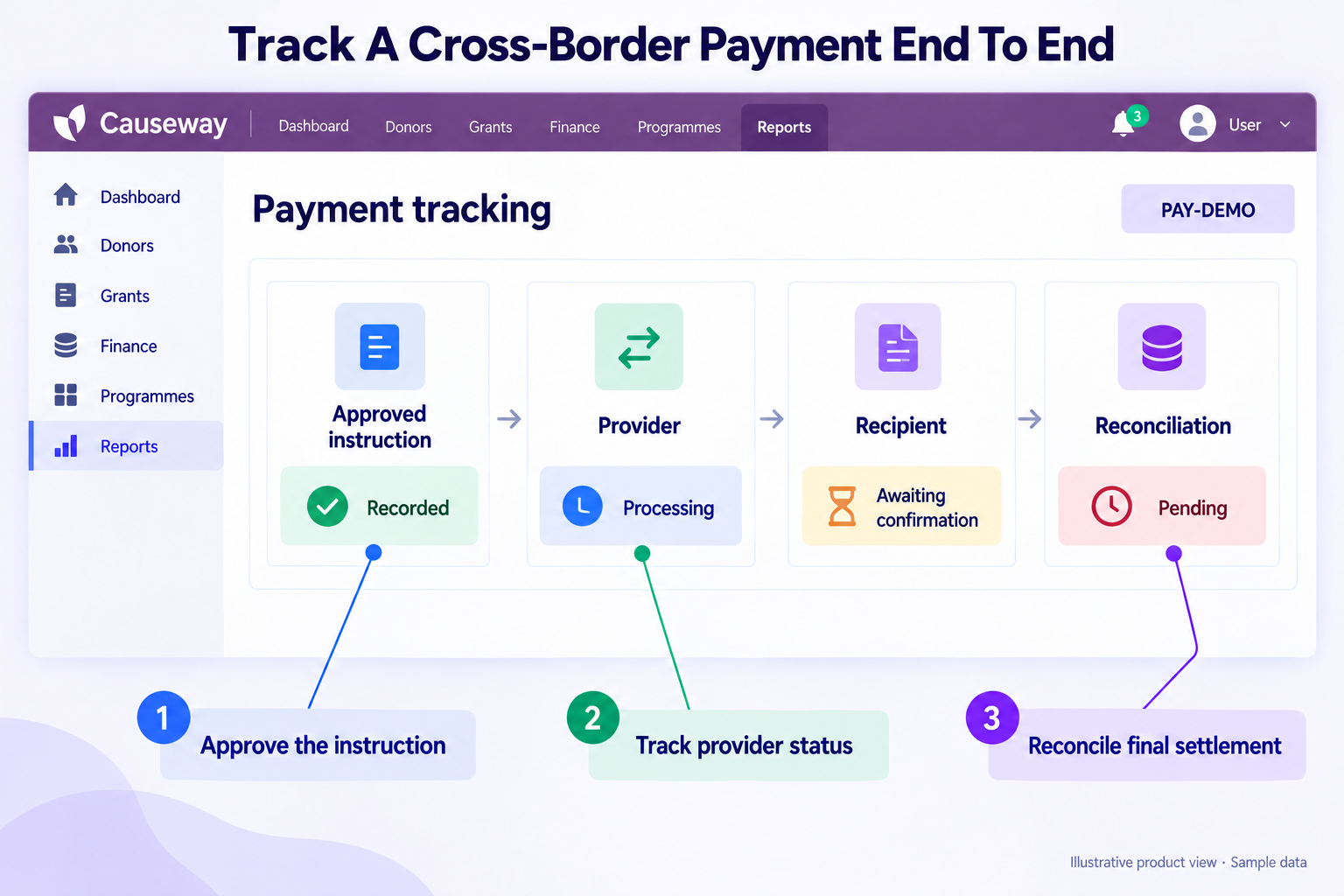
Cross-border payments for global NGOs move money between a donor, headquarters, country entity, supplier or partner. A controlled workflow connects the approved purpose and recipient to the provider instruction, FX rate, fees, settlement status and ERP reconciliation. Multi-currency accounting represents the transaction; the bank or payment provider executes it.
Keep those responsibilities separate. An approved transfer is not proof of receipt, and a quoted rate is not necessarily the settled rate. Retain the provider confirmation and reconcile the amount received to its grant, programme and accounting records.
The recipient and purpose come before the payment route
Identify the legal recipient, payment purpose, agreement, currency and required delivery date. Confirm bank or wallet details through an approved process. A request to change those details should trigger independent verification using a trusted contact route, with a record of who checked the change.
Assess the applicable legal, donor and provider requirements for the particular corridor. This can include recipient due diligence and sanctions-related checks, but the exact obligations depend on the entities, jurisdictions and transaction. Assign a qualified owner to the applicability decision instead of treating a generic ERP setting as global compliance approval.
Partner funding also needs the release conditions from the sub-award agreement. A valid bank account does not establish that the next advance is due. Keep the financial approval and the payment-detail verification as separate evidence.
What amount will the recipient actually receive?
Request a quote that identifies the source amount, receiving currency, exchange rate, provider charge, any known intermediary charges and expected timing. Record whether the quote expires and which costs or delays remain outside the provider's guarantee.
| Input | Why It Matters |
|---|---|
| Source amount and currency | Establishes what leaves the NGO's account |
| Conversion rate | Explains the exchange between source and receiving currency |
| Charges | Distinguishes transfer cost from programme funds |
| Recipient amount | Shows what the receiving organisation should obtain |
| Expected timing | Supports the programme's cash planning |
| Return conditions | Explains how a failed transfer will be handled |
Consider an example USD 10,000 transfer where USD 40 is deducted before conversion and the assumed rate is 0.90 EUR per USD. The expected amount is EUR 8,964, before any further deductions. If an additional EUR 15 is taken by an intermediary, the recipient receives EUR 8,949. These assumptions illustrate why the headline exchange rate alone cannot explain the final amount.
Keep the provider's conversion distinct from the rate required for multi-currency accounting. The same transaction can legitimately have a different accounting valuation and settlement amount, provided the difference is reconciled.
Preparation, approval and release are separate responsibilities
The person preparing a payment should supply the purpose, supporting records and proposed recipient. The approver should review authority, funding and release conditions. The person or service releasing the instruction should act within a defined limit and preserve the final provider reference.
Changes after approval need a clear rule. A corrected bank account or materially changed recipient amount should not inherit approval silently. Reapprove the changed instruction or document the authorised exception according to the NGO's policy.
For payment batches, retain both batch-level and individual transaction references. A provider can accept a file while rejecting one line. The operational status must reflect that distinction rather than marking every recipient as paid.
Reconcile settlement, fees and FX
Match the approved instruction to the provider's settled transaction and the bank movement. Retain the instructed amount, conversion rate, each charge and the final amount received. A status of submitted or accepted is not settlement evidence.
In the USD 10,000 example above, USD 40 is the pre-conversion charge. The remaining USD 9,960 converts to EUR 8,964 at 0.90. An EUR 15 intermediary charge explains the final EUR 8,949 receipt. The reconciliation should account for each difference once, with the supporting provider reference. Finance separately applies its approved accounting rate and records any resulting exchange difference.
Reconcile receipt with the partner's records
For a partner advance, match the receipt confirmation to the partner account. Explain differences between instructed and received amounts. Allocate charges according to the agreement, with the required review.
For transfers within a group, also match counterparties and periods in multi-entity reporting. An independent delivery partner requires a different reporting boundary from a controlled entity, even when both receive money from headquarters.
The full route has several accountable parties
Donor funding → HQ → country entity → partner, supplier or sub-grantee → local-currency settlement → bank or provider confirmation → Causeway reconciliation. Multi-currency accounting represents the currencies; payment execution moves the money; reconciliation explains the final settlement.
| Party | Responsibility | Evidence |
|---|---|---|
| Grant owner | Confirms purpose and release conditions | Agreement and approved milestone |
| Finance approver | Authorises amount and recipient | Approved instruction version |
| Bank or payment provider | Executes the contracted transfer | Status, charges and settlement reference |
| Recipient | Confirms amount received where required | Receipt and discrepancy report |
| ERP finance team | Codes and reconciles the transaction | Grant/project references and explained differences |
If HQ funds a country entity before onward payment, reconcile both transfer legs separately.
Explain rate differences and settlement charges with the Multi-Currency Grant Calculator.
Assign record ownership, reconciliation and recovery routes with the NGO Integration Map Generator.
Handle failed, returned or uncertain transfers
A timeout after submission creates uncertainty. The transfer may have been accepted even though the response was lost. Check the original instruction through the provider's supported status process before creating another payment. A stable business reference and duplicate-prevention controls reduce the risk of paying twice.
Use an exception queue with statuses such as awaiting confirmation, rejected, returned or under investigation. Record the current owner, expected response date and any communication with the recipient. Integration recovery requirements should cover both automatic updates and manual reconciliation.
If funds are returned, match the return to the original payment and explain charges or exchange differences. Resolve whether the obligation remains payable and which details need correction before resubmission. Returning money to the bank is not the same as completing the programme obligation.
Conclusion
Reconcile the transfer before treating the payment obligation as complete. The record should explain the approved recipient and purpose, source amount, fees, exchange rate and final settlement. Keep uncertain outcomes open while the provider investigates, and check the original reference before retrying. For partner advances, compare the receipt with the agreement and the partner account. The same evidence should let finance explain the bank movement and let programme staff know what funding actually arrived.
Scope your cross-border payment records
Review Causeway global NGO ERP as the approval, grant-coding and reconciliation layer in your cross-border payment architecture. Bring the corridors, recipient types, provider reports and release conditions. An ERP consulting assessment can define the interfaces and recovery responsibilities, keeping payment execution with the selected bank or provider and tracing the final settlement back to the approved purpose.
Frequently asked questions
Who should absorb transfer fees?
The agreement and approved policy should determine that responsibility. Record whether fees are deducted from the recipient amount or paid separately, and reconcile the actual outcome. Avoid silently reducing a partner's agreed programme funding without an authorised decision.
What should staff do after a payment timeout?
Treat the outcome as uncertain until the provider's status is established. Check the original reference before resubmitting, preserve the investigation record and escalate through the agreed support route. Sending a fresh instruction immediately can create a duplicate payment.