
An NGO can accept crypto donations through a suitable donation provider, then account for the gift, conversion or asset holding, fees and final settlement. The ERP needs the donor or receipt reference, valuation basis, campaign or fund designation and reconciliation evidence. Accepting a crypto-funded gift does not imply that the ERP processes cryptocurrency itself.
The workflow depends on who receives the asset and who converts it. Establish those responsibilities and the approved accounting treatment before mapping provider records into Causeway. Crypto remains an optional donation channel within a wider fundraising and finance operation.
Which assets and donation routes are permitted?
Agree an acceptance policy naming permitted assets, networks, minimum or maximum conditions where relevant, responsible approvers and the treatment of unexpected transfers. Identify the recipient legal entity and obtain advice on applicable legal, tax, accounting and donor-identification obligations before launch.
An asset name alone is insufficient. The same apparent token label can exist on different networks, and an unsupported transfer may be difficult or impossible for the recipient service to recover. The public donation instructions should match the provider's approved flow and make the supported route clear.
Record any restrictions attached to the gift. A crypto donation for a named programme still needs the same fund classification review as another contribution. The payment technology does not remove the obligation to understand the donor's terms.
Conversion and custody create different responsibilities
| Model | Main Responsibility | Question To Resolve |
|---|---|---|
| Provider converts to conventional currency | Review the provider and reconcile its settlement | Who legally receives the asset and which records are supplied? |
| NGO receives then converts | Control the asset until disposal and record both events | Who can authorise conversion and which venue is approved? |
| NGO retains the asset | Maintain custody, valuation and ongoing governance | Is holding the asset permitted under the approved policy? |
Ask the provider to explain the legal gift recipient, fees, conversion timing, settlement currency and information available for acknowledgement. If an intermediary receives the original gift, the NGO's records and communications must reflect the actual arrangement.
For direct custody, assign responsibility for key management, access recovery, approval of transfers and independent reconciliation. A wallet balance without a controlled access process is not a complete custody arrangement. Include this boundary in the security and vendor evidence review.
Gift, conversion and settlement are separate records
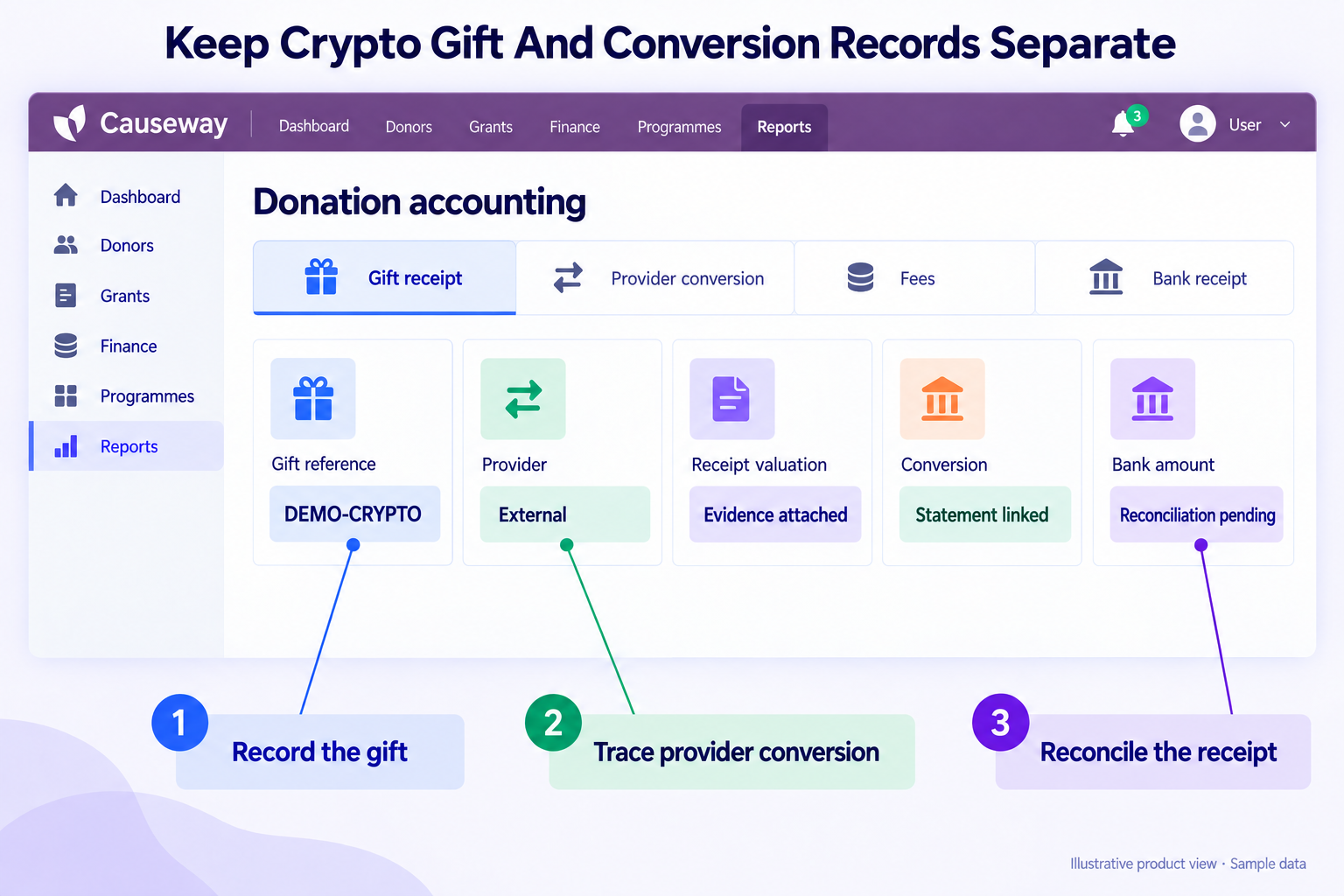
Keep the transaction identifier, network, asset quantity, receipt time, donor information available under the approved process, valuation source and restriction reference. Then preserve conversion proceeds, charges and bank settlement as separate events.
In this example, the approved accounting policy values a received gift at USD 500. A subsequent conversion produces USD 495, with USD 10 of fees, and USD 485 reaches the bank. The records should explain all three amounts. The accounting treatment of the USD 5 difference and USD 10 charge must follow the applicable policy; recording only USD 485 as the gift would lose the underlying history.
A transaction hash helps trace a network transaction. It does not by itself establish the donor's legal identity, the purpose of the contribution or the appropriate tax acknowledgement. Preserve the additional evidence required for those decisions.
Check jurisdiction-specific reporting
For US charities, the IRS virtual-currency FAQs discuss acknowledgement and reporting responsibilities. The Form 8282 guidance addresses certain dispositions of donated property within three years. Have the responsible adviser determine which requirements apply to the actual arrangement. For other jurisdictions, use the acknowledgement and reporting requirements approved by the local adviser.
Match the provider batch to the bank receipt
Use the provider's gift reference to connect the donor record, campaign designation and conversion record. A payout may combine several gifts, so retain both the individual amounts and the batch reference. Reconcile the sum of conversion proceeds less itemised charges to the expected payout, then match that payout to the bank receipt.
If the bank receives a different amount, keep the difference open while the owner checks fees, settlement currency and missing batch items. Do not change the original gift merely to make the bank total match. The acknowledgement follows the verified recipient arrangement and approved local policy; the settlement confirmation serves a separate accounting purpose. This distinction lets the team answer a donor query without treating a net payout as the complete donation record.
Plan for exceptions before a public launch
Test an unsupported asset, an incorrect network, a delayed conversion, a provider settlement discrepancy and a request to return a donation. Assign a person to investigate each exception and define when specialist assistance is needed. Avoid promising recovery of every mistaken transfer.
A return request needs verification and approval. Sending assets to an address supplied in an unverified message can create a new loss or misuse risk. Preserve the reason, destination verification and final transaction evidence under the approved policy.
Supporter communications should explain the actual process without promising investment returns, guaranteed conversion values or tax benefits. Connect the acknowledged gift to the donor relationship record and the reconciled finance entry, while keeping sensitive due-diligence information appropriately restricted.
A balanced worked accounting illustration
Assume the NGO's approved policy recognises the received asset and contribution at $500. The receipt entry debits the asset $500 and credits contribution income $500. On the example conversion, debit bank $485, debit provider fees $10 and debit the conversion difference $5, with a $500 credit clearing the asset. Both entries balance under those stated assumptions.
This demonstrates a record trail, not a prescribed accounting or tax treatment. A provider that legally receives the original donation may create a different accounting arrangement for the NGO. Obtain the applicable policy before adopting entries.
The integration flow is donor → crypto donation provider → transaction and donor/receipt information → conversion or asset handling → campaign/fund designation → reviewed accounting → reporting → bank reconciliation. Causeway's role in this design is the ERP record and integration workflow; it is not a claim that Causeway directly processes cryptocurrency.
Conclusion
Crypto donations are manageable only when acceptance, custody, conversion and reporting responsibilities are explicit. Choose a model the NGO can govern, retain the complete financial trail and resolve local requirements before launch. A payment option is useful when it fits the organisation's controls and donor needs, not simply because it is available.
Discuss your donation accounting boundary
Evaluate the ERP side of your provider-mediated donation workflow with Causeway donor and fundraising platform. Bring the provider's gift, conversion and settlement records plus the accounting policy approved for your arrangement. The integration scope should identify mappings, interfaces, exceptions and reconciliation evidence. Custody, conversion and payment execution remain with their assigned parties; the proposed connector needs its own acceptance test.
Frequently asked questions
Does a transaction hash prove who donated?
No. It identifies a network transaction but does not necessarily establish the legal donor or the donation's purpose. Collect and verify the additional information required by the NGO's approved acceptance and reporting process.
Can the ERP decide the donation's tax treatment?
No. The treatment depends on the jurisdiction, entity and transaction arrangement. The ERP should retain the evidence and apply approved mappings, while a qualified adviser determines the relevant accounting, acknowledgement and reporting requirements.