
A donor CRM gives fundraising teams a reliable history of the people and organisations supporting an NGO. It connects gifts, conversations, campaign responses and communication preferences so the next interaction reflects the relationship. Its usefulness depends on the quality of those connections, not the number of names in the database.
Fundraising management adds the work around that history: planning appeals, assigning follow-up, recording commitments, acknowledging gifts and reviewing results. Finance still needs a reconciled accounting record. Linking the two means a fundraiser can recognise a supporter without treating an uncollected pledge or failed payment as cash received.
A supporter record preserves distinct relationships
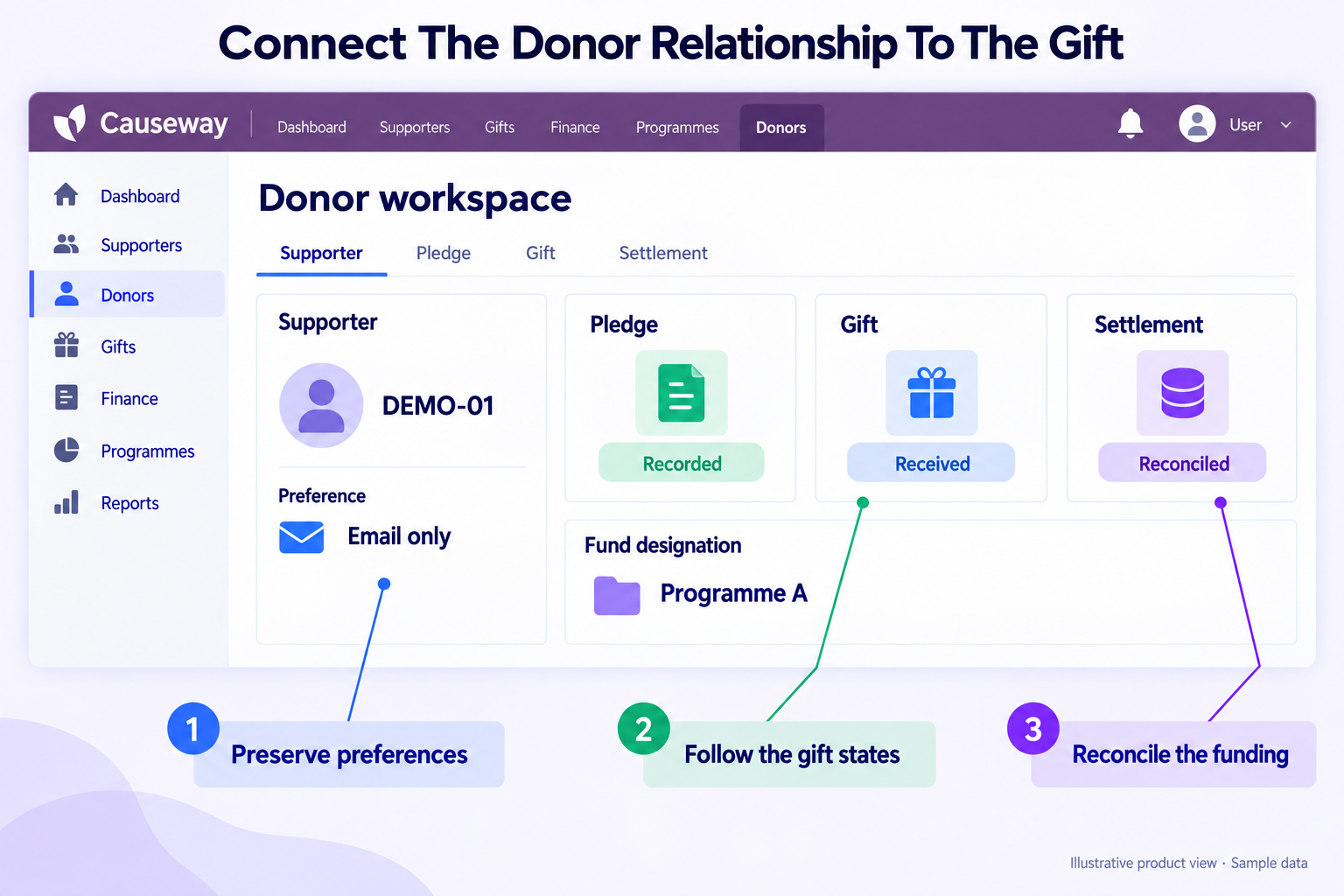
Separate the person or organisation from the gifts they make. One person may donate privately, represent a corporate sponsor and volunteer at an event. Those relationships should be connected without merging distinct legal donors or exposing unrelated information to every user.
Define who can create, merge and correct records. A likely duplicate needs review of identifiers and history, not an automatic merge based only on a shared surname or address. Preserve the source record identities so receipts, preferences and past communications remain explainable after a merge.
Record the purpose and source of contact information. An event registration should not silently become permission for every future campaign. Give fundraising staff a clear view of the approved communication status for each channel and a route to correct it when a supporter changes their preference.
Keep relationship notes proportionate
Useful notes describe relevant interactions, commitments and follow-up responsibilities. Avoid collecting speculative personal details simply because a free-text field exists. Role-based access and retention rules should also cover exports and campaign tools, where copies can outlive the central record. Align the design with the applicable privacy requirements.
Follow the gift through its actual states
A pledge, a successful payment and a reconciled bank receipt are different events. A recurring commitment also has a schedule whose future instalments have not yet been collected. Keep these states visible so campaign reports do not overstate available money.
| Record | Operational Meaning | Handoff To Finance |
|---|---|---|
| Pledge | A stated commitment under recorded terms | Accounting treatment reviewed under the applicable policy |
| Gift transaction | A specific contribution attempt or receipt | Amount, currency, donor and restriction reference |
| Settlement | Funds included in a provider payout | Gross receipts, fees, adjustments and net bank amount |
| Refund | Money returned against an earlier transaction | Original reference and approved correction |
For an example monthly gift of USD 25, twelve scheduled instalments represent a USD 300 annual commitment. If ten have succeeded, one failed and one is still due, collected payments total USD 250 before fees. Displaying USD 300 as received would hide the collection gap. The accounting recognition of a commitment requires a separate policy decision.
Use donation payment reconciliation to connect provider events to these records. The CRM should receive the status it needs for supporter care while finance retains control over postings and corrections.
Campaign purpose determines attribution and follow-up
Campaigns need a defined audience, purpose, owner, period and approved message. Record why a gift is attributed to a campaign and whether the donor restricted its use. A campaign label describes fundraising activity; it should not automatically create an accounting restriction that the donor never imposed.
When an appeal supports a restricted programme, preserve the wording or agreement establishing the restriction. Map gifts to the correct fund or award using the approved fund accounting structure. If several appeals fund the same programme, retain both campaign attribution and programme allocation rather than forcing one field to serve both purposes.
Assign follow-up work with an owner and due date. A major donor's proposal, a corporate sponsor's reporting request and a first-time supporter's acknowledgement require different actions. Staff should see what has already happened before contacting the person again.
Which donors belong in the retention calculation?
Choose a clear definition for each metric. Donor retention needs a starting cohort and a follow-up period. Gift frequency needs rules for refunds, failed transactions and soft credits. Campaign income should distinguish gross contributions from net receipts and should explain any allocation of acquisition costs.
For example, if 200 donors gave in the prior year and 120 of those same donors give in the current year, the simple retained-donor rate is 60%. New donors belong in acquisition reporting, not in the numerator of that retention calculation. A shared household or organisation record can also distort the result unless the counting unit is defined.
Review the number alongside actual relationship work. A large one-off emergency appeal may behave differently from regular giving. Segmentation helps explain that difference without making unsupported claims about why individual supporters stopped giving.
Test the handoff before replacing a tool
Run a new gift, a duplicate donor, a preference change, a failed recurring payment and a refund through the proposed setup. Check which system owns each update and how staff see unresolved exceptions. The comparison of fundraising CRM, grant management and ERP can help define those boundaries before implementation.
For assistive segmentation and follow-up, donor intelligence evaluation should preserve giving context, preferences and human review.
A compact supporter record
Supporter D-01 is a test individual record linked to recurring commitment RC-01 and campaign EDU. Keep communication status by channel, its source and review date, the relationship owner and collected-gift references. A corporate sponsor represented by the same person has its own legal donor identity.
The handoff is commitment RC-01 → attempt PAY-01 → settled gift GIFT-01 → provider payout → finance posting → bank reconciliation. Grant management receives the applicable funding conditions; it does not become the owner of every fundraising conversation. This boundary keeps donor care, award authority and accounting treatment connected without confusing their responsibilities.
If crypto is an approved donation channel, keep the provider, conversion and settlement trail described in crypto donation accounting for NGOs alongside the donor record.
Conclusion
A useful donor CRM preserves relationships and the history behind each gift. Keep commitments, collections, settlements and restrictions distinct, then connect them through stable references. Fundraising teams gain a more reliable basis for supporter care, while finance can reconcile the money without rebuilding the relationship history.
Discuss your donor relationship workflow
Evaluate how donor operations could connect with Causeway donor and fundraising platform. Bring your current CRM, campaign tools, payment providers and reconciliation examples so the discussion starts with the systems and handoffs you actually use.
Request a proposed scope that identifies the authoritative donor record, integration responsibilities and evidence needed for preference changes, refunds and duplicate resolution. Confirm which functions are available, which would remain in specialist tools and which would require configuration or development before selecting an approach.
Frequently asked questions
Should a CRM store card details?
Design the workflow so payment providers handle sensitive payment credentials and the CRM keeps only the references and status it needs. Confirm the actual security and compliance scope with the provider. A transaction reference is usually more useful for supporter service than a copy of payment credentials.
Is a campaign the same as a restricted fund?
No. A campaign describes fundraising activity, while a restriction depends on the terms attached to the contribution and the applicable accounting policy. Keep the two classifications connected where appropriate without assuming every campaign limits how the money can be used.