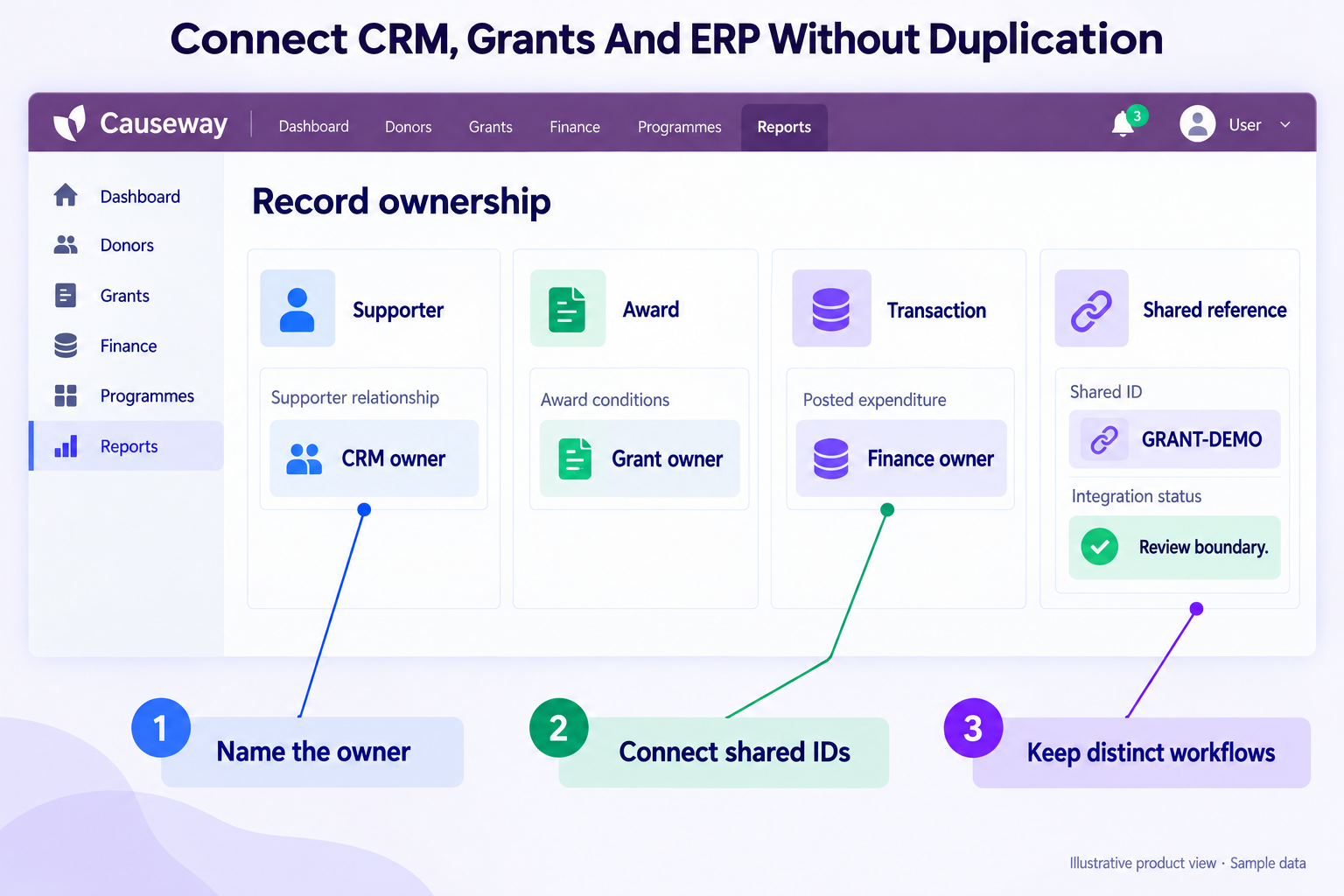
Donor CRM owns supporter identities, relationships, preferences and gift activity. Institutional grant management owns award agreements, conditions, budgets, amendments and reporting obligations. ERP connects those decisions to purchasing, accounting and programme delivery. One platform can cover all three, but each record still needs a clear owner.
The key distinction is a relationship versus an institutional award. One corporate supporter may make an appeal donation and fund a multi-year grant. Keep a shared identity, then retain separate gift and award records so a fundraising update cannot silently amend an approved grant.
Which system should own each record?
| Record Or Decision | Typical Lead Responsibility | What Other Systems Need |
|---|---|---|
| Supporter profile and contact preference | Fundraising or donor operations | Approved identity and communication status |
| Gift and campaign attribution | Fundraising with finance reconciliation | Transaction reference, purpose and correction status |
| Award terms and amendments | Grants team | Approved conditions, dates and budget version |
| Posted transaction and financial close | Finance | Reconciled status and authorised reporting outputs |
| Programme activity and result | Delivery and monitoring teams | Accepted measures with source and period |
These are starting responsibilities, not mandatory software boundaries. Confirm them with the people who approve the work. A system can display a copy of a record without becoming the authority permitted to change it.
The broader comparison of ERP, accounting, CRM and grant software helps identify the categories. The operational decision is more specific: which application creates the identifier, who approves changes and how other applications learn about corrections.
Follow a restricted gift across the boundary
Suppose a supporter contributes to a school-materials appeal. The CRM records the donor and campaign. The payment provider records collection and settlement. Finance reviews the gift's terms and assigns the appropriate fund or reporting dimension. Programme staff later request materials against an approved budget.
Preserve the campaign attribution and the financial restriction separately. They may be related, but they answer different questions. A broad campaign can contain gifts with different terms, and one restricted fund can receive money through several campaigns.
When a refund occurs, the originating transaction should identify the affected gift. Update the relationship and campaign view through the agreed process while finance records the correction. Payment reconciliation should explain the resulting bank adjustment rather than relying on a manual note in the donor record.
Follow an institutional award into delivery
An award starts with an agreement, eligible period, budget and reporting conditions. The donor contact may already exist in the CRM, but the award needs its own identity and version history. Connect it to procurement, expenditure and programme evidence through controlled references.
An amendment can change reporting dates or permitted costs without changing the donor's identity. Keep that approval in the grant record and communicate the relevant change to execution systems. A CRM opportunity stage is not a substitute for an approved award amendment.
Where delivery uses partners, add the sub-award relationship and its release conditions. An independent partner should not be represented merely as another donor contact or internal department because that is the easiest available field.
Decide whether integration or consolidation is better
Retaining specialist systems is reasonable when they serve important workflows well and their boundaries can be maintained. Consolidation can help when duplicated records and fragile handoffs outweigh the benefits of separate tools. Neither architecture is automatically better.
Assess the cost of each shared record: update frequency, required speed, failure impact and correction process. A nightly update may be acceptable for a management summary but unsuitable for a communication suppression that must take effect before an appeal. State the actual requirement rather than requesting every interface to be real time.
Use integration acceptance tests to check duplicate messages, delayed updates, failed writes and replayed corrections. Name the team that resolves mismatches. An integration that technically transfers records can still leave operational responsibility unclear.
Test a correction across every copy
Change a donor preference, correct an award code and refund a gift. Follow each change through all applications that use it. Check which copies update, which remain historical and where staff see an unresolved error. This exercise often reveals more than a demonstration of creating a new record.
Three practical application stacks
| Organisation | Possible Stack | Handoff That Must Work |
|---|---|---|
| Small fundraising charity | Donor CRM plus finance application | Gifts, refunds, fees and restrictions reconcile |
| Grant-funded delivery NGO | Connected NGO ERP plus specialist field capture | Accepted activities link to award costs and reports |
| Multi-country federation | Shared ERP core plus local payroll and bank services | Approved country records reach group reporting with clear exceptions |
Causeway is an ERP-first option for the connected NGO operating model. Retained specialist tools can remain valuable where their distinct work and interfaces are well owned. Compare the complete gift and award journeys before deciding whether to consolidate an application.
Assign record ownership, reconciliation and recovery routes with the NGO Integration Map Generator.
Conclusion
Choose software boundaries around authoritative records and approval responsibilities. Keep donor relationships, award conditions and financial transactions distinct, then connect their changes through reliable handoffs. Whether the architecture uses one suite or several tools, every correction should have a clear owner and a traceable effect.
Review your fundraising and grant architecture
Evaluate Causeway donor and fundraising platform as a connected NGO operating platform for donors, grants, finance and delivery. Bring a gift, an award amendment and a correction that crosses your current systems. An ERP architecture review can identify authoritative records, retained specialist tools, interface responsibilities and acceptance evidence so the proposed boundary reflects how your organisation actually works.
Frequently asked questions
Can one application handle all three areas?
It can, if the relevant capabilities are available and suitable for the organisation's workflows. Verify the actual scope and approval boundaries. Sharing an application does not remove the need to distinguish donor relationships, award conditions and accounting records.
Which system should own the donor name?
Choose an authoritative source through the data-governance process, often the system responsible for donor relationships. Define how approved corrections reach other applications and preserve the references needed to explain historical transactions after a name changes.
Is real-time integration always necessary?
No. The required timing depends on the decision and consequence of delay. Define appropriate timing for each update, with monitoring and recovery expectations, rather than increasing cost and complexity by demanding immediate synchronisation for every record.