
AI donor intelligence helps fundraising teams decide which records or relationships need attention. It can suggest segments, flag possible duplicates or prioritise follow-up. These outputs are uncertain recommendations; they do not establish a donor's intentions or permission to contact them.
Reliable assistance begins with a well-maintained supporter record. Giving history, campaign interactions and communication preferences need clear ownership and permitted purposes. Keep sensitive beneficiary information outside fundraising analysis unless a distinct, justified use has been established.
Relationship context comes before donor ranking
Separate a person from their household, employer, foundation and campaign interactions. A pledge is not a collected gift, and a failed recurring payment is not evidence that a supporter has lost interest. The donor CRM operating model should resolve those distinctions before an AI process consumes the records.
When matching possible duplicates, preserve the original identities and show the evidence for the proposed merge. A shared address or surname is not sufficient proof that two people are one donor. A reviewer should approve the change and retain a reversible history.
Turn changed behaviour into a review queue
For a worked workflow, a fundraising team wants to review recurring supporters whose collection pattern has changed. Start with the approved giving ledger, payment status, campaign history and contact preferences. Exclude records that cannot be used for this purpose.
| Step | Output | Control |
|---|---|---|
| Prepare eligible records | Supporters permitted for this analysis | Apply purpose and access restrictions |
| Compare giving patterns | Records with a change worth investigating | Distinguish provider failure from changed donor behaviour |
| Suggest follow-up groups | Payment help, relationship review or no action | Preserve reasons and source records |
| Review candidates | Approved work queue | Fundraiser considers context and preferences |
| Contact or close | Recorded human decision | Respect the selected channel and suppression rules |
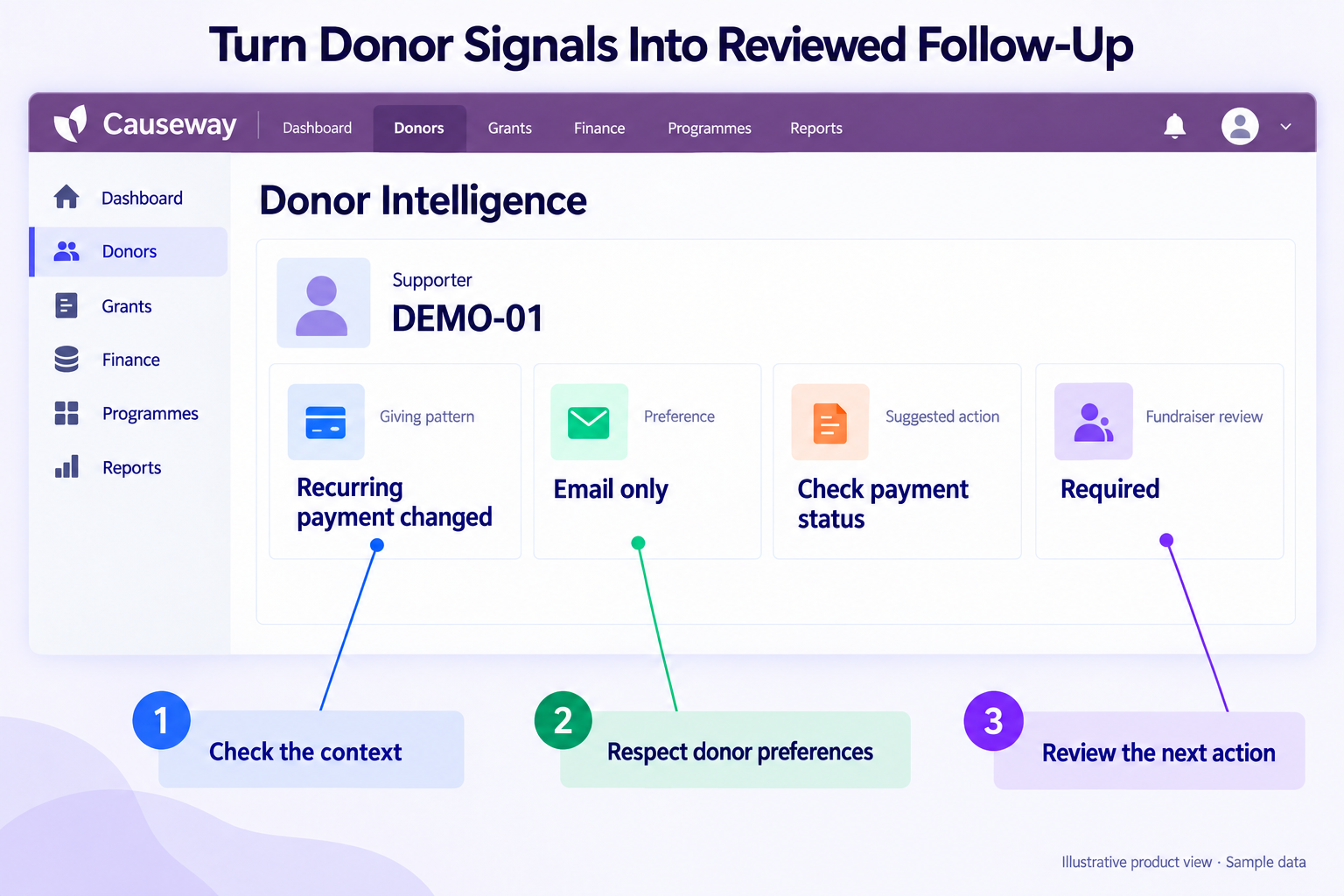
The fundraiser decides whether to contact each person. A failed collection may call for payment assistance rather than a renewal appeal.
Three patterns, three different actions
In a worked dataset, supporter D-01 normally gives $50 monthly but has one failed collection; D-02 gave $200 each quarter and has no gift in the current quarter; D-03 increased from $25 to $40 after an approved campaign. Those patterns deserve different responses.
| Supporter | Evidence To Read Together | Suitable Review Queue |
|---|---|---|
| D-01 | Payment failure code, recurring mandate and communication preference | Payment assistance |
| D-02 | Collected gifts, pledge schedule, relationship notes and campaign calendar | Relationship review |
| D-03 | Settled gift and campaign designation | Acknowledgement under the agreed preference |
Causeway Donor Intelligence includes lapse alerts and next-action suggestions. Each suggestion needs its reason and source records; the fundraiser chooses the action.
The response should distinguish what changed from why it changed. A gap in collected gifts is observable; a claim that a donor is dissatisfied requires evidence beyond that gap. If the payment provider reports an expired card, the team can resolve a collection problem without misclassifying the relationship.
What a donor review pack contains
For each recommendation, retain the supporter reference, comparison periods, collected-gift totals, refund treatment, reason, source records, permitted channel, owner and disposition. A reviewer should be able to reach the original gift or payment record without exporting unrelated personal details.
Suppose 40 suggested follow-ups enter a pilot and reviewers accept 30 as useful, reject six as stale payment-status issues and close four because contact is suppressed. The useful-suggestion rate is 30/40 = 75% for that reviewed set. This is a worked evaluation example, not a Causeway customer result. The reasons for the other ten cases tell the team what to improve.
Record the eventual action separately from the model suggestion. Accepted advice may still lead to no contact after the relationship owner adds context. Preserve that decision rather than counting every accepted suggestion as a campaign conversion.
Message drafting uses approved relationship context
Drafting help can turn approved campaign facts into a proposed message. The reviewer still checks the factual claims, tone, designation and intended recipient. Use approved programme information rather than asking a model to invent impact stories for individual donors.
For major-donor research, record the origin and permitted use of each input. Do not infer health, religion or other sensitive characteristics from names, addresses or affiliations. NGO privacy governance applies to profiling and communications as well as the CRM database.
For example, a draft can refer to a reconciled campaign total and a published programme update. The reviewer checks both source versions and removes any claim that the donor's gift caused an outcome that has not been attributed. The approved draft should retain those references so a later correction can reach the right relationship owner.
Useful recommendations need a defined evaluation
Define what a useful recommendation means before the pilot. Measure how many reviewed suggestions were appropriate, how many needed correction and how often a preference or suppression rule was violated. Assess errors across relevant operational groups, including countries and communication channels, without creating unnecessary sensitive profiles.
Where a campaign experiment is appropriate, define eligible groups, assignment method, period and outcome before comparing results. Separate collected gifts from pledges and gross gifts from refunds. A change in campaign timing or audience can otherwise be mistaken for an AI effect.
Use the AI governance framework for ERP to assign monitoring and override responsibility. Keep the review burden in the performance measure; a larger list of suggestions is not automatically more useful.
Connect stewardship to approved evidence
Fundraisers need accurate updates about what the programme did. Use reconciled donor reporting to provide approved figures and explanations, while keeping individual relationship notes out of institutional reports unless needed. This prevents a useful fundraising tool from becoming an uncontrolled reporting source.
A practical stewardship task starts with an approved programme update, its reporting period and the donors permitted to receive it. The relationship owner selects the relevant award or campaign and checks whether the update supports the proposed message. A programme-wide output should not be attributed to one donor unless the approved evidence supports that attribution.
After review, record the message version, selected channel, approval and send outcome. If the underlying programme figure changes before release, return the draft for review. If a donor opts out, close the communication task even when the AI suggestion remains relevant. Measure completed, appropriate follow-ups separately from suggested tasks; neither count alone establishes an increase in donations.
Conclusion
A useful donor recommendation gives the fundraiser a reason, supporting records and an appropriate next action. Distinguish a payment failure from a relationship change, and keep communication preferences in the decision. Evaluate the reviewed suggestions and resulting actions separately from donation growth. If the queue produces more corrections than useful follow-ups, improve the inputs and rules before expanding it; a longer contact list is not evidence of better donor intelligence.
Evaluate Causeway donor intelligence
Evaluate Causeway AI with a changed giving pattern, a failed recurring payment and a communication preference. The review should follow the source records into a reasoned next-action queue and the fundraiser's decision. Bring your relationship definitions and campaign measures so useful recommendations, corrections and resulting actions can be assessed consistently without assuming an unmeasured fundraising uplift.