

AI for NGO finance helps staff code transactions, match suppliers and purchase records, identify exceptions and prepare approval decisions using the ERP's operational context. Its useful output is a proposed action with supporting records: which account and grant apply, whether the amount matches the order and receipt, what restriction is unresolved and who must decide.
Causeway AI operates across finance, grants and procurement records. Document extraction is a separate upstream layer. Finance intelligence begins when structured information can be checked against approved supplier records, budgets, accounting dimensions and authority.
From structured information to a finance decision
For broader context, see AI for finance. NGO finance adds grant eligibility, restricted funds, programme coding and donor-funded procurement to the coding, matching and exception workflow.
Where invoices, receipts or grant documents first need to become structured data, SDLC Corp's DAN document intelligence platform can perform extraction, confidence scoring and human review before validated data enters Causeway.
Causeway applies supplier records, grant restrictions, programme context, budgets, accounting dimensions and approval rules to that structured information. The boundary matters because a correctly read invoice can still refer to an unapproved supplier, an ineligible cost or goods that have not arrived.
The working sequence is validated input → supplier match → accounting and grant coding → order and receipt match → budget and restriction checks → exception review → authorised approval → posting and reconciliation. Each step adds a different kind of evidence.
A purchase with a partial receipt
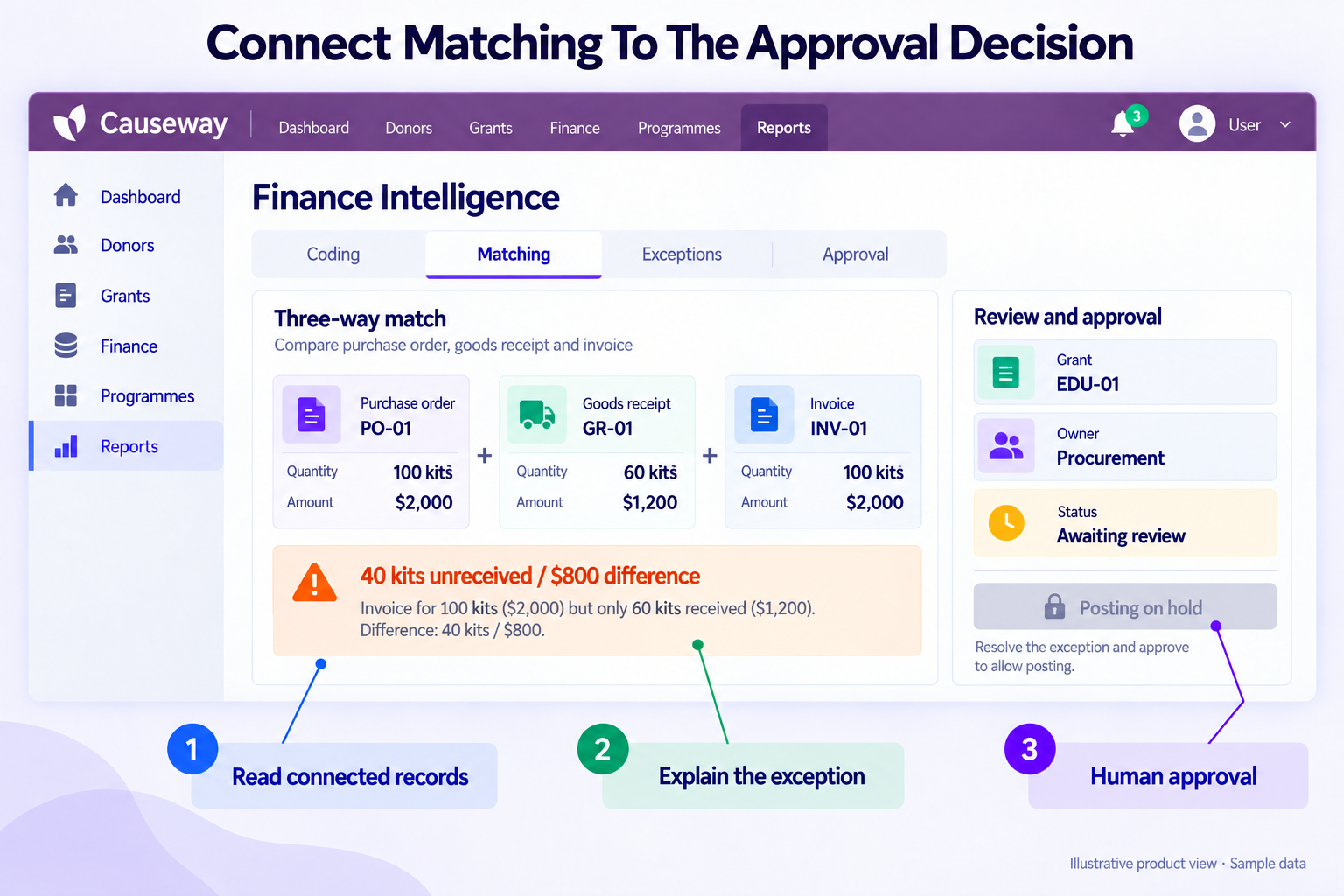
Consider a worked scenario for award EDU-01. The NGO orders 100 learning kits at $20 each. The approved purchase order is $2,000; a receipt confirms 60 kits; the supplier submits a $2,000 invoice for all 100. These numbers explain the workflow and are not implementation performance metrics.
| Record | Relevant Value | Finance Meaning |
|---|---|---|
| Approved order PO-01 | 100 kits, $2,000 | Authorised commitment |
| Receipt GR-01 | 60 kits, $1,200 | Accepted quantity at the agreed unit price |
| Invoice INV-01 | 100 kits, $2,000 | Supplier's requested charge |
| Difference | 40 kits, $800 | Unreceived quantity requiring resolution |
| Award context | EDU-01, current eligibility period | Funding conditions to check before posting |
A useful AI response identifies the quantity difference, links PO-01 and GR-01 and routes it to the procurement or receiving owner. It does not infer that the missing goods arrived because the supplier billed them.
The reviewer may obtain a corrected invoice, accept a documented delivery update or use another authorised procedure. The record keeps the discrepancy and its resolution. The procurement control workflow supplies the authority for that decision.
Coding requires both accounts and funding dimensions
The proposed accounting record needs more than a likely expense category. A materials expense can belong to one legal entity, programme, activity, grant and restricted fund. Supplier history is a useful signal, but last month's coding may belong to another award.
| Proposed Field | Evidence | Review Outcome |
|---|---|---|
| Expense account | Item purpose and approved chart | Finance accepts or corrects account |
| Entity | Contracting party and receiving operation | Post to the responsible books |
| Grant and fund | Approved request and award conditions | Retain eligible funding source |
| Programme and activity | Requesting team's delivery record | Link cost to the actual activity |
| Allocation | Approved shared-cost basis | Split totals reconcile to the invoice |
For a $1,000 service shared 60/40 between two grants, the proposed allocations are $600 and $400. Both grants still need an eligible purpose and available authority. A model should not allocate the whole cost to whichever award has the largest unused balance.
Corrections become part of the decision record: proposed coding, accepted coding, reviewer and reason. They are also useful for evaluation, provided the review set distinguishes a model error from a changed business rule.
Available budget includes open commitments
A budget check needs the approved budget version, posted expenditure and remaining commitments. With a $10,000 budget, $6,000 actual expenditure and $2,000 open commitments, available budget is $2,000 under this simple control model.
If a $500 invoice consumes an existing purchase commitment, actual expenditure becomes $6,500 and the remaining commitment becomes $1,500. Available budget stays $2,000. Counting the invoice while leaving the full commitment open would understate availability.
A new $3,000 request exceeds the available amount by $1,000. The response should identify the affected line and current version, then follow the approval or rejection rule. The restricted-fund control design also checks eligibility, dates and donor conditions: available money alone does not make the purchase permitted.
An exception queue should explain the next action
Anomaly detection becomes useful when the owner understands what caused the flag. A repeated amount alone may be a valid monthly service charge. The relevant context includes supplier identity, invoice reference, date, order, payment status and earlier reviewer decisions.
| Exception | Supporting Records | Responsible Next Action |
|---|---|---|
| Possible duplicate | Supplier, reference, amount and earlier invoice | Finance checks whether it is a duplicate or separate charge |
| Supplier mismatch | Approved vendor and invoice supplier | Procurement resolves identity before payee use |
| Unreceived quantity | Order, receipt and invoice lines | Receiving owner confirms delivery or disputed quantity |
| Ineligible grant cost | Award condition and proposed coding | Grant owner supplies valid authority or rejects allocation |
| Budget exceeded | Versioned budget, actuals and commitments | Budget owner follows the authorised exception process |
Keep the original flag after resolution, together with the decision and date. That makes it possible to distinguish a useful exception from a repeated false alarm.
Approval and posting remain accountable actions
The AI output can assemble a review pack containing proposed coding, matching results, exceptions and linked sources. Approval belongs to the authorised finance or grant owner. AI does not independently approve fiduciary decisions.
Separate approved, rejected, awaiting clarification and posted states. A corrected invoice may require a new review if it changes the amount, payee or funding allocation. It should not silently inherit the approval attached to a different transaction.
If a posting request times out, the integration checks the stable transaction reference before retrying. One approved invoice must not create two ledger entries because an acknowledgement was lost. This belongs in the integration recovery contract.
Measure decision quality at the accepted record
A finance pilot should measure whether the resulting record is correct and whether staff can explain the decision. Build a reviewed set of transactions covering partial receipts, shared costs, amendments, duplicates and missing references.
Useful measures include accepted coding accuracy, exceptions resolved correctly, false-positive rate, reviewer minutes per accepted record and duplicate postings. Preserve the numerator, denominator, evaluation period, transaction categories and review method. Report high-risk errors separately rather than hiding them in a single average.
For example, if a pilot flags 20 records and reviewers confirm 15 genuine exceptions, precision on those reviewed flags is 15/20 = 75%. This worked calculation says nothing about exceptions the system missed; measuring recall also requires the true exceptions in the unflagged set.
Re-run the same scenarios after relevant configuration or model changes. Use the Causeway AI workflow framework to keep permissions, evidence and user action part of the acceptance result.
Conclusion
AI finance assistance is valuable when it turns transaction context into a reviewable coding, matching or exception decision. Judge it by the accepted record and the clarity of the evidence. Keep document ingestion upstream, preserve grant and procurement controls, and retain human authority over approval and posting.
See Causeway AI in a finance workflow
Explore Causeway AI with a grant-funded purchase, a partial receipt and an invoice exception. AI capabilities are included, and the demonstration should follow the transaction from proposed coding to the authorised decision and reconciled record. Bring your chart of accounts, award conditions and approval policy so the workflow can be evaluated against the way your NGO actually operates.