
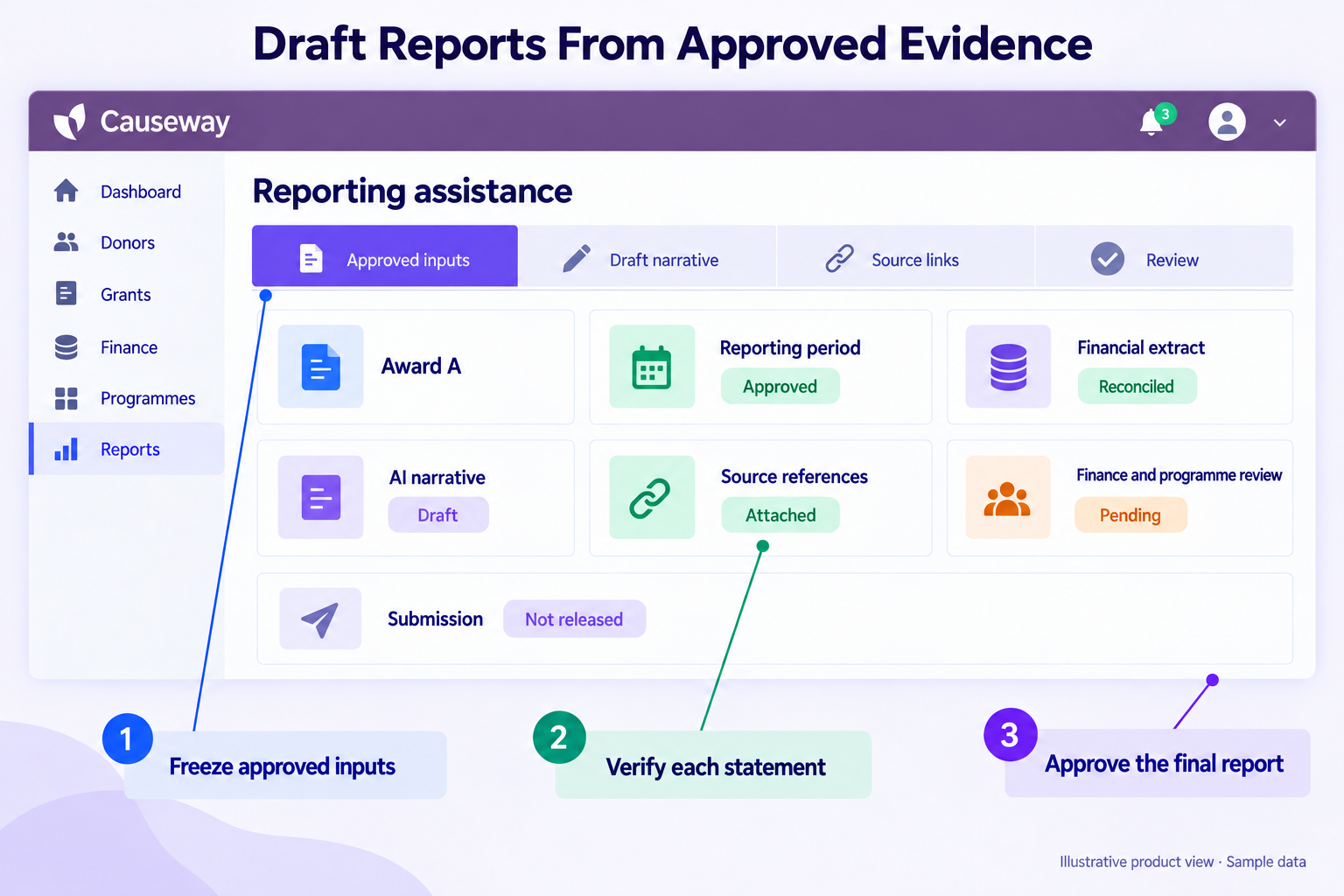
AI can assist grant and programme reporting by turning approved records into a draft explanation with traceable sources. It must not create missing outcomes, explain variances without evidence or replace the people responsible for approving the report. The starting point is a reconciled reporting pack, not a blank prompt.
Keep financial figures, programme indicators and narrative evidence connected by the award, period and approved version. A well-written paragraph can still be wrong if it combines different periods or treats participation counts as unique beneficiaries.
The reporting period needs an approved input version
Before drafting, prepare the approved budget version, expenditure extract, outstanding commitments, indicator definitions and relevant delivery evidence. Record the reporting currency, rate policy and cut-off date. The donor reporting workflow establishes these inputs and their reviewers.
Separate an approved record from a pending partner submission. If an input is missing, the draft should expose the gap for review rather than infer a plausible value. Changes after the cut-off should trigger an explicit revision, with the affected figures and statements identified.
Every material statement needs a supporting record
| Step | Record To Preserve | Review Question |
|---|---|---|
| Select evidence | Award, period, report and dataset versions | Are these approved for this submission? |
| Retrieve figures | Row or record references with units | Can the amount be reproduced? |
| Draft narrative | Proposed sentence and supporting references | Does each factual claim follow from evidence? |
| Review explanation | Finance and programme comments | Is the stated cause documented? |
| Approve and release | Final version, approver and submission copy | Does the released file match the approval? |
Do not rely on a citation label alone. Open the referenced record and verify that it supports the sentence. A source showing expenditure does not prove an outcome, and a source showing a delay does not establish that the delay caused every variance.
What changes between an unsupported and supported draft?
In this worked writing example, approved records show that training was rescheduled and its related expenditure has not yet been posted. They do not contain an outcome evaluation.
Weak draft: “The programme exceeded expectations and generated lasting improvements despite lower spending.” That statement invents a performance assessment and a lasting outcome.
Supported revision: “Training moved to the next reporting period, according to the approved delivery schedule. The current expenditure extract does not yet include the related costs. The programme team will update the activity and financial reports after delivery and reconciliation.”
The revision separates observed status from future work. It also preserves the distinction between cost, output and outcome explained in monitoring and evaluation.
A grant report with financial and programme evidence
Consider an award with a $100,000 budget, $80,000 posted expenditure, $10,000 open commitments and $10,000 uncommitted capacity. The programme schedule records eight completed sessions against ten planned. These are worked inputs for evaluating a reporting workflow.
The financial position alone does not explain the two-session gap. A linked, approved schedule records that two venues became unavailable and the sessions moved to the next quarter. The draft can explain the documented timing change while retaining the outstanding commitments. It cannot claim improved learning outcomes unless the programme has measured them.
| Proposed Sentence | Source Needed | Reviewer |
|---|---|---|
| Expenditure is $80,000 for the period | Reconciled ledger extract and currency basis | Finance lead |
| Eight of ten sessions were completed | Activity register and completion definition | Programme lead |
| Two sessions moved after venue delays | Approved schedule change | Programme owner |
| $10,000 remains committed | Open purchase commitments at the cut-off | Finance and procurement |
This sentence-to-source map gives the reviewer a small, usable evidence pack. A change to the expenditure extract should flag the related sentence for review; it should not silently update an already approved submission.
Missing partner evidence has a visible state
If one partner has not submitted its expenditure, the reporting workflow distinguishes accepted figures from the missing schedule. A draft can state that the consolidated pack excludes a pending partner submission if that is the approved reporting treatment. It should not fill the gap with last quarter's value or interpret the blank as zero spending.
Assign the missing item to a named owner with a due date and link it to the submission decision. When the schedule arrives, validate the period, grant coding, totals and supporting evidence before generating a new report version. Keep the earlier review history so the final approver can see what changed.
Causeway Grant Intelligence and Programme Intelligence support this connected view of awards, financial records and delivery evidence. The demonstration should show the specific records and review action, rather than only a polished narrative. A useful accepted result is a report whose material statements can be checked and whose outstanding gaps are clear.
A new template must preserve meaning and units
An assistant can help reorganise approved content into a donor's headings. Check that currency, period, aggregation and definitions survive that transformation. A cumulative figure must not become a period figure because the target template uses a different label.
Preserve donor conditions and amendment history from the grant record. If a template asks for a measure the programme does not collect, record the reporting gap and obtain the responsible team's decision. Do not manufacture a value or substitute a superficially similar indicator.
Finance, programme and release reviews have distinct owners
Finance verifies amounts, currency treatment and reconciliation. Programme leads verify delivery explanations and indicator interpretation. The designated approver accepts the complete submission. Sensitive records should remain accessible only to the people authorised to review them.
Use the AI governance workflow to control model access and retain versions. Store the evidence references, generated draft, material edits and final approval under the organisation's retention policy. A corrected draft should not leave an older, unsupported version available as the current report.
Track unsupported-claim frequency, reviewer corrections and time to an approved submission. Define the sample, period and acceptance criteria before claiming a productivity gain. A faster first draft is only useful if the final report is accurate and the overall review effort improves.
Bring financial schedules and programme evidence into the Donor Reporting Pack.
Causeway reports programme reporting moving from quarterly to weekly among its customer implementation outcomes. This is evidence of a reported operating change, not a measured attribution to AI alone. An AI reporting pilot should separately measure drafting effort, corrections and the reviewer’s time against the same approved source records.
Conclusion
Use AI to organise and explain evidence that has already been approved. Require reproducible figures, supported interpretations and named reviewers. The final output should make a donor report easier to verify, with no loss of meaning between the source record and the submitted narrative.
Plan evidence based reporting with Causeway
See how Causeway AI connects grant, finance and programme records for AI-assisted reporting. Use one reporting period, a reconciled financial schedule and a missing partner submission to evaluate the workflow. The useful result is a source-linked draft with visible gaps and distinct finance, programme and release reviews. Agree the acceptance criteria around the final approved report and the effort required to produce it.