
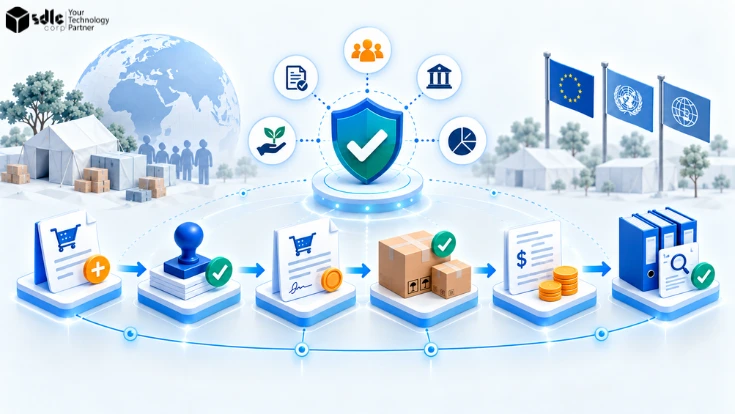
NGO procurement controls should make it possible to buy what a programme needs while preserving evidence of eligibility, authority and delivery. A policy that checks only the invoice arrives too late: the organisation may already have committed funds or accepted unsuitable terms.
Design the workflow from purchase request through receipt, invoice and allocation. Include the situations that disrupt a clean sequence, such as urgent purchases, partial deliveries and changes to an approved order. Effective controls explain what should happen in those situations and who may authorise an exception.
Funding eligibility comes before the purchase
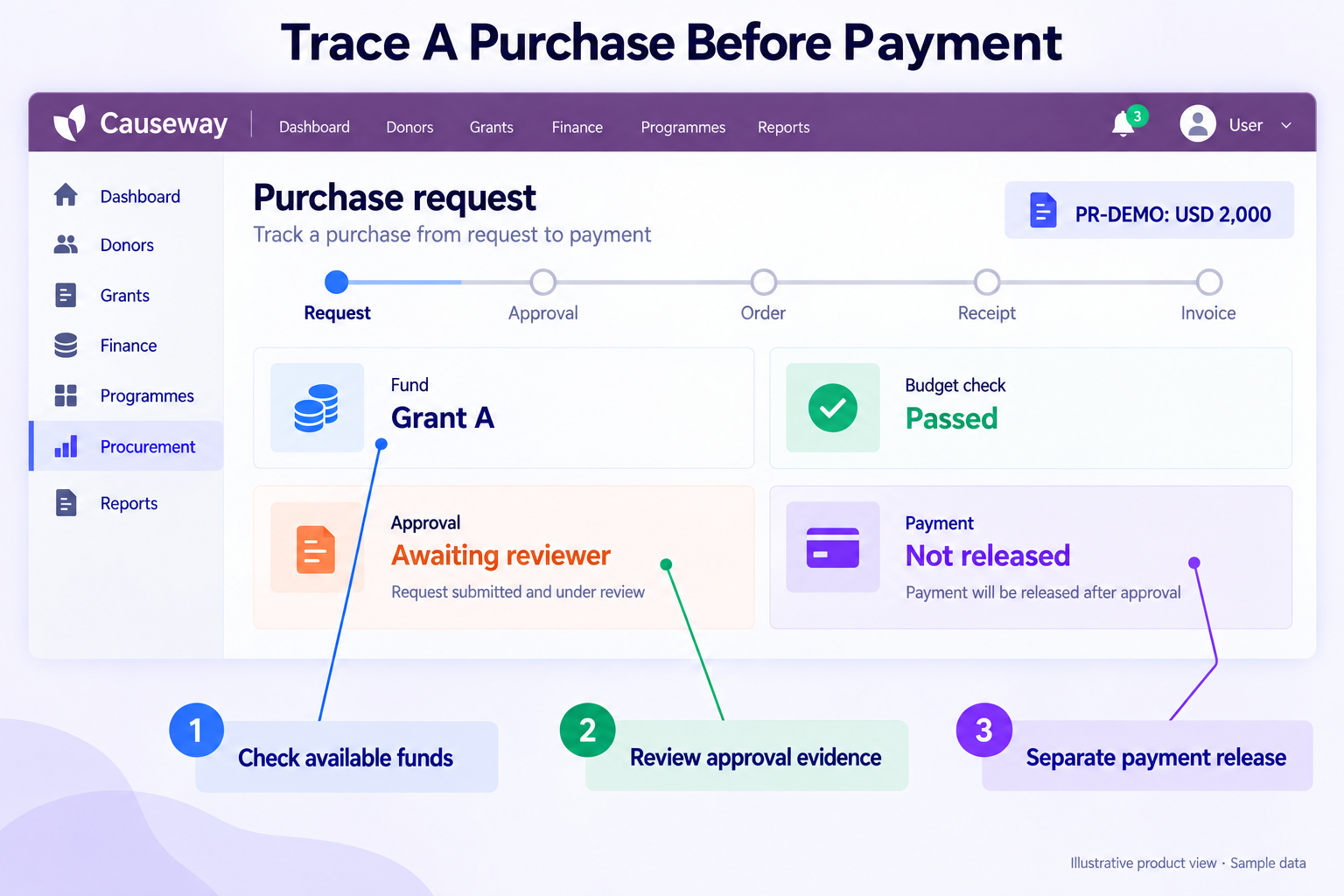
A purchase request should identify the need, estimated value, project or award, required date and relevant budget line. The reviewer needs to see whether the cost is permitted and whether sufficient spending capacity remains after existing obligations.
The restricted-fund budget design should distinguish posted expenditure from outstanding commitments. An approved order may reserve budget before an invoice exists. A later invoice must reduce the remaining commitment so the same purchase is not counted twice.
Record applicable donor conditions alongside internal procurement policy. Requirements for sourcing, eligibility or evidence may differ by award. Include these distinctions in the ERP requirements checklist rather than relying on buyers to remember exceptions from several agreements.
Requests and approvals need distinct authority
Different decisions need different evidence. The requester explains the operational need. The approver checks authority and budget. The purchasing role confirms supplier selection and commercial terms. The person recording receipt establishes what arrived and whether it was acceptable.
Smaller teams may combine some roles, but the combination should be an explicit risk decision with suitable review. A policy that demands separation while the system grants one user every role creates a false impression of control.
Access and audit requirements should cover delegated authority, temporary cover and role changes. A user's ability to approve should be checked at the time of the decision, not inferred from an old email or an approval list that is no longer maintained.
Quotation evidence supports the buying decision
Set sourcing requirements through the organisation's approved policy and relevant award terms. There is no universal rule that every NGO purchase must have three quotations. Different categories, values and circumstances may justify different procedures.
Where competition is required, preserve the comparison and selection rationale. A lower price does not automatically establish better value if specifications, delivery dates or support differ. Record conflicts of interest and the steps taken to manage them under the applicable policy.
Urgent purchasing needs a defined route. Capture the reason, authority, limits and follow-up review. “Emergency” should not become a reusable label that removes all checks. Track repeated exceptions so governance teams can distinguish unusual events from a process that routinely fails to meet operational needs.
The invoice must match accepted goods and funding
Consider an example order for 100 training kits. The supplier delivers 60 and invoices for those 60. The record should show the accepted quantity, invoice and 40 kits still outstanding. Closing the entire order would hide the remaining obligation; retaining the full original commitment after invoicing would overstate it.
| Situation | Useful Control |
|---|---|
| Partial delivery | Retain outstanding quantity and value |
| Invoice exceeds agreed price | Hold or route the difference for review |
| Goods rejected | Record rejection and supplier resolution |
| Cost split across awards | Preserve allocation basis and eligibility checks |
The operational match may involve an order, receipt and invoice, but the exact control should suit the purchase. Services can require milestone acceptance rather than a physical goods receipt. Define who can confirm completion and what evidence they must retain.
Resolve funding conflicts before releasing a purchase
A purchase shared between two awards may face different competition thresholds, eligible dates or supplier conditions. Record which rules apply to each allocation and obtain an authorised resolution before commitment. Choosing the most convenient rule or silently splitting an order can conceal the original conflict. Where conditions cannot be reconciled, change the funding allocation or seek an approved exception.
Supplier due diligence should match the purchase risk and applicable requirements. Retain identity and ownership checks where required, conflict-of-interest declarations, bank-detail verification and the decision to approve the supplier. A bank-detail change needs independent confirmation through a trusted route, rather than relying only on the message requesting the change.
Receipt confirms delivery; invoice approval confirms a payable; payment release authorises money movement. Preserve these boundaries even if one application displays all three. Overseas suppliers also require settlement and cross-border payment checks. Materials entering a store should create a linked inventory receipt and custody record, not disappear from control once the invoice is paid.
A threshold conflict and approval record
Assume an internal policy requires quotations above USD 5,000, while the award requires competition above USD 2,000. A USD 3,000 purchase charged wholly to that award follows the donor competition requirement as well as internal approval rules. These are example policy settings, not statutory thresholds. If the requirements contradict one another, pause commitment and obtain a documented resolution; selecting a lower threshold does not resolve every kind of conflict.
| Role | Action In The USD 3,000 Purchase | Evidence |
|---|---|---|
| Requester | Specifies 100 kits and award coding | Request PR-01 |
| Procurement | Records competition and supplier checks | Quote comparison QC-01 |
| Budget holder | Confirms eligibility and available budget | Approval under policy version 2 |
| Receiver | Accepts 60 kits; records 40 outstanding | Receipt GR-01 |
| Finance reviewer | Matches invoice for 60 kits | Invoice match and remaining commitment |
| Payment authoriser | Releases the approved payable | Bank instruction and later reconciliation |
Record role conflicts and an independent compensating review if the team cannot separate every function. A changed quantity or supplier returns to the authority required by the policy rather than inheriting the original approval automatically.
Keep an evidence trail through changes
An approved request can change before delivery. Revised quantities, supplier substitutions and increased prices may require fresh approval. Preserve the original decision and show what changed rather than replacing the approved record without explanation.
Auditability depends on the relationship between records: request, sourcing evidence, approval, order, receipt, invoice and payment. Each should be retrievable through stable references. Reviewers should not need to infer that two documents relate because their filenames look similar.
Use these exceptions in a live ERP demonstration. Ask the supplier to change an approved order, record a partial receipt and reject an invoice variance. Examine who is allowed to act and what the audit trail records after each step.
Where invoices arrive as scans, AI finance coding, matching and approvals can prepare proposed fields while preserving matching and approval controls.
Record who can request, review and approve each transaction in the Approval Matrix Builder.
Compare donor conditions with internal buying rules in the Procurement Threshold Builder. A lower competition threshold can apply without resolving every policy conflict.
Identify incompatible duties and compensating reviews with the Segregation-of-Duties Matrix.
Where purchases create stock or equipment, carry the receipt reference into inventory movements and asset custody so payment approval does not become the end of the record trail.
Conclusion
Procurement control begins before the organisation commits to a purchase. Connect eligibility, authority, supplier selection and delivery evidence, then preserve the trail when circumstances change. Testing partial deliveries and exceptions reveals more about the workflow than reviewing a sequence in which every purchase proceeds perfectly.
Evaluate your procurement controls
Evaluate your purchasing and approval workflows against Causeway. Bring your procurement policy, relevant donor conditions and examples of urgent purchases or partial deliveries.
Ask how the proposed scope would represent delegated authority, budget checks, sourcing evidence and invoice exceptions. Request a demonstration using those situations and identify any supplier, payment or inventory integrations required. The goal is a workable control design that fits your organisation's purchasing responsibilities.
Frequently asked questions
How should emergency purchases be approved?
Use a defined emergency route with named authority, spending limits and evidence requirements. Record why the normal route could not be followed and when follow-up review is due. Repeated emergencies should prompt investigation of the underlying planning or approval problem.
When does a purchase reduce available budget?
The budget-control policy should specify the commitment event, often an approved order or another authorised obligation. When the commitment becomes expenditure, reduce the outstanding portion accordingly. Show both components so users understand the available-balance calculation.




