NGO ERP compliance design combines a common control baseline with versioned country and donor rules. Shared identifiers and approval evidence support consistency. Applicability rules, local reporting mappings and authorised exceptions preserve the differences each entity needs.
A practical design separates the common operating core from governed local rules. The core contains shared identities, definitions and control principles. Country and donor configurations express justified differences, with clear ownership, versioning and tests. Ask each supplier to demonstrate the required local rules and identify gaps before selecting a product.
A global baseline supports local applicability
Agree a common set of controls for the organisation. Approvals must be traceable, access controlled and transaction references stable. Changes need review, and earlier reports must remain reproducible. Define their intended outcomes before prescribing identical screens or approval chains.
The global compliance framework begins with applicability. A shared control may support several obligations, but those obligations retain their own source and scope. Keep the relationship visible so a global policy change does not unintentionally remove a locally necessary control.
Document common data definitions such as award, entity, project, participant and reporting period. Shared definitions support comparison even when local workflows differ. If countries use the same label for different events, central reporting needs an explicit mapping rather than a cosmetic translation.
Configuration implements a reviewed local requirement
Configuration implements an approved decision; it does not determine what the law requires. Identify the local requirement, affected activity and responsible adviser before choosing a setting or development approach.
For example, UK charity reporting, US nonprofit reporting and German recordkeeping controls begin from different applicability questions. A shared finance module should not be presented as proof that all three sets of responsibilities are satisfied.
| Layer | Example | Change Authority |
|---|---|---|
| Global control | Approved access and audit trail | Organisation governance owner |
| Country configuration | Local reporting mapping | Local owner with relevant specialist review |
| Donor rule | Award eligibility or reporting condition | Authority defined by the agreement |
| User preference | Display language or saved view | Delegated user or administrator |
Separating these layers prevents a convenience setting from being confused with a mandatory control. It also helps estimate which changes need testing across the whole organisation.
Rules need effective dates
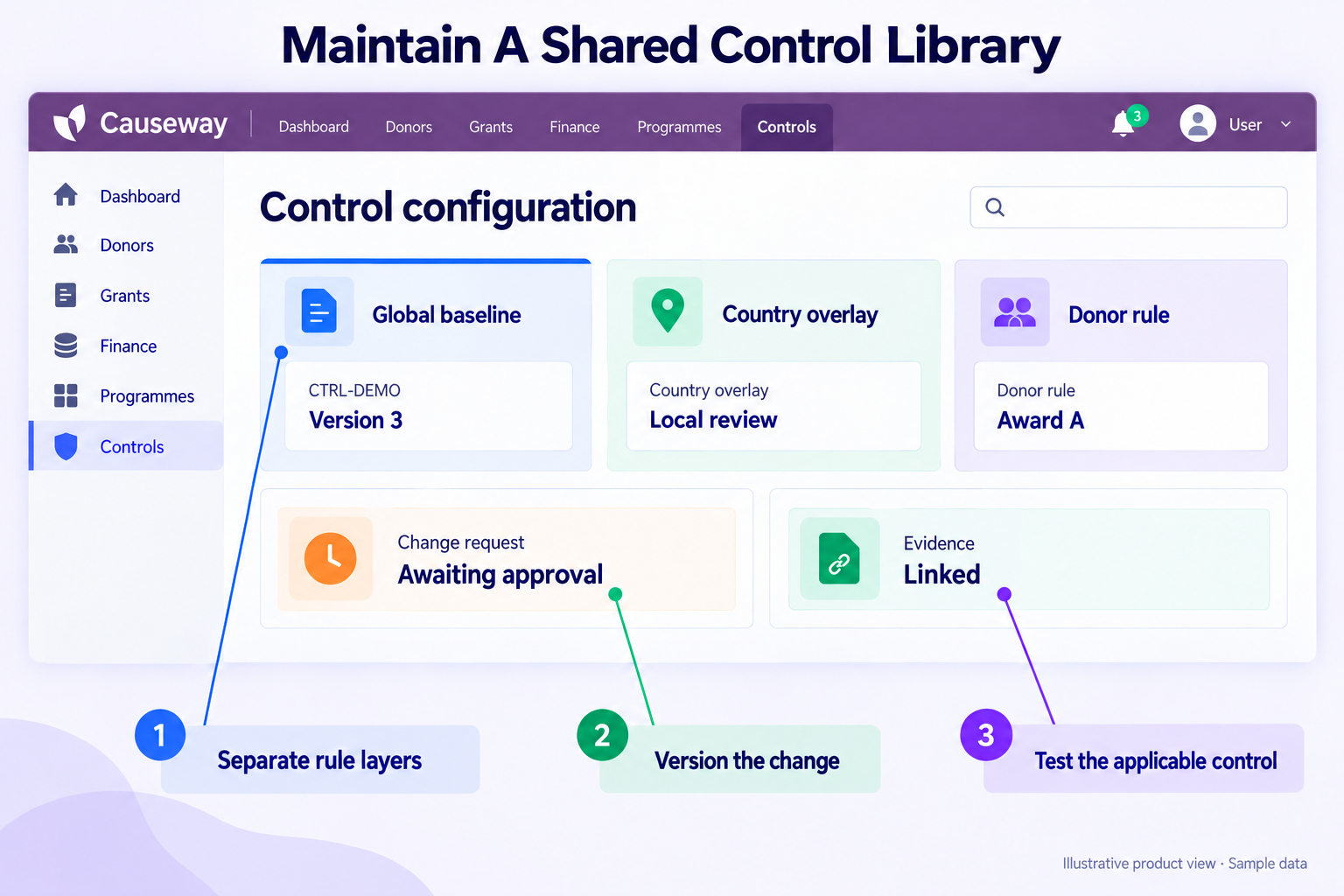
Keep the control ID stable when its configuration changes. In this design example, CTRL-07 blocks release when required partner evidence is missing. Its applicability points to entity E-02 and award G-24; version 2 takes effect at the next award period. Record which version the workflow evaluated. Keep its result and any authorised exception with the transaction. The evidence record retains the reviewer, source references and decision time.
| Stored Field | Design Example | Why It Is Separate |
|---|---|---|
| Control ID and version | CTRL-07 / v2 | Identifies the rule that ran |
| Applicability | E-02 / G-24 / reporting period | Determines which transactions use it |
| Effective boundary | Start of next award period | Prevents retroactive rewriting |
| Workflow outcome | Hold, release or authorised exception | Explains the operational result |
| Evidence reference | Review record and source documents | Supports later reproduction |
| Superseded version | CTRL-07 / v1 retained | Preserves prior-period decisions |
The register should show the source rule and where it applies. Add its effective date, configuration reference and review owner. Preserve earlier versions where historical transactions or reports depend on them. A current setting alone cannot explain how a prior-year report was produced.
Donor rules need separate applicability
Suppose a donor changes the permitted reporting categories for a new award period. Create a new mapping with an effective boundary rather than recoding the earlier submitted report. Check pending transactions and downstream reports for the consequences of the change.
Give unknowns a visible state. An unresolved local interpretation should not become an undocumented default simply because implementation needs to proceed. Define the interim restriction or escalation and the person responsible for obtaining a decision.
Test applicability with a small matrix
| Control | Entity A, UK Charity | Entity B, Indian NGO | Independent Partner |
|---|---|---|---|
| Global access review | Apply approved role policy | Apply approved role policy | Apply to accounts granted in the NGO system |
| Local charity return mapping | Assess UK regulator and period | Not the UK entity's filing route | Assess its own legal status |
| Foreign-contribution reporting | Assess relevant local obligations | Assess FCRA status, funding and period | Do not inherit Entity B's status |
| Award evidence before release | Apply if the agreement requires it | Apply if the agreement requires it | Submit the specified expenditure evidence |
For India, the global compliance register provides a source-led starting point for FCRA, donation reporting and data-protection applicability. The matrix is a design example; an empty product feature cell must not be interpreted as verified local support.
Change CHG-07 updates the example donor reporting mapping from version 1 to 2 for the next award period. The owner records the source amendment, effective date and affected entities. Run three checks. The new-period report must use version 2. The earlier submission must still reproduce version 1, and unrelated entities must remain unchanged.
Exceptions need their own authority and evidence
Require a reason and impact assessment for departures from the common design. The assessment should identify affected users, interfaces, reports and controls. Some exceptions are necessary; others expose a process that could be improved without additional customisation.
Record whether a difference is configuration, an external-system dependency or custom development. Each has a different maintenance burden. A local script maintained by one consultant should not be described as a standard global capability.
Use controlled release and rollback procedures appropriate to the change. Test that a new country rule does not alter another country's approvals or reports. Preserve evidence of who approved the change and what results were observed before deployment.
Test local and consolidated reporting
The multi-entity reporting design needs both local accuracy and a coherent group view. Test mappings, currency roles, period boundaries and adjustments with a dataset that includes real differences between units.
For each local output, identify the source records and review authority. For the group output, explain how local classifications map into the common structure. An unmapped category should produce a visible exception, not be dropped or assigned to an unexplained miscellaneous total.
Test a historical report after a configuration update. If the organisation cannot reproduce the earlier submission, the versioning design needs attention. Include this requirement in acceptance rather than discovering it during a later audit or donor query.
Maintain a versioned control library
Give each control a stable identifier, obligation source, applicability rule, owner, configuration reference and evidence definition. Keep country and donor overrides as linked records. Copying a full checklist for every office makes it difficult to identify which version is authoritative when a shared requirement changes.
| Library Field | Example Design Decision |
|---|---|
| Control identity | FIN-REL-04 remains stable across country deployments |
| Applicability | Applies to partner advances under specified agreements |
| Required action | Review expenditure evidence before the next release |
| Local parameter | Country team approves a threshold under delegated authority |
| Evidence | Review record, exception decision and released payment reference |
| Change history | Effective date, approver, affected entities and retest result |
FIN-REL-04 is an example internal identifier. Keep the NGO's identifiers separate from legal references and certification-control numbers. Link obligations to their actual source, such as the GDPR principles where applicable, and preserve the adviser-approved interpretation.
Test changes against existing records
Suppose an award amendment changes the threshold for approval. Decide whether the new threshold applies to pending requests, new requests only or a defined effective date. Replaying old transactions under today's rule can misrepresent why an earlier approval was valid. Keep the historical decision together with the rule version that governed it.
Regression tests should cover a normal approval, a rejected action, an authorised exception and a previously approved record. Review the results with the control owner before release. The same library can then support audit preparation without implying that configuration alone proves compliance.
Map each obligation to its control, evidence and reviewer in the Global Compliance Controls Matrix. Preserve the effective rule version so a later configuration change does not rewrite an earlier decision.
Conclusion
Keep the shared control stable while making local applicability explicit. Each entity and award should point to the right rule version, effective period and approved exception route. Before accepting a change, reproduce an earlier report and test a current transaction in both an affected and an unaffected entity. That combination shows whether local configuration works without rewriting history or spreading a rule beyond its proper scope.
Design your Causeway control library
Discuss a shared-core approach for Causeway, using local requirements already reviewed by your responsible specialists. Bring examples of country reporting differences and donor rules that affect the same workflow.
Ask the consultation to distinguish reusable configuration, external dependencies and proposed development. Request evidence for versioning, local access boundaries and regression testing. The resulting scope should identify supported needs and unresolved gaps without assuming that global coverage follows from a multi-country product presentation.
Frequently asked questions
Which controls can be shared globally?
Controls such as traceable approval, access governance and stable record references can often share common principles. Their detailed implementation may still vary. Assess applicability and local requirements rather than assuming identical settings are appropriate everywhere.
Who should approve a country-specific change?
The relevant local process owner and any required legal, finance or privacy specialist should validate the need. The global design owner should assess cross-system effects. Record the authority, test evidence and release decision so responsibility remains clear.