

Data residency for global NGOs is the decision about where ERP records and their copies are stored. Cross-border transfer assessment also considers access and disclosure across jurisdictions. A database hosted in one country does not, by itself, settle where backups, support access, analytics or AI processing occur.
Map those locations and activities for each legal entity, data category and deployment model. The result should connect hosting decisions to operational responsibilities and the applicable transfer arrangements, rather than relying on a cloud-region label.
Map every copy and recipient
Begin with collection, then follow storage, use, disclosure, backup and deletion. A useful map for a programme might read: field device → country service → central ERP → authorised report → donor portal. Each arrow requires a purpose and an accountable owner.
Do not assume that the donor report needs identifiable case records. Aggregate reporting can answer a funding question without exporting a beneficiary register. Apply privacy and data-minimisation requirements before deciding which records cross a boundary.
Classify the records before selecting locations. Public programme summaries, donor contact details and sensitive case notes need different handling. Record the fields each recipient needs and whether names or case identifiers can be removed. A report with fewer fields may meet the same purpose with less exposure; retain the approved field list with the interface definition.
A location and recipient register
This sample register specifies questions to resolve for a proposed deployment. Its locations and providers must be completed from the actual architecture and agreements.
| Data Or Copy | Location Evidence | Recipient And Access | Review Needed |
|---|---|---|---|
| Beneficiary case records | Production region and backup regions | Named controller and hosting processor | Purpose, sensitive fields, access and applicable transfer rules |
| Donor communication history | CRM and email-service locations | Fundraising team and communication provider | Preferences, permitted use and retention |
| Payroll export | ERP export destination | Payroll provider and authorised staff | Minimum fields and secure exchange |
| Support ticket attachment | Support service storage | Support personnel and subprocessors | Redaction, access countries and deletion |
| AI prompt and response | Inference service and logs | Model service and application operator | Retention, onward use and permission controls |
Keep region names, legal entities and support locations separate. A supplier's headquarters does not establish the storage region, and a production region does not establish where every subprocessor operates.
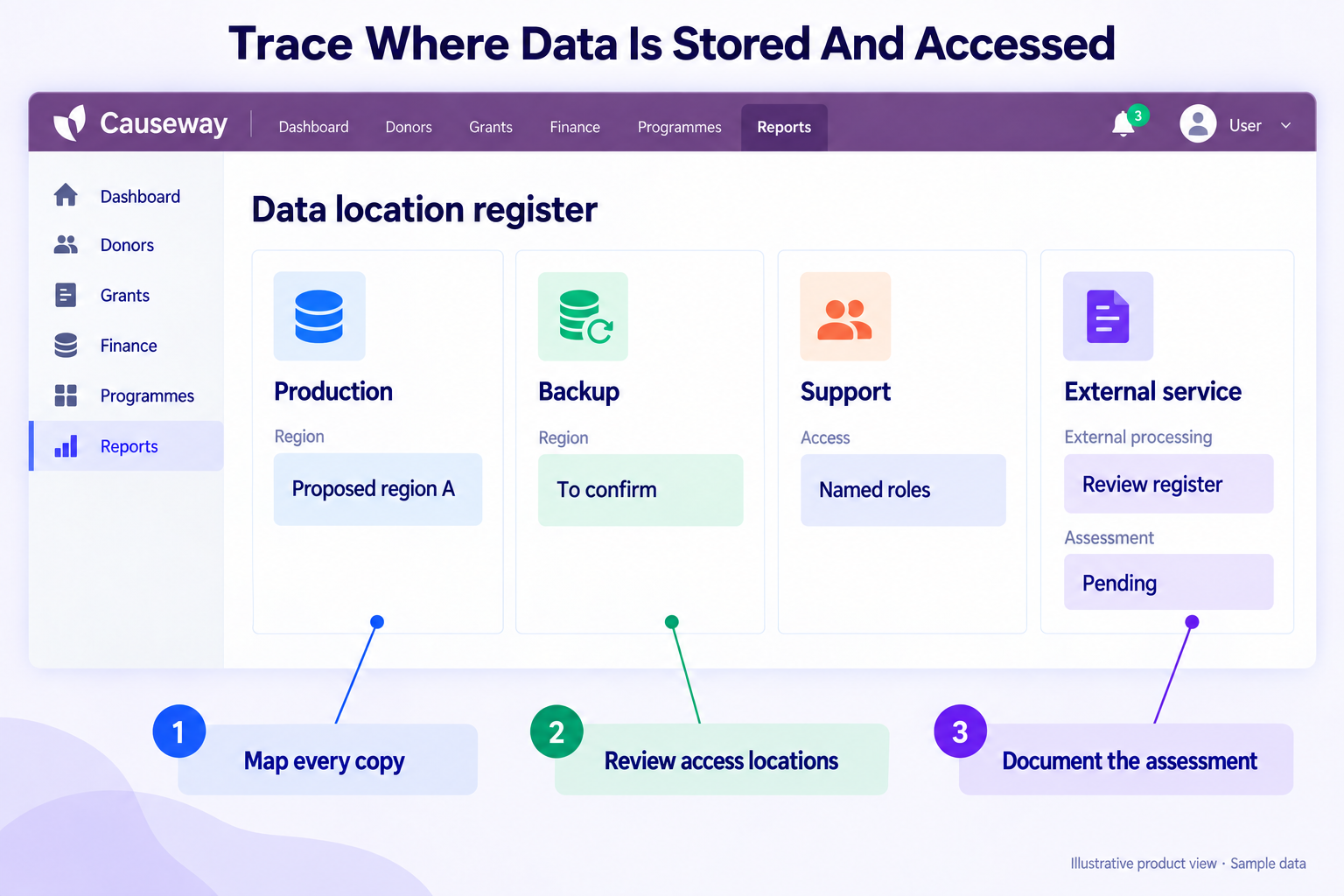
Remote access can change the transfer assessment
For EU personal-data transfers, the European Commission describes routes including adequacy decisions and appropriate safeguards. Its international transfer guidance provides the starting framework. Determine which route applies to the actual parties and processing before configuring access.
The Commission's standard contractual clauses are one relevant mechanism, not a substitute for assessing the arrangement. Keep the selected contractual terms and assessment with the processor record. Do not automatically apply the EU answer to UK or other-country transfers.
In a programme-support scenario, an administrator outside the storage region may request access to investigate an error. Record the administrator's employing entity, countries of access, permitted records and duration. Review whether this changes the applicable transfer assessment before granting the access.
Match technical controls to the assessment
Use restricted administrative sessions, minimal exports and logged access. Encryption protects different risks depending on where keys are held and who can obtain plaintext. Record that boundary instead of treating encryption as a universal answer to location requirements.
Include permissions for exports, interfaces and search results in security testing. A screen restriction is ineffective if the same user can retrieve the prohibited records through a report or integration.
An acceptance test should follow one permitted export and one denied export through the same route. Check the resulting file, access log and temporary copy, not just the screen message. If a support account expires after two hours, repeat the request after expiry and confirm that cached links or saved sessions do not retain access.
Compare hosting options and evidence
Cloud and self-hosted deployment change operational responsibility, but either can involve external backups, support tools and subprocessors. Ask for a complete location register and change-notification process, then compare them with the proposed architecture.
Use vendor assurance evidence to verify the service boundary. A certificate for one entity or hosting service does not establish every location, processing purpose or transfer arrangement in your deployment.
Before acceptance, resolve the production and backup regions, recipient identities, support countries, transfer basis where applicable, retention periods and exit process. Assign an owner to review changes to providers or locations.
A support request can change the data boundary
Suppose a programme database is hosted in Region A and the support operator works in Country B. The support ticket also accepts attachments and stores them in Region C. Those are three separate locations to assess. A region choice for the production database describes only the first.
A useful support record identifies the problem, minimum diagnostic fields, authorised recipient, access period and deletion route. If a count and error reference are sufficient, the operator does not need a full beneficiary export. The approved support route should remain usable when the issue is urgent, so staff are not pushed into an uncontrolled transfer.
| Review Item | Evidence Required Before Access |
|---|---|
| Purpose and necessity | Defined troubleshooting question and minimum fields |
| Recipient | Legal entity, role and authorised personnel |
| Locations | Storage, support access, onward processing and backup |
| Applicable transfer arrangement | Recorded legal assessment and relevant terms |
| Technical boundary | Approved access, logging and export restrictions |
| End of access | Expiry, deletion or return evidence and owner |
Private cloud and self-hosted arrangements should go through the same map. A dedicated customer environment does not describe every external service, and customer-managed infrastructure still needs a plan for support, monitoring and AI processing.
During acceptance, use a test record to exercise the approved access route and a deliberately unauthorised request to test denial. Check what appears in logs, exports and support attachments. Retain both results with the architecture version. Reassess the route when a recipient or location changes, rather than assuming the original deployment decision covers every later service.
Map each obligation to its control, evidence and reviewer in the Global Compliance Controls Matrix. Keep production, backup and support locations connected to their recipients and approved access routes.
Provider changes and exit need a record trail
When a provider proposes a new subprocessor or location, compare the change with the accepted data map. Record the affected service, data categories, access countries and planned start date. The responsible privacy and service owners assess the new arrangement before the relevant configuration changes. Keep the prior map so an earlier transfer can still be explained.
At exit, list the records to return, their usable format and the reconciliation needed to accept them. Track deletion separately for production, support copies and backups under the agreed retention and deletion terms. A closed account is not deletion evidence. The exit record should identify completed actions, any retained copies, their reason and expiry, and the person responsible for checking the remaining steps.
Conclusion
A residency decision is complete only when the map includes stored copies, recipients and remote access. Match those routes to the applicable assessments and operating controls, then test the permitted and denied paths. Keep provider changes and exit arrangements on the same record trail. The next hosting decision should follow the organisation's approved boundary and support needs, with a named owner for any location or access question that remains unresolved.
Scope your Causeway data locations
Discuss the production, backup, support and integration boundaries for Causeway global NGO ERP. SDLC Corp's cloud consulting service can support an architecture discussion based on your approved location and access requirements.