
Canadian registered charity reporting combines financial information with records of activities and governance. An ERP can help organise those records, but producing a financial report does not complete the annual information return. The organisation still needs to confirm applicability, gather non-financial information and review the submission.
Begin by distinguishing a registered charity from other nonprofit organisations. Then map the applicable return requirements to source records and responsible reviewers. This makes preparation more reliable and prevents a software template from becoming the assumed authority for what the organisation must file.
Registration and fiscal period define the return
A registered charity completes T3010 annually. The deadline is six months after its fiscal-period end, as the Canada Revenue Agency's T3010 page explains. That obligation should not be generalised to every Canadian nonprofit organisation.
Record the charity's legal identity, registration details and fiscal period. Confirm the applicable return version and supporting requirements before building the preparation calendar. Where several entities or operating units exist, identify which records belong to the registered charity's return.
Use the compliance register to preserve the applicability decision, source and owner. Keep donor reports and other obligations as separate entries so their periods and definitions are not confused with the annual charity return.
Financial and activity records have different owners
Create a worksheet linking required information to its source, preparer and reviewer. Finance may own account balances, while programme or governance teams own other answers. Assign those responsibilities early rather than collecting everything after the accounts are ready.
The fund accounting structure should preserve awards, restrictions and allocations under the charity's approved accounting policies. A donor name alone is not enough to explain whether a receipt is restricted or how an expense relates to an activity.
| Record Group | Preparation Control |
|---|---|
| Financial records | Reconcile totals and explain adjustments |
| Activity records | Preserve definitions, dates and supporting evidence |
| Governance information | Obtain confirmation from the responsible owner |
| Award records | Retain conditions, amendments and allocation basis |
| Submitted return | Save the approved version and confirmation |
The CRA's books and records guidance explains that responsibility remains with the charity even when a third party maintains its records. Design access and retrieval arrangements accordingly rather than assuming an accountant or software provider holds the only usable copy.
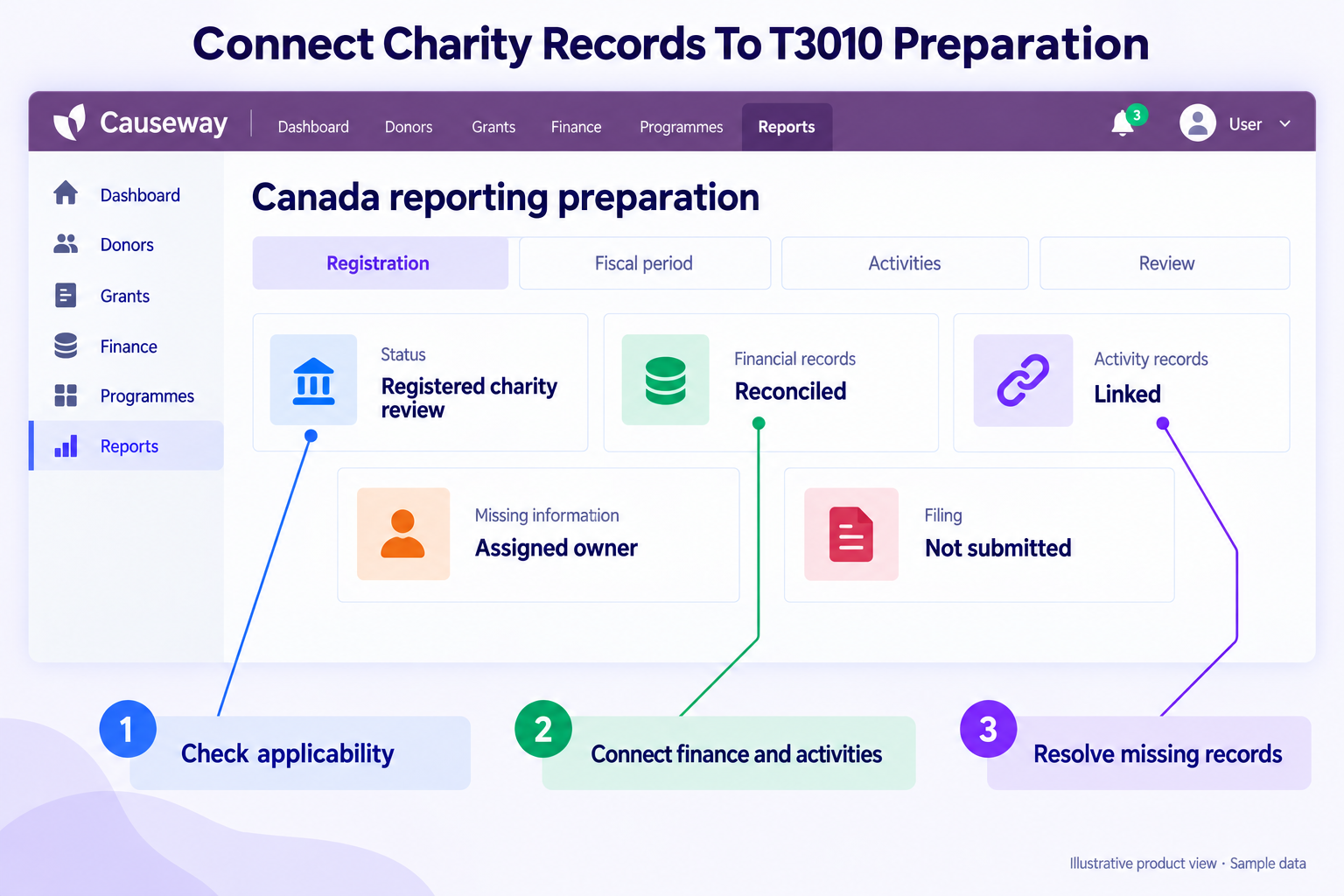
Connect fundraising and programme evidence
Keep relationship information, received funds and programme activity connected through identifiers without treating them as the same event. A fundraising opportunity is not a receipt. Expenditure on an activity does not by itself prove what the activity achieved.
Align periods, currencies and evidence in donor reports and annual activity information. Identify the population, counting method and reviewer for each material statement.
For an example community programme, distinguish 300 service encounters from 180 unique participants. Preserve the rule used to identify a person across visits and protect the underlying personal data. A reporting label should make clear which measure is being presented.
If records come from partner organisations, agree the definitions and review process before incorporating their totals. Missing partner data should remain visible rather than becoming zero or being replaced by an unsupported estimate.
Missing evidence remains an open reporting issue
Reconcile the preparation workpapers to reviewed financial records and investigate unmapped or unusual items. Keep adjustments traceable to their reason and approval. A correction made only in the return spreadsheet should not leave the underlying records unexplained.
The country-rule configuration should retain effective mappings and previous reporting versions. If a classification changes, identify the effect on both current preparation and historical comparison. Preserve the original submitted return separately from later working versions.
Maintain an issues log for missing documents, inconsistent activity counts and unresolved applicability questions. Assign owners and dates. The final reviewer needs a clear view of what remains uncertain, not only a checklist showing that every screen was visited.
Record categories need their own retention decisions
Use a retention schedule by record category, informed by current CRA guidance and other applicable obligations. Do not assume every document has the same retention period or that deleting an ERP record removes copies from exports and connected systems.
Test retrieval before the reporting deadline. Select one reported figure. The team should be able to retrieve its transaction, supporting document, allocation and approval without relying on a former employee's mailbox.
Name the external bookkeeper, hosting provider and implementation partner, then record what each is responsible for. The charity needs a way to retrieve usable records, attachments and history. Agree that route before a service changes or ends. Include that requirement in the system scope and ongoing review.
Reconcile the return to the approved records
Map the approved financial records to the applicable T3010 fields. Explain each adjustment separately. Give programme, governance and fundraising information its own reviewers. The same ledger balance may support several disclosures, so retain the source and calculation rather than relying only on the final exported total.
Record who approved the submitted version and how corrections will be handled. A later accounting change should trigger a review of its reporting effect, not an automatic overwrite of the retained filing evidence.
A source-to-return preparation map
| Record | Workpaper Mapping | Review Evidence |
|---|---|---|
| Reviewed revenue and expense balances | Applicable financial fields for the return version | Reconciliation and explained adjustments |
| Activity register | Required activity descriptions | Programme owner verifies period and meaning |
| Director or trustee register | Relevant governance information | Responsible officer confirms current facts |
| Grants and transfers | Applicable disbursement information | Agreement, recipient and classification review |
At year end, confirm the registration, fiscal period and form version. Reconcile the financial figures and complete the non-financial answers and attachments. Obtain the authorised review, then retain the filing confirmation. A pending activity statement is not resolved by a complete accounts export.
CRA's linked books-and-records guidance also affects the hosting decision. Being able to access records electronically from Canada is not the same as keeping those records in Canada. Include the actual record and backup arrangements in the local review rather than relying on a vendor's headquarters or login location.
Map each obligation to its control, evidence and reviewer in the Global Compliance Controls Matrix. Reconcile the charity's fiscal period and activity records before mapping data into T3010 preparation.
Conclusion
Reconcile the charity's fiscal period and activity records before mapping data into T3010 preparation. Confirm registered charity status and the applicable return version, then assign financial, programme and governance information to its reviewers. Keep the submission and filing confirmation with the supporting workpapers. The practical acceptance test is retrieval: the charity should be able to explain a reported figure and obtain its evidence even if its bookkeeper or hosting service changes.
Map your canadian charity records
Causeway supports configurable finance, reporting, approval and recordkeeping controls within a global NGO operating platform. Evaluate those controls against your reviewed requirements for Canadian registered charity records and T3010 preparation. Bring the registered charity's fiscal period, financial reconciliation and activity register. Follow a reported total back to its source, then check how the team resolves missing activity evidence before approving the return.
Frequently asked questions
Do all canadian nonprofits file T3010?
No. T3010 is the registered charity information return. Other nonprofit organisations may have different obligations. Confirm the organisation's status and applicable requirements with current official guidance and the appropriate adviser before selecting a reporting workflow.
Can a financial export complete the whole return?
No. The return can require information beyond ledger totals. Map the relevant financial, activity and governance items to their owners and evidence. A financial export can support preparation without replacing the complete review and authorisation process.
How should missing activity evidence be resolved?
Record the gap, affected statement and responsible owner. Obtain and review the source evidence or determine the appropriate treatment with the preparer and adviser. Do not silently replace missing information with zero or present an unverified estimate as final.