An NGO ERP can help a charity maintain records and prepare reports, but it does not determine which UK reporting regime applies. England and Wales, Scotland and Northern Ireland have distinct charity regulators and requirements. The starting point is the charity's legal and registration position, not the country selected in a software menu.
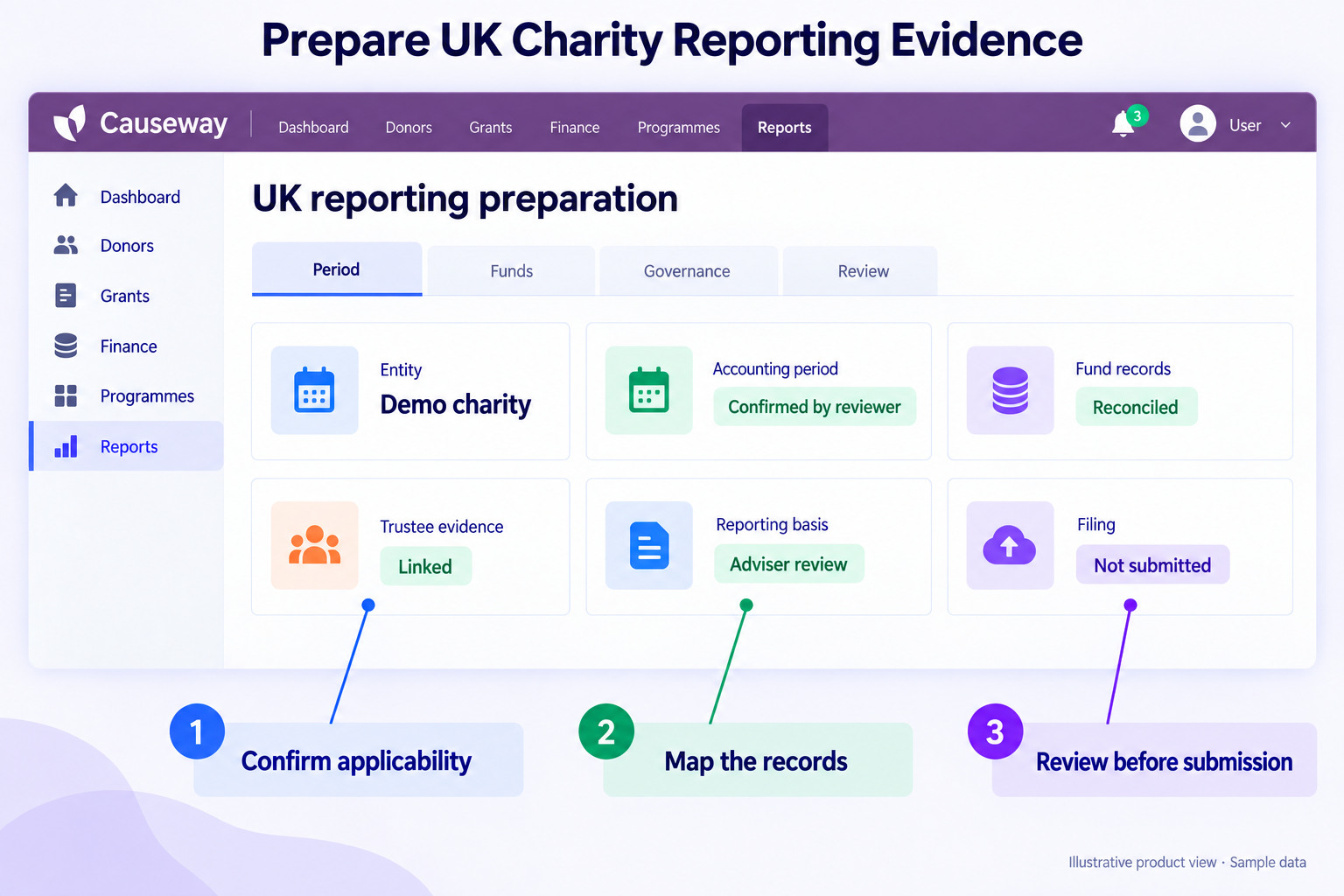
For a charity in England and Wales, confirm the applicable reporting basis and accounting period before preparing records. Organisations registered elsewhere in the UK need the relevant regulator's requirements. Connect each reporting obligation to its source records, reviewer and approval process.
Which UK reporting jurisdiction applies?
Record the legal entity, charity registration, organisational form and reporting responsibilities. Identify any additional registrations or reporting obligations before configuring a calendar. A management office in one location does not establish the full jurisdictional position of the charity.
The global compliance register provides a useful structure: source, applicability, owner, evidence and review date. Keep regulator reporting separate from donor submissions and internal governance reports, even where they draw on some of the same records.
For Scotland or Northern Ireland, obtain the relevant local regulator guidance rather than reusing an England and Wales checklist. If the organisation operates across regimes, document which entity or registration each submission concerns and who validates the requirements.
Accounting start and end dates can trigger different rules
The Charity Commission's annual-return guidance applies to England and Wales and explains that registered charities report annually, with the required submission depending on circumstances. It also flags accounting-threshold changes for financial years ending on or after 30 September 2026.
The official charity accounts guidance distinguishes the introduction of SORP 2026 for accounting years starting on or after 1 January 2026 from the threshold changes tied to financial-year end dates. SORP means Statement of Recommended Practice; its applicability should be assessed for the charity's accounting circumstances.
These are different date tests. Record the accounting period's start and end, applicable reporting basis and reviewer decision. Do not select a rule solely because the return is being prepared in 2026. Check the current official guidance and obtain accounting advice where the position is uncertain.
Accounts and narrative statements need different evidence
Create a reporting specification showing which records support the accounts, trustees' report and annual-return questions relevant to the charity. Some information comes from finance; other information depends on governance or activity records. A ledger export is not the complete submission.
The shared-core and local-rule design should preserve local reporting mappings and their effective dates. When a category changes, retain enough history to reproduce earlier reports. An unmapped amount should become an exception for review rather than disappear into a convenient total.
| Preparation Item | Evidence To Retain |
|---|---|
| Reporting basis | Applicability decision and accounting period |
| Financial totals | Reconciliation to reviewed records |
| Narrative statements | Programme or governance source and reviewer |
| Final documents | Approved version and sign-off |
| Submission | Filed version and confirmation |
Restricted funds and governance records support the report
Keep donor restrictions, internal designations and budget availability distinct in the fund accounting records. Configure the records needed to support the charity's approved accounting treatment rather than assuming a single “restricted” checkbox resolves every question.
Preserve award agreements, approved amendments and allocation evidence. Where a report describes activities or achievements, maintain the supporting programme records and definitions. A change in participant-counting method should not silently alter the meaning of a year-to-year comparison.
Personal information in governance, donor or programme records also requires appropriate handling. Assess GDPR responsibilities where that framework applies, and review current UK data-protection requirements separately. Limit access and exports to what the reporting process actually needs.
Check controls with a qualified adviser
Use a small, representative reporting period to test the configuration. Include a restricted award, a correction and a narrative item requiring non-financial evidence. Ask the reviewer to trace figures and statements back to their source records.
Confirm that the selected reporting basis, account mappings and document requirements match the charity's circumstances. Keep unresolved questions in an action log with an owner. A software supplier can explain configuration, but the charity's accounting and governance responsibilities need appropriate professional review.
After submission, retain the exact filed version and its approvals. If a later correction affects the report, assess the required follow-up through the relevant official process. Do not replace the historical submission with a refreshed report without preserving what was actually filed.
Retain the decision behind each reporting mapping
Keep a short applicability record naming the regulator, accounting period, approved reporting basis and reviewer. Attach the source used at the time of approval. When guidance changes, compare the new requirement with that record and identify which mappings or outputs need retesting.
A software label such as "UK charities" is insufficient evidence for every entity and period. The implementation team should produce an output from reconciled records. The responsible adviser then checks its mapping before the team relies on it.
A fund mapping and year-end evidence pack
For a worked £600 training invoice, retain the expense account, restricted education fund, award EDU-01 and reporting period. The approved mapping assigns the amount to the appropriate local reporting category; the source record still preserves its programme and award dimensions. A £100 correction retains its authority and original reference rather than silently replacing the earlier entry.
Before year-end sign-off, complete the applicability record, bank and ledger reconciliations, fund balances, account-to-report mapping, narrative evidence review and required independent review. Keep the final approved documents and filing confirmation together. The checklist supports the charity's chosen reporting basis; it does not choose that basis for the trustees.
Map each obligation to its control, evidence and reviewer in the Global Compliance Controls Matrix. Keep the charity's reporting jurisdiction and accounting period alongside each mapping.
Conclusion
Begin with the charity's reporting jurisdiction and accounting period. Those facts determine which framework and instructions the team must review. Reconcile the applicable financial and narrative records, preserve the approved fund mappings and retain the submitted version. When a mapping changes, keep the reason and reviewer so the earlier report remains explainable. The system is ready to support reporting when the team can trace the output back to the records and decisions behind it.
Map your UK reporting requirements
Causeway supports configurable finance, reporting, approval and recordkeeping controls within a global NGO operating platform. Evaluate those controls against your reviewed requirements for UK charity reporting, fund mappings and approved accounts. Bring the charity's reporting jurisdiction, accounting period and approved accounts mappings. Demonstrate how a changed fund classification reaches the workpapers while the earlier submitted version remains retrievable.
Frequently asked questions
Do the same rules apply across the UK?
No. The charity regulators and relevant requirements differ across England and Wales, Scotland and Northern Ireland. Confirm the organisation's registration and reporting position. Use the relevant regulator's requirements for each jurisdiction in which the charity has reporting responsibilities.
Does every charity use the same reporting basis?
No. The appropriate basis depends on the charity's circumstances and applicable rules. Record the accounting period and obtain the relevant review before configuration. Date-sensitive changes make it particularly important not to reuse an old checklist without checking applicability.
Can ERP replace trustee responsibility?
No. ERP can support records, reviews and evidence, but responsibility for governance and approved reporting remains with the relevant people. Use the system to make those responsibilities easier to exercise and demonstrate, rather than treating an automated output as final authority.