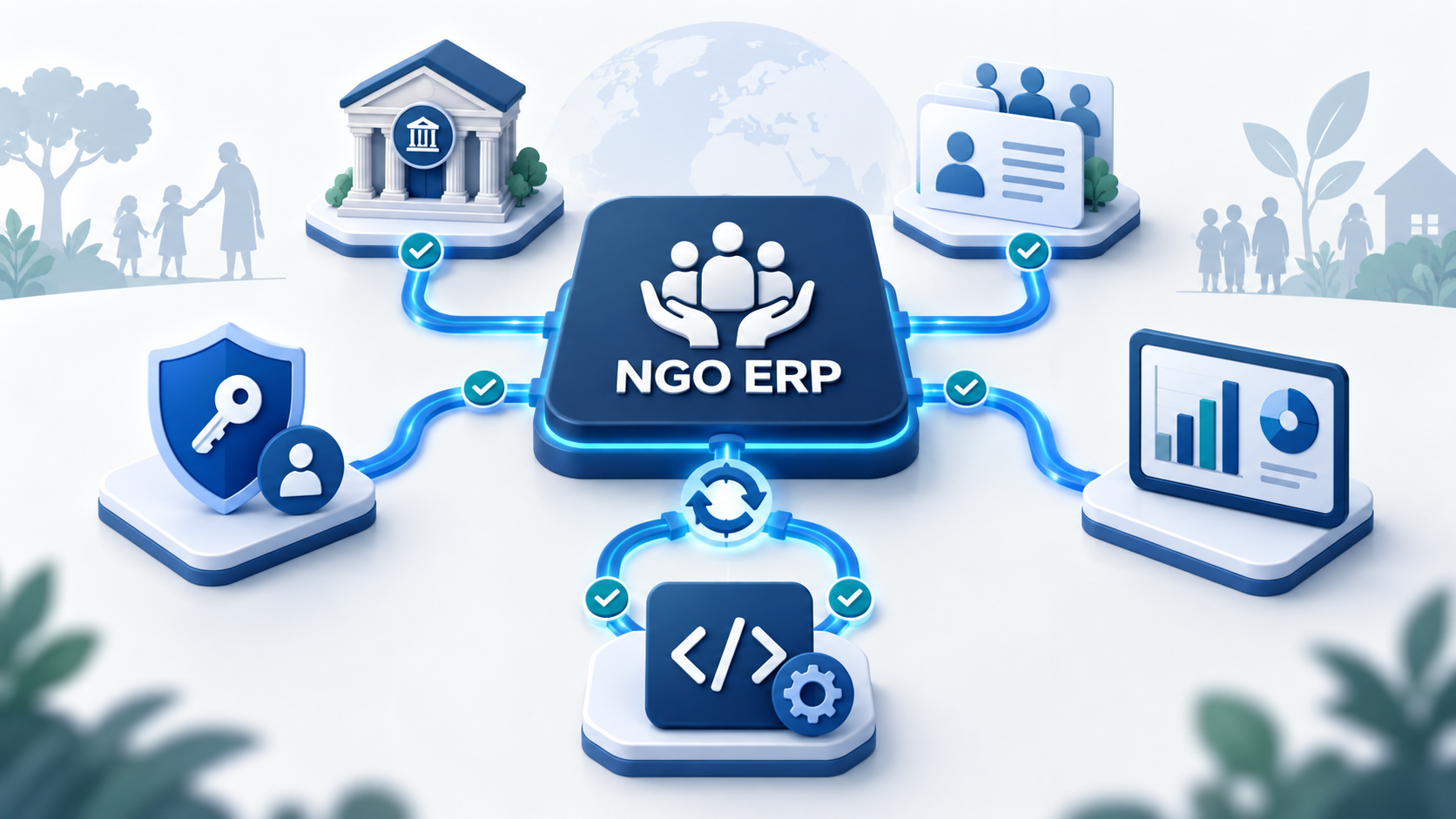
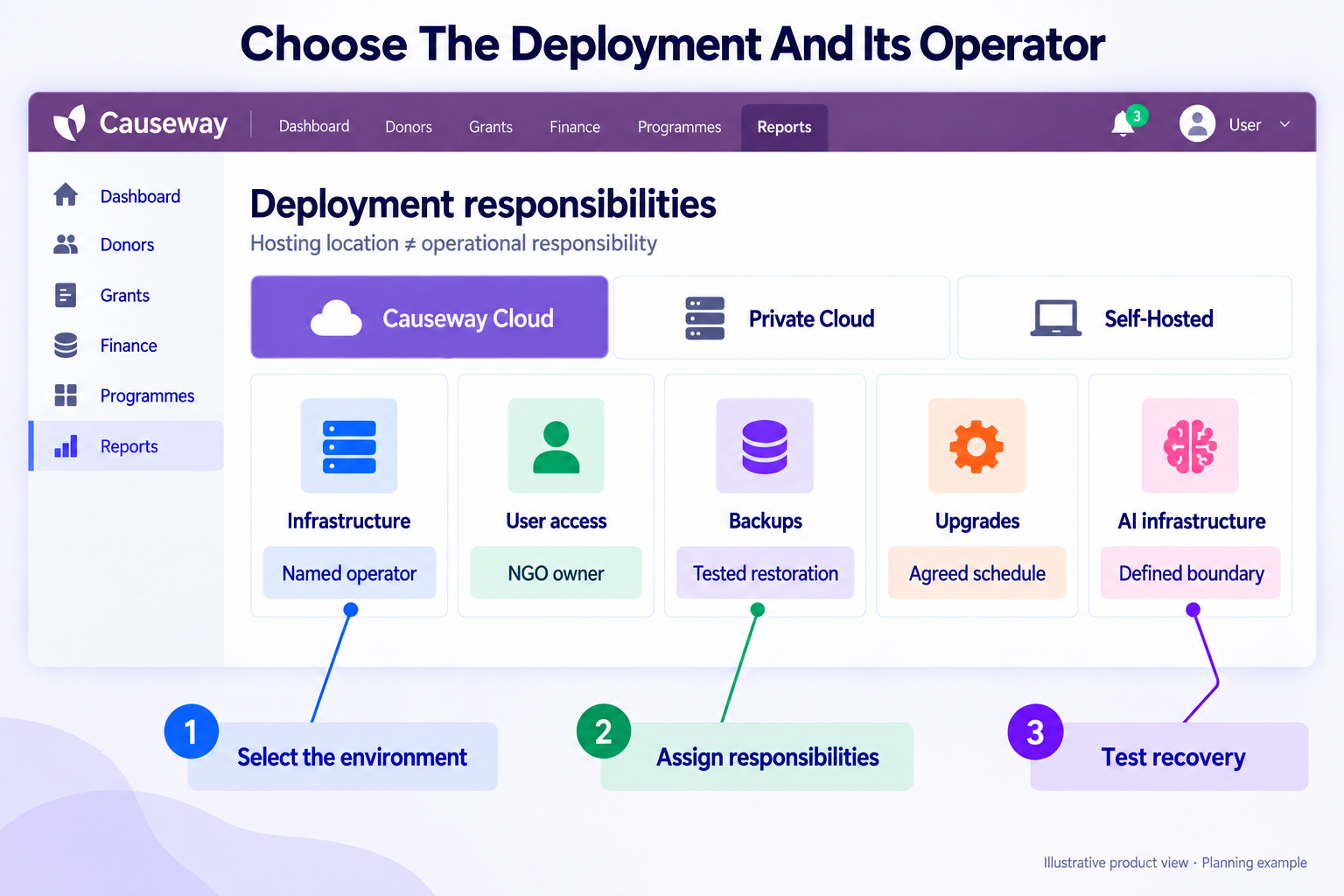
Causeway supports cloud, private-cloud and self-hosted deployment. The important decision is not only where the system runs, but who operates the infrastructure, database, security, backups, upgrades and recovery.
A private cloud can be supplier-managed. A self-hosted system can run on rented infrastructure. In every model, the NGO retains responsibility for its users, data and business decisions. The comparison below separates the hosting arrangement from the team that operates it.
Three deployment choices, two different decisions
| Option | Hosting Arrangement To Define | Operator To Name |
|---|---|---|
| Causeway Cloud | Contracted service region and included environments | Provider responsibilities plus NGO business ownership |
| Private Cloud | Dedicated customer environment and infrastructure boundary | Supplier, NGO or managed-service operator under the agreement |
| Self-Hosted | Customer-selected infrastructure, including rented infrastructure | Customer or its contracted operations team |
Private cloud suits an organisation that needs a dedicated environment while retaining a managed operating model, provided the contract establishes both. Self-hosted deployment suits a customer that needs infrastructure control and can staff or contract the operating responsibilities. Causeway Cloud can reduce the infrastructure work carried by a smaller internal IT team.
A dedicated environment does not by itself prove a particular recovery time, security certification or data-residency outcome. Those are separate acceptance requirements. Start with the organisation's mandatory boundary, then choose an operator who can demonstrate the required service.
Operating responsibilities belong in the deployment agreement
Use the following matrix as a starting point for contract discussions. It describes responsibilities to assign, not fixed terms shared by every vendor.
| Responsibility | Managed Cloud Proposal | Self-Hosted Proposal | Acceptance Evidence |
|---|---|---|---|
| Infrastructure patching | Provider or named infrastructure operator | NGO or contracted operator | Named owner, patch window and rollback record |
| Application upgrades | Provider with agreed customer testing | Joint release plan with local operator | Tested version, compatibility checks and rollback rehearsal |
| User permissions | NGO with platform support | NGO with platform support | Joiner, mover and leaver tests |
| Backups and recovery | Provider execution, NGO recovery acceptance | Local operator execution, NGO acceptance | Restored database, attachments and interface state |
| Integrations | Shared boundary with each connected provider | Shared boundary including local network | Ownership map and recovery tests |
Record both the person who performs a task and the person who accepts its outcome. “Backups included” is incomplete when nobody has established whether attachments, encryption keys and transaction queues can be recovered together. Use the security requirements to turn these assignments into tests.
Data locations include backups and administrative access
The production database is only one location. Include backup copies, logs, support exports, analytics services and any AI processing. A local database can still send personal information to an external service. The data residency assessment should trace these paths before a location is accepted.
Define how administrators connect, how temporary access expires and which records show what they did. If support requires an export, specify its permitted contents, retention and deletion. Avoid copying a complete beneficiary database to solve a narrow configuration issue.
Test recovery and upgrades as operating work
Set a recovery time objective, meaning the acceptable service interruption, and a recovery point objective, meaning the tolerable loss of recent data. These are business requirements to agree; they are not properties established by a daily backup schedule.
Rehearse restoration into an isolated environment. Check balances, documents, identities and the status of in-flight payments before reconnecting interfaces. A restored transaction queue must not resend an instruction already accepted by a bank. The integration recovery design needs to cover that boundary.
For upgrades, keep a list of extensions and interface versions. Run regression scenarios against the proposed release, agree the cutover authority and retain a usable rollback path. Self-hosting increases the importance of having a capable operator available when these tasks are due.
Database, AI and environment operations
Database operations include capacity, backups, restore testing, access management and maintenance. Assign an owner to monitor storage growth and slow operations. Record who responds when reporting or batch processing affects the service. Keep application and database changes coordinated so a rollback does not leave incompatible versions.
For AI infrastructure, record where the model runs and where its supporting data is processed. List the services it calls, permitted records, credentials and usage costs. A customer-hosted ERP can still call an external AI service. Conversely, a private-cloud arrangement needs an explicit design for any customer-controlled AI requirement.
Separate production, testing and development environments. Use test or appropriately protected data for routine tests, and prevent test integrations from issuing real payment instructions. A restore rehearsal should reconnect external systems only after transaction and queue state have been reconciled.
High availability addresses some service failures; disaster recovery addresses a broader loss of service or environment. Neither replaces an end-to-end recovery exercise. A replicated erroneous deletion may still need a usable backup. Record the failure scenario, recovery point, elapsed time and business reconciliation for each exercise.
Observability should cover application health, database capacity, failed jobs and interface queues, with alerts reaching an accountable operator. The NGO needs visibility of incidents and service outcomes even when another party performs the technical work.
Three organisations, different operating choices
For a small IT team with standard connectivity, managed cloud may be a good fit. The provider still needs to demonstrate suitable location, recovery and service commitments. The organisation still needs an owner for access decisions, data quality and supplier oversight.
An organisation with a mandatory hosting boundary and an established operations team may prefer self-hosting. Its decision should include on-call coverage, security monitoring, database administration and the cost of keeping those skills available.
A federation may retain local systems while introducing a shared ERP for group consolidation. Before selecting a hybrid architecture, identify which records move between systems and which party resolves a discrepancy. More deployment flexibility also creates more boundaries to operate.
The operating model drives the full cost
Compare hosting, service management, upgrades, recovery exercises, security work and internal staff effort over the same period. Include retained systems and connectivity where required. Use the implementation and total-cost model with unresolved charges left visible, rather than treating self-hosted infrastructure or cloud administration as free.
Model the three- or five-year ownership cost with the NGO ERP TCO Calculator. Missing costs remain unresolved rather than becoming zero.
Compare two proposals with the same recovery target and operating hours. One proposal may include database support while the other assigns it to the NGO. Add the staffing or contracted service cost before comparing totals. Assign a budget owner to every unresolved charge. A cheaper hosting quote does not establish a lower operating cost when the work has simply moved to another team.
Conclusion
Choose the deployment model by pairing the required infrastructure boundary with a team that can operate it. Managed cloud is useful when the provider's service commitments fit the NGO's needs. Private cloud adds a dedicated environment, but its operating duties still need an agreement. Self-hosting requires a capable internal or contracted team. Before acceptance, demonstrate recovery, upgrades and incident ownership under the chosen arrangement. The deciding evidence is a workable operating plan, not the location label alone.
Plan your Causeway deployment
Scope ERP implementation services around the agreed rollout, responsibilities and acceptance evidence.
Causeway supports Causeway Cloud, Private Cloud and Self-Hosted / Customer-Managed Deployment. Software starts at $8/user/month, billed annually; implementation and applicable operating services are separately scoped. Discuss your operating responsibilities and location requirements for Causeway global NGO ERP with SDLC Corp. A cloud consulting assessment can help define the infrastructure, support and integration scope to include in the proposal.