NGO enterprise resource planning (ERP) connects finance, grants, donors, programmes, procurement and people through shared records and controlled workflows. Its value is the ability to trace funding into an approved budget, a purchase, a payment and an evidenced programme report without reconstructing the same story across spreadsheets.
An NGO can have accurate accounts and still struggle to answer a basic operational question: how much of a grant remains available, which activities it will fund, and who can approve the next purchase. The difficulty often lies between systems. Finance holds expenditure, programme teams maintain delivery records, and donor conditions sit in documents that purchasing staff rarely see.
What NGO ERP connects
For broader context, see enterprise resource planning fundamentals. Generic ERP connects core enterprise functions. NGO ERP extends that operating model around funds, grants, donors, programmes, beneficiaries and reporting obligations.
The main building blocks are finance, grant management, programme delivery, procurement and people. Donor relationship management may also be included or connected. Each block answers a different question. Finance records the transaction; grant management checks the award conditions; procurement establishes the obligation; programme teams explain what was delivered.
These records need common identifiers without becoming one undifferentiated record. A donor can fund several awards. One award can support several projects. A project can use more than one funding source. Treating donor, grant and project as interchangeable fields makes later reporting difficult. The distinction between these dimensions starts with fund accounting and grant budgets.
| Record | Question It Answers | Connection To Preserve |
|---|---|---|
| Donor | Who provides support? | Awards and relationship history |
| Award | What was agreed? | Conditions, period and reporting obligations |
| Budget | What may be spent? | Approved version and permitted dimensions |
| Purchase | What has been committed? | Approval, supplier and remaining obligation |
| Programme Result | What happened? | Activity, indicator definition and supporting evidence |
People records introduce another set of relationships: staff assignments, expenses, leave and approval authority. Access should follow actual responsibilities. A programme officer may need a project's available budget without needing payroll information or confidential beneficiary records.
How a grant moves through the organisation
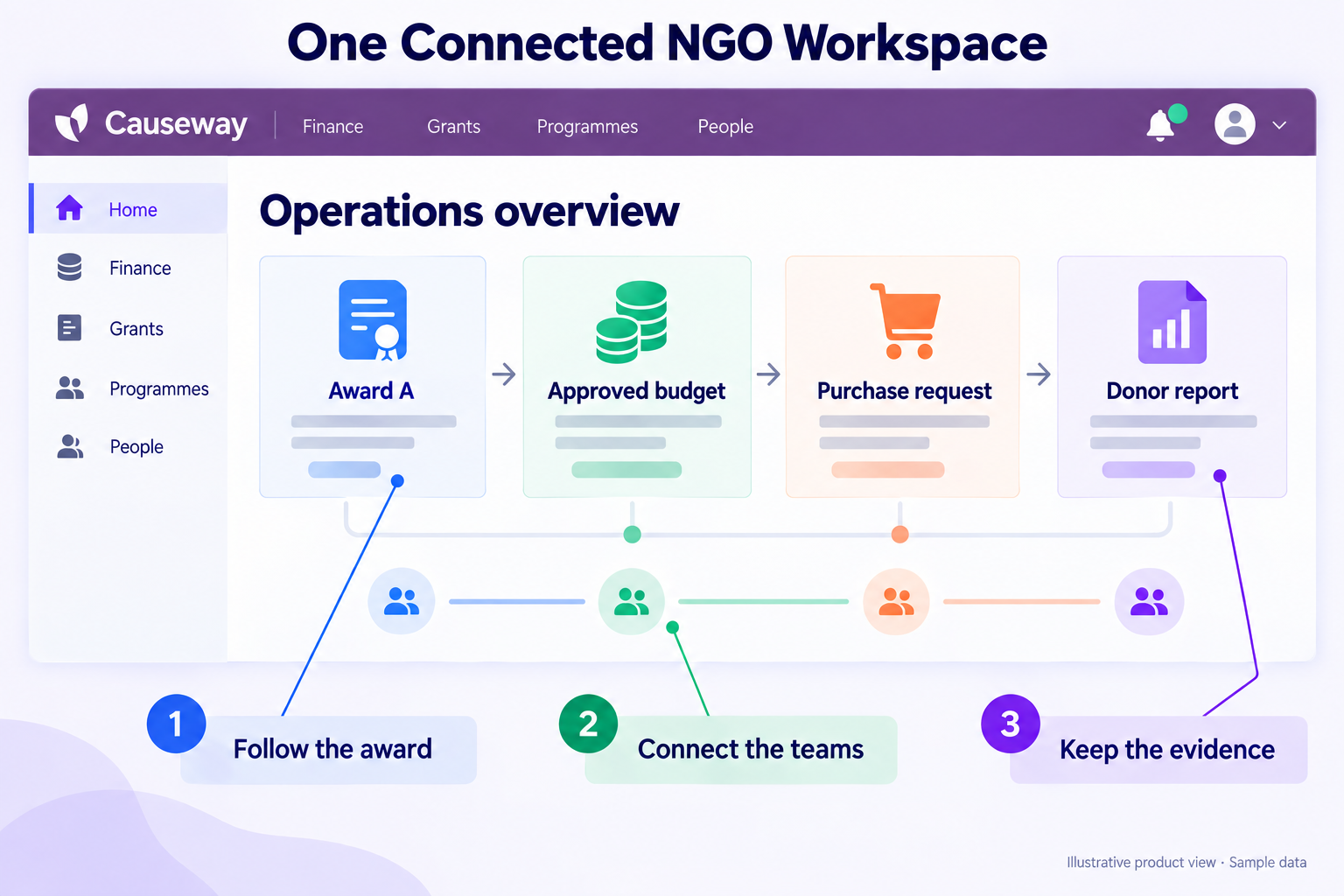
Consider an example community learning grant. The agreement supports training materials and venue costs during an agreed delivery period. A grant officer records those conditions. Finance approves a budget, and a programme manager requests materials against the correct line.
Before approving the request, the responsible person needs to see both previous spending and outstanding commitments. When the supplier delivers only part of the order, the system should preserve the remaining obligation. When an invoice is posted, it should not count the same amount again as both expenditure and an outstanding commitment.
The programme team then records completed sessions and attendance under a defined counting method. A donor report combines reconciled expenditure with those delivery records. Payment alone does not establish that a session happened, and attendance alone does not show that the expenditure was allowable. The connected workflow keeps both forms of evidence accessible.
An ERP demonstration becomes meaningful when it follows this complete path, including a rejected purchase or changed budget. A dashboard containing attractive totals cannot establish that the underlying controls work.
Beyond the award ledger
An NGO's operating cycle can begin with an individual donation rather than an institutional grant. Fundraisers need to recognise a supporter, record their communication preferences and understand the purpose of a gift. Finance needs the amount actually received, processing fees, restrictions and a reference that survives refunds. These are connected responsibilities with different owners. A donor CRM and fundraising workflow should preserve the relationship while the ledger preserves the accounting record.
Payment collection and programme disbursement also need distinct workflows. A successful checkout does not establish that a donation has reached the bank. Similarly, an approved partner transfer does not establish that the recipient received the expected local currency. Match processor or bank references to approved transactions, then track unresolved settlements through reconciliation. Online donation payment controls belong in the operating model even when a specialist provider handles checkout.
Some NGOs deliver through independent organisations. Each partner then needs an agreement, approved budget, reporting obligations and a documented release decision. Treating a partner's advance as completed programme spending can overstate delivery. Sub-award management connects the parent award to partner reporting without assuming that every partner is a subsidiary.
People, supplies and field delivery
An outreach programme may rely on volunteers, purchased supplies and visits recorded without reliable connectivity. A rota answers who is assigned; an inventory movement answers which supplies left a store; a delivery record answers what service took place. The records should share appropriate programme references while keeping safeguarding information restricted.
Volunteer management needs eligibility and supervision controls as well as scheduling. Inventory and asset records need custody and movements as well as purchase values. Offline field operations need a safe route from a device record to an accepted central record. These capabilities matter where the organisation actually runs those activities; purchasing every module at once is rarely a useful starting point.
Choose scope from operating pressure
Start with the work that repeatedly fails between teams. A fundraising charity may prioritise gift reconciliation and donor records. A grant-funded network may prioritise partner advances and consolidated reporting. A relief organisation may prioritise stock custody, field capture and rapid but controlled procurement.
Use a capability checklist organised by NGO operating model to distinguish essential first-phase work from later expansion. Record the operational consequence of each missing capability: delayed payments, unusable field data, unexplained stock losses or slow closeout. That consequence provides a stronger basis for scope than the number of modules on a product page.
Where accounting and CRM fit
Accounting software may already handle the ledger and statutory reporting well. Customer relationship management, or CRM, software may hold donor contacts, communications and fundraising opportunities. A specialist grant application may manage award conditions. These systems can remain useful if their boundaries are explicit.
Assign record ownership when comparing ERP, accounting, CRM and grant management software. For example, changing a donor's address in two systems requires a defined source of truth. Sending approved supplier payments to a bank requires stronger controls than exporting a management report.
Integration adds operating responsibilities. Someone must monitor failures, resolve conflicting records and reconcile totals. A connection that transfers data successfully most of the time can still create considerable work when nobody owns its exceptions. Include these responsibilities when comparing a shared ERP with a connected set of specialist tools.
For a vendor-specific comparison, use the NGO ERP transformation case study alongside your record-ownership map. Verify the scope and supporting evidence before applying any reported outcome to your own organisation.
When a shared system becomes useful
Look for recurring operational friction rather than an arbitrary employee count. Common triggers include repeated rekeying of grant codes, conflicting budget balances, approvals that cannot be reconstructed, and month-end reports that depend on one person's private spreadsheet.
A smaller organisation with straightforward funding may not need a broad ERP immediately. Documenting responsibilities and improving an existing accounting setup can be a sensible first step. Conversely, a relatively small NGO operating across several restricted awards and legal entities may face substantial control complexity.
Ask teams to trace one recent transaction from request to report. Note where they switch applications, copy information, seek clarification or lose the approval trail. That exercise creates a practical baseline for deciding what a new system must improve.
What to check before evaluating software
Turn the baseline into a short set of testable NGO ERP requirements. Specify the record, decision, exception and expected evidence. “Track grants” is too broad; “show approved budget, posted expenditure and remaining commitments for a selected award and date” can be tested.
Agree which requirements are mandatory and which could be phased. Identify who owns data quality, country rules, interfaces and user adoption. Then use a structured NGO ERP selection process to compare demonstrated workflows and delivery responsibilities. A supplier's roadmap should remain separate from functionality that has been shown to work.
AI assistance and deployment choices
AI in NGO ERP can assist record search, analysis, reporting and exception review when permissions and human decision rights remain intact. An assistant's explanation is not an approval to spend or a substitute for evidence about programme results.
Cloud and self-hosted deployment assign different responsibilities for infrastructure, upgrades and recovery. Compare those responsibilities alongside integrations and country operations before selecting a delivery model.
A short decision checklist
Choose a connected platform when several teams need the same award, project and approval records and reconciliation failures are recurring. Retain a specialist tool when it performs a distinct job well and its owner can maintain a reliable interface. Improve the process first when unclear ownership, rather than missing functionality, causes the problem. Follow the award-to-closeout workflow to test the proposed boundary with one complete example.
Causeway is a global NGO operating platform with seven years of product implementation and operating experience. Its connected model brings funding, finance, grants, procurement, programmes, donors, people, beneficiaries, outcomes and reporting into one operating context.
Turn the operating needs above into testable requirements with Global NGO ERP Requirements Builder. Keep mandatory requirements separate from preferences.
Trace funding through activities, costs and results with the Grant-to-Impact Data Model.
A platform assessment should also cover volunteer roles and assignment controls alongside employee records.
The generic ERP versus NGO-specific ERP comparison explains how to separate standard configuration from an extension needed for a mandatory NGO workflow.
Causeway reports programme reporting moving from quarterly to weekly across multiple customers. That result concerns reporting cadence: the operating model should connect the approved finance and programme records needed for each reporting cycle.
Conclusion
NGO ERP is most useful when it connects the decisions surrounding money and programme delivery. Start by tracing a real award through its operational handoffs. If teams cannot reliably explain the budget, authority, expenditure and supporting results, define those gaps before choosing software. The first deliverable should be a clear operating model and testable requirements, not a longer feature list.
Connect your NGO operations with Causeway
If you are evaluating Causeway NGO ERP, contact SDLC Corp to discuss the workflows connecting your finance, grants, programmes and people teams. Bring a representative award, a budget report and one difficult approval scenario so the discussion can focus on your operating needs.
Ask for a demonstration against those examples and a clear distinction between available functionality, configuration, integrations and proposed development. You can also explore the proposed delivery approach while evaluating the product. Base your decision on an agreed scope and demonstrated evidence for your organisation.
Frequently asked questions
Is NGO ERP the same as accounting software?
No. Accounting software primarily supports financial records and reporting. NGO ERP can connect those records to grants, procurement, programmes and people workflows. The exact boundary varies by product, so check which responsibilities are included and which depend on other applications.
Does a small NGO need ERP?
Size alone does not determine the answer. Consider funding restrictions, reporting complexity, entity structure and the work required to reconcile existing systems. Improve a simple process first if that resolves the problem; evaluate ERP when disconnected workflows create persistent control or reporting gaps.
Can existing tools stay connected?
Yes, where interfaces and responsibilities are suitable. Specify which application owns each record, what may be read or changed, and how failures are detected and reconciled. An available API does not by itself establish that a complete, supported integration exists.