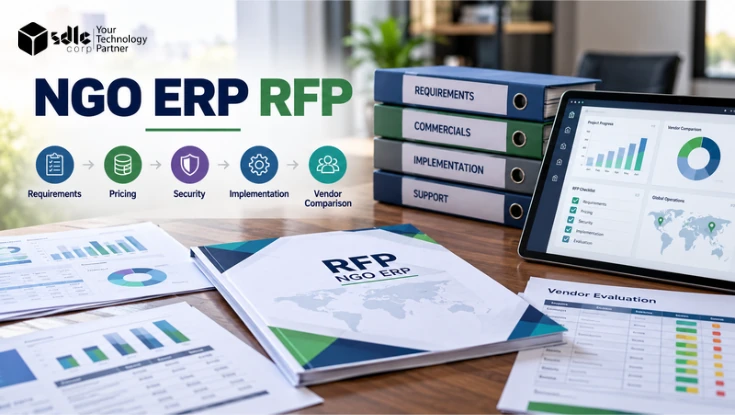
An NGO ERP request for proposal (RFP) should make vendor responses comparable. It needs to explain the organisation's operating context, the work being procured and the evidence required to evaluate fit. A large list of features without scope assumptions often produces proposals that look similar but cover different responsibilities.
Give suppliers the same operating facts, prioritised requirements and response fields. Require them to declare unanswered items and assumptions so you can resolve material differences before a commercial commitment.
The operating context defines the RFP scope
Open with a factual summary of entities, countries, programmes, funding arrangements and current applications. Identify the business problems driving the purchase and the workflows included in this procurement. Distinguish an initial phase from possible later expansion.
Include a scope table that vendors can respond to directly. Avoid phrases such as “complete digital transformation” unless the specific deliverables and boundaries are defined.
| RFP Section | Information To Supply |
|---|---|
| Organisation | Legal entities, operating units and responsible contacts |
| Current Landscape | Applications, ownership and known interfaces |
| Initial Scope | Workflows, users, reports and countries included |
| Exclusions | Retained services and work outside this procurement |
| Constraints | Required dates, dependencies and availability of internal teams |
State which assumptions are confirmed and which remain open. If volumes or local needs remain unknown, show them as open items. Ask the vendor which changes would affect its estimate and by how much.
Attach prioritised requirements and scenarios
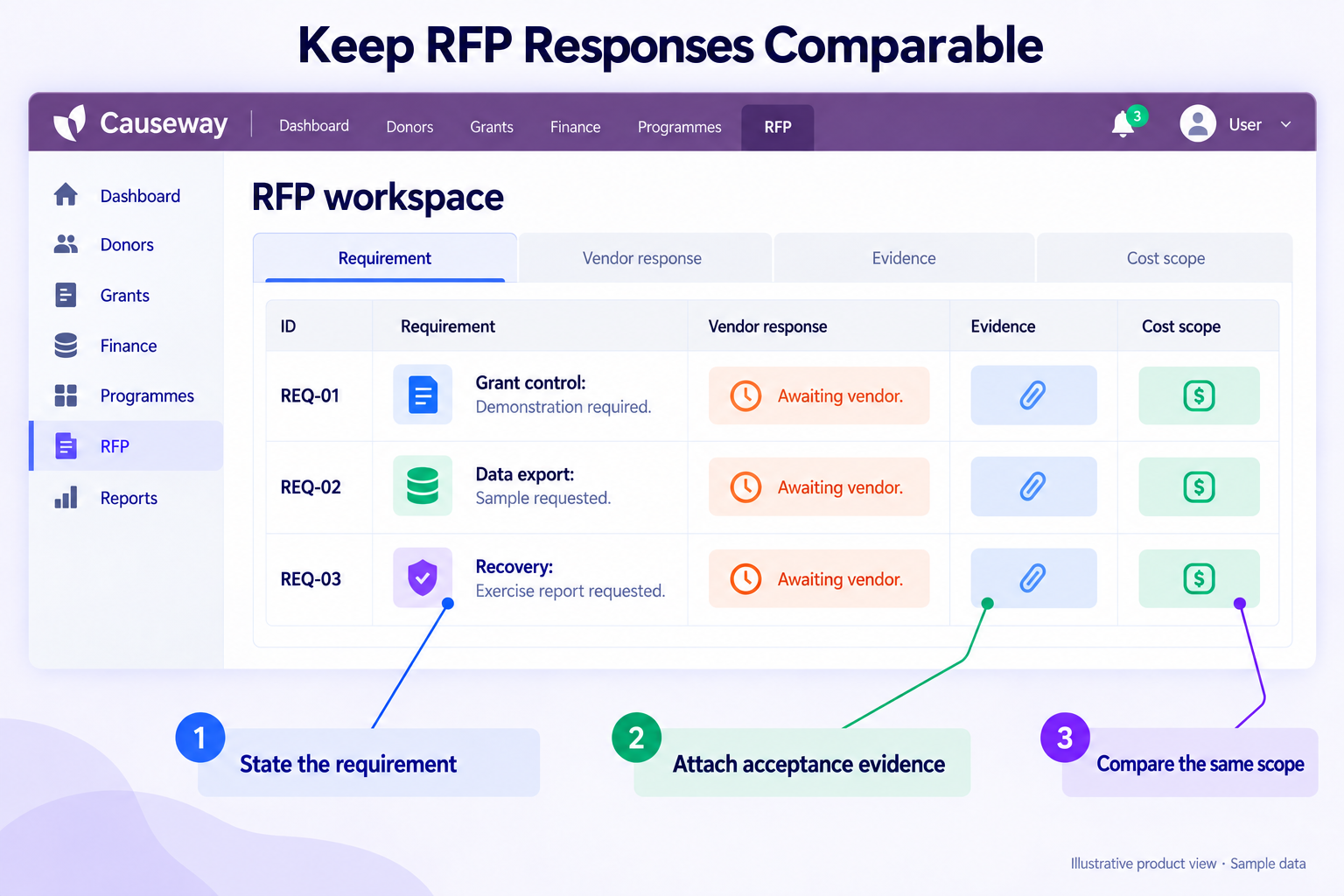
Use the requirements checklist with stable identifiers, priorities and evidence. Ask vendors to respond against those identifiers so clarifications can be tracked without renumbering the scope.
Give vendors five response choices: standard capability, configuration, third-party dependency, custom development or unsupported need. Each response should include evidence, assumptions, limitations and relevant cost or timing implications.
Add selected live demonstration scenarios covering normal processing and exceptions. A restricted purchase, partial invoice, revoked permission and donor-report reconciliation provide a more concrete basis for evaluation than a generic product tour.
Requirement response table
| Field | Vendor Response Requested |
|---|---|
| Requirement ID | Preserve the supplied identifier |
| Fit Classification | Standard, configured, third-party, custom or unsupported |
| Evidence | Documentation or demonstrated scenario reference |
| Dependencies | NGO decisions, external access or other products |
| Delivery | Proposed work and acceptance condition |
| Commercial Effect | Included cost, estimate or stated exclusion |
Evidence required for security, delivery and support
Ask for the proposed deployment and responsibility model. Identify who provides hosting, access administration, backup, recovery testing, monitoring and incident response. Require evidence relevant to the proposed service rather than general corporate statements.
For implementation, request a dependency-led plan covering discovery, configuration, data preparation, integrations, testing, training and cutover. Require the vendor to name the work expected from your team. A schedule without those assumptions is difficult to assess.
For support, describe the services you need and ask vendors to state coverage, escalation, exclusions and third-party boundaries. Include how changes, upgrades and custom components will be maintained. Request a practical data-export and transition approach for the end of the relationship.
Add schedules for high-risk dependencies
Include separate response schedules when fundraising, payments, partners or field operations are in scope. This prevents a general response such as "supported through integrations" from concealing an unpriced dependency.
| Schedule | Required Response Detail |
|---|---|
| Fundraising | Donor record owner, campaign tools, preference updates and gift reconciliation |
| Payments | Providers, supported countries, methods, currencies, settlement evidence and fees |
| Sub-awards | Parent-child award links, advances, monitoring, amendments and closeout |
| Offline operation | Available actions, device limits, synchronisation conflicts and recovery |
| Assurance | Service scope, report or certificate period, exclusions and customer controls |
| Data locations | Storage, backup, support access, subprocessors and change notification |
Name the supplier behind each dependency and state whether the connection already exists. Price its implementation and recurring charges separately. Attach an acceptance test. Attach the vendor trust evidence checklist to the security schedule and align payment requirements with the actual operating countries. Resolve unclear procurement boundaries before commissioning implementation.
Request comparable commercial responses
Use the total-cost framework to request one-off, recurring and internal-effort assumptions over the same period. State the currency basis and ask vendors to identify taxes, travel, usage-related charges and other exclusions where applicable.
Separate the base proposal from optional items. Ask what events trigger a change in price, such as additional entities, integrations, environments or scope changes. Do not combine optional future phases into the initial total without labelling them.
| Cost Group | Response Needed |
|---|---|
| Initial delivery | Scope, assumptions and payment milestones |
| Recurring service | Charging basis, period and included support |
| Integrations | Build, third-party fees and maintenance responsibilities |
| Internal effort | Expected roles and participation |
| Options | Separate price and dependency for each option |
Request explicit exclusions. A blank cell should not be treated as zero cost or included scope. Clarify material omissions before comparing totals.
How clarifications reach the final agreement
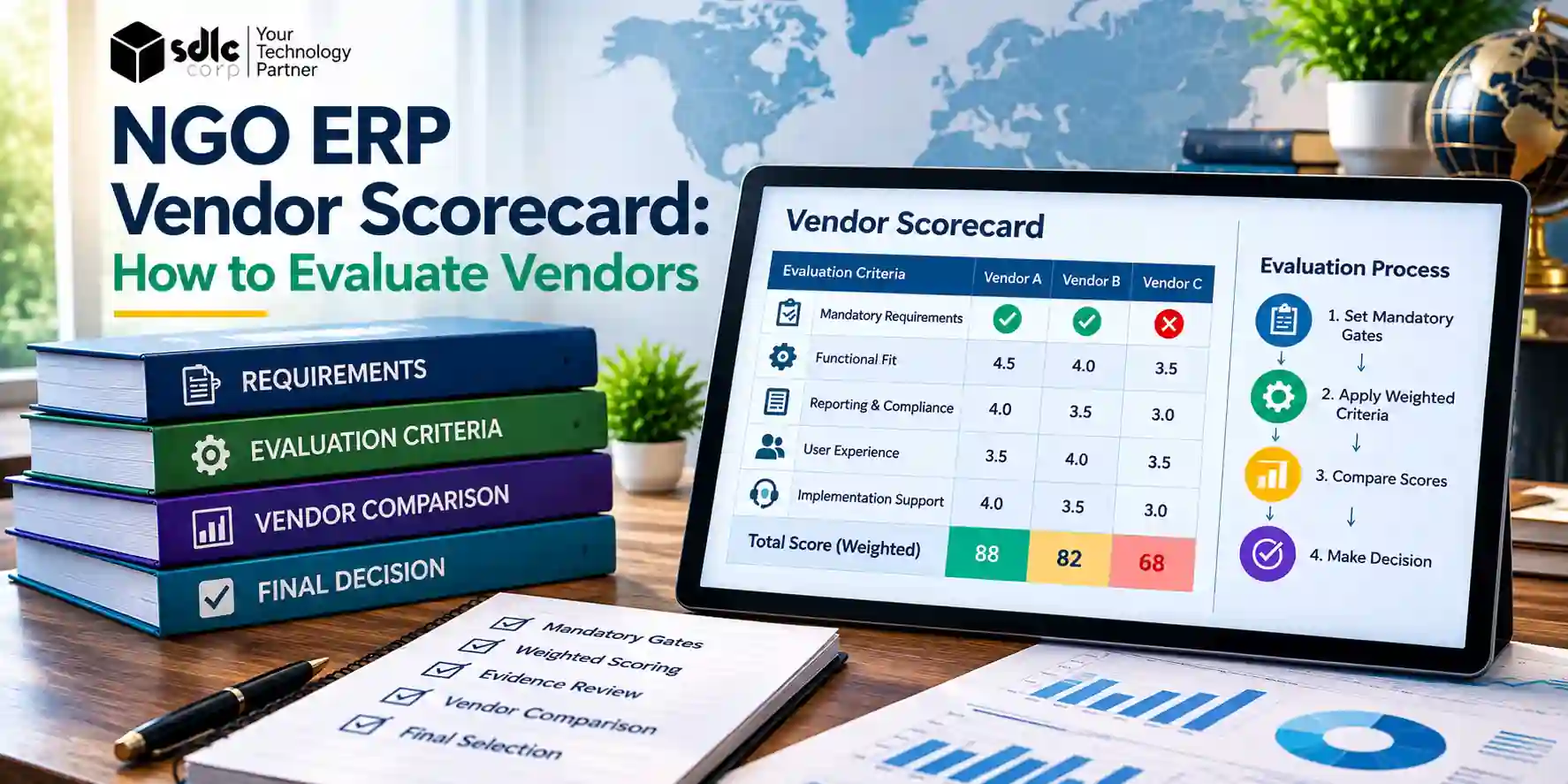
Publish the relevant decision criteria and mandatory gates. The vendor scorecard can support evaluation, but the RFP should explain what evidence is required and how unresolved answers will be handled.
Define a clarification process with a contact, submission method and response date. Where a clarification changes the common requirements, provide the same revised information to participating suppliers as appropriate to your procurement process.
Preserve versions of the RFP, responses and clarifications. Before contracting, reconcile the selected proposal to the final requirement set and acceptance conditions. A negotiated statement of work should not quietly omit a mandatory requirement that drove the original selection.
Two requirement clauses a vendor can answer
FIN-01 uses a $10,000 budget, $6,000 of posted expenditure and $2,000 of open commitments. The remaining budget is $2,000. Under the supplied test policy, a new $3,000 request must be rejected. The available amount remains $2,000 and the rejection retains the actor, time and reason.
INT-01: Replaying an accepted donation settlement event must leave one gift and one financial posting. The response must show the original event reference, processing outcome and reconciliation route after a lost acknowledgement.
For each clause, the vendor supplies fit class, version, dependencies, demonstration evidence, delivery owner and commercial treatment. The evidence pack needs completed responses and observed test results. Add the architecture and data-location map. Include service responsibilities, delivery dependencies and the full cost schedule. A general brochure cannot replace those records.
Give suppliers the same scope and evidence fields through the NGO ERP RFP Builder.
Sequence country waves around accepted dependencies with the NGO ERP Implementation Planner.
Include a reference-evidence field alongside each proposed delivery approach. The NGO ERP transformation evidence provides a reference destination for Causeway; require the supplier to substantiate the relevant scope, dates and attributable results in its response.
Causeway’s reported multi-customer outcomes include 67% fewer payroll-related queries. Where reducing payroll administration is a buying objective, the RFP should define the query categories, counting method and baseline period. Keep the reported result separate from the supplier’s acceptance commitment for the proposed scope.
Conclusion
The RFP is ready when two suppliers can price the same work and explain their differences against the same evidence. Check one requirement from operating need through response, demonstration, cost and contract wording. If that chain breaks, resolve the missing assumption before issuing or awarding the procurement. Preserve clarifications in the final scope so a favourable proposal does not become a smaller delivery commitment after selection.
Scope a Causeway RFP response
Discuss an RFP response for Causeway using your scope, requirement identifiers and evaluation scenarios. Ask for explicit classifications of current capability, configuration, integrations and proposed development.
A useful response should make responsibilities, assumptions, costs and acceptance evidence comparable with other proposals. If requirements remain unclear, first identify the missing operating facts. Use them to improve the procurement scope before selecting a supplier.
Frequently asked questions
Should an RFP include every possible feature?
No. Include requirements relevant to the organisation's operating model and intended scope. Separate essential, desirable and future needs. An indiscriminate feature list can obscure priorities and encourage superficial yes-or-no responses.
How should vendors declare custom development?
Require a distinct response classification with scope, assumptions, dependencies, maintenance responsibility and acceptance evidence. Ask whether the cost is included or estimated separately. Do not allow custom work to appear indistinguishable from demonstrated standard functionality.
What makes pricing responses comparable?
They need the same scope, period, currency basis and treatment of options and exclusions. Include recurring services, integrations and expected internal effort. Clarify blank or ambiguous items before comparing totals.