
Volunteer management connects people who offer their time with roles the NGO can safely support. A contact list records who is interested; an operating process establishes eligibility, training, availability, supervision and what happened during an assignment. The distinction matters when programmes depend on regular attendance or involve vulnerable participants.
The software should help coordinators make appropriate assignments and preserve necessary evidence without exposing sensitive records to everyone. Start with the volunteer journey and the programme's responsibilities, then decide which functions belong in a specialist tool and which should connect to the ERP.
Role requirements come before recruitment
Describe the activity, location, expected commitment, supervisor and skills required. Identify any checks, training or authorisations that must be completed under the organisation's policies and applicable local requirements. Avoid using one generic eligibility flag for roles with different risks.
Distinguish an expression of interest from an approved volunteer. The intake process should explain what information is collected, why it is needed and what happens next. Capture communication preferences separately from the operational contact details needed for an assignment.
When a volunteer also donates, connect the relationship carefully to the donor CRM. A shared person record can prevent duplicate contact, but it should not make confidential onboarding information visible to fundraising staff.
From applicant to an approved assignment
| Stage | Coordinator's Decision | Record To Keep |
|---|---|---|
| Application | Is the person suitable for the proposed next step? | Application and review outcome |
| Eligibility | Are required conditions satisfied for this role? | Status, reviewer and relevant expiry |
| Training | Has the person completed the required preparation? | Course or briefing record |
| Assignment | Does availability match an approved activity? | Role, time, place and supervisor |
| Completion | What attendance or work was confirmed? | Reviewed activity record and exceptions |
Give eligibility records review dates and expiry rules where appropriate. A person cleared for one activity should not automatically be assigned to every role. Restrict access to detailed checks; coordinators may only need to know whether a condition is satisfied and whom to contact for clarification.
Control safeguarding and access
Every assignment should identify the responsible staff member or authorised supervisor. Include the escalation route for absence, safety concerns or changes in the activity. A schedule that names volunteers without supervision arrangements can leave field teams uncertain about who is accountable.
Keep sensitive concerns in a restricted process rather than a public rota comment. The volunteer record can show that an assignment is paused without revealing confidential details. Align access with the beneficiary and sensitive-data controls used by the programme.
Assignment readiness is more than an available shift
| Readiness question | Result needed before assignment |
|---|---|
| Is the person eligible for this role? | Recorded decision under the organisation's role policy |
| Are required checks current? | Authorised confirmation of completion, scope and expiry |
| Is training complete? | Required course and completion record |
| Are there assignment restrictions? | Permitted duties, locations and supervision level |
| Which participant records are needed? | Minimum access for the assigned task and duration |
| Who supervises the work? | Named supervisor and route for concerns or incidents |
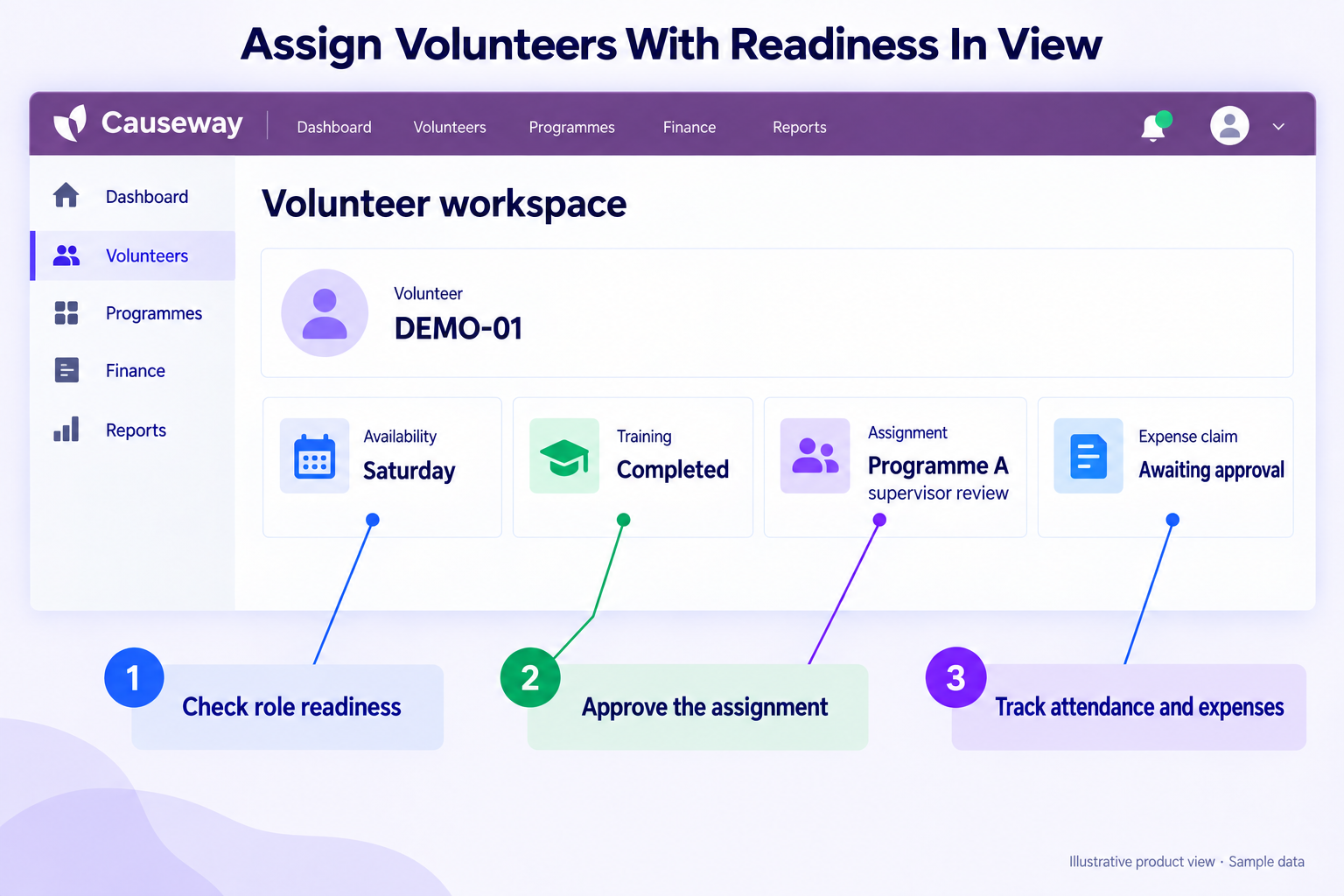
For a volunteer supporting vulnerable participants, an approved application alone is insufficient. The supervisor checks readiness for the particular assignment. Keep sensitive check results restricted; scheduling staff may need an eligibility status rather than the underlying documents. End participant-record access when the assignment ends, and pause future shifts when a required check expires until an authorised reviewer resolves it.
When eligibility changes during an assignment
Example: a volunteer's required training expires halfway through an assignment. The coordinator needs the affected role, expiry date and next scheduled activity together. Pause work that requires the expired training, assign a qualified substitute and record who authorised the change. Completion of a new course should restore eligibility only after the required evidence is reviewed.
Keep the roster decision separate from sensitive safeguarding material. A supervisor may need to know that a person cannot take a role without seeing the underlying case details. At departure, close future shifts, recover equipment and remove access. Retain attendance and approved expenses under the applicable retention policy. A completed assignment should therefore have an end date, a responsible supervisor and no unexplained future access.
Planned capacity and actual attendance differ
Match the number and type of volunteers to the activity's needs. Track confirmed assignments separately from expressions of interest and keep a process for cancellations or substitutions. A replacement should satisfy the same role requirements before being accepted.
For an example event needing six volunteers for four hours, planned capacity is 24 volunteer-hours. If five attend for the full session and one attends for two hours, recorded attendance is 22 hours. Those hours describe participation; they do not by themselves measure programme outcomes or establish an accounting value for donated services.
Agree who confirms attendance and how corrections are recorded. Where field connectivity is unreliable, use a controlled offline capture process and reconcile delayed submissions before reporting totals.
Connect expenses and programme reporting
Volunteer expenses need a purpose, supporting evidence and approval under the NGO's policy. Keep reimbursement records separate from paid employment or supplier classifications unless the responsible advisers determine otherwise. The system should apply the approved arrangement rather than infer legal status from the word volunteer.
Link approved expenses to the relevant programme or funding source. If a donor imposes conditions, preserve the eligibility decision. Finance should be able to reconcile the payment without gaining unnecessary access to personal onboarding notes.
Report attendance and contribution using clearly defined measures. Monitoring and evaluation may use volunteer activity as an input or output, but hours alone cannot prove beneficiary impact. Retain enough context to explain what work occurred and how it supported the programme.
A volunteer record and reimbursement example
Example volunteer V-01 is a record linked to Role R-01, Supervisor S-01 and Activity A-01. The coordinator sees availability, training completion, eligibility status and any relevant expiry. Detailed safeguarding or identity-check material remains in the restricted record held by its authorised owner.
For a worked expense claim, V-01 submits $20 for travel. The reviewed policy and receipts support $18; $2 is returned for clarification. The accepted reimbursement retains the activity, grant eligibility, approver and payment reference. It does not change the volunteer into an employee or supplier merely because a payment is made.
People operations also need employee and consultant records, onboarding, attendance, leave, training and expenses. Where local payroll remains in a specialist service, the approved payroll result and financial journal cross a controlled interface. Keep calculation ownership and employment classification explicit.
Conclusion
Volunteer readiness belongs to a particular assignment, not merely an approved applicant profile. Check eligibility, required training, supervision and access before scheduling work, then record attendance and expenses against the programme. A changed or expired requirement should pause the affected duties until review. This gives coordinators a realistic view of available capacity while keeping participant information and safeguarding decisions with the responsible people.
Map your volunteer operations
Discuss how volunteer operations could fit alongside Causeway. Bring role descriptions, onboarding steps, rotan examples and reimbursement rules so the discussion reflects the programme's actual responsibilities.
Ask which records would remain in a specialist volunteer tool, which need integration and what capability would require configuration or development. Confirm access boundaries and acceptance tests for expired eligibility, replacement volunteers and corrected attendance. The proposed scope should help coordinators without assuming that an ERP contact record covers the full volunteer journey.
Frequently asked questions
Should volunteer hours be reported as programme impact?
They can describe a contribution or activity input, but they do not establish the resulting change for participants. Use outcome measures appropriate to the programme and explain how volunteer work contributed without equating time spent with impact achieved.
Can fundraising staff see volunteer onboarding records?
Access should follow a defined purpose and the approved privacy rules. Fundraising staff may need a relationship link or communication preference, while sensitive eligibility or safeguarding information remains restricted to the people responsible for those decisions.