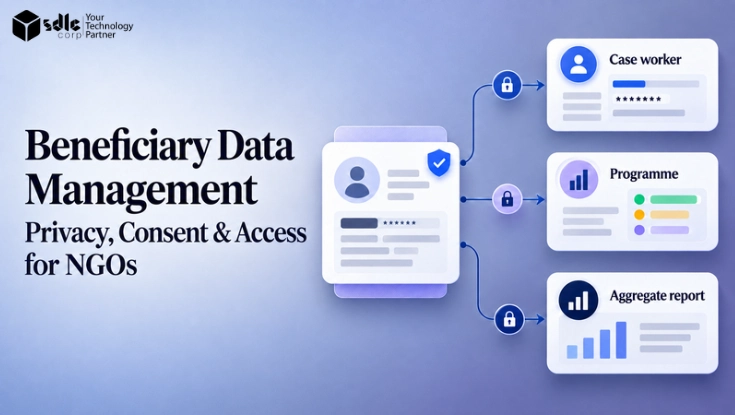
Beneficiary records can help an NGO coordinate support, avoid duplicate services and report programme results. They can also expose people to harm when sensitive details are collected unnecessarily, shared too widely or retained without a clear purpose. A larger database is not automatically a better programme record.
Begin with the service being delivered and the minimum information needed to deliver it responsibly. Define who needs identifiable records, who needs only aggregate results and what happens when a person leaves the programme. These decisions should shape forms, access rules and reporting before data collection starts.
Which beneficiary fields are necessary?
For each field, state its purpose and owner. A field may be necessary for eligibility, contact, safeguarding or a specific reporting obligation. “It may be useful later” is a weak basis for routinely collecting sensitive information.
Separate required fields from genuinely optional ones and explain the consequences of not providing information. Review free-text boxes carefully: they can accumulate sensitive details that structured reporting never needed. Design staff guidance around what should not be entered as well as what should be recorded.
Translate the decisions into testable system requirements. For example, specify that an aggregate report must omit direct identifiers, or that a restricted case-note field is unavailable to ordinary programme reporting roles. Test exports as well as on-screen forms.
A minimal sample beneficiary record
This field model uses a test identifier and contains no personal case narrative.
| Field | Sample Value | Sensitivity And Access |
|---|---|---|
| Record ID | DEMO-01 | Pseudonymous reference; still protect the linkage |
| Service eligibility | Review completed | Restricted to roles needing eligibility evidence |
| Assigned team | Team A | Programme operational access |
| Contact route | Held in separate protected field | Assigned case worker only where necessary |
| Health or safeguarding notes | Not included in routine report | Separate heightened controls if collection is justified |
| Retention trigger | Case closure review | Named record owner and approved policy |
Do not treat pseudonymisation as anonymisation. Someone holding the linking key may still identify the person. Reports should use the smallest field set needed for their stated purpose.
The purpose determines the processing assessment
Applicable privacy law and the processing context determine the lawful basis and any additional conditions for sensitive information. Consent should not be treated as a universal checkbox. A relationship involving dependency or unequal power can require particular care when assessing whether consent is appropriate.
The European Commission's GDPR principles include purpose limitation, data minimisation and storage limitation. Where the General Data Protection Regulation applies, translate the relevant GDPR responsibilities into access, retention and request-handling requirements. Other jurisdictions may impose different or additional obligations.
Provide understandable notices in a format and language suitable for the people concerned. If information will be shared with a partner, explain the relevant purposes and responsibilities. A privacy notice should describe the actual workflow, not an idealised process that staff cannot follow.
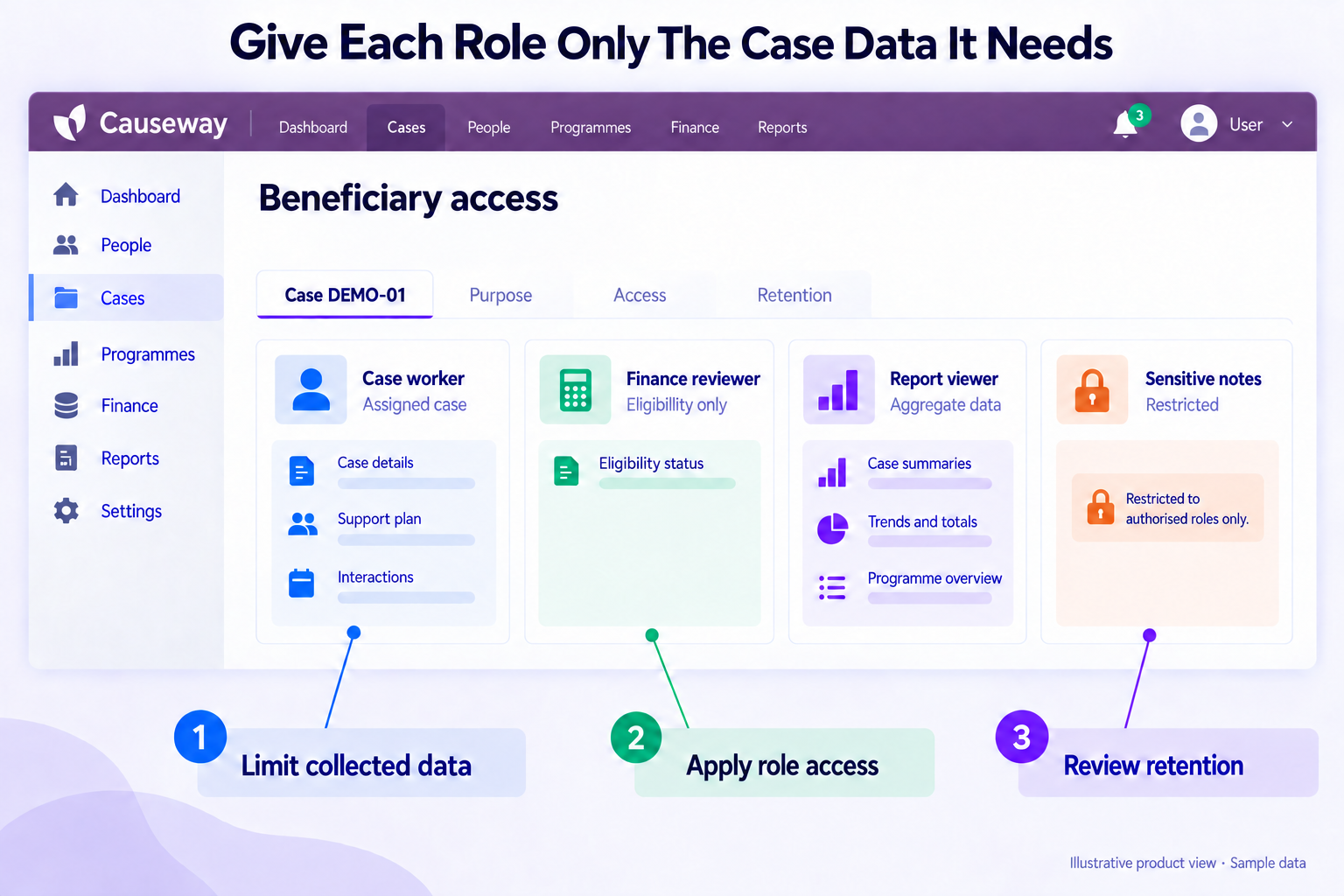
Sensitive case records need restricted access
Design access around responsibility and context. A case worker may need identifiable records for assigned participants; a finance reviewer may need evidence that an eligible service occurred without access to detailed case notes. Country or project boundaries may also matter.
The ERP security requirements should cover object-level access, exports, privileged accounts and role changes. Hiding a menu item is insufficient if the same records remain accessible through a report or interface. Test a user whose assignment has ended and check that previously granted access is removed.
| Role | Possible Need | Information To Restrict |
|---|---|---|
| Assigned case worker | Contact and service history | Unrelated cases |
| Programme manager | Delivery and exceptions | Unnecessary sensitive notes |
| Finance reviewer | Eligibility and cost evidence | Detailed personal narratives |
| Donor reporting user | Approved aggregate results | Identifiable beneficiary lists unless specifically justified |
Adapt these roles to the programme's responsibilities and applicable privacy requirements before assigning permissions.
Identity corrections must preserve the original history
Duplicate records can lead to repeated contact, inconsistent support and inflated reporting. Matching is difficult when names change, spelling varies or reliable identifiers are unavailable. A probable match should normally enter a reviewed process rather than trigger an irreversible automatic merge.
Preserve the reason, reviewer and source-record references when records are merged. Define how a mistaken merge can be corrected. Avoid collecting additional sensitive identifiers solely to make matching convenient without assessing necessity and risk.
For programme result reporting, distinguish unique people from service encounters. One person attending four sessions represents four attendances but may represent one participant in a defined period. Both measures can be useful when labelled correctly.
Set retention and deletion rules
Assign retention rules by record category and purpose. Include the event that starts the period, relevant obligations, review owner and any hold that prevents deletion. Closing a programme does not necessarily justify deleting every record immediately or keeping every record indefinitely.
Test what deletion or anonymisation means across connected applications, exports and backups. A front-end delete action may leave other copies untouched. Document how those copies are controlled and what can realistically be removed or isolated under the applicable requirements.
A referral can change the privacy risk
Consider a programme that records a child's support needs and refers the family to a partner service. The partner needs enough information to provide that service, but a full case file may include health details, family circumstances and unrelated notes. Define the referral purpose, recipient role, minimum fields, secure transfer method and retention decision before sharing.
For processing under UK GDPR, the ICO explains that special category data requires both an Article 6 lawful basis and an Article 9 condition. Its special category guidance also highlights heightened assessment needs. Children and vulnerable adults require particular attention to how information is explained and who can safely provide or receive it.
Review whether the proposed processing needs a data protection impact assessment. Include partner access from other countries, onward sharing, device copies and support access in the assessment. A country field on a beneficiary record does not itself restrict where the record can be viewed. The GDPR requirements review should translate those decisions into demonstrable access and transfer controls.
Walk a closed record through disposal
For DEMO-01, the owner first checks the retention trigger, applicable obligations and any legal or safeguarding hold. If disposal is authorised, record the approval, remove or anonymise the relevant live fields, notify connected systems holding copies and verify completion. Retain a minimal disposal log rather than the deleted case narrative. Backups require a documented expiry and restoration procedure so a restore does not quietly reinstate records scheduled for disposal.
Include remote partner access and backup copies in the data-residency assessment. An authorised referral must specify the purpose, minimum fields, recipient, transfer route and permitted retention before information leaves the source system.
Share aggregated results safely
Aggregation reduces exposure but does not automatically remove identification risk. Small groups, detailed locations or rare characteristics can make people recognisable. Review the combination of fields and the recipient's context before sharing.
Use reporting definitions that preserve usefulness without unnecessary detail. Limit routine exports, record authorised sharing and give staff a route for questions. A privacy-conscious reporting process is easier to maintain when it is built into normal work rather than added only before publication.
Before release, check whether a small group can identify a person when combined with location, age or a rare service need. A total for an entire programme may be safe while a village-level breakdown exposes one household. The reporting owner should approve the grouping and suppression rules, then check the actual export. Keep the version and recipient list so a later correction or withdrawal can be traced.
Conclusion
Useful beneficiary data begins with a defined purpose and proportionate collection. Keep sensitive access narrow, manage duplicates carefully and distinguish people from service encounters in reports. Review retention and sharing across the full data lifecycle. These choices make the record more trustworthy while reducing unnecessary exposure.
Design beneficiary access with Causeway
Discuss translating your beneficiary-data responsibilities into requirements for Causeway. Bring a field inventory, role matrix and examples of the aggregate reports your teams need.
Ask for demonstrations using test records, including restricted notes, duplicate review, revoked access and export controls. Clarify which decisions require your privacy or safeguarding specialists and which can be implemented through configuration. A suitable scope should identify these responsibilities before any personal records are introduced.
Frequently asked questions
How can NGOs avoid counting a person twice?
Use a controlled identity and duplicate-review process, then define the unit and period for each metric. Count distinct people separately from visits or attendances. Review possible matches rather than automatically merging records based on weak identifiers.
What happens when records are shared with partners?
Define the purpose, information required, recipient responsibilities and permitted handling before sharing. Use appropriate agreements and controls for the applicable context. Keep a record of authorised transfers and provide only the information needed for the agreed activity.