
Poker App Development Guide: From Product Idea to Launch-Ready Platform
A poker app is not just a card table on mobile. The product has to manage real-time gameplay, table state, player accounts, wallet events, tournament rules, risk checks, support workflows, and post-launch updates without creating disputes for players or operators.
Start With the Product Model, Not the Feature List
The first mistake many teams make is starting with a long list of features before deciding what kind of poker business they want to run. A social poker app, a private club product, a tournament-focused platform, and a real-money poker room have very different requirements. The gameplay may look similar on the surface, but the back office, wallet, compliance, reporting, and risk workflows are not the same.
Before design or development begins, define the operating model. Decide whether the app will use virtual chips, sweepstakes-style mechanics, fiat payments, club-based access, or licensed real-money gameplay. This decision affects the account system, payment flows, tax and compliance reporting, responsible gaming controls, data retention, and even how support teams handle disputes.
Audience
Define whether the app is built for casual players, competitive users, private clubs, casino operators, or a region-specific market.
Game model
Choose the initial formats: Texas Hold’em, Omaha, cash tables, Sit & Go, MTT, freerolls, private tables, or club-based play.
Risk profile
Map fraud, collusion, multi-accounting, chargebacks, payment disputes, and regional compliance before the build starts.
Planning and Market Research
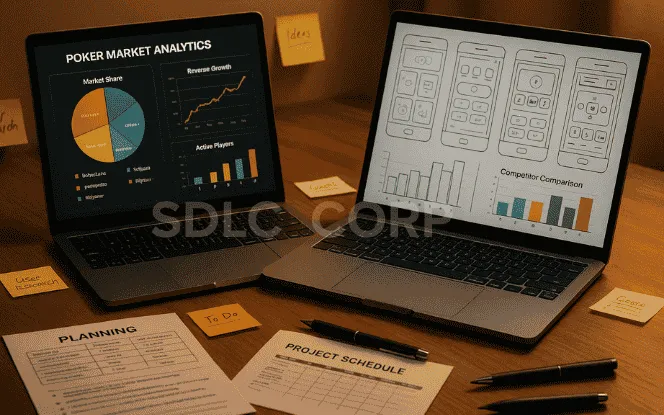
Market research should answer practical product questions. Which player segment is underserved? Which game formats are expected in the target region? Are users looking for quick casual sessions, competitive tournaments, social rooms, or a branded poker platform with wallet and admin controls? The answers shape the first release.
Define the first playable release
Do not try to launch every variant and every promotion on day one. A focused MVP might include one poker variant, a clean lobby, account registration, secure wallet or chip flow, hand history, basic admin controls, and a small set of tournaments.
Study competing poker apps carefully
Review their onboarding, lobby structure, table speed, payment flow, tournament registration, support screens, app reviews, and complaint patterns. User reviews often reveal gaps that sales pages hide: slow withdrawals, unstable tables, poor customer support, or confusing chip systems.
Confirm legal and payment assumptions early
Target markets decide whether you need KYC, AML workflows, geolocation, responsible gaming tools, tax reporting, or payment restrictions. These items should be designed into the product, not added after development is complete.
Design the App Around Fast Decisions
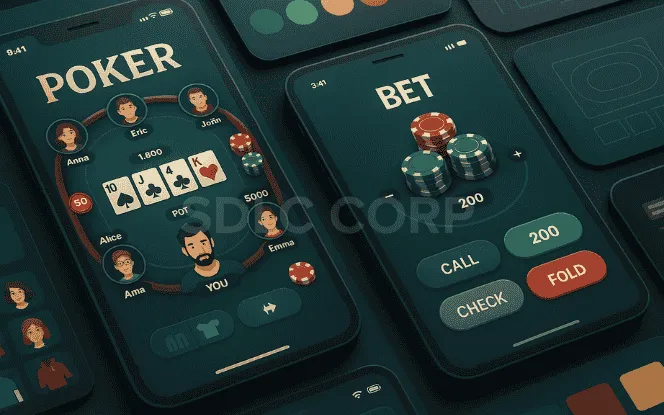
Poker players make repeated decisions under time pressure. The interface should make table actions easy to read and difficult to mis-tap. Every visual element has a job: cards must be clear, buttons must be reachable, chip values must be visible, timers must be obvious, and the player should always understand the current game state.
| Design area | What to get right | Common mistake |
|---|---|---|
| Lobby | Clear filters for game type, blinds, player count, tournaments, private tables, and availability. | Showing too many rooms without sorting or useful filters. |
| Table screen | Readable cards, pot value, action buttons, timer, seat status, and player balance. | Overloading the table with animations and promotional banners. |
| Wallet or chip flow | Simple deposit, withdrawal, bonus, transaction history, and balance-state messaging. | Showing a balance number without explaining pending, locked, or bonus amounts. |
| Mobile layout | Thumb-friendly buttons, compact action areas, and stable table view on smaller devices. | Designing for desktop first and shrinking the experience later. |
Build the Core Platform Architecture
The development phase should be planned around the systems that protect gameplay integrity. A poker app needs a game client, server-authoritative table logic, account services, wallet events, tournament rules, back-office tools, support workflows, and monitoring. The architecture must keep game state consistent even when players disconnect, payments retry, or traffic spikes.
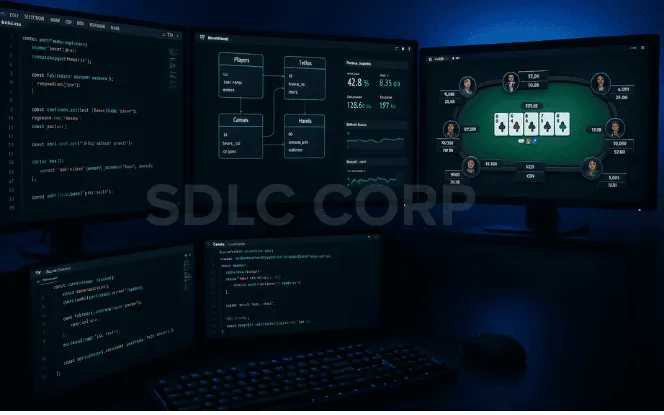
Game client
The client manages the lobby, table visuals, player actions, cards, chips, animations, chat, notifications, and device-specific performance. It should never be trusted as the final authority for game outcomes.
Game server
The server should own table state, hand progression, player actions, timeouts, blinds, side pots, hand ranking, reconnect behavior, and the event log used for dispute handling.
Wallet and ledger
Every balance change should create a traceable event. Deposits, withdrawals, bets, wins, rake, refunds, and manual adjustments need a ledger trail rather than a simple balance update.
Admin and operations
Operators need user management, table controls, tournament settings, risk flags, reports, support access, permission roles, and audit logs for sensitive actions.
When the product needs source-code ownership, custom table logic, wallet workflows, and operator-specific admin controls, custom poker app development is usually the safer path than forcing a generic template to fit a complex business model.
Select the Technology Stack Based on Gameplay Needs
The best stack depends on latency needs, supported devices, target regions, payment model, and long-term maintenance. Avoid choosing tools only because they are popular. Poker requires stable real-time communication, predictable server behavior, fast reconnects, and reliable data storage.
| Layer | Common choices | Selection criteria |
|---|---|---|
| Client app | Native mobile, Flutter, React Native, Unity, Cocos | Device coverage, animation needs, team capability, app performance, and release speed. |
| Real-time transport | WebSockets, Socket.IO, custom socket services | Latency, reconnect behavior, message ordering, monitoring, and ability to handle table spikes. |
| Backend services | Node.js, Go, Java, .NET, Python | Concurrency, developer availability, maintainability, payment integrations, and operational support. |
| Databases | PostgreSQL, MySQL, MongoDB, Redis | Ledger integrity, hand-history storage, reporting, caching, and session/state management. |
| Cloud and DevOps | AWS, Google Cloud, Azure, DigitalOcean | Regions, scaling, uptime, backup, monitoring, deployment workflow, and cost control. |
Plan Payments, Wallets, and Security Before Launch
Payments and wallets are high-risk areas. A poker app may look polished, but if the wallet cannot reconcile deposits, withdrawals, wagers, wins, rake, and reversals, the operation will struggle. Even social poker apps need reliable chip records, bonus rules, refund handling, and support visibility.
Wallet accuracy
Use immutable ledger entries, reconciliation reports, clear balance states, and approval workflows for manual changes.
Data security
Protect authentication, sessions, payment references, private data, admin access, and sensitive logs with layered controls.
Fair-play controls
Plan anti-collusion checks, device signals, multi-account detection, suspicious timing patterns, and investigation workflows.
Test the Product Like an Operator, Not Just Like a User
Quality assurance should cover more than whether buttons work. Poker QA must test hand logic, side pots, all-in scenarios, reconnects, timeouts, tournament breaks, table balancing, wallet events, payment retries, admin actions, permissions, fraud flags, and support cases.
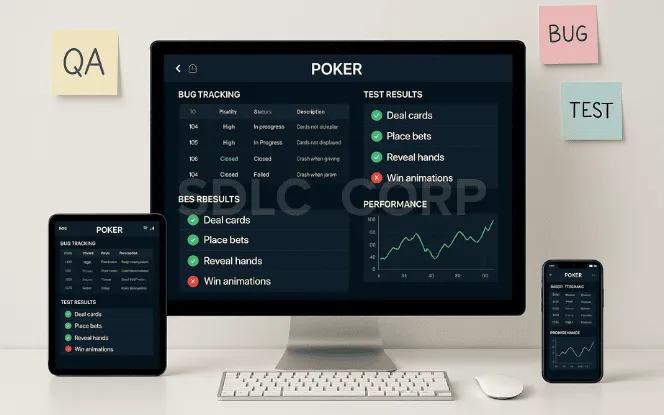
Gameplay QA
- Betting actions, fold/call/raise rules, side pots, blinds, and timeout behavior.
- Hand ranking, winner calculation, split pots, and tournament progression.
- Reconnect behavior during active hands and unstable network conditions.
Operational QA
- Deposits, withdrawals, refunds, bonuses, and failed payment retries.
- Admin permissions, audit logs, support workflows, and account actions.
- Load tests for concurrent tables, tournament peaks, and lobby activity.
Launch Strategy: Start Smaller, Measure Faster
A staged launch reduces risk. Start with a limited geography, controlled player group, lower table limits, or a small set of tournaments. During the first weeks, watch wallet reconciliation, dispute frequency, support tickets, crash logs, table stability, retention, and payment success rates.
| Launch stage | Focus | Success signal |
|---|---|---|
| Private beta | Gameplay, UI clarity, crashes, support flow, and early feedback. | Players can complete sessions without confusion or technical failure. |
| Limited market release | Payments, wallet reconciliation, retention, fraud rules, and load behavior. | Operations team can monitor, investigate, and resolve issues quickly. |
| Scale-up | More variants, tournaments, promotions, regions, and payment options. | Growth does not create unstable tables, payment disputes, or support backlog. |
Poker App Development Cost Factors
Cost depends on the amount of custom logic, number of platforms, table and tournament complexity, wallet model, admin scope, security requirements, compliance workflows, and post-launch support. A simple MVP and a real-money operator platform should not be estimated the same way.
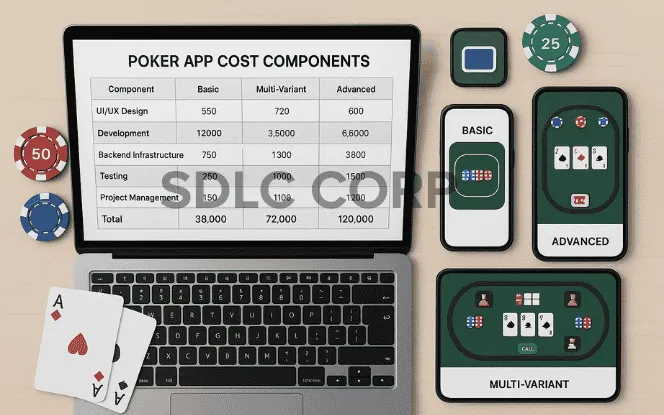
| Build type | What it usually includes | Estimated range |
|---|---|---|
| Basic MVP | One poker variant, simple lobby, account login, basic chip flow, limited admin, and standard UI. | $10,000 – $25,000+ |
| Multi-feature app | Multiple variants, multiplayer tables, wallet, chat, leaderboards, improved UI, and stronger admin tools. | $25,000 – $75,000+ |
| Advanced platform | Tournaments, real-money flows, anti-cheat, analytics, KYC support, audit logs, scalable backend, and monitoring. | $75,000 – $150,000+ |
| Monthly support | Bug fixes, security patches, server monitoring, feature improvements, and platform maintenance. | $2,000 – $8,000+ / month |
For deeper pricing details, use the dedicated poker app development cost breakdown. Keep this guide focused on the full build process, and let the cost page handle detailed pricing comparisons.
Build a Poker App With the Right Foundation
SDLC Corp helps teams plan poker products around gameplay, wallets, tournaments, back-office operations, security, QA, and launch readiness. The goal is not just to release an app, but to create a platform that operators can manage and players can trust.
Discuss Your Poker App RoadmapFinal Takeaway
A poker app succeeds when the product is planned around real operating conditions. The visible table experience matters, but the systems behind it matter more: table state, wallet accuracy, hand history, support access, fair-play signals, payment handling, security, and post-launch monitoring.
Teams that define the product model early, keep the first release focused, and build with operational visibility usually avoid the most expensive rework later. That is the difference between launching a poker app and building a poker platform that can grow.