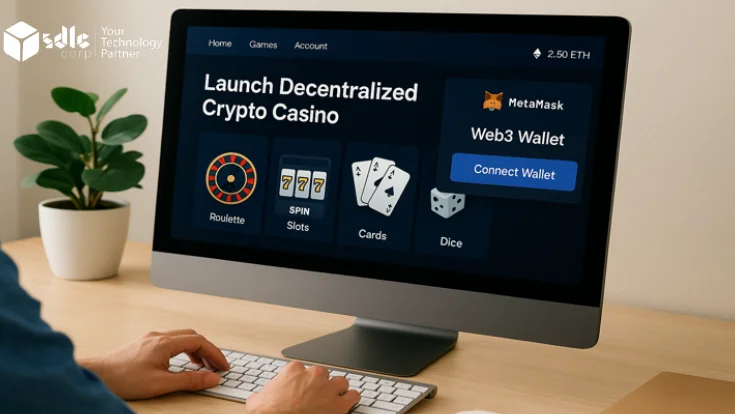
A decentralized crypto casino uses blockchain infrastructure for payments, game settlement, and records — replacing the trust-us-because-we-say-so model of traditional online casinos with smart contracts that players can inspect. For operators, the appeal is faster settlement, wallet-native login, and on-chain audit trails. For players, the draw is verifiable fairness and custody of funds. This guide covers everything you need to decide before you build: legal framework, chain selection, smart contract architecture, wallet UX, security, revenue models, and cost.
This post covers the build: how to design and launch a decentralized crypto casino from scratch. For the broader casino platform stack (wallet, compliance, backend), see our online casino software guide. For monetisation strategy across casino products, see our casino monetization guide.
What is a decentralized crypto casino?
A decentralized casino uses blockchain components instead of relying on a single central operator to hold funds, run game logic, and report outcomes. In practice, that means wallet login, on-chain deposits and withdrawals, smart-contract-enforced payout rules, and records any player can verify independently.
Most production products are hybrid — not fully on-chain. A practical architecture typically uses:
- Smart contracts for treasury management, settlement rules, and payout execution
- Off-chain game client for the user experience — rendering, animation, session state — where full on-chain execution would be too slow and expensive
- Provably fair RNG — either commit-reveal schemes on-chain or Verifiable Random Functions (VRFs) from services like Chainlink VRF — for games where outcome randomness must be publicly verifiable
- Wallet-based login (MetaMask, WalletConnect, Trust Wallet) replacing username/password authentication
Decentralized vs crypto-accepting: A casino that accepts Bitcoin as a deposit method but runs on a centralised server is not a decentralized casino — it is a crypto-payment casino. A decentralized casino's defining characteristic is that core financial rules (payouts, treasury, house edge enforcement) are encoded in smart contracts the operator cannot unilaterally modify after deployment.
Why operators are launching decentralized crypto casinos

- Verifiable fairness as a product differentiator: In traditional online casinos, players trust the operator's word that games are fair. In a decentralized casino, the settlement logic is in a public smart contract — players can verify it independently. This is a genuine product advantage in markets where player trust in operators is low.
- Wallet-native payments: On-chain deposits and withdrawals remove the friction of bank transfers, card chargebacks, and PSP approval delays. Settlement can be near-instant. For crypto-native players this is a significant UX improvement.
- Access to the crypto-native player base: Players who hold ETH, USDC, SOL, or BNB and prefer not to convert to fiat for online gaming represent an underserved segment. A well-built crypto casino product captures this directly.
- No revenue share: Unlike white-label casino solutions that charge ongoing revenue share, a custom decentralized casino gives you full ownership of the product and all generated revenue after launch.
- Programmable tokenomics: Token rewards, staking, and DAO governance can be built into the product architecture from day one — mechanics that are difficult to retrofit into traditional casino platforms.
Step 1 — Legal and regulatory requirements for crypto casinos

Start with legal, not code. Crypto gambling is legal in some jurisdictions and prohibited in others — and the "decentralized" label does not exempt a product from gambling regulation in most markets. If money changes hands and outcomes are random, regulators in most jurisdictions treat it as gambling regardless of the underlying infrastructure.
- Licensing jurisdictions for crypto casinos: Curaçao (GCB) is the most common starting point for crypto-native gambling operators — it explicitly accommodates virtual currency operations and has a faster approval timeline than Malta or the UK. See our gambling licence guide for a full jurisdiction comparison.
- KYC and AML obligations apply regardless of decentralization: A crypto casino that does not collect player identity faces AML risk in most jurisdictions. Even products that launch without KYC typically implement it as volume grows — regulators follow the money on-chain with increasing sophistication.
- Geo-blocking is mandatory: The US (most states), UK, France, Netherlands, and other regulated markets require specific local licences to serve players. Your smart contracts cannot enforce this — you must implement IP-based and wallet-based geo-blocking at the application layer.
- Token classification risk: If your casino issues a native token, securities regulators in some jurisdictions may classify it as a security, triggering registration requirements. Get legal advice on token structure before issuing any token.
Do not build first and ask legal questions later. The cost of retrofitting KYC, geo-blocking, and compliance reporting into a launched product is significantly higher than building them correctly from the start. Legal review before development is not optional for any product that accepts real money.
Step 2 — Choosing the right blockchain for your crypto casino
Your chain choice affects transaction fees, confirmation speed, wallet ecosystem, developer tooling, and player UX. There is no universally best chain — the right choice depends on your game types, target player geography, and team skills.
| Chain | Tx fees | Speed | Wallet ecosystem | Dev tooling | Best for |
|---|---|---|---|---|---|
| Ethereum | High (variable) | ~12s finality | Largest | Mature | High-value, less-frequent transactions; institutional credibility |
| Polygon (PoS) | Very low | ~2s | Large (EVM) | Mature EVM | High-frequency games (slots, dice) on EVM; low-cost player actions |
| BNB Chain | Low | ~3s | Large | EVM-compatible | Asian player base; cost-sensitive deployments |
| Solana | Near-zero | <1s | Growing | Rust/Anchor | Very high-frequency games; sophisticated dev team with Solana experience |
| Arbitrum / Base | Low (L2) | Fast | EVM | EVM-compatible | Ethereum security with lower fees; good for DeFi-adjacent products |
Practical starting point for most teams: Polygon or BNB Chain for a first launch — low fees, large wallet ecosystem, EVM compatibility (Solidity contracts, MetaMask support), and straightforward tooling. Start on one chain. Multi-chain support can be added after launch once the core product is proven.
Step 3 — Designing the decentralized crypto casino architecture

The most important architectural decision is deciding what goes on-chain and what stays off-chain. Putting too much on-chain creates a slow, expensive game experience. Putting too little on-chain removes the trust properties that make a decentralized casino worth building.
What goes on-chain
- Treasury contract: Holds player deposits and house funds. Controls withdrawals and payout execution. This is the core trust primitive — players need to know their funds are in a contract the operator cannot simply drain.
- Settlement logic: Win/loss determination for provably fair games. The settlement rule is public and immutable after deployment (or upgradeable via a transparent governance mechanism).
- Payout execution: Automated transfer of winnings from the treasury contract to the player wallet. No manual approval required.
- Token contracts: If you issue a native token for rewards or governance, its issuance and distribution rules live on-chain.
What stays off-chain
- Game rendering and UX: Slot reels spinning, card animations, roulette wheel — everything visual. Running this on-chain would cost thousands of dollars per second in gas.
- Game state for fast-paced games: In-game session state (current bet, current hand) is managed off-chain with periodic settlement posts to the contract.
- Player database: Account data, KYC records, responsible gambling settings, session history — stored off-chain with standard database infrastructure.
- Admin and back office: Risk management, player support tools, reporting — traditional web application.
Provably fair RNG implementation
For games where outcome randomness must be publicly verifiable:
- Chainlink VRF: The most production-ready option for EVM chains. The VRF contract generates a random number with a cryptographic proof that it cannot have been manipulated by the operator or the oracle. Costs per request vary by chain and gas price.
- Commit-reveal scheme: The operator commits to a seed before the game round, the player contributes entropy, and the final outcome is derived from both after the round closes. Lower cost than VRF but requires trust in the operator's commit mechanism.
- Hash-based provably fair: Common in traditional provably fair casinos — server seed + client seed + nonce → SHA256 hash → game outcome. Verifiable post-round but not on-chain unless you post the proof to the contract.
Step 4 — Game selection for a crypto casino launch

Launch with a small, well-tested game set. A clear, fair product with three games beats a large lobby with untested mechanics. You can expand the game library post-launch once the core infrastructure is proven.
- Dice and coin flip: Simplest on-chain settlement logic. Binary outcome, immediate settlement, easy to make provably fair. Good first game for any decentralized casino — lets you prove the fairness model before adding complexity.
- Roulette: Familiar to players, straightforward settlement rules, easily adapted to on-chain randomness. Slightly more complex settlement contract than dice but still manageable as a second game.
- Slots: High repeat-play frequency — the most important game category for revenue. Settlement is more complex (payline calculations), but the off-chain rendering and on-chain outcome post model is well understood. Strong for player retention once the math and pacing are tuned.
- Blackjack or video poker: Multi-step games with player decisions. Harder to implement provably fairly because game state evolves across multiple actions. Better to add these after the simpler games are running well and audited.
Get your game contracts audited before mainnet launch. A single bug in a slot payout calculation or a reentrancy vulnerability in the treasury contract can drain the entire house fund. Budget for at least one professional smart contract audit — from firms like OpenZeppelin, Certik, or Trail of Bits — before real money goes on-chain.
Step 5 — Wallet integration and payment flows

Wallet login replaces the traditional email/password flow. The wallet UX is one of the highest-friction points in crypto casino onboarding — bad wallet UX causes abandonment before a player ever places a bet.
Wallet support to include at launch
- MetaMask: The most common EVM wallet. Desktop browser extension and mobile app. Required support for any EVM chain deployment.
- WalletConnect: Protocol that connects mobile wallets to desktop dApps via QR code. Adds support for hundreds of wallets through one integration. Essential for mobile player acquisition.
- Coinbase Wallet: Growing user base, especially in the US. Worth adding if North America is a target market (with appropriate geo-blocking for regulated states).
Payment flow design
- Show the full transaction before signing: Display chain, token, amount, estimated gas cost, and what the transaction does — before asking the player to sign. Players who are surprised by a gas fee abandon at that point and rarely return.
- Support stablecoins at launch: USDC and USDT remove price volatility from the player's balance — a player who deposits 100 USDC knows exactly what their balance is worth regardless of ETH price movements. Most serious crypto casino players prefer stablecoin play.
- Keep the initial asset list small: Support 2–3 assets well rather than 15 assets badly. Adding more currencies is straightforward post-launch; debugging a failed deposit flow for an obscure token during peak traffic is not.
- Automatic withdrawal where possible: If your treasury contract can execute payouts automatically on win settlement, do it. Manual withdrawal steps add friction and create support ticket volume.
Step 6 — Testing, security, and staged launch for a crypto casino

Before mainnet launch, test as if both real players and adversarial attackers are using the product simultaneously. Smart contract bugs and UX failures are both expensive — but contract bugs can be catastrophic.
Trust features that define a strong decentralized crypto casino
The features below are what separates a crypto casino that retains players from one that sees high acquisition and immediate churn. Each one addresses a specific player concern about on-chain gaming.


Revenue models for a decentralized crypto casino

Good revenue is easy for players to understand. Avoid models that create hidden extraction — they damage the trust that the decentralized model is designed to build.
- House edge: The most transparent and defensible model. The house edge is encoded in the smart contract and visible to any player who reads it. A publicly auditable house edge is a stronger trust signal than a competitor's "certified fair" badge. Typical house edges: dice/roulette 1–3%, slots 3–8%.
- Transaction fees on withdrawals: A small flat fee on withdrawals (in addition to gas) can contribute to revenue, but keep it visibly disclosed at deposit time. Surprise fees on withdrawal are the fastest way to generate negative reviews.
- Token staking yield from house revenue: A portion of house edge revenue distributed to token stakers. This creates a buyer of your token with a fundamental reason to hold it beyond speculation — the token represents a claim on ongoing house revenue.
- Premium memberships / VIP tiers: Subscription access to higher game limits, faster withdrawals, or exclusive game variants. Works when the value is clearly stated and the base experience is strong enough to retain non-paying players who contribute to table and lobby fill.
For a detailed breakdown of casino monetisation tactics and how to sequence them, see our casino monetization strategies guide.
Build cost for a decentralized crypto casino
Cost is driven by contract complexity, game count, frontend quality, audit scope, and legal/compliance setup. The ranges below reflect market rates for experienced blockchain game development teams.
The audit cost is non-negotiable. A professional smart contract audit from a reputable firm costs $15,000–$50,000 depending on contract complexity. Do not skip it to hit a budget. The cost of a single exploit that drains your treasury is the entire product — and the reputational damage is permanent in the crypto community.
Security checklist for a decentralized crypto casino
- Smart contract audit by a reputable firm before any mainnet deployment with real funds
- Reentrancy protection on all functions that transfer funds — the most common critical vulnerability in casino contracts
- Admin key management — multisig wallet (Gnosis Safe) for all privileged contract functions, never a single EOA
- Treasury split — separate hot wallet (for immediate payouts) and reserve (cold storage) with defined rules for moving between them
- Upgrade mechanism — if contracts are upgradeable (proxy pattern), the upgrade key must be behind multisig and the upgrade process must be time-locked and publicly announced
- Sandwich attack protection — monitor for patterns where a wallet makes large deposits immediately before and after triggering a provably fair game round
- Bot and rapid-retry detection — on-chain activity monitoring for automated abuse of bonus mechanics or RNG retry patterns
- Incident response plan — documented procedure for what the team does if a payout contract fails or a treasury drain begins. Who has authority to pause contracts? How fast can you act?
FAQ — Launching a decentralized crypto casino
How do I launch a decentralized crypto casino?
Start with legal review and licensing before writing any code. Select your target jurisdictions, get a gaming licence (Curaçao GCB is the most common starting point for crypto casinos), then choose your blockchain based on fee structure and wallet ecosystem. Design a hybrid architecture with smart contracts handling treasury and settlement while the game client runs off-chain. Commission a smart contract audit before mainnet deployment, run a closed beta, and launch with a capped treasury. See our gambling licence guide for the regulatory process.
How much does it cost to build a decentralized crypto casino?
A lean MVP with 2–3 games (dice, roulette, slots) on a single chain costs approximately $35,000–$65,000 and takes 2–3 months with an experienced team. A full platform with 5–10 games, native token, DAO governance, KYC integration, and a professional smart contract audit runs $100,000–$250,000+. The smart contract audit ($15,000–$50,000 depending on complexity) is the single most important non-negotiable budget item.
Which blockchain is best for a crypto casino?
Polygon and BNB Chain are the most practical starting points for most teams — low transaction fees, large wallet ecosystems (MetaMask, WalletConnect), EVM compatibility (Solidity contracts, familiar tooling), and straightforward deployment. Ethereum is better for high-value, infrequent transactions where credibility matters more than fee cost. Solana supports very high-frequency, low-latency games but requires a team experienced with Rust and the Solana stack. Start on one chain and add more post-launch.
Do crypto casinos need a gambling licence?
Yes in most jurisdictions — the "decentralized" label does not exempt a product from gambling regulation where money changes hands on random outcomes. Curaçao (GCB) is the most common licence for crypto casino operators due to its explicit accommodation of virtual currency operations, faster approval (~2–4 months), and lower cost than Malta or the UK. The licence also improves banking access and PSP relationships. Operating without any licence creates regulatory, banking, and player-trust risk as the product grows.
What is provably fair RNG and how does it work?
Provably fair RNG allows players to verify that a game outcome was generated fairly — that the operator did not know the result in advance and could not have manipulated it. The most production-ready implementation for on-chain casinos is Chainlink VRF, which generates a random number with a cryptographic proof verifiable on-chain. Commit-reveal schemes are a lower-cost alternative: the operator commits to a seed before the round, the player contributes entropy, and the final outcome is derived from both. Players can verify any historical round by checking the on-chain inputs and the published derivation formula.
What is the difference between a white-label and a custom crypto casino?
A white-label crypto casino uses an existing platform's smart contracts, games, and backend — you brand and market it, they operate the underlying infrastructure. Faster and cheaper to launch ($10,000–$30,000 setup plus ongoing revenue share), but you have no control over the contract code, game logic, or token economics. A custom build takes longer (2–9 months) and costs more ($35,000–$250,000+), but you own the contracts, own all revenue, and can implement any game, token, or governance mechanic you want. For a B2B operator looking to differentiate, custom is usually the right long-term choice.