To develop a game like Clash Royale you need to engineer a specific type of real-time competitive experience: a 1v1 card-based tower defence battle that resolves in under three minutes, with a deep card collection meta, synchronous real-time gameplay at mobile network latency, and a trophy-ranked matchmaking system that keeps every skill level engaged. Clash Royale, developed by Supercell and launched in 2016, generates over $300 million annually and remains one of the highest-grossing mobile games globally. This guide covers the core mechanics, technology stack, development process, and realistic cost to build a Clash Royale-inspired title.
How this differs from our other mobile game guides: Our Free Fire guide covers battle royale with 50-player lobbies. Our PUBG guide covers realistic military simulation. Clash Royale is a fundamentally different category — a synchronous 1v1 real-time strategy card game played in 3-minute sessions on mobile, with a collectible card meta and asynchronous trophy progression. The technical challenges (deterministic real-time sync at mobile latency, card balance across hundreds of combinations) and the design challenges (session length, meta health) are unique to this genre.
$300M+
Annual revenue at peak
3 min
Target match duration
Unity
Primary engine — C++ networking layer
160+
Cards in the collection
What makes Clash Royale technically distinct as a game to develop
Clash Royale is not a card game that added real-time elements — it is a real-time strategy game that uses cards as its interaction layer. The distinction matters for development because the engineering challenges are primarily from the real-time strategy side, not the card game side.
- Synchronous real-time at mobile latency: Both players see the same game state simultaneously. Cards placed by one player must appear on the opponent's screen within milliseconds — across mobile networks that may have 50–200ms latency. Clash Royale uses a deterministic lockstep model: both clients run identical simulations, and the server only transmits input events (card plays, positions), not state. This eliminates bandwidth requirements for physics state but requires both simulations to be perfectly identical — any floating-point divergence causes the dreaded desync.
- The Elixir resource mechanic: Elixir regenerates at a fixed rate (one unit per 2.8 seconds; faster in overtime) and each card costs a specific Elixir amount. This creates the core strategic tension — spend Elixir now or accumulate for a bigger play. Implementing this correctly requires the Elixir counter to tick identically on both clients and the server with no drift over a 3-minute match.
- Three-lane tower structure: Two side towers and one King Tower per player, each with independent HP pools. A card's area of effect must correctly intersect with tower hitboxes. Projectile trajectories (arrows, rockets, spells) must be calculated identically on both clients. The King Tower's activation rule (only activates when a Princess Tower falls) is a specific game state transition that must fire at exactly the same moment on both sides.
- Card collection with hundreds of combinations: With 160+ cards, each combination of eight-card deck has interactions with every other card. Balance is not a launch-day task — it is a continuous live operations function. Clash Royale releases balance patches every two weeks. Your game needs a balance tooling pipeline built into the back office from day one.
- Session-length product design: Three minutes is not an accident — it is precisely calibrated to fit in a commute, a queue, or a break. Overtime (30-second sudden death with double Elixir) adds a pressure crescendo that ends matches decisively. Your session length, overtime mechanic, and win/loss state must all be designed together as a single pacing system.
Key features to develop in a Clash Royale-like game
Card collection and deck building
Players collect cards across rarity tiers (Common, Rare, Epic, Legendary) through chests, the shop, and battle rewards. Each card can be upgraded using duplicates and gold. The deck builder allows players to select eight cards from their collection. The system must validate deck legality (no duplicate cards), display Elixir cost distribution, and surface card level mismatches for matchmaking purposes.
Real-time 1v1 battle system
The core loop: both players start with four cards in hand, draw from their shuffled deck as cards are played, manage Elixir regeneration, and place cards by tapping on the arena half. The battle runs for 3 minutes standard, followed by 1 minute of single overtime and then sudden death. Towers accumulate damage from troops and spells. Win condition: destroy more towers than the opponent; instant win if the King Tower falls.
Trophy-based matchmaking and arenas
Players accumulate trophies by winning matches and lose them by losing. Trophy count gates access to arenas — each arena has a distinct visual theme and unlocks a new card pool. Matchmaking pairs players within a narrow trophy range to ensure competitive balance. A separate King Level (account level) and card levels also factor into skill assessment. The matchmaking algorithm must find matches quickly — a 30-second wait is acceptable on mobile; 90 seconds is not.
Chest reward system and progression
Players earn chests by winning battles. A chest queue holds four slots — chests must be unlocked over real time (2 hours to 12 hours depending on rarity). This timed unlock mechanic is the core retention loop: players return after the timer expires to collect rewards and queue the next chest. Chests contain cards, gold, and gems. The chest type earned rotates through a fixed cycle (players can look up the next Crown Chest or Magical Chest in their cycle).
Clan system and card donations
Clans allow players to request and donate cards to each other — the primary free card acquisition mechanic. Players can request specific cards up to twice per day; clan members can donate up to the daily cap. Card donations generate XP for both donor and recipient. The Clan Wars feature adds asynchronous competitive play between clans, adding a layer of progression separate from the individual trophy ladder.
Pass Royale and seasonal content
Clash Royale operates a seasonal model with a Battle Pass (Pass Royale) offering cosmetic rewards, extra chests, and gold bonuses for paid subscribers. Each season introduces a new card, balance changes, and seasonal cosmetics. The season system requires a backend with season state management, pass progression tracking per player, and a live ops pipeline for releasing new content without full app updates.
Technology stack for developing a Clash Royale-like game
Game Engine
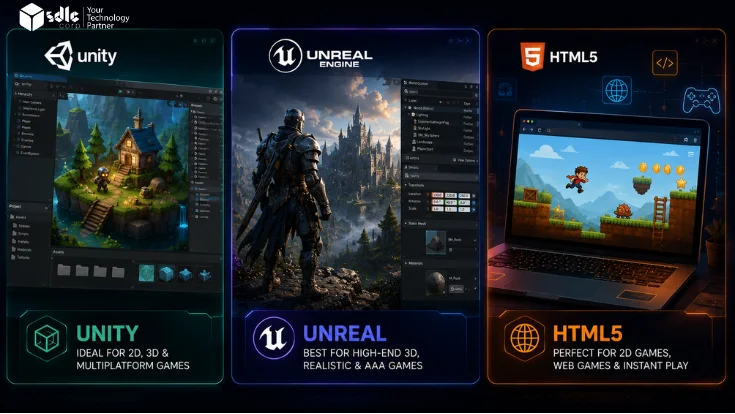
Unity — the standard choice for mobile card/strategy games. Clash Royale is built on Unity with a custom C++ networking layer. Unity's 2D physics, animation system, and mobile performance optimisation tools are well-suited to this genre. Use Unity 2022 LTS or 2023 LTS for best mobile support.
Networking Model
Deterministic lockstep — both clients run identical physics simulations. Only input events (card play, position) are transmitted, not game state. Requires strict floating-point determinism (use fixed-point math for physics). Latency compensation via input delay buffering (Ggpo-style rollback for fast connections).
Backend
Node.js or Go for the matchmaking service and game session coordinator. Dedicated game servers (one per active match) for the authoritative simulation referee. Game server instances spun up on demand via AWS GameLift or custom orchestration.
Database
PostgreSQL for player accounts, card collections, trophy records, and progression. Redis for matchmaking queues, active session state, and leaderboard rankings. MySQL for card catalogue and static game data.
Real-time Messaging
WebSocket for the battle session (low-latency bidirectional). Kafka for async event processing — battle results, chest awards, clan activity. Redis Pub/Sub for matchmaking notifications (match found signal to clients).
Infrastructure
AWS with auto-scaling game server fleet. CloudFront CDN for asset delivery (card art, animations, audio). AWS GameLift for dedicated server fleet management. Multi-region deployment (US East, EU West, Asia Pacific) to minimise matchmaking latency.
Art Pipeline
Spine for 2D skeletal animation (Clash Royale's troop animations are Spine-based — smooth, compact file sizes). Adobe Animate or Toon Boom for frame-by-frame animations. Photoshop / Illustrator for card art and UI assets.
Anti-Cheat
Server-side simulation referee validates all client-reported match outcomes. Clients cannot self-report wins. Replay validation — server replays the match from stored inputs to verify the reported outcome matches. Rate limiting on card play events to prevent automated play injection.
Analytics
Amplitude or GameAnalytics for player behaviour telemetry (deck usage, match outcomes by card combination, chest funnel conversion). Card balance analytics requires custom tooling — win rates by card, by deck archetype, by arena tier.
Step-by-step development process for a Clash Royale-like game
1
Core battle loop prototype
Before art, before cards, before matchmaking — build the core 1v1 arena with two towers per side, Elixir regeneration, and one test card that can be placed. Validate that the deterministic lockstep model works across two devices on your target network conditions. This is the highest-risk technical component — if the simulation diverges, the entire game breaks. Spend 4–6 weeks proving this works before committing to the full game.
2
Card system and 10–15 launch cards
Design the card archetypes: troops (ground, air, building-targeting), spells (area damage, direct damage, support), buildings (towers, traps). Implement 10–15 cards covering each archetype for prototype testing. Card balance requires play data — design for testability (easily adjustable stats without a code deployment) using a data-driven card configuration system where stat changes are JSON edits, not code changes.
3
Matchmaking and session management
Build the matchmaking queue: players submit trophy count and deck; the system pairs players within a configurable trophy band. Session creation: allocate a dedicated game server, exchange connection details with both clients, start the match. Handle disconnection gracefully — a player who disconnects should be able to reconnect to an in-progress match within 30 seconds without losing the session.
4
Progression and chest system
Implement the chest queue (four slots), timed unlock mechanics, and card/gold distributions by chest rarity. The progression system is the primary retention and monetisation driver — the decision points (wait for the free chest or use gems to unlock now) must be tuned for optimal conversion without feeling exploitative. Test the chest cycle length against daily active session targets.
5
Art production and card expansion
Once the system is stable, commission full art production: card illustrations, troop animations (Spine), arena themes, UI assets. Expand to 40–60 launch cards covering all archetypes. Each card needs: portrait art, in-game model/animation set, sound effects, and a tuned stat profile. Art production is the primary cost driver at this stage — budget accordingly.
6
Clan system, social features, and live ops tools
Build clan creation, clan search, card request/donation system, and clan chat. Implement the back office tools your live ops team needs: card stat editor, event configuration, season management, chest cycle control, and push notification templates. Launch without live ops tooling and you will be making emergency code deployments to fix balance issues.
7
Soft launch, balance pass, global launch
Soft launch in 2–3 markets (Supercell traditionally soft launches in Canada, Finland, and Australia) to collect real match data. Run balance analysis: which cards have above 55% win rate at each arena? Which deck archetypes dominate the meta? Ship a balance patch before global launch. Monitor day-1, day-7, and day-30 retention against benchmarks. Global launch only when D7 retention exceeds 25%.
Cost to develop a game like Clash Royale
| Component | Proof of concept | Full launch | Notes |
|---|
| Core battle engine | $30k–$60k | $60k–$150k | Deterministic lockstep networking, arena physics, card placement, Elixir system. Highest-risk component. |
| Card system (20–60 cards) | $20k–$40k | $60k–$150k | Data-driven card config, stat balancing tools, rarity system, upgrade mechanics. Scales with card count. |
| Art and animation | $30k–$80k | $100k–$300k | Card portraits, Spine troop animations, arena art, UI. Largest cost driver at full production quality. |
| Matchmaking and servers | $15k–$40k | $40k–$100k | Matchmaking service, dedicated game server fleet, session management. Ongoing AWS costs scale with concurrent players. |
| Progression and monetisation | $15k–$35k | $35k–$80k | Chest system, Pass Royale, shop, gem purchases, card donations. Payment processing integration. |
| Clan and social systems | $10k–$25k | $25k–$60k | Clan creation, card requests/donations, clan wars, social graph. |
| Back office and live ops tools | $10k–$25k | $25k–$60k | Card stat editor, event management, balance tooling, analytics dashboard. Non-negotiable for post-launch. |
| QA and soft launch | $10k–$20k | $20k–$50k | Structured QA including network condition simulation, balance testing, performance testing on target devices. |
| Total — POC / MVP | $100k–$250k | — | Playable 1v1 with 15–20 cards, basic chest system, no clans, one arena. |
| Total — full launch | — | $350k–$1M+ | 40–60 cards, full art production, clan system, Pass Royale, multi-region servers, live ops tooling. |
The card balance investment is ongoing, not one-time. Clash Royale ships balance updates every two weeks. Budget for a dedicated game designer on the live ops team from launch — card balance is a full-time job once the game has real match data flowing. Our Unity game development team delivers projects with the live ops tooling built in from the start.
Game development services we deliver

Mobile card games

Real-time multiplayer

Unity development

Game backend & servers

UI/UX design

Art & animation

Monetisation systems

QA & testing

Analytics & live ops

Cross-platform

Matchmaking systems

Post-launch support

Card art & design

MVP prototyping

Soft launch support
FAQ — Developing a game like Clash Royale
How much does it cost to develop a game like Clash Royale?
A proof-of-concept with a playable 1v1 battle system, 15–20 cards, and a basic chest reward loop costs approximately $100,000–$250,000. A full launch-quality game with 40–60 cards, full art production, clan system, Pass Royale, multi-region servers, and live ops tooling runs $350,000–$1M+. The largest cost driver is art production — Spine-animated troops and high-quality card illustrations represent 40–50% of total art budget. See our game development services for a scoped estimate.
How long does it take to develop a Clash Royale-like game?
A playable proof-of-concept takes 4–6 months with a focused team. A full launch-quality mobile card battle game with 40+ cards, clan system, and matchmaking takes 14–24 months. The critical path is usually the card art production (each card needs portrait art, in-game animation, and sound effects) and the deterministic networking validation (proving the lockstep simulation does not diverge across real-world mobile network conditions).
What is the hardest part of building a Clash Royale-like game?
Deterministic lockstep networking on mobile. Both players run identical physics simulations — any floating-point divergence between the two clients causes a desync that breaks the match. This requires using fixed-point arithmetic for all physics calculations (not floating-point), rigorously testing across different device models and OS versions, and implementing a rollback or resync mechanism for minor divergences before they compound into visible desyncs.
What game engine is best for a Clash Royale-like game?
Unity is the industry standard for mobile card and strategy games. Clash Royale itself is built in Unity with a custom C++ networking layer for the deterministic simulation. Unity's 2D physics, Spine animation integration, mobile performance tooling, and the large pool of experienced Unity mobile developers make it the practical choice. Use Unity 2022 LTS or 2023 LTS for mobile projects requiring long-term stability.
How do you monetise a Clash Royale-like game?
The core monetisation model is chest acceleration (paying gems to unlock chests instantly rather than waiting), the Pass Royale battle pass (monthly subscription with extra chests, gold, and cosmetics), and the shop (direct card and resource purchases). The model is free-to-play with cosmetics and progression acceleration — not pay-to-win. Card levels do affect power, which creates some competitive tension, but the community tolerates this because competitive play (tournaments, challenges) uses equalised card levels. For monetisation architecture, see our game monetisation guide.