Introduction
South Africa’s online casino market is growing fast. But operators must follow strict licensing and compliance rules. The right licence and software can reduce legal risk This guide explains a safer way to enter the market.
Key Insights
- Online casino licences are not directly issued, but fixed-odds betting licences create a compliant pathway.
- Provincial regulators control approvals and enforce operational standards.
- Mobile-first infrastructure is essential due to dominant smartphone usage.
- Local payment rails directly impact conversion and retention.
- Advertising restrictions require controlled acquisition strategies.
- Compliance design determines long-term sustainability.

Industry Resources
A guide to getting an iGaming licence in South Africa, with legal requirements and application steps. It also covers AML/KYC, responsible gaming, and ongoing compliance.
Download Resource1. Overview of the South African Online Casino Market
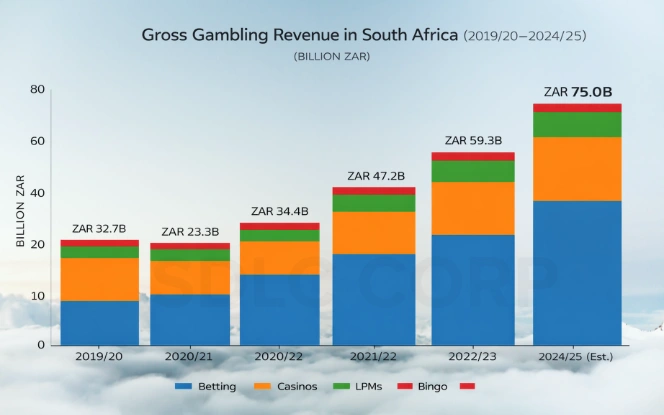
South Africa’s gambling industry is expanding at a sustained pace, led primarily by betting activity. In the 2023/24 financial year, gross gambling revenue (GGR) reached approximately ZAR 59.3 billion, reflecting more than 25% year-on-year growth. Moreover, betting now accounts for the majority share of total gambling revenue, clearly outperforming traditional casino and limited payout machine segments.
Digital participation continues to accelerate. South Africa has over 50 million internet users, and smartphone access dominates online activity. Therefore, most betting transactions now occur on mobile devices rather than desktop systems. In addition, fixed-odds betting licenses issued at the provincial level enable operators to legally offer casino-style products within a regulated structure.
Market forecasts project continued online expansion through 2030, supported by mobile adoption and growing consumer familiarity with digital wagering. However, regulatory oversight remains provincial and compliance-focused. As a result, operators who combine legal precision with mobile-first execution hold the strongest competitive advantage.
Note: FY2024/25 values are estimated; final audited figures may differ.
2. Is Online Casino Legal in South Africa in 2026?
South Africa uses a dual regulatory system in which national law sets the framework and provincial boards issue and enforce licences, but Section 11 of the National Gambling Act still says no one may offer an “interactive game” unless a national law authorises it; the NGB FAQ also states that online gambling is not legal, while online betting is legal only through a licensed South African bookmaker.
This distinction is the central issue for operators: provincial authorities can license betting and monitor licence conditions, while the NGB provides oversight, and its October 2025 notice on the SCA ruling states that bookmakers may not offer fixed-odds bets on casino games such as roulette and must remain within their licensed gambling mode.
For operators comparing entry models, it helps to first review the broader launch process in how to start an online casino: a step-by-step guide, then adapt that framework to South Africa’s stricter legal structure. As a result, in 2026, a standalone online casino model is not a legally safe entry route in South Africa; a compliant strategy should focus on licensed online betting, strict product classification, and provincial licence conditions, with any “casino-style” expansion treated as a legal-risk matter requiring formal local counsel review before launch.
3. How Licensing Works for Online iGaming Businesses in South Africa
Licensing in South Africa works at the provincial level, not through one national online gambling license. National law sets the legal framework, while provincial gambling boards issue licenses and enforce conditions. Therefore, operators must choose the correct product model first. In practice, lawful remote activity is usually structured through licensed betting/bookmaker routes, not a standalone online casino license.
The process typically includes province selection, application filing, and regulator review of ownership, funding, key persons, and operating controls. In addition, regulators assess AML/KYC systems, responsible gambling and self-exclusion controls, and technical readiness before approval. Fees and license categories vary by province, so operators should use province-specific fee schedules in ZAR and avoid relying on generic national cost estimates.
Summary of Gambling Licence Costs in South Africa
South Africa does not have one national licence fee table. Fees are set by each province, so costs vary by licence type and regulator. Therefore, use a provincial benchmark for planning and review the Western Cape Gambling and Racing Board fee schedule before applying.
The table below uses Western Cape public tariffs as a budgeting reference. These figures are useful for estimates, but they are not a national standard.
| Licence Cost Item (Western Cape Benchmark) | New Application Fee | Annual Licence Fee | Annual Investigation Fee |
|---|---|---|---|
| Bookmaker | ZAR 15,096 | ZAR 3,028 | ZAR 12,089 |
| Bookmaker Premises | ZAR 15,096 | ZAR 614 | ZAR 1,507 |
| Key Employee | ZAR 614 | ZAR 163 | ZAR 614 |
| Casino Operator | ZAR 604,111 | ZAR 302,056 | ZAR 9,063 per table + ZAR 6,043 per slot |
Also budget for legal, compliance, and technical setup costs. In most cases, the total launch cost is much higher than the tariff table alone.
4. Choosing the Right Online Casino Business Model
Your business model determines licensing fit, launch speed, margin, and operational control in South Africa.
It must align with the provincial bookmaker/fixed-odds route, so do not choose only by game catalog or price.
Check who controls KYC, payments, player wallet, reporting, and responsible gambling tools.
When evaluating your stack, review what is included in an online casino software solution to map components to local compliance needs.
Many new entrants start with faster models, then shift to higher-control setups after operations stabilize.
1) White-Label Model
The white-label model is ideal for fast market entry and lower upfront cost. In this setup, the vendor usually controls the system, wallet, games, and a large part of the compliance stack, while the operator focuses on branding and player acquisition. If you are assessing whether this route fits your launch strategy, reviewing the top features of a white-label casino solution can help clarify what is typically included and where control limitations usually appear. However, margins are usually lower, customization is limited, and access to player data may be restricted. Therefore, this model is better suited for testing market demand before making a larger investment.
2) Turnkey Model
The turnkey model is ideal for operators who want a balance between launch speed and operational control. In this structure, the vendor provides the system, back office, and integrations, while the operator manages branding, marketing, and day-to-day operations. As a result, operators usually get stronger control over CRM, bonuses, and reporting than in a white-label setup. Moreover, launch time is still shorter than a fully custom build, which makes this model a strong option for regulated market entry.
3) Fully Owned System Model
The fully owned system model is best for long-term control and scale. In this approach, the operator controls the system, payment integrations, player wallet logic, CRM, and data pipeline. This improves margins and allows deeper optimization across risk management, retention, and business intelligence. However, it also requires the highest budget, a strong internal technical team, and mature compliance capabilities. Therefore, this model is most suitable for operators with strong capital and a long-term growth strategy.
5. Steps to Enter the South African Online Casino Market
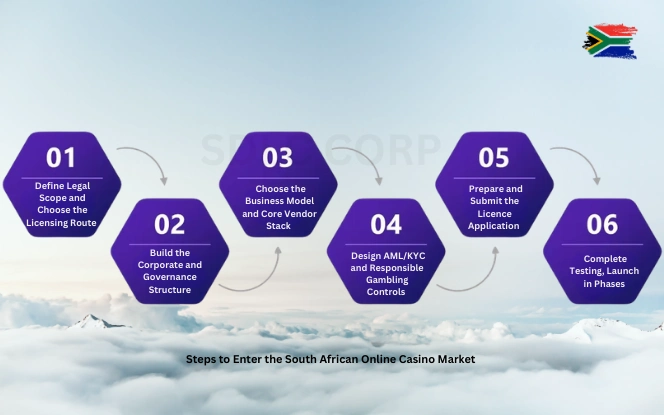
Entering South Africa requires a compliance-first rollout, not a marketing-first launch.
Therefore, the first step is to define a lawful product scope under a provincial bookmaker/fixed-odds route. If you start with the wrong structure, later work on system, payments, and acquisition can become unusable.
A strong entry plan also separates licensing, technical setup, and commercial launch into clear phases. Moreover, this reduces rework during regulator review. In practice, operators that move in the right order launch faster and face fewer approval delays.
1) Define Legal Scope and Choose the Licensing Route
Start by defining exactly what you plan to offer, including sports betting products and any casino-style content boundaries. Then map that product scope to a lawful provincial licence route, usually under a bookmaker/fixed-odds structure. This step is critical because product misclassification can block approval or create enforcement risk later.
2) Build the Corporate and Governance Structure
Create the operating entity and document ownership, directors, key employees, and decision-making roles. Prepare source-of-funds evidence, shareholder records, and management disclosures for regulator review. At this stage, clear governance improves suitability checks and reduces delays in background investigations.
3) Choose the Business Model and Core Vendor Stack
Select a white-label, turnkey, or fully owned system model based on budget, control, and launch speed. After that, choose system, payments, KYC/AML, game content, and support vendors with audit-ready systems. Vendor contracts should clearly define data access, reporting rights, uptime obligations, and compliance responsibilities.
4) Design AML/KYC and Responsible Gambling Controls
Build onboarding rules for identity verification, age checks, and risk-based customer due diligence. Then configure transaction monitoring, alert thresholds, escalation workflows, and record-keeping processes. You should also implement deposit limits, self-exclusion, and player protection controls before application submission.
5) Prepare and Submit the Licence Application
Compile the full application pack, including the business plan, financial model, ownership documents, and control policies. Include operational procedures for payments, fraud response, customer support, and responsible gambling handling. A complete and internally consistent submission improves review efficiency and reduces regulator follow-up cycles.
6) Complete Testing, Launch in Phases, and Monitor Compliance
Before launch, test KYC flows, deposits, withdrawals, bonus logic, fraud flags, reporting outputs, and incident handling. Then launch in phases with controlled traffic so you can verify system stability and compliance reporting accuracy. Scale marketing only after payments, player support, and control systems perform consistently under live conditions.
6. AML/KYC System Design for an Online Casino Business
AML/KYC must be built into the system from day one, not added after launch. In South Africa, the system should support a risk-based process across signup, deposits, gameplay, and withdrawals. Therefore, identity checks, payment controls, and monitoring rules should work in one connected workflow. If these systems run separately, teams miss risk signals and create reporting gaps.
A strong AML/KYC setup protects revenue and improves compliance readiness. Moreover, it helps prevent fraud, bonus abuse, mule accounts, and suspicious transaction activity before it scales. In practice, high-performing operators use auditable workflows, consistent escalation rules, and clear recordkeeping to maintain control as player volume grows.
Core AML/KYC Design Requirements
- Risk-based onboarding (CDD/KYC): verify identity, age, contact details, and payment ownership at signup.
- PEP/sanctions screening: screen at onboarding and re-screen users during the customer lifecycle.
- Transaction monitoring: track deposits, withdrawals, betting velocity, linked accounts, and device reuse.
- Alert and case management: route flagged activity into review queues with evidence, notes, and decision history.
- Audit logs and control governance: log rule triggers, overrides, and actions with role-based access and secure retention.
7. Payment Solutions and Banking for Online Casinos
Payment setup is a core growth lever in South Africa, not just an operations function. South Africa had 51.7 million internet users by the end of 2025, with 127 million mobile connections, and 98.7% of those connections were broadband-capable. Therefore, deposits and withdrawals must work fast on mobile, with short checkout flows and low failure rates. In parallel, the gambling market is large enough to justify this investment: the NGB reported R59.3 billion GGR in FY2023/24, and betting generated 60.5% of total GGR, which signals high transaction volume and strong digital payment dependency.
A strong SA-facing payment stack should use multiple rails in ZAR, not a single method or bank. PPRO’s South Africa market data shows a mixed payment landscape, with cards (43%), bank transfers (22%), and e-wallets (20%) all playing meaningful roles in online transactions; moreover, South African shoppers complete almost 50% of online purchases on mobile devices. As a result, operators should combine local card acquiring, EFT/A2A options, wallet support, and payout controls with bank-grade reconciliation, name matching, and AML/KYC-linked withdrawal checks. This structure improves conversion, reduces settlement risk, and supports cleaner audits as transaction volumes grow.
8. RNG, Game Fairness, and Certification Readiness
RNG and game fairness should be treated as licensing-grade controls, not marketing claims. In South Africa, operators must be able to show that game outcomes are random, rules are clear, and payout behavior matches the approved game setup. Therefore, each live game should be mapped to a valid certificate, exact version ID, RTP setting, and release record. If a game build changes without control, the fairness evidence may no longer be defensible.
Certification readiness also depends on release discipline and evidence management. For example, operators should keep one audit-ready register that tracks supplier name, game ID, version, RTP, certificate reference, deployment date, and production checksum/hash. Teams can also review GLI standards while preparing technical certification evidence. Moreover, they should define re-certification triggers for game updates, RTP changes, engine changes, or major integration changes. In practice, this structure reduces launch delays, speeds up dispute handling, and improves regulator response time.
What to Keep Ready Before Launch
Certification register: game title, supplier, game/version ID, RTP setting, certificate reference, and go-live date.
Build integrity controls: pre-production and production checksum/hash validation to confirm the certified build was deployed.
Release and change control: approvals, test evidence, rollback plan, and post-release validation for every game update.
Fairness and dispute evidence: gameplay logs, result logs, wallet transaction logs, and a documented player dispute workflow.
Re-certification trigger matrix: clear rules for when updates require re-testing or new certification evidence.
9. Cost of Starting an Online Casino in South Africa
There is no fixed cost to start an online casino in South Africa. The final budget depends on the province, licence route, business model (white-label, turnkey, or owned system), number of games, compliance setup, and launch scale. Therefore, this section should present approximate starting ranges, not one fixed number.
In most cases, operators underestimate non-software costs. Licensing fees may look manageable at first, but legal work, AML/KYC setup, payments integration, staffing, tax planning through marketing usually drive the real budget. As a result, the best approach is to present a starting cost table and clearly state that costs increase based on requirements and growth targets.
Approximate Startup Cost for an Online Casino in South Africa (ZAR)
| Cost Item | Approx. Starting Range (ZAR) | Notes |
|---|---|---|
| Provincial licensing & regulatory fees | From ~ZAR 50,000+ | Varies by province, licence type, and number of key persons |
| Legal, compliance & application preparation | ZAR 150,000 – ZAR 1,500,000+ | Includes legal structuring, policy drafting, and filing support |
| Casino software / system setup | ZAR 500,000 – ZAR 20,000,000+ | Depends on white-label, turnkey, or owned system model |
| Game content & aggregation | ZAR 100,000 – ZAR 2,000,000+ | Changes with supplier mix, game count, and commercial terms |
| KYC/AML, fraud & compliance tools | ZAR 50,000 – ZAR 1,000,000+ | Based on automation level and vendor stack |
| Payments & banking integration | ZAR 50,000 – ZAR 500,000+ | Excludes ongoing transaction fees |
| Operations team (pre-launch + early months) | ZAR 300,000 – ZAR 3,000,000+ | Support, compliance, risk, finance, and CRM staffing |
| Marketing & player acquisition launch budget | ZAR 250,000 – ZAR 10,000,000+ | Depends on brand strategy, channels, and CAC targets |
10. Ongoing Compliance Obligations
Compliance in South Africa continues after licence approval. Operators must keep their provincial licence active, follow licence conditions, and show licence information on the website homepage. In addition, gambling access must be restricted to 18+ users, and online betting is allowed only through licensed South African bookmakers.
AML/CFT duties are also ongoing. Gambling institutions must maintain a risk-based compliance program (RMCP), apply ongoing due diligence, monitor transactions, and keep records that support audits and regulatory reporting. Moreover, these controls must work in daily operations, not only in policy documents.
Key Ongoing Obligations
Maintain licence conditions and renewals: keep approvals current and aligned with the exact activities offered.
Run ongoing KYC/CDD: verify customers at onboarding and update due diligence during the customer relationship.
Monitor and report suspicious activity: file STR/SAR reports as soon as possible, and review the FIC reporting obligations for timing and reporting duties.
Handle cash and sanctions reporting correctly: report cash transactions over R49,999.99 and submit a TPR if a client matches the TFS list.
Keep records for 5 years: retain CDD, transaction, and report-related records for the required statutory periods.
Responsible Gambling Support in South Africa
Gambling and betting platforms should always include responsible gambling controls such as age checks, deposit limits, self-exclusion tools, reality checks, and player support access.
If gambling stops being entertainment or starts causing financial, emotional, or family problems, users can contact the National Responsible Gambling Programme and self-exclusion support for help.
South Africa responsible gambling support: users can call the toll-free helpline 0800 006 008. Users can also access self-exclusion support if they need to restrict gambling access.
Conclusion
Starting an online casino business in South Africa requires more than a strong brand or game portfolio. The market has clear commercial potential, but success depends on correct licensing strategy, compliance-ready systems, local payment support, and a mobile-first user experience. Therefore, operators who build the legal and technical foundation first are more likely to scale without disruption.
The strongest approach is to treat launch as a regulated operations project, not only a marketing rollout. In practice, the right business model, software stack, AML/KYC design, and certification controls will shape long-term performance. If these elements are planned correctly from day one, South Africa can become a sustainable and scalable market for growth.
FAQ's
How much does an online gambling licence cost in South Africa?
The cost of an online gambling licence in South Africa varies by province and gambling type. Typical costs include: application fee (ZAR 10,000–50,000), initial licence fee (ZAR 250,000–2,500,000), annual renewal (ZAR 100,000–1,000,000), and software/system certification (ZAR 50,000–200,000).
How much money do you need to start an online casino?
The total cost to start an online casino depends on your business model. Estimated Year 1 investment:
● White-label startup: $100,000–$250,000
● Turnkey launch: $500,000–$2,000,000
● Independent build: $2,500,000–$10,000,000+
Which online casino is highly rated in South Africa?
Based on your 2026 win-rate list, the leading online casino sites in South Africa are:
● Panther Bet – 97.36%
● Jackpot City Casino – 97.87%
● Betway – 97.55%
● 10bet – 98.14%
Is gambling tax-free in South Africa?
No. A 15% withholding tax applies to gambling winnings of R25,000 or more. Winnings below R25,000 are generally paid in full. This applies to casino winnings, betting, lottery payouts, and online gambling. For current tax guidance, users should review SARS.
How do you open an online casino in South Africa?
To start an online casino business in South Africa, register a local company, apply for a provincial gambling licence, and choose a compliant B2B system vendor.
Use AML/KYC-ready software, legal betting products, and local payment support to launch compliantly and scale.
How big is the online gambling market in South Africa?
Online betting sites now account for 85.5% of all betting revenue in South Africa.
Mobile betting has helped drive a 550% increase in online gambling over the past four years.