Introduction
Artificial Intelligence (AI) and Machine Learning (ML) are revolutionizing the gaming industry, bringing smarter gameplay, personalized experiences, and enhanced security to Ludo games. From adaptive AI opponents to fraud detection and predictive analytics, AI-driven technologies are redefining how players interact with digital Ludo games.
This blog explores how AI and ML enhance Ludo games, improving opponent intelligence, user engagement, real-time decision-making, and fair play mechanisms for a more dynamic gaming experience.

AI-Powered Smart Opponents in Ludo Games
Adaptive AI-Based Bots for Single-Player Mode
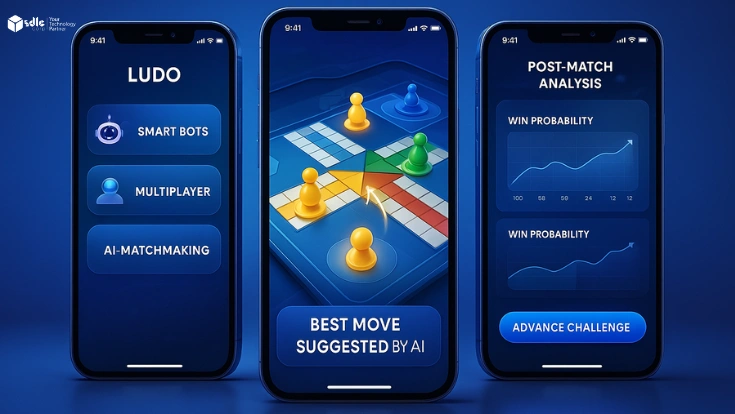
Many players enjoy solo gaming, but traditional AI opponents often become predictable, which reduces the challenge and overall excitement. Modern AI-driven bots solve this issue by adapting to the player’s style in real time. Working with an experienced ML development company makes it easier to build these advanced systems with accuracy and consistent performance.
AI-powered bots enhance gameplay by:
Learning from player behavior and adjusting difficulty levels dynamically
Using decision-making algorithms to create more human-like actions
Avoiding repetitive patterns, offering fresh and varied challenges
Example: An AI opponent can analyze a player’s strategy and counter it with smarter, more strategic moves, resulting in a more engaging and rewarding single-player experience.
Machine Learning for Personalized Ludo Game Experiences
Player Behavior Analysis for Customization
ML algorithms analyze game history, playstyle, and engagement metrics to tailor the gaming experience.
AI-based personalization includes:
- Dynamic difficulty adjustments based on player skills.
- Custom in-game recommendations for themes, tokens, and boards.
- Predictive move suggestions to assist new players.
Example: A casual player may receive simplified AI opponents, while experienced users face more challenging bots.
AI-Driven Predictive Analytics for Engagement & Retention
Understanding Player Behavior for Retention Strategies
AI tracks in-game actions to predict player drop-offs and suggest retention strategies.
ML-based analytics help in:
- Identifying when a player is likely to leave the game.
- Triggering incentives like rewards, discounts, or personalized game invites.
- Recommending tournaments or in-game events based on past activity.
Example: If a player frequently leaves matches midway, AI sends a real-time incentive (e.g., bonus coins) to encourage continued gameplay.
AI for Fraud Detection & Fair Play in Ludo Games

Preventing Cheating & Game Manipulation
AI ensures fairness and integrity in online Ludo games by detecting:
- Unusual dice roll patterns indicating hacked RNG systems.
- Multi-account abuse where users exploit referral programs.
- Bots & automated scripts used to manipulate gameplay.
AI-based fraud prevention includes:
- Anomaly detection models to flag suspicious activity.
- Blockchain-powered game verification for transparent results.
- Real-time intervention to warn or ban unfair players.
Example: If AI detects a player winning every dice roll unnaturally, it triggers a manual review or an automatic gameplay restriction.
Enhancing Multiplayer Matchmaking with AI
Smart Matchmaking Algorithms for Balanced Gameplay
AI-powered matchmaking ensures fair competition by pairing players of similar skill levels.
Key AI-based matchmaking benefits:
- Avoids mismatched games between beginners and expert players.
- Uses historical game data to create competitive yet fair matches.
- Adapts player rankings dynamically based on win/loss history.
Example: A beginner will not face a high-ranking player, improving retention and enjoyment.
For implementation, our enterprise AI development company can help you operationalize the strategies and use cases discussed in this article.

AI-Driven Chatbots & Customer Support
AI-Powered Chatbots for Real-Time Assistance
AI enhances in-game customer support by automating issue resolution and answering FAQs instantly.
AI chatbots in Ludo games:
- Provide instant responses to common queries (e.g., game rules, payment issues).
- Offer multilingual support for a global player base.
- Detect player frustration and escalate critical issues to human support.
Example: If a player loses progress due to a bug, an AI chatbot can retrieve saved data and restore the game session instantly.
Future of AI in Ludo Games: What’s Next?

AI-Generated Game Strategies & Coaching
Future Ludo games could feature AI-powered in-game coaching, where:
- AI analyzes player decisions and suggests better strategies.
- Players receive real-time guidance on dice roll probabilities.
AI for Augmented Reality (AR) Ludo Games
AI is being integrated with AR-based Ludo games, allowing:
- Real-world environments as game boards.
Voice-Controlled Ludo Games with AI Assistants
Voice-enabled AI can allow players to control moves, roll dice, or chat using voice commands.
Example: A player can say, “Roll my dice”, and AI executes the action in-game.
To turn these ideas into production-ready solutions, partnering with expert AI development services can help you design, build, and scale your AI initiatives.

Conclusion
AI and Machine Learning are reshaping the Ludo gaming experience by enabling smarter gameplay, personalized engagement, and stronger fraud detection. With AI-powered bots, predictive analytics, and automated matchmaking systems, Ludo games are becoming more immersive, fair, and enjoyable for players.
A development team that works with an experienced AI consulting company can build advanced Ludo platforms supported by real-time analytics, adaptive difficulty settings, and smooth multiplayer interactions.
By integrating AI into the development process, creators can deliver intelligent, dynamic, and future-ready Ludo games that drive long-term retention and sustain high engagement levels.