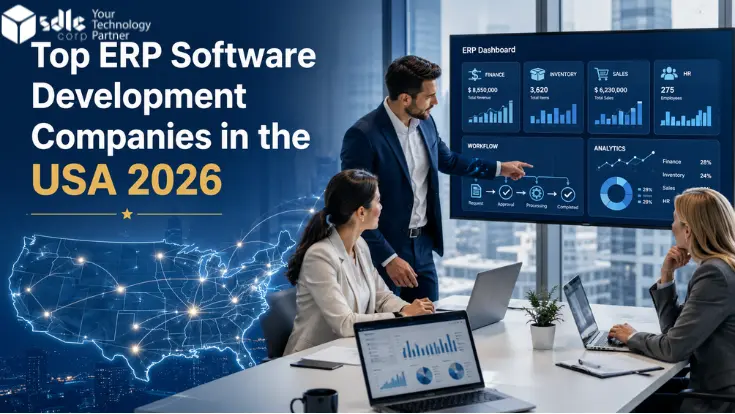
The top 10 ERP development companies in the USA include SDLC Corp, Appinventiv, Fingent, Matiyas Solutions, Itransition, and other trusted providers.
This guide compares their ERP services, industry experience, pricing, integrations, migration, and support to help you choose the right company.
ERP software connects core business functions in one system, reducing manual work and improving data accuracy. The right ERP development company also supports smooth migration, integration, testing, and long-term maintenance.
As a result, this guide compares leading ERP software development companies in the USA based on expertise, delivery capability, and project fit.
Top ERP Software Development Companies in USA 2026
Each ERP company serves a different business need. SDLC Corp supports custom ERP development, Odoo implementation, integrations, data migration, testing, and long-term support. However, other providers may focus on enterprise ERP projects, software modernization, manufacturing systems, ERP consulting, or independent project advisory.
Therefore, review each company’s ERP experience, industry knowledge, delivery process, platform expertise, pricing, and support model before making your decision. In practice, the right provider will depend on your current systems, required modules, integrations, number of users, budget, and launch timeline.
Because company services, team sizes, pricing, and client ratings may change, check recent profiles, official websites, client reviews, and contract terms before starting your ERP project.
SDLC Corp

Best for businesses seeking custom ERP, Odoo, integrations, migration, and long-term support from one delivery partner.
SDLC Corp provides custom ERP development, system integration, migration, and long-term support. Businesses that need tailored modules can explore its Odoo development services. In addition, its Odoo implementation services help connect finance, inventory, sales, HR, manufacturing, and reporting. As a result, the company can support startups, growing businesses, and large enterprises across multiple industries.
- Core strengths: Custom ERP development, Odoo, integrations, migration, automation, and long-term support
- Engagement model: Full-cycle projects, dedicated teams, staff augmentation, and ongoing support
- U.S. delivery model: U.S.-headquartered with global engineering capacity
- Industries: Manufacturing, logistics, retail, healthcare, finance, eCommerce, and professional services
- Security and ownership: Secure development practices, code reviews, data controls, and clearly defined ownership terms
- Public Clutch pricing: $25–$49/hr; 250–999 employees; 5.0/5 (view source)
Plan Your ERP Build With SDLC Corp
Define the scope, platform, integrations, migration plan, and delivery model before implementation starts.
Appinventiv

Best for larger digital transformation programs that combine ERP, enterprise software, cloud, mobile, and AI.
Appinventiv develops enterprise software, ERP platforms, mobile applications, and AI-powered business solutions. In addition, it supports product planning, cloud integration, testing, and modernization. Therefore, the company may suit large and complex digital transformation projects.
- Core strengths: Enterprise software, ERP platforms, cloud, mobile applications, AI, and modernization
- Engagement model: Full-cycle digital transformation, dedicated teams, and product engineering
- U.S. delivery model: U.S.-aligned client collaboration with global delivery teams
- Industries: Healthcare, finance, retail, logistics, technology, and consumer services
- Security and ownership: Project governance, secure development, documentation, and contract-based IP ownership
- Public Clutch pricing: $25–$49/hr; 1,000–9,999 employees; 4.6/5 (view source)
Fingent

Best for businesses that need custom enterprise software or an Odoo-focused ERP implementation.
Fingent builds custom enterprise software and ERP solutions around specific business processes. In addition, its services cover software consulting, cloud development, integrations, automation, and application modernization. As a result, Clutch clients frequently highlight its communication, flexibility, and reliable delivery.
- Core strengths: Custom ERP, Odoo, enterprise software, cloud development, automation, and integrations
- Engagement model: Consulting, full-cycle development, and long-term application support
- U.S. delivery model: U.S.-based client support with distributed engineering teams
- Industries: Healthcare, finance, real estate, education, logistics, and professional services
- Security and ownership: Structured testing, documented delivery, secure access controls, and contract-defined ownership
- Public Clutch pricing: $25–$49/hr; 250–999 employees; 4.9/5 (view source)
Matiyas Solutions
Best for businesses seeking ERPNext implementation, customization, integrations, migration, training, and long-term support from one delivery partner.
Matiyas Solutions is a certified Frappe & ERPNext partner providing end-to-end ERPNext implementation, customization, system integration, data migration, user training, and ongoing support. Its team helps businesses configure ERPNext around their operational requirements, including finance, inventory, manufacturing, CRM, HR, projects, sales, and other core business functions. Matiyas serves startups, SMEs, and growing enterprises across multiple industries and international markets.
- Core strengths: ERPNext implementation, customization, integrations, data migration, automation, training, and ongoing support
- Engagement model: Fixed-scope projects, consulting, implementation services, dedicated resources, and ongoing support
- U.S. delivery model: Remote and on-site ERP consulting and implementation support for clients across North America and other international markets
- Industries: Manufacturing, healthcare, retail, trading & distribution, logistics, professional services, construction, pharmaceuticals, agriculture, nonprofit, and more
- Delivery and maintainability: Upgrade-safe ERPNext customization, documented development, testing, training, and knowledge transfer
- Public Clutch pricing: $25–$40/hr; 1–50 employees; 5.0/5 (view source)
Itransition

Best for large organizations that need ERP engineering, Microsoft Dynamics 365, integrations, and managed services.
Itransition provides ERP engineering, enterprise application development, automation, integration, and managed IT services. In addition, its team works with Microsoft Dynamics 365, cloud platforms, business intelligence, and custom software systems. Therefore, the company may suit large organizations with complex technology environments.
- Core strengths: ERP engineering, Dynamics 365, enterprise applications, automation, cloud, and business intelligence
- Engagement model: Consulting, full-cycle delivery, managed services, and dedicated teams
- U.S. delivery model: U.S. client support with distributed global delivery
- Industries: Finance, healthcare, manufacturing, retail, logistics, and business services
- Security and ownership: Documented architecture, security reviews, access controls, and contract-based ownership
- Public Clutch pricing: $25–$49/hr; 1,000–9,999 employees; 4.9/5 (view source)
Panorama Consulting Group

Best for independent ERP selection, transformation planning, implementation oversight, and change management.
Panorama Consulting Group helps organizations select, plan, and manage ERP and digital transformation projects. In addition, its consultants support software selection, process improvement, implementation management, contract negotiation, and organizational change. Because the firm remains independent of ERP vendors, buyers can use it for vendor-neutral advice.
- Core strengths: ERP selection, business process improvement, implementation oversight, and change management
- Engagement model: Independent ERP advisory and transformation consulting
- U.S. delivery model: U.S.-based consulting team serving national and global clients
- Industries: Manufacturing, distribution, retail, public sector, healthcare, and professional services
- Security and ownership: Vendor-neutral advisory, documented governance, contract review, and client-controlled data
- Estimated planning rate: $100–$149/hr; 50–249 employees; 4.6/5 (view source)
Ultra Consultants

Best for manufacturing and distribution companies planning ERP transformation and process improvement.
Ultra Consultants specializes in ERP transformation for manufacturing and distribution companies. In addition, its services include technology selection, process improvement, implementation management, vendor negotiation, and change management. Therefore, the firm may suit businesses with complex production and supply-chain operations.
- Core strengths: Manufacturing ERP, process improvement, software selection, implementation management, and change support
- Engagement model: Independent consulting, vendor selection, and implementation advisory
- U.S. delivery model: U.S.-based consulting delivery
- Industries: Manufacturing, distribution, supply chain, industrial products, and consumer goods
- Security and ownership: Vendor-neutral consulting, governance planning, documented requirements, and client-owned decisions
- Estimated planning rate: $125–$175/hr; 50–249 employees; 5.0/5 (view source)
Third Stage Consulting Group

Best for businesses seeking independent ERP advice, digital strategy, implementation support, and organizational change.
Third Stage Consulting Group provides independent ERP and digital transformation advisory services. In addition, its team helps businesses select software, improve processes, manage implementations, develop digital strategies, and prepare employees for change. Because the firm does not represent a specific ERP vendor, it can provide vendor-neutral guidance.
- Core strengths: ERP selection, digital strategy, implementation support, process improvement, and change readiness
- Engagement model: Independent advisory and transformation consulting
- U.S. delivery model: U.S.-based consulting with remote and on-site support
- Industries: Manufacturing, distribution, healthcare, retail, public sector, and services
- Security and ownership: Independent guidance, documented governance, client-controlled data, and clear advisory scope
- Estimated planning rate: $50–$99/hr; confirm directly with the company
Iflexion

Best for businesses that need a tailored enterprise platform instead of a standard ERP product.
Iflexion develops enterprise web applications, business portals, workflow systems, mobile applications, and custom operational platforms. In addition, its team handles consulting, interface design, development, integration, testing, and support. Therefore, the company may suit businesses that need a tailored platform rather than standard software.
- Core strengths: Custom enterprise platforms, business portals, workflows, mobile apps, integration, and support
- Engagement model: Full-cycle custom software development and long-term maintenance
- U.S. delivery model: U.S.-aligned client collaboration with distributed engineering teams
- Industries: Healthcare, finance, retail, education, travel, and professional services
- Security and ownership: Custom architecture, secure development, source-code delivery, and contract-defined IP ownership
- Pricing: Custom quote; contact the company for current team and rate details
Radixweb

Best for cloud-based enterprise software, legacy modernization, integrations, and long-term product improvement.
Radixweb builds and modernizes enterprise software using cloud, AI, data engineering, and secure application architecture. In addition, its services include custom software development, legacy modernization, integrations, cloud-native systems, and ongoing product improvement. Therefore, the company can support growing businesses and large enterprises.
- Core strengths: Cloud-native ERP, enterprise software, modernization, integrations, AI, and data engineering
- Engagement model: Full-cycle development, modernization, dedicated teams, and ongoing product support
- U.S. delivery model: U.S.-aligned client support with global engineering delivery
- Industries: Healthcare, finance, manufacturing, logistics, retail, and technology
- Security and ownership: Secure architecture, code reviews, data controls, documentation, and contract-defined ownership
- Public Clutch pricing: $25–$49/hr; 250–999 employees; 4.8/5 (view source)
Quick Comparison of the Top ERP Development Companies in the USA
Use this table to compare the leading ERP development companies by project fit, delivery model, U.S. collaboration, and public pricing.
| Company | Best For | Delivery Model | U.S. Delivery Model | Public Pricing |
|---|---|---|---|---|
| SDLC Corp | Custom ERP, Odoo, integrations, migration, and support | Full-cycle projects, dedicated teams, and ongoing support | U.S.-headquartered with global engineering capacity | $25–$49/hr |
| Appinventiv | Large ERP and digital transformation programs | Full-cycle transformation and product engineering | U.S.-aligned collaboration with global delivery | $25–$49/hr |
| Fingent | Custom ERP and Odoo-focused implementations | Consulting, full-cycle development, and support | U.S.-based support with distributed delivery | $25–$49/hr |
| Matiyas Solutions | ERPNext implementation, customization, integrations, migration, and support | Fixed-scope projects, consulting, dedicated resources, and ongoing support | Remote and on-site ERP support for North American clients | $25–$40/hr |
| Itransition | Dynamics 365, ERP engineering, and integrations | Consulting, full-cycle delivery, and managed services | U.S. client support with global delivery | $25–$49/hr |
| Panorama Consulting Group | Independent ERP selection and implementation oversight | Vendor-neutral ERP advisory and transformation consulting | U.S.-based consulting team | $100–$149/hr* |
| Ultra Consultants | Manufacturing and distribution ERP transformation | Independent consulting and implementation advisory | U.S.-based consulting delivery | $125–$175/hr* |
| Third Stage Consulting Group | ERP strategy, software selection, and change readiness | Independent advisory and transformation consulting | U.S.-based remote and on-site support | $150–$199/hr* |
| Iflexion | Tailored enterprise platforms and workflow systems | Full-cycle custom software development | U.S.-aligned collaboration with distributed teams | $50–$99/hr* |
| Radixweb | Cloud ERP, modernization, integrations, and product improvement | Full-cycle development, dedicated teams, and support | U.S.-aligned support with global engineering delivery | $25–$49/hr |
Published rates and ratings are directory signals and may change. However, rates marked with an asterisk (*) are planning estimates rather than verified company-published prices. Therefore, confirm current pricing, team availability, and contract terms directly with each provider.
Turn Your ERP Shortlist Into a Clear Delivery Plan
Define the platform, modules, integrations, migration plan, budget, and delivery model before implementation starts.
How Much Does ERP Software Development Cost in the USA?
ERP software costs depend on the number of modules, users, integrations, data migration, security, reporting, and customization. For example, a focused ERP project may start near $25,000, while a complex enterprise platform can exceed $250,000.
Therefore, use these ranges for early planning only. Final pricing still depends on discovery, scope, technical risks, and the delivery model.
| Project Type | Planning Range | Typical Scope |
|---|---|---|
| Focused ERP MVP | $25,000–$75,000 | Core finance, inventory, user roles, basic reporting, and one or two essential integrations. |
| Mid-sized custom ERP | $75,000–$250,000 | Several business modules, approval workflows, dashboards, third-party integrations, data migration, and scalable infrastructure. |
| Enterprise ERP platform | $250,000–$500,000+ | Complex workflows, legacy migration, advanced security, multiple locations, large user groups, and long-term support. |
Common Pricing Models
Fixed Price
Fixed pricing works best when the scope, modules, timeline, and approval rules are stable. However, new requirements usually need a separate change request.
Time and Materials
This model fits ERP projects with changing needs. As a result, you pay for the time used and can adjust priorities as the system develops.
Dedicated Team
A dedicated model provides an ongoing ERP team for development, integrations, modernization, and support. Therefore, it offers better continuity for larger programs.
How We Selected These ERP Development Companies
To keep the comparison practical, we used seven buyer-focused criteria for U.S. startups, growing businesses, and enterprises. In addition, we reviewed full-cycle delivery, platform knowledge, client proof, team flexibility, security, and commercial clarity.
| What We Evaluated | Why It Matters | What We Checked |
|---|---|---|
| Client Evidence | Shows how a company performs on real ERP projects. | Verified reviews, case studies, testimonials, ERP outcomes, and recurring client feedback. |
| Delivery Experience | Reduces the risk of delays, weak planning, and failed implementation. | Project complexity, measurable outcomes, delivery history, migration experience, and published ERP work. |
| Engagement Options | Affects flexibility, cost control, communication, and project continuity. | Fixed-price projects, dedicated teams, staff augmentation, consulting, and ongoing support. |
| Technical Expertise | Confirms the team can handle the required modules, integrations, and data. | Odoo, Dynamics 365, SAP, Oracle, cloud, APIs, databases, security, testing, and modernization skills. |
| Industry Experience | Reduces setup time and costly mistakes in complex workflows. | Experience across manufacturing, logistics, retail, healthcare, finance, eCommerce, and professional services. |
| Security and Ownership | Protects business data, source code, custom modules, and intellectual property. | Access controls, code reviews, data protection, backup plans, security practices, and ownership terms. |
| Commercial Clarity | Helps prevent scope creep, unclear costs, and unexpected contract issues. | Pricing signals, project minimums, milestones, change-request rules, licence costs, and contract structure. |
Use this framework to compare delivery risk, ownership, communication, technical fit, and support before choosing an ERP development partner.
What Buyers Should Expect From an ERP Development Partner in 2026
After building a shortlist, check how each ERP provider handles AI-assisted work, delivery accountability, contract structure, and specialist talent. As a result, you can compare quality, cost, and project control more clearly.
AI Governance Matters More Than Hype
Ask how the company reviews AI-generated code, protects business data, records prompts, tests outputs, and controls access. However, human review should remain part of delivery even when AI improves speed.
Faster Coding Does Not Guarantee Faster Delivery
ERP projects still depend on discovery, process mapping, integrations, migration, testing, training, and support. Therefore, a reliable partner should explain how every stage will be managed.
Contracts Are Shifting Toward Outcomes
Look for clear milestones, acceptance criteria, deliverables, ownership rules, and change-control terms. As a result, outcome-based planning makes progress easier to measure and reduces confusion.
Specialist Talent Matters as Much as Cost
ERP projects may require solution architects, integration engineers, data specialists, security experts, QA teams, and industry consultants. Therefore, the lowest rate may not provide the right skills.
What the 2026 Research Signals
These figures are broad market signals. Therefore, they should support vendor evaluation rather than replace project-specific due diligence.
Choose the ERP Partner That Fits Your Project
The right ERP development company is not always the largest or the cheapest. Instead, your best fit depends on platform experience, industry knowledge, budget, timeline, security, integrations, and support.
Before signing, compare the proposed team, relevant case studies, communication process, pricing model, approval rules, ownership terms, and support plan. As a result, an experienced ERP partner can reduce handoffs across planning, development, migration, testing, training, and long-term support.
Ultimately, a strong engagement should leave your business with reliable software, maintainable code, clear ownership, accurate documentation, and a delivery model that can grow with your needs.
Plan Your ERP Build With More Control
Define the scope, technical risks, delivery model, and ownership rules before the first sprint. As a result, SDLC Corp can shape the roadmap, build the right team, and set clear milestones and responsibilities.
Frequently Asked Questions
The best company depends on your project needs. For example, SDLC Corp is suitable for custom ERP, Odoo, integrations, and migration. Meanwhile, Matiyas Solutions fits ERPNext implementation, customization, migration, and support projects, while Panorama Consulting Group focuses on independent ERP advisory and software selection.
A small ERP project may take three to six months. However, a larger system with custom modules, data migration, complex integrations, and several departments may take six to twelve months or longer.
ERP development cost depends on the number of users, modules, integrations, data volume, security needs, customization, and support. Therefore, a discovery phase is usually required before an accurate estimate can be prepared.
Choose an existing ERP platform when your workflows are standard and you need a faster launch. However, choose custom ERP when your approvals, reports, pricing rules, manufacturing processes, or integrations are unique.
An ERP proposal should include the project scope, modules, delivery team, timeline, integrations, data migration plan, testing process, training, support, ownership terms, licence costs, and total estimated cost.
ERP projects often fail because of unclear requirements, poor data quality, excessive customization, weak testing, limited user involvement, unrealistic timelines, and insufficient employee training.
Ownership depends on the contract. Therefore, it should clearly state who owns the source code, business data, designs, documents, custom modules, integrations, and intellectual property created during the project.