Online casino software development cost in 2026 starts around $30,000 for a lean single-market launch and moves past $300,000 for a custom multi-market build. That range covers platform setup, payment and KYC integrations, compliance implementation, QA, and year-one hosting and support — but excludes gaming license fees, legal formation, staffing, and marketing.
For buyers comparing online casino platform cost or broader iGaming platform cost, the key distinction is whether an estimate covers only the software build or the full first-year technical operating budget.
Quick answer: Online casino software cost usually starts around $30,000 for a lean setup and can exceed $300,000 for a custom multi-market platform. A full first-year technical budget can reach $60,000 to $730,000+ once hosting, support, compliance implementation, integrations, monitoring, and launch support are included.
One market, a focused feature set, and a faster path to launch.
Wider payments, stronger reporting, and more room to scale.
More control, more custom logic, and more multi-market complexity.
These are one-time platform build/setup ranges. Full first-year totals (build plus year-one hosting, support, and operations) are included in the first-year table.
Online casino software cost by launch model
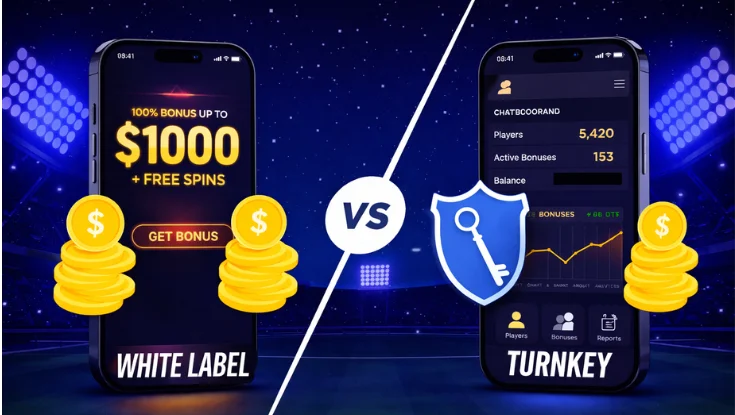
The launch model has the biggest effect on software budget and platform complexity. There are three standard routes.
White-label
White-label is usually the lowest-cost entry point. In SDLC Corp’s setup-only model, the platform fee is paid once upfront with no monthly platform charge, and ongoing costs are pass-through vendor fees (payments, KYC, hosting). Other vendors price white-label differently — some use monthly platform fees or revenue-share models. Back-office control, payment flexibility, and product changes are constrained by the platform.
Turnkey
Turnkey gives operators a broader foundation with more room for payment, reporting, and operational tailoring. It costs more upfront than white-label but reduces expensive rebuild work later.
Custom platform
Custom development gives the highest control over wallet logic, promotions, reporting, and market expansion. It also creates the highest build cost and the heaviest delivery responsibility.
For implementation scope, see our online casino software service page; for custom platform builds, see iGaming software development.
First-year online casino software cost example
Many buyers focus on build cost and miss the full first-year picture, which creates budget pressure after launch. The year-one table shows a realistic planning view for a mid-range operator.
Included: platform setup, core build, integrations, compliance-related implementation, QA, launch support, hosting, monitoring, and year-one technical support. Not included: gaming-license fees, corporate/legal setup, staffing, marketing, affiliate spend, payment reserves, and jurisdiction-specific legal advisory costs.
| Budget line | Lean launch | Growth launch | Custom launch |
|---|---|---|---|
| Platform setup and core build | $30k–$60k | $80k–$160k | $180k–$400k+ |
| Payments, KYC, and provider integrations | $8k–$18k | $20k–$45k | $40k–$90k |
| Compliance, security, and approval work | $7k–$15k | $15k–$35k | $25k–$70k |
| QA, hardening, and launch support | $5k–$12k | $12k–$28k | $20k–$50k |
| Hosting, monitoring, and support for year one | $10k–$24k | $24k–$60k | $48k–$120k |
| Estimated year-one total | $60k–$129k | $151k–$328k | $313k–$730k+ |
* White-label setup-only cost starts from $15,000. These are planning ranges, not fixed market prices; they separate one-time build work from year-one operating needs so you can compare quotes against the real first-year technical budget.
Online casino software cost calculator
Estimates a likely build range and a year-one operating range. Figures are planning estimates only — not a final vendor quote. Operating ranges cover platform license, hosting, and support only; game provider revenue share, payment processing fees, and KYC costs are separate and vary with gross gaming revenue (GGR — player wagers minus winnings paid out, before operating expenses) and transaction volume.
Setup, platform work, integrations, security, QA, and launch support.
Hosting, monitoring, support, updates, and vendor operations.
Share your selections with our team for a detailed, itemized quote.
Excludes license fees, legal setup, marketing, staffing, PSP reserves, game provider revenue share, and payment processing fees.
What pushes online casino software cost up
Online casino software cost rises when complexity increases across several workstreams at once.
- More markets: each adds payment localization, compliance implementation, content checks, and operational support.
- More payments: each gateway adds integration, QA, reconciliation logic, exception handling, and support overhead.
- More game suppliers: every provider increases integration effort, contract coordination, release management, and maintenance.
- Deeper compliance: KYC, AML, safer-play tooling, audit logs, and responsible-gaming controls increase build and testing effort.
- Broader reporting: finance, bonus, fraud, VIP, and retention reporting often require more engineering than buyers expect.
- Custom product logic: the more custom rules in cashier, back office, bonus handling, or user flows, the less useful a standard platform becomes.
Every new market adds legal work, payment setup, and support complexity.
Gateways, fraud checks, and reconciliation raise build time fast.
More providers mean more integrations, contracts, and ongoing support.
KYC, AML, audit logs, and player protection increase scope and testing.
Finance, bonus, fraud, and retention reports add more work than buyers expect.
Custom rules create flexibility, but increase build and support cost.
Low headline estimates usually drift upward when complexity is priced too lightly at the start.
Online casino software cost by workstream
| Workstream | Share of build budget | What it covers |
|---|---|---|
| Discovery and solution design | 3%–6% | Scope, vendor map, market plan, and technical approach |
| UX and front end | 5%–10% | Lobby, account flows, cashier, promotions, and mobile UX |
| Core platform engineering | 28%–40% | Casino wallet system, player account management, back office, reports, bonus logic, GGR, NGR, and hold percentage calculations |
| Payments and provider integrations | 10%–18% | Payment gateway setup, APIs, PCI DSS controls, reconciliation, and failure handling |
| Compliance and security | 10%–20% | KYC verification, AML compliance, responsible gambling tools, logging, RNG certification support, and hardening |
| QA and launch readiness | 10%–15% | Functional testing, regression, release checks, launch support |
| Post-launch support | 8%–15% | Monitoring, fixes, version updates, and vendor change requests |
This split helps buyers compare proposals line by line. If one quote looks much cheaper, check which workstreams are missing.
Casino Software Cost Driver Checklist
Every online casino project has different technical and business requirements, so development costs can vary significantly. The checklist below highlights the main factors that influence the final software budget. Businesses can use it to estimate how additional features, integrations, and regulatory requirements may affect the overall investment.
| Cost Driver | Impact on Development Cost | Why It Increases the Budget |
|---|---|---|
| Custom Platform Development | Very High | Requires complete platform architecture, a dedicated casino wallet system, player account management, backend development, and extensive testing. |
| White-Label Platform | Low | Uses an existing platform with limited customisation and a faster implementation path. |
| Payment Gateway Integrations | High | Each payment gateway requires separate integration, PCI DSS controls, reconciliation logic, security testing, and failure handling. |
| Casino Game Integrations | High | Every game provider or game aggregator requires API integration, RNG certification checks, release coordination, and maintenance. |
| KYC & AML Compliance | High | KYC verification, AML compliance monitoring, audit trails, and regulatory reporting increase development and testing effort. |
| Licensing Jurisdictions | High | Supporting multiple regulated markets requires additional compliance work, responsible gambling controls, reporting rules, and local requirements. |
| Live Dealer Games | Medium to High | Live streaming infrastructure, supplier integrations, monitoring, and session reliability increase technical complexity. |
| Native Android & iOS Apps | Medium | Separate mobile applications require additional design, development, testing, release management, and maintenance resources. |
| AI Fraud Detection | Medium | Machine learning, player risk scoring, payment monitoring, and suspicious behaviour detection require custom implementation. |
| Multi-language & Multi-currency Support | Medium | Localisation, multi-currency support, exchange-rate handling, and regional QA increase platform complexity. |
Example Casino Software Budget
A startup launching a white-label online casino with approximately 1,500 games, two payment gateways, KYC verification, AML monitoring, responsible gambling controls, and one regulated market could expect a software investment of around $45,000 to $85,000, excluding licensing, legal setup, marketing, and operational expenses. A custom multi-market casino platform with advanced reporting, loyalty features, mobile applications, player account management, and multiple game providers can exceed $300,000 depending on project scope.
Typical Gaming Licence Costs by Jurisdiction
| Jurisdiction | Typical Cost Level | Notes |
|---|---|---|
| Curaçao | Low | Suitable for many international casino operators. |
| Anjouan | Low | Often selected for cost-effective offshore operations. |
| Malta (MGA) | Medium to High | One of the most respected regulated gaming jurisdictions. |
| UK Gambling Commission | High | Requires extensive compliance and ongoing regulatory reporting. |
| Brazil | Very High | High licensing fees and strict regulatory requirements for licensed operators. |
Gaming licence costs are separate from software development costs. Operators should budget independently for licensing fees, legal services, regulatory compliance, financial audits, and annual licence renewals when planning an online casino business.
What online casino software cost usually includes — and excludes
Most software proposals cover platform setup and configuration, payment and KYC integrations, game provider or game aggregator connections, compliance and security implementation, QA and launch testing, and year-one hosting and technical support. A well-structured proposal breaks each into separate line items so cost drivers are visible.
The first-year cost table separates one-time build cost from year-one operating cost for exactly this reason — a software quote that only shows build cost will understate your actual first-year spend.
What most casino software quotes leave out
Most low-cost proposals omit some or all of the following. Each adds to your real first-year spend:
- Gaming license fees — not included in software quotes, and they vary widely by jurisdiction. As published reference points: the MGA charges a €5,000 application fee plus a €25,000 annual B2C license fee (mga.org.mt), and UKGC remote casino fees start at £4,224 for the F1 band (gamblingcommission.gov.uk). Curaçao now licenses through the Curaçao Gaming Authority under the LOK framework — confirm current application, annual, and local-substance costs with the CGA or qualified counsel (cga.cw).
- Legal and corporate formation — iGaming-specialist legal work typically runs several thousand to tens of thousands depending on jurisdiction and entity structure.
- Payment service provider reserves — many PSPs require a cash reserve (often $20,000–$100,000+) held against chargebacks. A capital requirement, not a cost, but it affects liquidity from day one.
- Post-launch change requests — vendors frequently exclude change-request fees from the initial quote. Regulatory updates, gateway changes, and feature additions often generate significant spend in months 3–12.
- Ongoing game provider fees — revenue share to game providers typically runs 10–20% of GGR; not a software cost, but a major recurring expense in the same budget model.
- Staffing and compliance operations — customer support, KYC review staff, and ongoing compliance reporting are not platform costs but are directly triggered by going live.
A software-only proposal may still be valid, but it should not be treated as a full launch budget. The worked example separates both.
How these cost ranges were estimated
The planning ranges here are derived from iGaming platform project scopes across white-label, turnkey, and custom engagements in regulated and offshore markets. They reflect the distribution of actual delivery scopes — not manufacturer list prices or single-vendor quotes.
- Scope drives cost more than model. A lean white-label with deep payment integration can cost more than a basic turnkey. Ranges reflect median-case scope per tier.
- Compliance scope is the most variable line. A single-market Curaçao launch is lighter than a dual-regulated UK–MGA build. Compliance can move the number by 30–50%.
- Post-launch support is often underpriced. Vendors frequently quote build cost without a realistic year-one support and change-request budget; the year-one totals include a support estimate.
- These are planning benchmarks, not binding quotes. Use them to sense-check proposals and spot scope gaps — not as a substitute for a detailed RFP response from a shortlisted vendor.
How to compare vendor quotes
Before approving a quote, check quote quality, not just headline price.
Ask these before you sign
- What is included in compliance implementation, testing, and launch support?
- Which reports are included on day one: finance, bonus, fraud, retention, VIP, RTP, GGR, NGR, hold percentage, or only basic ops?
- Which third-party fees sit outside the quoted software cost?
- What support is included in the first 90 days after launch?
- What happens to pricing when we add a new market, provider, or payment method?
- Who owns the source code, deployment workflow, operational data, and vendor dependencies?
- What is the rollback, monitoring, and incident-response plan at launch?
If those answers are vague, the quote is not detailed enough for budget approval.
Red flags in low-cost proposals
- One total number with no workstream breakdown
- Vague wording around security, QA, reporting, or launch readiness
- No clear treatment of change requests or vendor dependencies
- No year-one operating estimate alongside the build quote
- No ownership detail for source code, data, integrations, or back-office access
- No explanation of what is excluded from the quoted cost
A low entry quote can still produce a high total cost if key workstreams are deferred or left undefined.
How to keep online casino software cost under control
Online casino software cost is easier to control when version one stays tight and the scope is explicit.
- Launch in one market first when possible.
- Limit the early payment stack to what you truly need.
- Keep provider count focused in phase one.
- Protect compliance, QA, security, and reporting rather than trimming them.
- Move non-core features into phase two.
- Ask for a separate line item for post-launch support and maintenance.
The safest way to reduce cost is to reduce scope, not essentials. For a white-label-only budget, see the white-label online casino cost guide. For the full launch process including licensing, banking, and market selection, see the how to start an online casino guide.
Businesses that require greater customization, advanced integrations, and complete platform ownership can explore our Turnkey Casino Solution to understand how a fully managed casino platform supports long-term growth and scalability while maintaining greater operational control.
Ongoing monthly operating costs after launch
Build cost is a one-time spend. Operating cost determines whether the business is sustainable. The main recurring lines after launch:
| Cost line | Typical range | Notes |
|---|---|---|
| Platform license / SaaS fee | $0white-label (setup-only)$1,500–$7,000per month · turnkey / custom | Setup-only white-label has no monthly charge; some vendors use monthly or revenue share. Turnkey and custom carry ongoing platform costs. |
| Game provider revenue share | 10–20%of GGR | Per-provider; aggregator deals may lower blended rate |
| Payment processing fees | 2–6%per transaction | Higher for high-risk merchant accounts; varies by PSP |
| KYC / AML verification | $0.50–$3per check | Volume-based; enhanced due diligence costs more |
| Hosting and infrastructure | $1,000–$5,000per month | Scales with player volume and market count |
| Technical support and maintenance | $2,000–$8,000per month | Incident response, updates, vendor management |
| Responsible gambling tools | $500–$2,000per month | Required in MGA, UKGC, and most regulated markets |
| License renewal and compliance | $1,000–$6,000per month | Ongoing reporting, audit preparation, renewal fees |
* Planning estimates only. Game provider revenue share is the largest variable — it scales directly with GGR, so a successful casino pays significantly more here than an early-stage one.
Example: 2-market turnkey launch budget
To make the ranges concrete, here is how a typical mid-range turnkey launch budget breaks down for an operator targeting two regulated markets — one EU jurisdiction (MGA) plus a second mid-complexity regulated market.
| Budget line | Estimate | Notes |
|---|---|---|
| Platform setup and core build | $120k–$200k | Turnkey base with dual-market configuration |
| Payments, KYC, provider integrations | $30k–$55k | Local payment methods for the second market; SEPA and cards for EU |
| Compliance and security | $25k–$50k | MGA requirements plus second-market compliance work |
| QA, hardening, launch support | $15k–$30k | Dual-market adds regression and localization testing |
| Hosting, monitoring, year-one support | $30k–$65k | Scaled for two active markets |
| Software total (year one) | $220k–$400k | Platform and operations only |
| Licensing (two mid-complexity markets) | $40k–$80k | Not included in software quote — shown for context |
| Legal and corporate setup | $15k–$40k | Not included in software quote — shown for context |
* Planning estimates only. Licensing and legal figures are not software costs — shown to give the full first-year picture.
High-fee markets are budgeted separately. Some jurisdictions carry far higher entry costs. Brazil’s federal SPA/MF authorization, for example, requires a grant fee of BRL 30 million (around US$6 million) for a five-year license covering up to three brands — entirely separate from, and far larger than, the software budget above.
Online casino software cost — FAQ
What is the typical online casino software development cost in 2026?
How much should I budget for year one?
What drives the biggest increase in cost?
Is white-label always the cheapest option?
What should a serious proposal include?
How long does development usually take?
What is often missing from early estimates?
Can I reduce cost without reducing quality?
Does casino software development cost include gaming licence fees?
Why is custom casino software more expensive than a white-label platform?
Which features increase online casino software development costs the most?
Share your launch model, markets, and scope — we will return an itemized build and year-one estimate.
Written by Michael Klein — iGaming Strategy Expert, 18 years in the industry. Specializes in casino platform selection, vendor evaluation, and iGaming cost planning. View profile
Reviewed by SDLC Corp iGaming Compliance Team.
Editorial note: All cost figures are planning estimates only — not vendor quotes or legal advice. Costs vary by scope, vendor, and jurisdiction. Last reviewed: May 2026.