
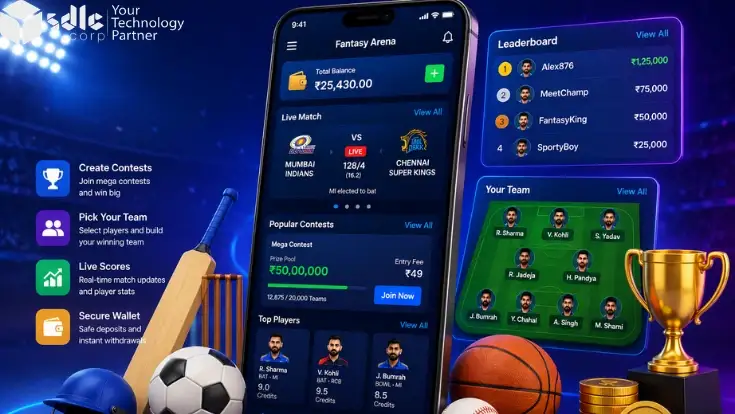
The online fantasy sports industry has witnessed a meteoric rise in popularity, with platforms like FanDuel leading the charge. This pioneering app has transformed how fans interact with sports, offering real-time contests and exciting cash prizes. Entrepreneurs and startups are eager to capture similar success by building their own fantasy sports platforms.
If you’re wondering how to develop a fantasy app like FanDuel, this comprehensive guide will walk you through the key aspects of the development process from core features and technology stack to cost structure and legal considerations. Whether you’re a seasoned developer or a budding entrepreneur, understanding what it takes to build a high-performing, compliant fantasy sports app is essential. Let’s dive in!

Market Overview

Growth of Fantasy Sports
The global fantasy sports market was USD 24,853.7 million in 2024 and is projected to reach USD 56,381.2 million by 2030, according to the Grand View Research fantasy sports market report. North America, particularly the United States, remains one of the key markets, followed by countries like India and the UK. Fantasy sports apps like FanDuel cater to various sports, including football, basketball, baseball, and cricket, offering strong growth potential.
Why FanDuel is a Market Leader
FanDuel's success stems from its user-friendly interface, diverse contest formats, and secure payment systems. It was among the pioneers in implementing daily fantasy sports (DFS), offering players short-term, high-reward contests.
Core Features of a Fantasy App like FanDuel

1. User Registration and Profile Management
Email & social media login
Profile editing
Account verification
2. Live Score Integration
Real-time updates for ongoing matches
Integration with official sports APIs
3. Contest Creation & Participation
Public and private contests
Entry fees and prize distribution
4. Drafting & Team Management
Player selection with real-time stats
Flexibility to edit teams before the match starts
5. Leaderboard and Rewards
Real-time ranking system
Automated prize distribution
6. Payment Gateway Integration
Secure deposits and withdrawals
Support for multiple currencies and payment methods
7. Admin Panel
Contest management
User moderation
Financial and analytical dashboards
8. Push Notifications
Game updates
Promotional alerts
Reward announcements
Contest Types in a FanDuel-Like Fantasy App
A strong fantasy sports app should offer different contest formats so users can choose how they want to play. Some users prefer small private contests with friends, while others enjoy large prize pools with thousands of players. Adding multiple contest types improves engagement and gives users more reasons to return.
Head-to-Head Contests
In this format, two users compete directly against each other. The user with the higher fantasy score wins the contest prize.
Private Contests
Private contests allow users to create leagues and invite friends, family, or office groups. This feature helps increase sharing and organic user growth.
Mega Contests
Mega contests include a large number of users and bigger prize pools. These contests are useful for attracting high participation during major matches and tournaments.
Practice Contests
Practice contests help new users understand the app without risking real money. This improves user confidence before they join paid contests.
Winner-Takes-All Contests
In this contest type, the top-ranked user wins the full prize amount. It creates excitement and works well for competitive users.
Real-Time Scoring Engine
The scoring engine is one of the most important parts of a fantasy app like FanDuel. Users expect live points, instant ranking updates, and accurate match data. Even a small delay can affect trust, especially in real-money contests.
A real-time scoring engine connects with live sports data APIs and updates player points based on actual match performance. It calculates scores for runs, goals, assists, wickets, catches, strike rate, economy rate, and other sport-specific rules.
The system should also handle delayed data, match interruptions, player changes, and final score verification. This keeps the contest fair and reduces disputes after the match ends.
Wallet, KYC, and Withdrawal Flow
A FanDuel-like fantasy app must have a safe and clear money flow. Users should be able to deposit money, join contests, track winnings, and request withdrawals without confusion.
The wallet should separate real money, bonus balance, winnings, and locked contest entry amounts. This helps avoid payment errors and keeps the transaction system transparent.
KYC verification is also important for real-money fantasy sports apps. It helps confirm user identity, prevent fraud, and meet compliance rules in supported regions.
A proper withdrawal flow should include user request, KYC check, fraud review, admin approval, and payment settlement. This makes payouts safer and builds user trust.
FanDuel-Like App Architecture Flow
A fantasy app may look simple to users, but many systems work together in the background. A clean architecture helps the app run smoothly during live matches, high traffic, and payment activity.
User Joins a Contest
When a user joins a contest, the app checks wallet balance, confirms contest rules, locks the selected team, and stores the entry data.
Live Match Data Starts
Once the match starts, live sports APIs send real-time updates to the backend.
Scoring and Leaderboard Update
The backend scoring engine calculates fantasy points and updates the leaderboard.
Winner Verification and Payout
After the match ends, the system verifies the final score, calculates winners, and moves prize money to user wallets.
This flow must be fast, secure, and scalable. It helps the platform manage thousands of users without score delays, payment errors, or leaderboard issues.
Technology Stack for Fantasy Sports App Development

Choosing the right technology stack is crucial to ensure scalability, performance, and security.
Front-End Development
React Native or Flutter (for cross-platform)
Swift (iOS)
Kotlin (Android)
Back-End Development
Node.js or Django
MongoDB or PostgreSQL
Redis for caching
APIs and Third-Party Services
Sports data APIs: Sportradar, FantasyData
Payment gateways: Stripe, PayPal, Razorpay
Cloud storage: AWS, Google Cloud
DevOps & Security
CI/CD tools: Jenkins, GitLab CI
Containerization: Docker
Security: SSL encryption, two-factor authentication
Legal Requirements and Compliance

Operating a fantasy sports app involves adhering to various legal regulations.
United States
In the United States, fantasy sports platforms should review the UIGEA official text and state-level gaming rules before launching real-money contests.
State-wise regulations for real-money gaming
India
Classified as a game of skill by the Supreme Court
Registration with a self-regulatory body like AIGF
Europe
GDPR compliance for user data
Country-specific gambling laws
Make sure to consult with a legal advisor to ensure your app remains compliant across jurisdictions.
Monetization Strategies

A FanDuel-like app can be highly profitable if monetized effectively.
Entry Fees
Charge users a fee to participate in premium contests. A portion of the pool can be retained as revenue.
In-App Advertisements
Run ads from networks like AdMob or Facebook Audience Network.
Subscription Plans
Offer premium features like early access to contests, analytics, and an ad-free experience.
Merchandise and Sponsorships
Collaborate with sports brands to sell merchandise and run sponsored contests.
Also Read: How to develop a betting app like Sportsbet.
Development Cost Breakdown

The cost to develop a fantasy app like FanDuel depends on multiple factors:
Feature | Estimated Cost |
UI/UX Design | $5,000 - $10,000 |
Front-End Development | $10,000 - $20,000 |
Back-End Development | $15,000 - $25,000 |
API Integration | $5,000 - $10,000 |
Testing & QA | $5,000 - $10,000 |
Total | $40,000 - $75,000 |
Note: Costs may vary based on location, complexity, and developer expertise.
Explore: Sports Betting App Development: Challenges and How to Solve Them.
Hiring a Fantasy App Development Company

If you're not technically inclined, hiring a fantasy app development company is a smart move. Look for companies with:
- Proven track record in fantasy sports apps
- Strong portfolio and client testimonials
- Transparent pricing and timelines
- Post-launch support and maintenance
Challenges and Solutions

Data Accuracy
Challenge: Real-time sports data is complex and dynamic.
Solution: Partner with reliable sports data API providers.
Legal Uncertainty
Challenge: Varying gambling laws across regions.
Solution: Collaborate with legal experts to navigate compliance effectively.
User Retention
Challenge: Maintaining user interest beyond major tournaments.
Solution: Introduce gamification elements and loyalty programs.

Common Mistakes to Avoid When Building a Fantasy App
Many fantasy sports apps fail because they focus only on design and basic features. A successful app needs strong backend logic, legal planning, secure payments, and smooth live performance.
Using Low-Quality Sports Data APIs
Cheap or unreliable sports APIs can cause score delays and wrong leaderboard results. Always choose a trusted sports data provider for real-time contests.
Ignoring Legal Rules
Fantasy sports laws change by country and state. Before launch, check whether your target market allows skill-based fantasy contests, paid contests, or real-money gaming.
Weak Wallet Security
A fantasy app handles deposits, winnings, and withdrawals. Poor wallet security can create fraud, payment disputes, and user trust issues.
Slow Leaderboard Updates
Users expect live rankings during matches. A slow leaderboard can reduce engagement and make users doubt the platform.
Launching Too Many Sports at Once
It is better to start with one or two popular sports and improve the experience first. After testing the app properly, you can add more sports and contest formats.
Post-Launch Maintenance and Scaling
Fantasy app development does not end after launch. The platform needs regular monitoring, updates, and performance improvements to handle users, contests, payments, and live sports data.
Post-launch support includes fixing bugs, improving app speed, monitoring servers, updating APIs, adding new contests, and improving security. This keeps the app stable during peak match hours.
As the platform grows, you may need to add more sports, more payment methods, better analytics, referral campaigns, and advanced admin controls. A scalable backend makes this growth easier and safer.
Fantasy App Launch Strategy
A smart launch strategy helps reduce risk and improve early user response. Instead of launching every feature at once, start with a focused MVP and test it with real users.
You can begin with one popular sport, limited contest types, secure wallet features, and basic admin controls. After the first launch, track user activity, contest participation, payment success rate, and feedback.
Once the app performs well, you can add private contests, loyalty rewards, more sports, advanced analytics, and promotional campaigns. This step-by-step approach helps build a stronger fantasy sports platform.
Conclusion
Developing a fantasy app like FanDuel is both a challenging and rewarding endeavor. With the right features, tech stack, legal strategy, and monetization plan, you can build a robust fantasy sports platform that captivates users and generates significant revenue.
To summarize, your journey should include thorough market research, choosing a competent development team, ensuring legal compliance, and focusing on user engagement. Ready to build your own fantasy sports app? Partner with SDLC Corp, a leading fantasy app development company trusted by startups and enterprises worldwide.
FAQ's
What is a Fantasy Sports App, and How Does It Work?
A fantasy sports app allows users to create virtual teams based on real-life athletes and earn points based on their live performance in actual matches. Users compete in contests, join leagues, and win cash prizes based on their team’s score.
How Much Does It Cost to Develop a Fantasy App Like FanDuel?
The development cost for a fantasy sports app like FanDuel ranges between $40,000 and $75,000, depending on features, technology stack, design complexity, and geographic location of the development team.
Is It Legal to Launch a Fantasy Sports App?
Yes, but legal compliance varies by country:
- USA: Must comply with UIGEA and state-specific laws
- India: Considered a game of skill, legal under the Supreme Court ruling
Europe: Must follow GDPR and local gambling laws
Consult with a legal advisor before launching.
How Long Does It Take to Build a Fantasy Sports App Like FanDuel?
The development timeline for a fantasy sports app like FanDuel typically ranges from 6 weeks to 24 weeks, depending on various factors such as feature complexity, tech stack, platform support (iOS, Android, web), API integrations, and customization requirements.
Can I Integrate Cryptocurrency Payments Into a Fantasy Sports App Like FanDuel?
Yes! You can integrate crypto payments into your fantasy sports app by using blockchain payment gateways like Coinbase Commerce, BitPay, or custom smart contracts. This allows users to deposit, withdraw, and participate in contests using digital currencies like Bitcoin, Ethereum, or stablecoins. However, you must ensure regulatory compliance, as crypto payments in gaming apps are subject to gambling and financial regulations in many countries.
Is It Possible to Include NFTs in a Fantasy Sports App?
Absolutely. NFTs can be used to create unique digital collectibles, such as rare player cards, team badges, or achievement tokens. You can also offer NFT-based rewards for contest winners or allow users to trade these assets within your app’s marketplace. To implement this, you'll need to integrate blockchain protocols like Ethereum or Polygon and ensure your app’s NFT functionality complies with local laws.


