Why Odoo for Automotive Is Essential for Modern Operations
Automotive businesses face operational complexity that compounds with scale. A component manufacturer supplying multiple OEMs runs different production schedules, quality standards, and delivery commitments simultaneously. A dealership network manages vehicle inventory, service bookings, warranty claims, and financing across multiple locations. An aftermarket parts distributor tracks thousands of SKUs with demand patterns that vary by region and season. What makes Odoo valuable in these environments is not that it automates individual tasks — it is that it connects the systems managing each of them into one operational picture.
Growing operational complexity
Managing multiple suppliers, coordinating production across facilities, tracking inventory across locations, and aligning sales, service, and finance — each is manageable separately; managing all of them in disconnected tools accumulates friction and delay that an integrated ERP eliminates.
Demand for real-time visibility
Automotive decisions — production scheduling, procurement, pricing — require current data. When inventory levels, order status, and production progress are updated in real time across one system, managers can respond to changes before they become production stoppages or delivery failures.
Rising customer expectations
Buyers and fleet operators expect accurate delivery commitments, responsive service, and consistent product quality. Meeting these expectations requires the sales, production, and service teams to be working from the same current information — which is only possible when they share one system.
Cost control under margin pressure
Automotive margins are tight. Excess inventory, production downtime, procurement errors, and billing delays each erode profitability. Odoo provides the tracking and automation that keeps these costs visible and controllable rather than discovered at month-end reporting.
How Odoo for Automotive ERP Works
Odoo for automotive is a configuration of Odoo's modular ERP applied to automotive workflows — production planning, inventory management, CRM and sales, procurement, after-sales service, and financial management share a single database and update each other automatically.
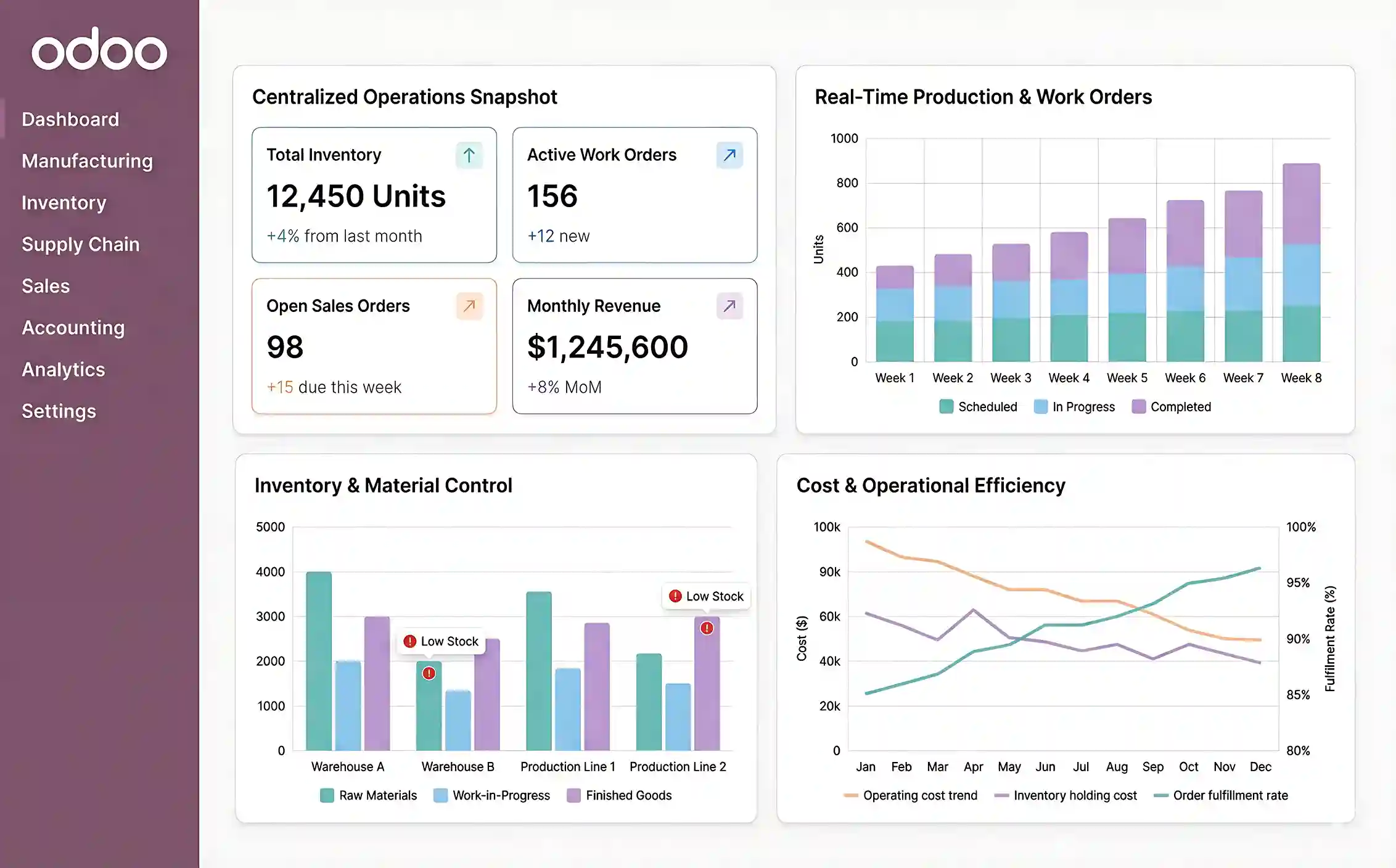
One shared database across all departments
Sales, production, procurement, inventory, finance, and service all work from the same data. When a confirmed sales order is placed, it automatically affects production scheduling and triggers material requirements planning. There is no manual transfer of information between systems and no reconciliation overhead.
Automated cross-department workflows
Production orders generate material consumption records that update inventory. Completed production triggers billing events. Service orders link to spare parts inventory and customer history. Each business event flows automatically through the relevant modules rather than requiring manual entry in each system.
Real-time operational visibility
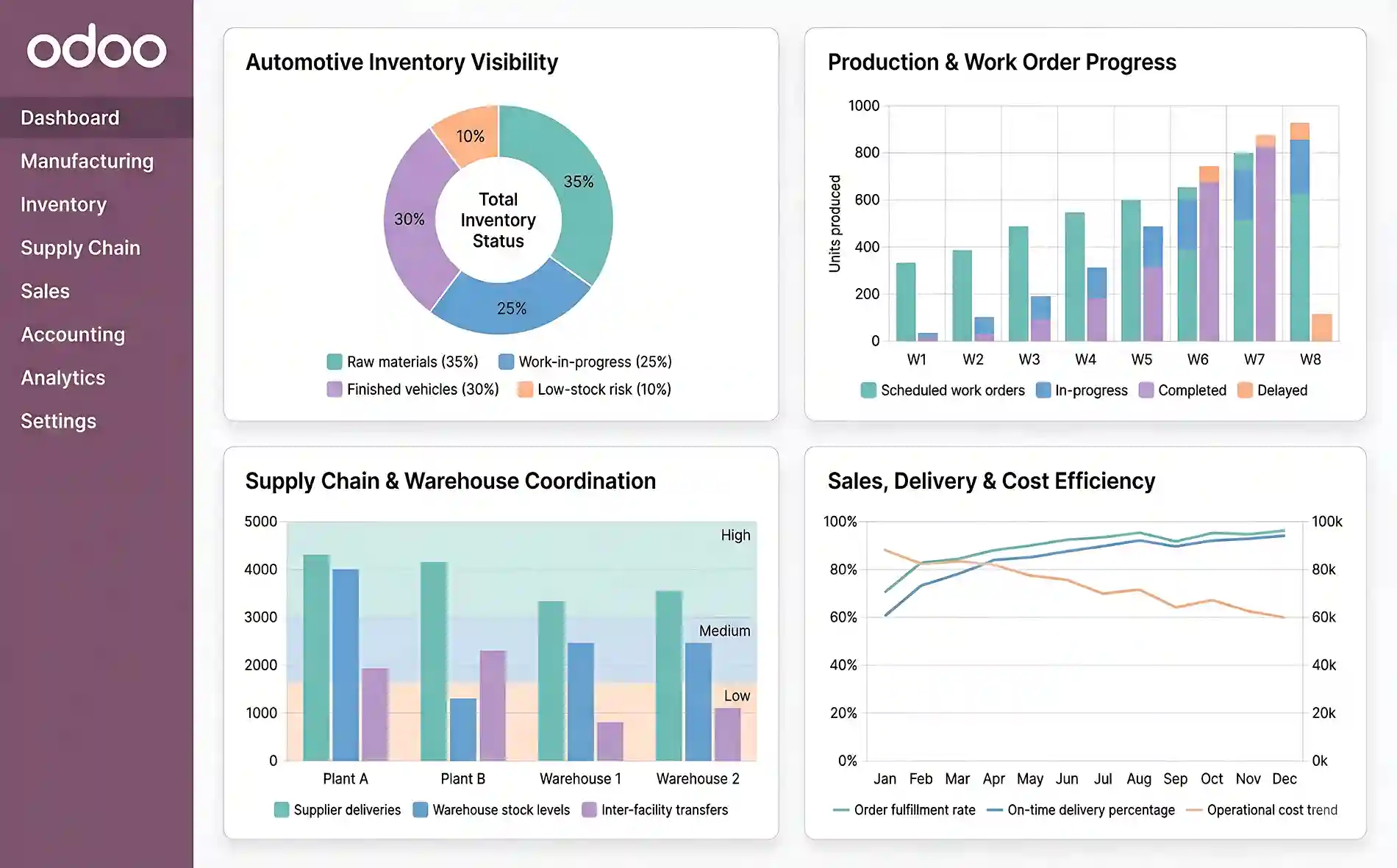
Live dashboards show production progress, inventory levels, open orders, supplier delivery status, and financial performance simultaneously. Managers do not wait for daily or weekly reports — they see the current state of operations and can identify issues before they escalate.
Modular implementation and scalability
You implement the modules your operation needs — production planning, inventory, CRM, service management, finance — and add others as the business grows. Odoo's architecture means adding a new module does not require rebuilding existing configurations, and scaling to new locations or product lines happens within the same system.
Key Benefits of Odoo for Automotive Industry Operations
The business outcomes from an Odoo automotive implementation cluster around four areas: operational accuracy from shared data, faster response from real-time visibility, production stability from better planning, and cost reduction from eliminating manual processes. These are not independent — each depends on the others, and all of them depend on the quality of the implementation.
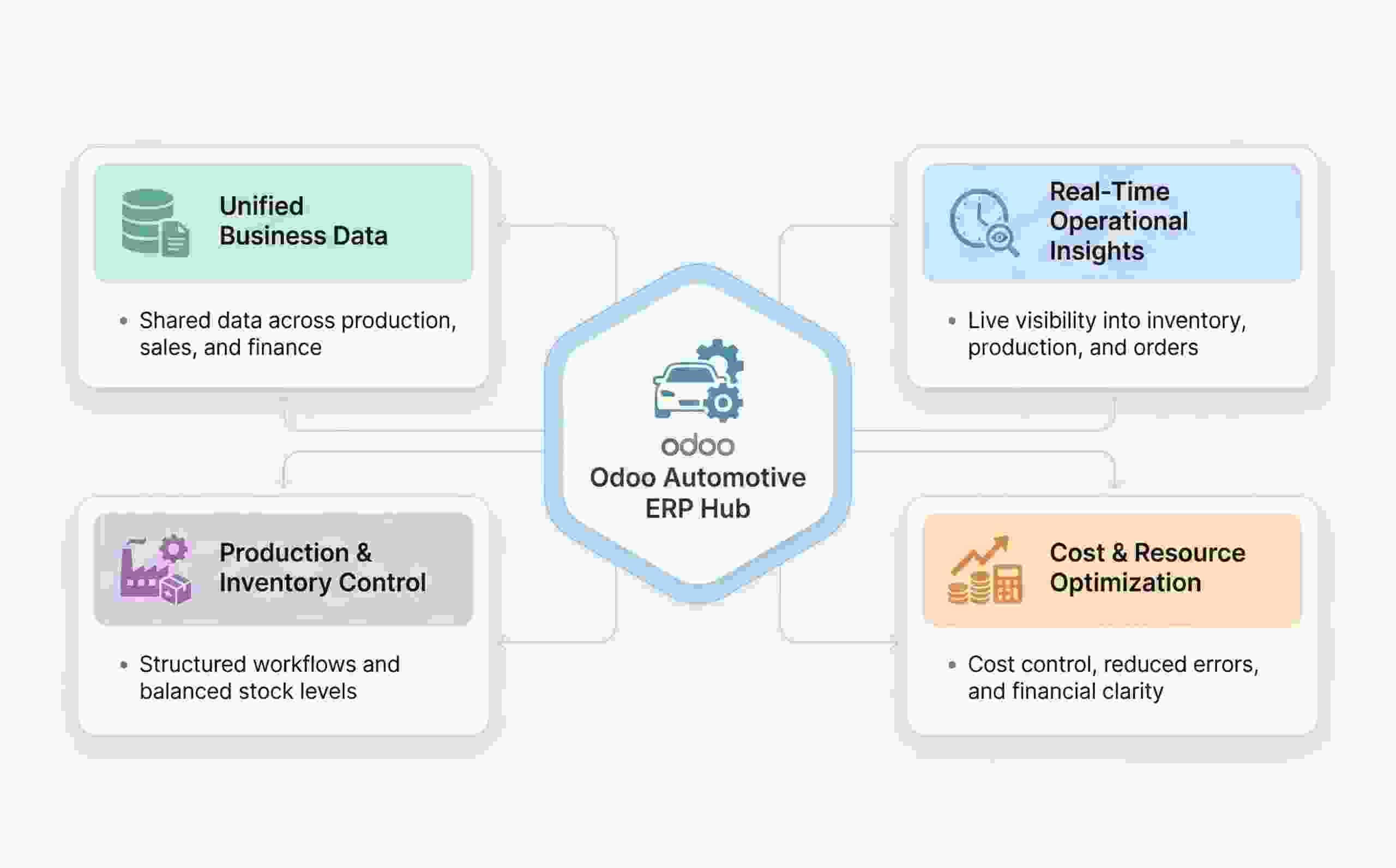
Unified data across departments
- Single source of truth for production, sales, and finance
- No data duplication or reconciliation between systems
- Consistent information across all teams and locations
- Faster access to accurate business data for decisions
Real-time visibility and response
- Live inventory levels across all warehouses and locations
- Production progress tracked at work-order level in real time
- Order status and delivery timelines visible instantly
- Issues identifiable before they cause operational disruption
Stable, predictable production
- Structured production workflows reduce unplanned interruptions
- Materials aligned with production schedules automatically
- Work orders tracked from creation to completion
- Quality checks embedded in production workflows
Lower operational costs
- Manual data entry and reconciliation eliminated
- Inventory holding costs reduced through accurate replenishment
- Fewer production errors and rework events
- Financial tracking and reporting automated and accurate
Practical Odoo Applications in the Automotive Industry
Odoo is used across different types of automotive businesses — component manufacturers, vehicle dealers, aftermarket distributors, fleet operators, and service centres — each with different workflow requirements. The applications described here are the ones that deliver the most consistent operational improvements across these business types.
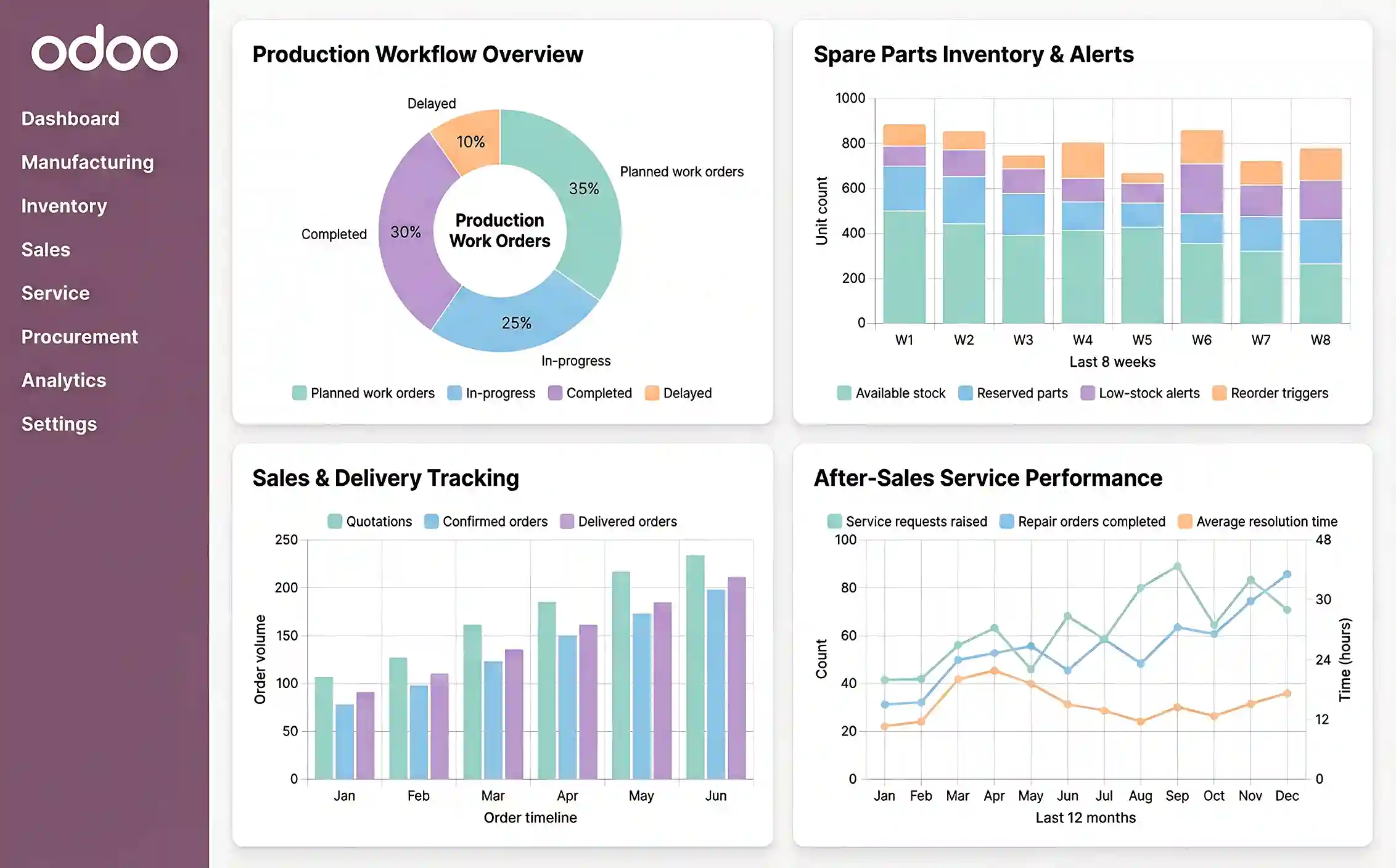
Production workflow management
Bills of materials, work orders, and production schedules are managed in one system. Production steps are sequenced with material requirements linked to inventory levels — so a work order cannot proceed without confirming that the required materials are available or on order. Progress is tracked at each stage, with delays visible as they occur rather than when a delivery is missed.
Spare parts and inventory management
Parts inventory is tracked across multiple warehouses and locations in real time. Automated reorder points prevent shortages without overstocking slow-moving items. Inventory accuracy improves because movements — receipts, issues to production, returns, adjustments — are recorded immediately in the system, not batched into a daily or weekly update.
Sales and customer order handling
Customer enquiries convert to quotations, confirmed orders, and delivery records within one workflow. Order status is linked to production and inventory, so sales teams can give customers accurate delivery commitments rather than estimates. CRM provides full interaction history per customer, supporting both new business development and account management.
After-sales service and support
Service orders are managed alongside the customer and vehicle history they relate to. Spare parts availability is checked against inventory at the point of scheduling. Warranty claims, maintenance histories, and recurring service schedules are tracked in the same system — so service teams have the complete picture when a vehicle or customer arrives. See our guide to Odoo for automotive manufacturing companies.
Common Automotive Challenges Solved by Odoo
The operational problems Odoo addresses in automotive businesses are consistent: fragmented data creates coordination failures, inventory imbalances create production disruptions, planning gaps create delivery delays, and limited visibility prevents managers from intervening early enough. Each challenge has a specific root cause that Odoo addresses through a specific capability.
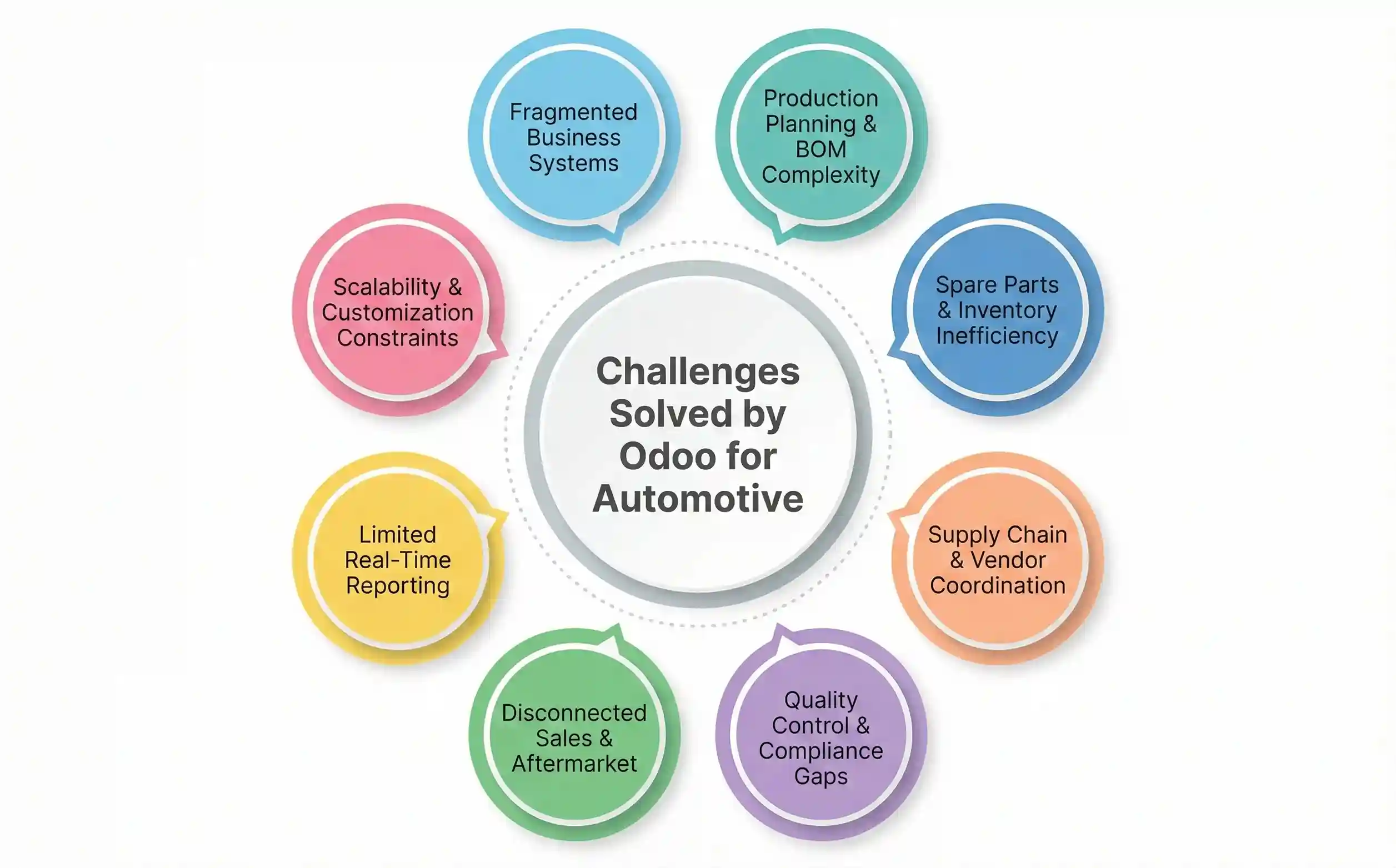
Data silos between departments
Inventory imbalances
Production delays
Limited operational visibility
Odoo for Automotive Manufacturing and Production Planning
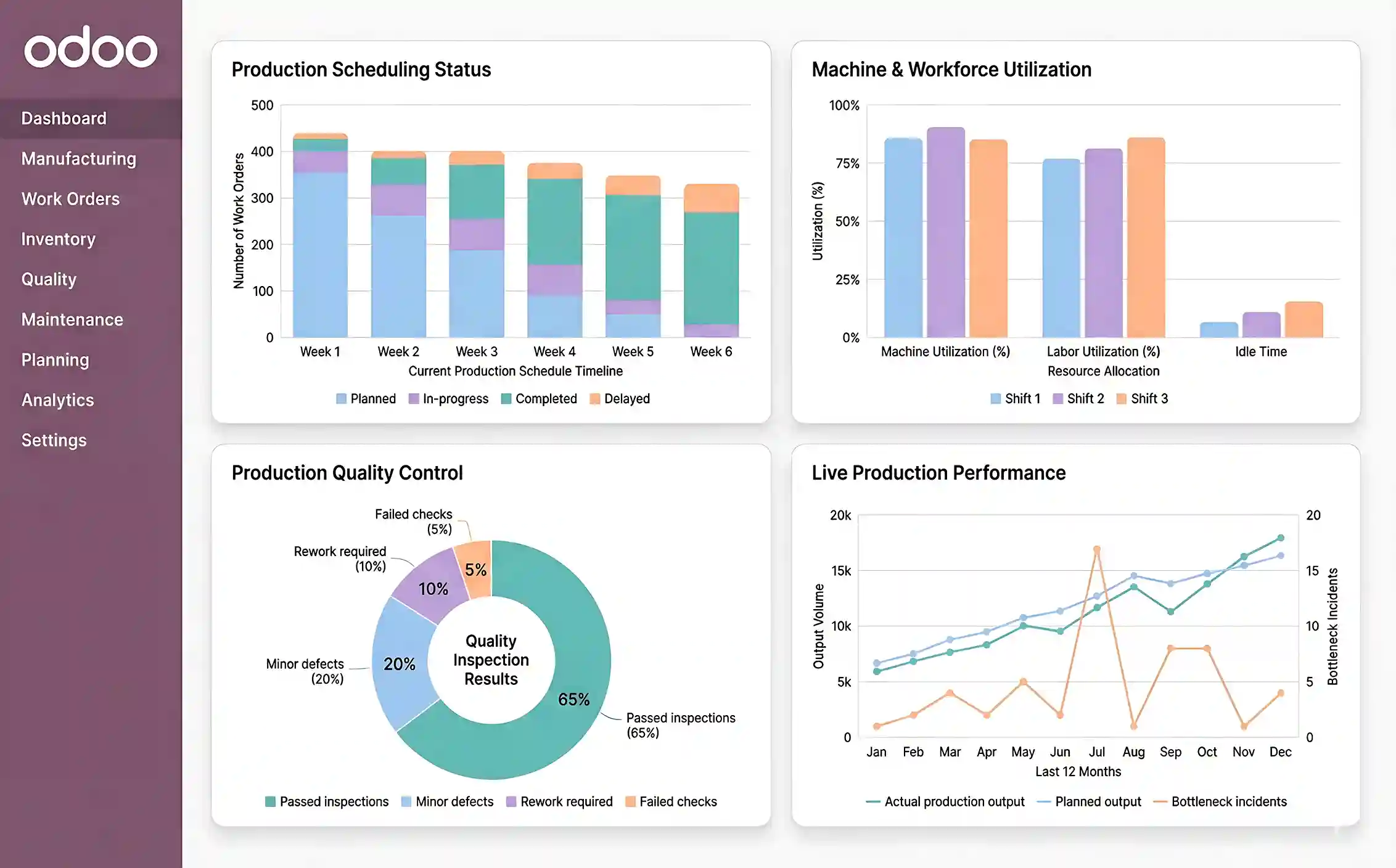
Production planning in automotive manufacturing is constrained by material lead times, work centre capacity, quality requirements, and delivery commitments that all interact with each other. Odoo's manufacturing module manages this complexity by connecting production scheduling to inventory availability, work centre loading, quality control, and delivery planning in one workflow. For a deeper look, see our guide to Odoo for automotive manufacturing companies.
Structured production scheduling
Production plans are built against confirmed demand and material availability. Work orders are sequenced by dependency and work centre capacity. Schedule changes — from a material shortage or a priority shift — are visible immediately across all affected downstream steps, allowing planners to adjust before a delay becomes a missed delivery.
Resource allocation and utilisation
Machine availability, operator assignments, and tooling requirements are managed alongside production scheduling. Capacity constraints are visible before orders are confirmed, preventing overcommitment. Idle time and bottlenecks are trackable by work centre, providing the data needed for continuous capacity improvement.
Integrated quality control
Quality check points are embedded directly in production routings — at goods receipt, between production operations, and before finished goods are dispatched. Results are recorded against the production order and linked to the materials and work centres involved. Defects are identified at the step where they occur, not at final inspection.
Real-time production monitoring
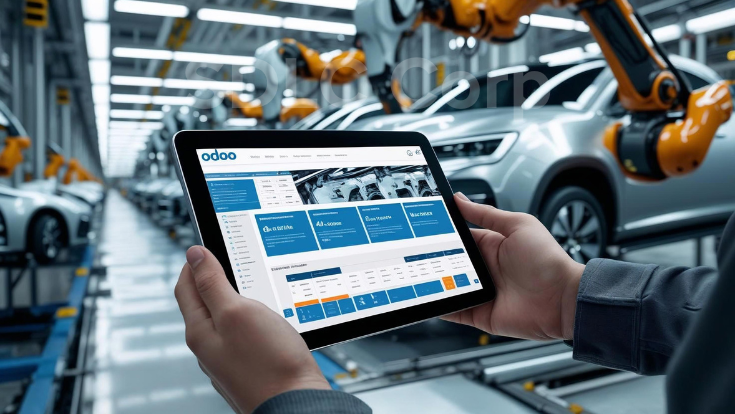
Shop floor operators confirm work order progress on tablets or terminals. Production managers see live status across all open orders — which steps are complete, which are in progress, and which are stalled. When a bottleneck appears, it is visible in real time rather than surfacing as a delay in the delivery schedule.
Inventory and Spare Parts Management with Odoo for Automotive
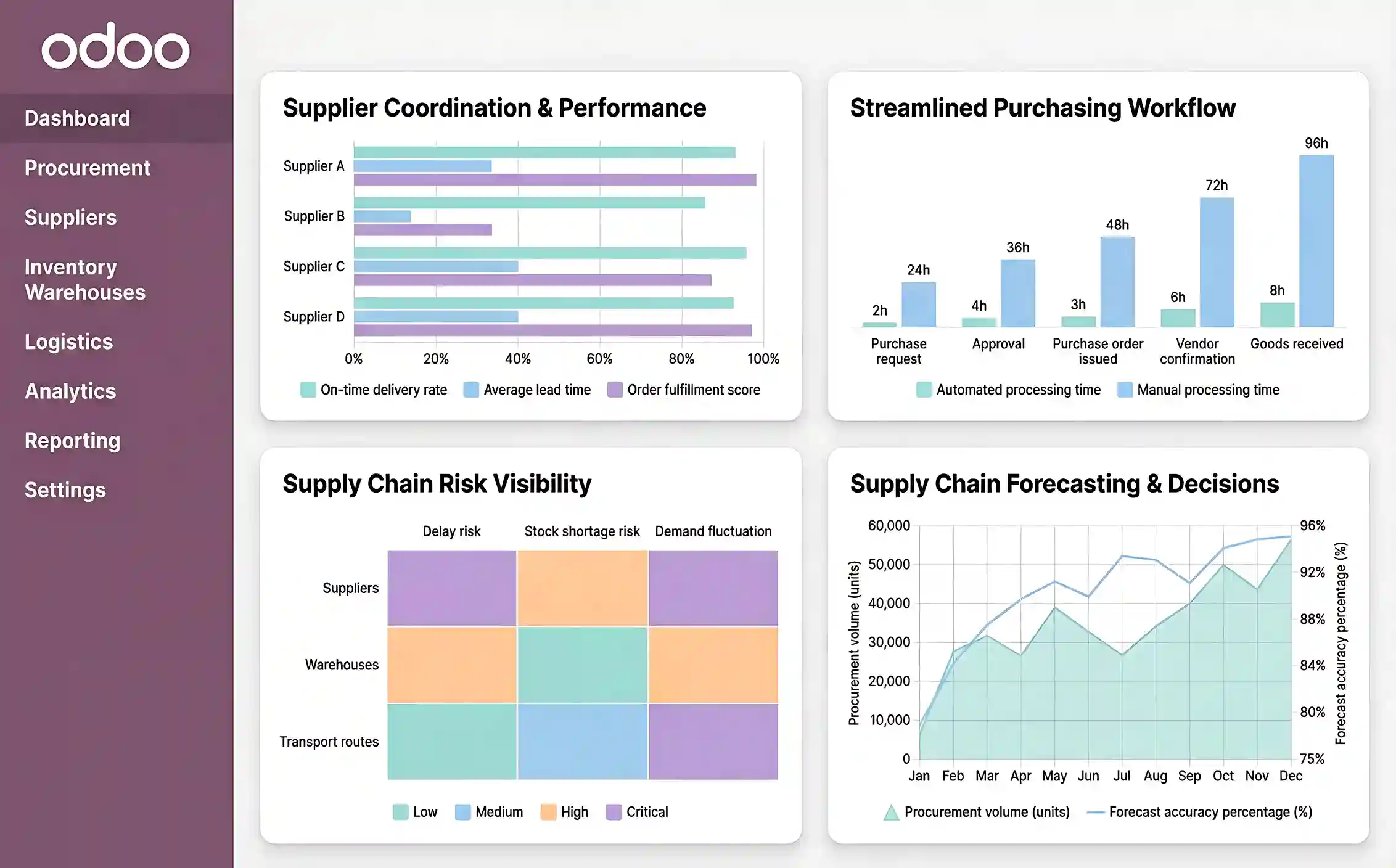
Automotive inventory management is complicated by part number proliferation, variable demand by model and vintage, multi-location stock, and the service-level requirements of after-sales operations. A part not in stock at the right location at the right time is a production stoppage or a missed service commitment. Odoo addresses this by centralising inventory data, automating replenishment, and providing the reporting needed for demand-based stocking decisions.
Multi-location stock tracking
- Real-time visibility of parts across all warehouses and locations
- Accurate tracking of parts movement and consumption
- Inter-location transfer workflows
- Reduced risk of stock mismatches and phantom inventory
Automated replenishment
- Minimum and maximum stock levels per part and location
- Purchase orders triggered automatically at reorder point
- Emergency procurement reduced significantly
- Stock availability maintained without manual monitoring
Spare parts for service
- Faster parts identification for service and repair orders
- Availability confirmed at point of service scheduling
- Slow-moving parts identified and destocked systematically
- High-demand parts planned and pre-stocked accurately
Inventory reporting
- Stock valuation and movement reports on demand
- Slow-moving and obsolete inventory identification
- Demand pattern analysis for better forecasting
- Inventory accuracy metrics and reconciliation support
Improving Supply Chain Efficiency with Odoo for Automotive
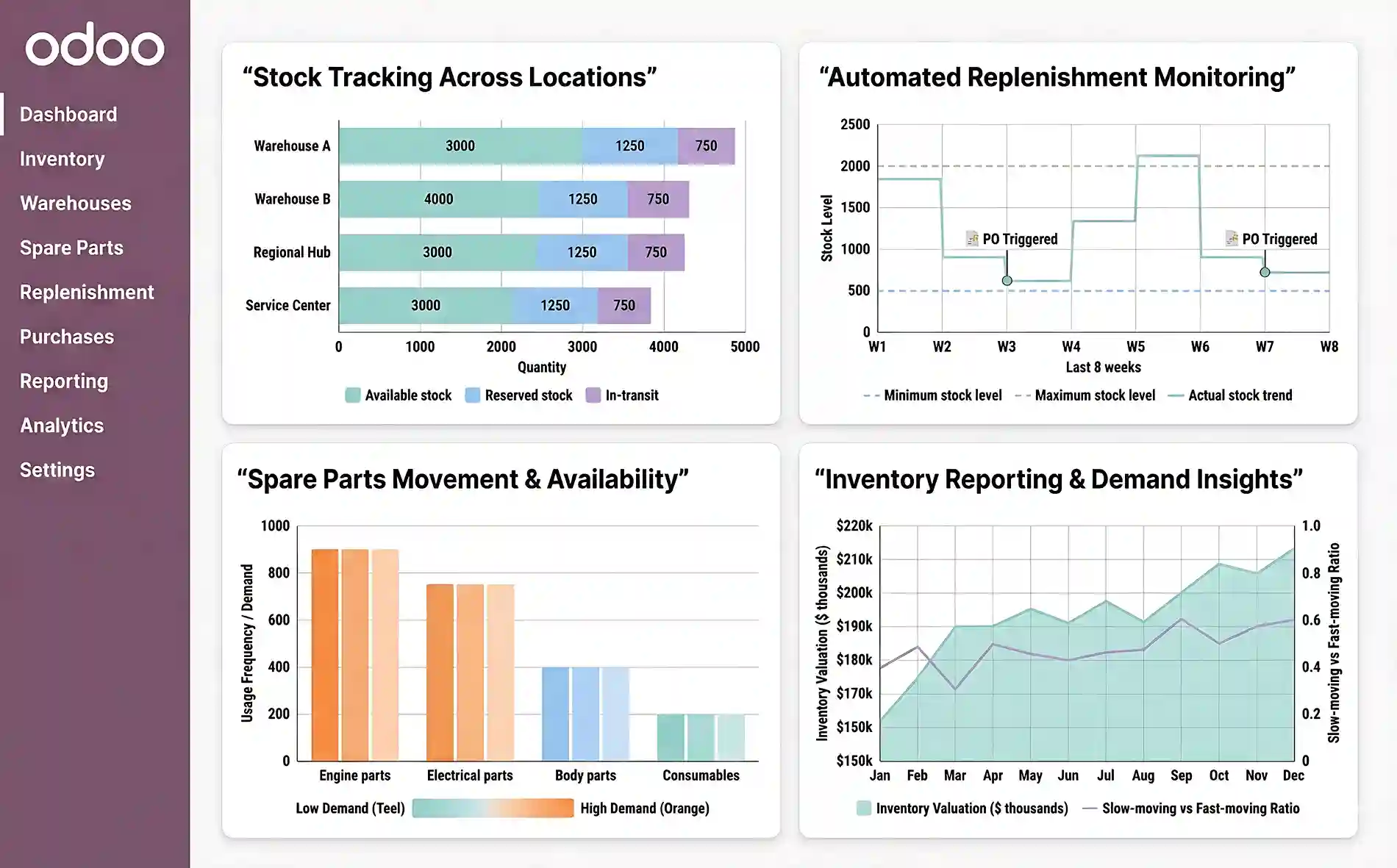
Automotive supply chains are multi-tier, time-sensitive, and exposed to disruptions that can halt production within days of a missed delivery. Managing them across phone calls, emails, and spreadsheets creates the exact visibility gap that turns a supplier delay into a production stoppage. Odoo strengthens supply chain coordination by centralising supplier information, automating purchasing workflows, and providing the real-time status visibility that allows procurement teams to act before delays escalate.
Supplier coordination
Centralised supplier records include pricing, lead times, minimum order quantities, and delivery history. This builds a data-based picture of supplier reliability — supporting informed sourcing decisions rather than relationship-based assumptions.
Automated purchasing
Purchase orders are generated automatically from reorder rules or material requirements planning outputs. Approval workflows route orders to the right authorisers without manual intervention, reducing the delay between a stock need and a confirmed order.
Disruption management
Inbound shipment status is visible against expected delivery dates. Partial deliveries and overdue orders are flagged in real time, giving procurement teams time to expedite, source alternatives, or adjust production schedules before the impact reaches the floor.
Data-driven procurement
Supplier performance history, demand patterns, and inventory position feed procurement planning. Decisions about supplier selection, safety stock levels, and order timing are made on current data rather than on experience and intuition.
The supply chain risk that costs most in automotive operations is not unit price — it is production downtime from missing materials. Automated reorder rules and inbound shipment tracking address this directly by surfacing problems while there is still time to respond.
What Odoo Delivers for Automotive Businesses
Odoo for automotive works because automotive operations are interdependent. Production scheduling depends on inventory availability. Inventory management depends on accurate demand from sales and service. Supplier relationships depend on purchasing data that reflects actual consumption. Finance depends on operational data from all of these. When these functions run in separate systems, the gaps between them are where delays, errors, and cost overruns accumulate.
Odoo closes those gaps by putting everything in one system. The operational improvements — better production stability, more accurate inventory, faster delivery commitments, cleaner financial records — are all downstream of that integration. Implementation quality determines how completely those improvements are realised.
What this guide covered
- Why automotive operations need ERP integration across departments
- How Odoo works as an automotive ERP platform
- Key operational and financial benefits of Odoo for automotive
- Practical applications: production, sales, after-sales service
- Common challenges Odoo solves in automotive operations
- Manufacturing and production planning capabilities
- Spare parts and inventory management across locations
- Supply chain coordination and procurement automation
- Financial management and compliance reporting
Ready to implement Odoo for your automotive business?
SDLC Corp's Odoo consulting team has delivered automotive ERP implementations for manufacturers, dealers, and distributors. We configure production, inventory, service, and finance modules to match your operational structure.
Schedule a consultation