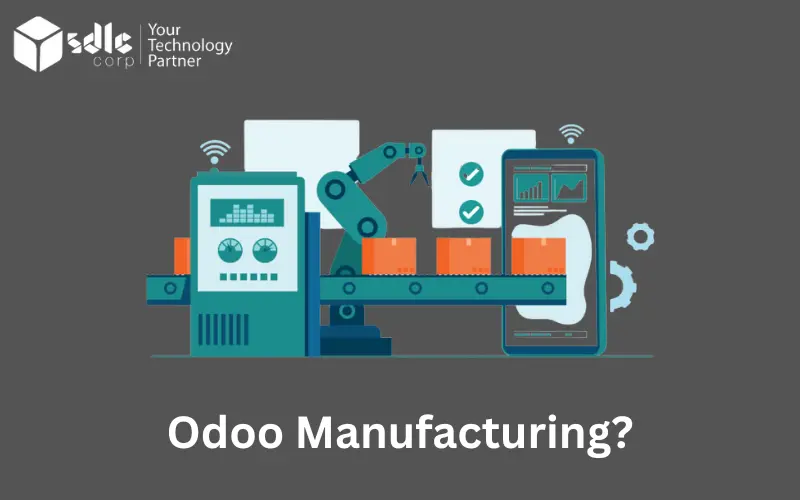
Manufacturing operations depend on a supply of accurate, timely information across production planning, inventory, procurement, quality control, and finance. When each of these functions runs in a separate system, coordination failures accumulate at every handover point — a production order is delayed because material availability was not visible, a quality defect is missed because the check point was not triggered, a cost variance appears because consumption was not recorded at the work order level.
Odoo Manufacturing ERP integrates all of these functions in one platform. Production schedules draw from actual inventory. Work orders trigger quality checks at the right stages. Cost accounting links directly to production consumption. This guide covers what Odoo does in each manufacturing area and what businesses typically gain from a well-configured implementation.
Planning an Odoo Manufacturing implementation?
SDLC Corp configures Odoo Manufacturing to match your production processes, BoM structures, and quality requirements — not a generic template.
Fully Integrated ERP for Manufacturing Operations
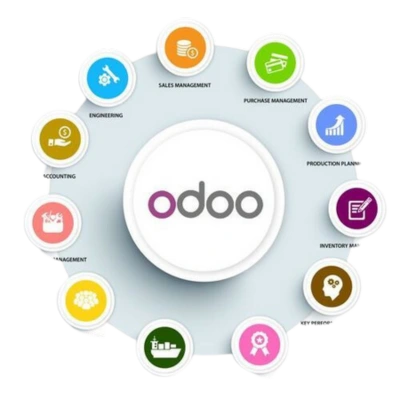
The core operational advantage of Odoo Manufacturing ERP is not any single module — it is the integration between modules. A confirmed sales order drives material requirements. A purchase order receipt updates inventory. A work order records material consumption and updates production costs. A finished goods confirmation triggers outbound delivery. This chain of automatic updates eliminates the manual data synchronisation that causes delays and errors in manufacturing businesses running disconnected systems. See our guide to essential Odoo modules for manufacturing companies.
Single data source
Sales, inventory, production, procurement, and finance share one database. A stock move in inventory is visible in production planning and finance simultaneously — no batch synchronisation, no manual transfers between systems.
Automatic downstream updates
Production order confirmation triggers material reservation. Work order completion updates inventory consumption. Finished goods receipt updates available stock. Each event propagates automatically to every downstream record it affects.
Scalable module architecture
Start with the modules you need — manufacturing, inventory, purchasing, accounting — and add others as the business grows. Odoo's modular design means new capabilities integrate with existing configurations without a system rebuild. See Odoo customisation services for tailored extensions.
Cross-department visibility
Sales can see production capacity before confirming delivery dates. Procurement sees material requirements before shortages occur. Finance sees production costs as work progresses. Decisions across departments are made on shared, current data.
Manufacturing Planning, MRP, and Automated Scheduling
Effective production planning in Odoo starts with the Material Requirements Planning engine — the system that analyses confirmed demand (from sales orders or forecasts), checks current inventory positions, reviews open purchase orders, and generates the procurement and production recommendations needed to meet that demand. When this engine runs against accurate data, production stoppages from material shortages become preventable

MRP engine and demand-driven planning
Odoo's MRP module analyses demand from sales orders, manufacturing orders, and forecasts to generate replenishment recommendations. Material shortages are identified before they affect production — not after a work order stalls. Planned orders for purchasing and manufacturing are generated automatically, reviewed by planners, and confirmed when ready.
Production scheduling and capacity planning
Manufacturing orders are scheduled against work centre capacity, taking into account machine availability, operator shifts, and material availability. The scheduling engine identifies capacity constraints before orders are confirmed — preventing overcommitment and the downstream delivery failures it causes
Automated production order generation
Manufacturing orders are created automatically from reorder rules or demand signals — with the correct BoM, routing, and scheduled dates pre-populated. Planners review, adjust if needed, and confirm. The manual effort of creating individual production orders from scratch is eliminated for standard products.
Continuous and batch production support
Odoo supports both discrete manufacturing (individual production orders per batch or job) and continuous production workflows. Process manufacturers using lot-based production benefit from Odoo's batch tracking, yield recording, and by-product management.
Bill of Materials and Work Order Management
The Bill of Materials is the structural foundation of manufacturing in Odoo — it defines what goes into a product, in what quantities, through which production steps, at which work centres. The accuracy of the BoM determines the accuracy of everything downstream: material requirements planning, production cost accounting, and inventory consumption. Odoo supports multi-level BoM structures, product variants, by-products, and configurable routing.
Bill of Materials
- Multi-level BoM supporting complex product structures
- Product variants — one BoM covers multiple configurations
- By-product and scrap recording at each production step
- Kit BoMs for make-to-order assembly products
- Version control to manage BoM engineering changes
- Cost roll-up from component costs to finished product cost
Work Orders and Routing
- Routing defines the sequence of operations per product
- Work orders assigned to specific work centres and operators
- Planned vs. actual time tracking per operation
- Material consumption recorded at work order level
- Shop floor tablet interface for operator confirmations
- Real-time production progress visible to management
Work Centres
- Define capacity, efficiency, and operating costs per work centre
- Machine and operator availability calendars
- Utilisation tracking and OEE reporting
- Maintenance integration — downtime affects scheduling
- Overtime and shift configuration for capacity planning
Production Flexibility
- Backorder creation for partially completed production orders
- Scrap recording with reason codes per operation
- Component substitution when primary material is unavailable
- Lot and serial number tracking through production
- Immediate availability update when production is confirmed
BoM configuration is the highest-leverage decision in an Odoo Manufacturing implementation. How you structure multi-level BoMs, handle product variants, and configure routing directly determines the accuracy of MRP outputs, production costs, and inventory consumption. This is where an experienced Odoo development partner adds the most value during initial configuration.
Integrated Quality Control and Compliance
Quality failures in manufacturing are not primarily a detection problem — they are a timing problem. Defects caught at the work centre where they occur cost a fraction of the same defects caught at final inspection or, worse, by a customer. Odoo's quality module embeds quality checks directly in production and receiving workflows, making defect detection happen at the right point rather than at the end.

Quality control points in production routings
Quality checks are defined as operations within the production routing — at goods receipt, between specific production steps, or before finished goods are dispatched. The check is triggered automatically when the preceding step is completed. Operators cannot proceed past a quality gate without recording a result.
Configurable quality checks and measurement tests
Checks can be simple pass/fail, measured values against tolerance ranges, or multiple-step inspection procedures. Each check type can specify the sample size, the measurement instrument, and the action to take on failure — quarantine, rework, or scrap. The instructions and acceptance criteria are visible to the operator at the point of checking.
Quarantine, rework, and scrap workflows
When a quality check fails, Odoo can automatically move the affected lot to quarantine, create a rework production order, or record the material as scrapped with the associated cost. The quality event is linked to the production order, the lot, and the work centre — providing the traceability needed for root cause analysis.
Lot traceability and quality history
Every quality result is linked to the material lot it tested. The lot traceability report traces a finished goods lot back to every raw material lot that contributed to it. When a customer raises a quality issue, the affected lots — and every other product that used the same raw material — are identifiable in minutes.
Quality analytics and defect reporting
Quality dashboard tracks failure rates by product, work centre, supplier, and operator. Patterns that indicate systemic problems — a work centre with consistently high defect rates, a supplier whose incoming material frequently fails goods receipt checks — become visible before they generate significant cost.
The cost ratio: A defect caught at goods receipt typically costs 1× to resolve. The same defect caught at final inspection costs 10×. The same defect reaching a customer costs 100× or more in returns, rework, and relationship damage. Quality check positioning in the routing is one of the highest-value configuration decisions in Odoo Manufacturing.
Inventory Control and Supply Chain Integration
Manufacturing inventory management is complicated by the fact that the same component may sit at the goods receipt dock, on a picking shelf, in a work-in-progress buffer, in a quarantine zone, and in a finished goods bay simultaneously — with different planning implications at each location. Odoo's inventory module tracks stock at location level in real time, with automated replenishment rules and full lot traceability.
Multi-location stock tracking
Raw materials, WIP, and finished goods tracked at storage location level across multiple warehouses. Stock moves update in real time as goods are received, consumed in production, transferred, or dispatched. No batch reconciliation cycles.
Automated replenishment
Reorder rules trigger purchase order drafts when stock falls below minimum levels. MRP-generated planned orders use current inventory positions and open purchase orders to avoid both shortages and over-procurement. Emergency buying is reduced when replenishment is systematic.
Lot and serial number tracking
Every material lot is traceable from supplier delivery through production consumption to finished goods delivery. Recall management, warranty tracking, and quality investigations all depend on this traceability chain being complete and accurate.
Barcode and mobile operations
Goods receipt, production picking, inter-location transfers, and finished goods confirmation are all handled by barcode scan on tablet or handheld. This closes the gap between what physically moved and what the system recorded — the source of most inventory discrepancies.
Procurement integration
Purchase orders flow from MRP recommendations or manual requisitions. Vendor lead times, minimum order quantities, and price lists are stored per supplier and used in planning calculations. Three-way matching of purchase order, goods receipt, and supplier invoice reduces payment errors.
Inventory valuation
Odoo supports standard cost, average cost (AVCO), and FIFO inventory valuation methods. Production cost accounting uses the valuation method applied to each product — ensuring that manufactured product costs reflect actual material and operation costs.
Shop Floor Management, Costs, and Reporting
The value of Odoo Manufacturing data depends on how readily it is accessible for decisions. Shop floor operators need to know what to work on next and what materials to use. Production managers need to see progress across all open orders. Finance needs accurate cost data. Executives need performance trends. Odoo provides the right view at the right level — from operator tablet interfaces to executive dashboards — drawing from the same operational data.
Shop floor interface
- Tablet-optimised work order display for operators
- Step-by-step instructions with quality check integration
- Time tracking — start, pause, stop per operation
- Material consumption confirmed at point of use
- Scrap and rework recording with reason codes
- No manual paper-based job cards required
Production cost accounting
- Standard cost vs. actual cost variance per production order
- Labour cost calculated from time tracking records
- Machine cost calculated from work centre hourly rates
- Overhead allocation configurable by routing step
- By-product and scrap credited against production cost
- Cost roll-up reports by product, work centre, or period
Production dashboards
- Live status of all open manufacturing orders
- Work centre utilisation and capacity loading
- Planned vs. actual time and material consumption
- On-time production rate and delay analysis
- OEE (Overall Equipment Effectiveness) tracking
- Scrap and rework rate trends by product and work centre
Management reporting
- Finished goods production volume by period and product
- Material consumption and variance reports
- Quality failure rates and cost of poor quality
- Supplier performance and purchase cost analysis
- Inventory ageing and slow-moving stock reports
- Custom report builder for specific KPI requirements
Why Choose SDLC Corp for Odoo Manufacturing ERP
Odoo Manufacturing ERP implementations succeed when the system is configured to reflect how the manufacturing operation actually runs — the BoM structure, the production routing, the quality requirements, the cost accounting method. Generic configurations produce generic results. SDLC Corp's approach to Odoo Manufacturing implementation starts with workflow mapping: understanding your production processes before any configuration decision is made.
Workflow mapping before configuration
We document your production workflows, BoM structures, quality requirements, and cost accounting needs before building anything. Configuration decisions are made against real operational requirements, not assumed from a generic template.
Manufacturing-specific configuration expertise
BoM design for multi-level and variant products, routing configuration, quality control point positioning, MRP parameter setup, and production cost method selection — the decisions that determine whether the system delivers accurate outputs. See our Odoo development company page for our manufacturing project portfolio.
Custom development where standard Odoo falls short
Specific compliance reporting requirements, non-standard production workflows, integration with shop floor equipment or PLM tools, and industry-specific functionality — our development team builds what the standard modules cannot cover. See our Odoo customisation services.
Training and ongoing support
Role-specific training for production planners, shop floor operators, quality managers, and finance teams. Post-go-live support covering system issues, configuration improvements, and Odoo version upgrades. Odoo consulting services for ongoing optimisation.
What this guide covered
- How Odoo Manufacturing ERP integrates across production, inventory, procurement, and finance
- MRP engine, demand-driven planning, and automated scheduling
- Bill of Materials structures, work orders, routing, and work centres
- Quality control: embedded check points, quarantine, traceability, and analytics
- Inventory management: multi-location tracking, replenishment, and lot traceability
- Shop floor management, production cost accounting, and reporting dashboards
Ready to implement Odoo Manufacturing ERP?
Our Odoo consulting team maps your production processes and configures the system to match — BoM structures, quality requirements, MRP setup, and cost accounting. Scoping sessions are no cost.
Schedule a consultation

What does Odoo Manufacturing ERP include?
How does Odoo handle Bill of Materials for complex products?
How does Odoo MRP work in practice?
Can Odoo track production costs accurately?
How does quality control work in Odoo Manufacturing?
Is Odoo Manufacturing suitable for small and mid-sized manufacturers?