
One stable integration.
All your providers.
SDLC Corp builds casino API integrations with wallet-first architecture, rollback-safe settlements, round reconciliation, and audit-ready reporting — built to hold under production traffic.




A casino game API is a money system — not just a content feed
Every bet, win, and rollback flows through it. Wallet correctness, settlement accuracy, and round reconciliation are as important as game variety.
Most online casino API integrations fail in production for the same three reasons. Understanding them before you build saves more time than fixing them after go-live.
No idempotency on wallet calls
Provider retries — which are normal — create duplicate wallet credits. Finance reconciliation breaks.
Reconciliation built too late
Open rounds accumulate unnoticed. Finance books don't close. Disputes can't be resolved quickly.
Game catalog before wallet
Games load in the lobby but bets fail or produce duplicate credits. Wallet was built around the UI.
SDLC Corp builds wallet-first. Game content is built on top of it.
Idempotency, rollback handling, round reconciliation, and audit logs are non-negotiable requirements — not features to add later. We design the money system before connecting a single game.
Choose your casino API approach
Three proven models — each with different trade-offs on speed, control, and commercial economics.

Single API, hundreds of studios
One integration unlocks a large catalog. Fastest path to market for most operators.
- Fastest time-to-first-game
- Lower engineering overhead
- Best for MVP and rapid expansion
- Works with white-label casino out of the box
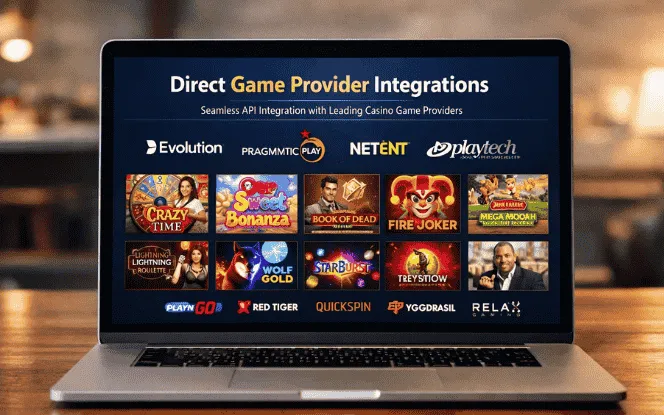
Full control and exclusives
One-to-one with each studio. Better commercial terms and exclusive content access.
- No aggregator fee layer
- Exclusive or early-access games
- Deeper reporting and promo hooks
- Full upgrade path control
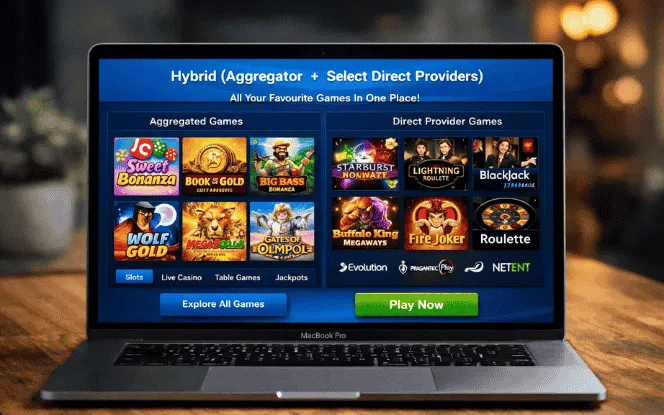
Aggregator speed + direct economics
Launch fast, then add direct integrations where economics justify it. What most mature operators run.
- Best of both models
- Phased provider expansion
- No vendor lock-in
- Grows with your platform
| Factor | Aggregator | Direct | Hybrid |
|---|---|---|---|
| Time to first game | Days–weeks | Weeks–months/provider | Days via aggregator |
| Commercial control | Aggregator terms | Full | Mixed |
| Engineering load | Low | High/provider | Medium, grows with directs |
| Reporting depth | Aggregator-level | Full provider-level | Mixed |
How the money flow works
Every game round must produce an auditable chain from session creation through bet debit to outcome settlement. This is where most integrations fail.
Session Start
Token tied to player, currency, device, and jurisdiction rules. Governs all downstream wallet behaviour.
Bet Request
Validate session and balance, debit or reserve funds. Idempotency key required — provider will retry.
Win / Loss Settlement
Post final outcome, credit winnings, close round cleanly. Linked round ID is non-negotiable.
Rollback Handling
Reverse failed transactions safely using idempotency keys and immutable audit logs.
Round Reconciliation
Three-way match: platform ledger vs provider report vs bank settlement. Daily, with drift alerting.
Reconciliation is built as a reporting feature instead of a system component with its own alerting. Open rounds accumulate for days before anyone notices.
Many vendors connect endpoints.
We build stable money flows.
Wallet correctness, reconciliation, and audit logs are non-negotiable on every SDLC Corp casino API integration.
Platform-first thinking
Wallet correctness and reconciliation come first. Game content is built on top of a proven money foundation — not the other way around.
Integration discipline
Phased rollout, production monitoring, and repeatable QA playbooks on every project. No exceptions, no shortcuts.
Full-stack delivery
Aggregator integrations, direct providers, payments, KYC/AML, and back office — all from one team, one codebase.

Online casino API integration that holds under production traffic
Our integrations survive provider API changes, catalog rotations, and traffic spikes without emergency patches. We design for the edge cases — duplicate callbacks, rollback storms, disconnection scenarios — before the first player signs up. The phased rollout approach means every failure mode is caught in sandbox, not discovered at 2am under live traffic.