
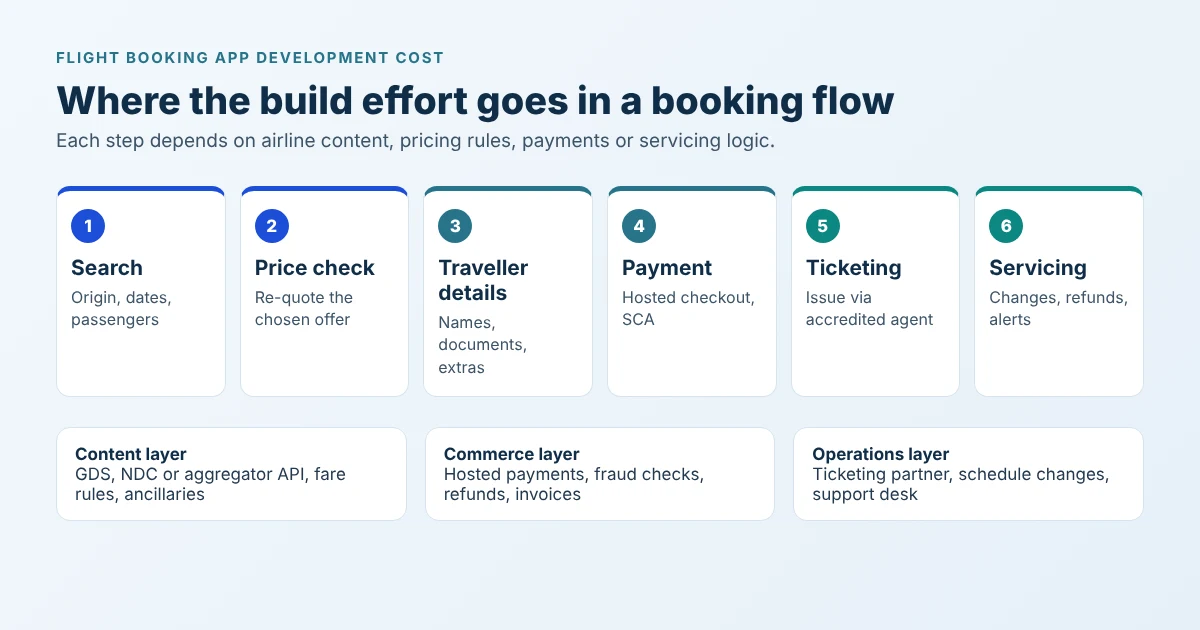
Flight booking app development cost depends less on screen count than on four decisions. They are where your airline content comes from, who issues the tickets, how payments and refunds work, and how much post-booking servicing the app must handle. A search-and-redirect app that sends travellers to airline sites is a modest build. However, a full booking app that prices offers, takes payment, issues tickets and manages changes is a regulated commerce product.
This guide explains each cost driver, shows what belongs in a first release, and gives a planning example you can adapt. It also covers revenue models, because the way the app earns money changes what you have to build.
Key points
- Content source, ticketing route, payments and servicing drive most of the cost.
- An aggregator API and a ticketing partner are the fastest way to launch.
- A focused first release keeps the budget under control.
- Your revenue model changes what you have to build.
How SDLC Corp prices this work
A cross-platform mobile app for iOS and Android has an indicative price of $10,000 when it connects to an existing backend with documented APIs. A flight booking app usually also needs a booking backend, airline content integration, payments and ticketing workflows, so that scope is estimated after free initial scoping. See our mobile app development services for what the app build includes.
What Drives Flight Booking App Development Cost
Most budgets move because of integration and operational scope, not design polish. The table below shows how each driver changes the effort.
| Cost driver | Lower-effort choice | Higher-effort choice |
|---|---|---|
| Airline content | One aggregator API with normalised data | Several GDS, NDC and low-cost carrier sources merged and de-duplicated |
| Ticketing | A ticketing partner issues tickets under its accreditation | Your own IATA or ARC accreditation and settlement processes |
| Booking scope | One-way and return economy fares | Multi-city trips, fare families, seats, bags and other ancillaries |
| Payments | Hosted checkout from a payment provider | Multiple currencies, wallets, split payments and fraud screening rules |
| Servicing | Booking view and email support | In-app changes, cancellations, refunds and schedule-change handling |
| Platforms | One cross-platform app | Separate native iOS and Android apps plus a web booking site |
| Markets | One country, one language | Several languages, currencies, tax rules and consumer protection regimes |
Swipe the table sideways to see every column.
In practice, the first two rows decide most of the flight booking app development cost. Therefore, settle content and ticketing before you estimate screens.
Airline Content and Ticketing Shape the Budget
An app can only sell what its content source returns. Flight content usually reaches a booking app in one of three ways, and each one brings different integration work.
Global distribution system (GDS)
Networks such as Amadeus, Sabre and Travelport that connect airlines with travel sellers.
Build impact: commercial agreement, certification and legacy fare and booking records.
NDC connections
Airline offers and orders sent through IATA's XML-based New Distribution Capability standard.
Build impact: richer fares and ancillaries, but each airline adopts the standard at its own pace.
Aggregator API
A single API that combines GDS, NDC and low-cost carrier content.
Build impact: faster start, with fees per booking and less control over the content mix.
IATA describes NDC as a standard for shopping, ordering, servicing and paying for airline products through APIs. You can read the programme overview on the IATA NDC programme page.
Access routes also change over time. For example, Amadeus closed its self-service developer portal on 17 July 2026 and kept its Enterprise APIs, as PhocusWire reported. So a prototype built on a free sandbox may need a new contract before launch.
Who Issues the Tickets?
Searching flights and issuing tickets are separate steps. To issue tickets for most full-service airlines, a seller needs IATA accreditation, or ARC accreditation in the United States, or a partner that holds it. Many new booking apps therefore start with a consolidator, a host agency or an API provider's ticketing service.
For instance, Duffel's Managed Content service lets sellers without their own accreditation sell flights under Duffel's ticketing authority, for a fee. This choice affects your legal setup, cash flow and support process, not just the code.
Features for a First Release and Later Phases
A focused first release keeps flight booking app development cost under control. Start with the journey that proves demand, then add features once real bookings show what travellers use.
| Feature | First release | Later phase |
|---|---|---|
| Flight search and filters | One-way and return, price and stops filters | Multi-city, flexible dates, fare calendars |
| Offer pricing | Re-price the chosen offer before payment | Fare families and branded fare comparison |
| Traveller details | Passenger names and contact data | Saved travellers, loyalty numbers, document scanning |
| Payments | Hosted card checkout | Wallets, instalments, multi-currency pricing |
| Extras | None, or bags only | Seat maps, meals, insurance, hotel and car add-ons |
| After booking | Booking details and email confirmation | Flight status alerts, in-app changes and refunds |
| Admin | Booking list and manual refund handling | Markup rules, reporting and support tooling |
Swipe the table sideways to see every column.
Travellers also compare your app with tools they already know. Google Flights offers price tracking, Skyscanner offers an "Everywhere" destination search, and Hopper offers price predictions. You do not need these features on day one. However, plan your data model so that fare alerts can be added later without a rebuild.
Payments, Refunds and Compliance
Payments add both build work and ongoing obligations to flight booking app development cost. The safest pattern is a hosted checkout or tokenised card field from a payment provider. That way, raw card numbers never touch your servers, which keeps your PCI DSS scope smaller. The PCI Security Standards Council publishes the standard and the self-assessment questionnaires.
Refund rules matter as much as checkout. In the United States, the Department of Transportation's 2024 rule requires prompt refunds when an airline cancels or significantly changes a flight and the passenger does not accept the alternative. Under the rule, ticket agents must also refund on request, as the DOT final rule page explains. As a result, your app needs a clear refund workflow, status tracking and customer messaging.
- Use a payment provider that supports strong customer authentication where it applies, such as in Europe.
- Show the full price, including taxes and fees, before payment.
- Store booking references, payment events and refund decisions for audit and support.
- Agree which party is the merchant of record: your company, your ticketing partner or the airline.
How a Flight Booking App Makes Money
Older guides often assume that airlines pay a fixed sales commission on every ticket. In reality, most large US airlines cut base agency commissions to zero in 2002, and many other markets followed. Today, booking apps usually combine several income streams.
| Revenue model | How it works | What you need to build |
|---|---|---|
| Service fee | A visible booking fee per ticket or order | Fee rules by route, cabin or market, shown before payment |
| Markup | A margin on net or negotiated fares | Markup engine, fare agreements and price monitoring |
| Ancillaries | Margin on seats, bags and other extras | Ancillary shopping through NDC or your content provider |
| Cross-sell | Commission on hotels, cars, insurance or transfers | Partner integrations and combined trip views |
| Subscription | A paid tier for fare alerts or member pricing | Billing, entitlements and alert infrastructure |
| Advertising | Paid placements or metasearch referrals | Ad slots, tracking and clear labelling of sponsored results |
Swipe the table sideways to see every column.
Choose the main model before development starts. For example, a markup model needs fare agreements and a pricing engine, while a service-fee model mainly needs transparent fee display and reporting. That difference shows up directly in flight booking app development cost.
A Worked Example: Planning the Budget
Illustrative example
Suppose a regional travel company wants a cross-platform booking app for one country. The plan below shows how flight booking app development cost splits into parts you can estimate. It is a planning aid, not a quote.
- App layer. Search, results, offer pricing, traveller details, checkout and booking history in one cross-platform app.
- Booking backend. Offer caching, order records, user accounts and an admin panel for refunds and support.
- Content integration. One aggregator API first, with a second source only after launch data justifies it.
- Payments. A hosted checkout from one provider, with refunds handled through the provider's API.
- Ticketing. The aggregator's ticketing service at launch, which avoids an accreditation project in the first phase.
- Servicing. Booking views and email support at launch; in-app changes in the next phase.
With this split, each part can be estimated, tested and accepted separately. The app layer alone fits the indicative price above if the backend already exists. Then the backend, content, payments and servicing work are priced on scope.
For a real reference point, our travel app case study describes an iOS and Android booking platform that combined six live travel data sources and moved from concept to launch in six months.
How to Reduce Flight Booking App Development Cost
- Start with one content source. Add more airlines or GDS connections when booking data shows the gap.
- Use a ticketing partner first. Apply for your own accreditation later, if volume and margins justify it.
- Build one cross-platform app. Separate native apps rarely add value in a first release.
- Keep servicing manual at first. Handle changes and refunds through an admin panel before automating them.
- Launch in one market. Each extra country adds currency, language, tax and consumer-law work.
- Agree acceptance criteria early. Clear criteria stop rework during testing.
For broader budgeting guidance across software projects, see our guide to software development cost, pricing and timelines.
Next Step: Scope Your Booking App
Before you ask for a quote, write down your target market, your content source, your ticketing route and your main revenue model. Those four answers make any estimate of flight booking app development cost far more accurate.
Plan your flight booking app with us
Our travel app development company team can review your booking flow, content options and first-release scope. Initial scoping is free.
Flight Booking App Development Cost FAQs
How much does flight booking app development cost?
It depends mainly on the airline content source, the ticketing route, payments and post-booking servicing. A cross-platform app that connects to an existing backend has an indicative price of $10,000 with SDLC Corp. A full booking product that also needs a booking backend, content integration, payments and ticketing is estimated on scope after free initial scoping.
Do I need IATA accreditation to launch a flight booking app?
Not always. Issuing tickets for most full-service airlines requires IATA accreditation, or ARC accreditation in the United States, or a partner that holds it. Many new apps launch with a consolidator, a host agency or an API provider's ticketing service and apply for their own accreditation later.
How long does it take to build a flight booking app?
On our mobile projects, simple apps take 2 to 4 months and mid-complexity apps on two platforms take 4 to 7 months. A booking product with content integration, payments and ticketing usually sits at the upper end. For example, our travel app case study moved from concept to launch in six months.
Should I start with a GDS or an aggregator API?
An aggregator API is usually the faster start, because one integration returns content from several sources. A direct GDS or NDC connection gives more control over fares and ancillaries, but it needs commercial agreements, certification and more integration work.
Which features should the first version include?
Start with one-way and return search, offer re-pricing, traveller details, a hosted checkout, booking confirmation and an admin panel for refunds. Add seat maps, fare alerts, loyalty features and in-app changes once real bookings show demand.