Week three of the audit
Most capital improvement programs do not fail at delivery. They fail at evidence, in a meeting eleven months earlier where somebody says the funding split can be reconciled later.
By week three an auditor has stopped asking how the program is going. Instead the questions get very specific.
- Show me the approval chain for change order 14 on the Marlow Street reconstruction.Requisition through payment, with named approvers and timestamps
- Show me which portion of invoice 2291 went to the federal grant.Fund source split evidenced on the transaction, not at year end
- Show me the drawing revision the contractor was holding on 3 April.Point in time reconstruction of the record
Most agencies can answer eventually. But "eventually" carries a price, and staff usually pay it in weeks.
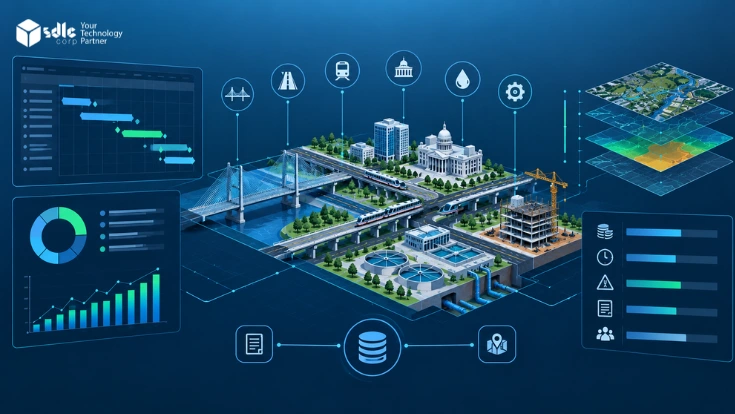
So this guide sets out what a PMIS for public infrastructure actually does, and how it differs from the capital improvement program software an agency may already run.
It then walks through the four ledgers a program has to keep reconciled, what fund source accounting demands at transaction level, why document control is really claims defence, and a six phase rollout that survives contact with staff.
Key Takeaways
- A PMIS is an evidentiary system first. Buy it for defensibility, because the efficiency then follows on its own.
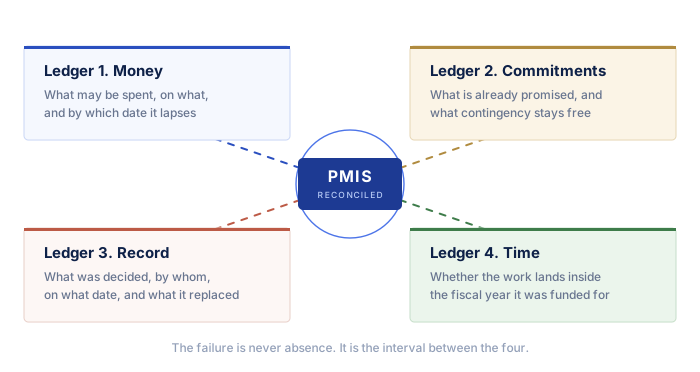
- Public capital work runs four parallel ledgers: money, commitments, record and time. Staff route around any platform that keeps only one.
- Fund source accounting at transaction level is non negotiable. Everything else on the requirements list is a preference.
- Benefit scales with processes actually in use, not with modules licensed. Broad users report roughly double the benefit of narrow ones.
- Sequencing and change management sink implementations, while software capability almost never does.
A note on the numbers. Durations, KPI ranges and cost splits below are typical for mid size single agency programs, drawn from published research and delivery experience. Treat them as planning anchors rather than commitments, and baseline your own active portfolio before you quote any of them.
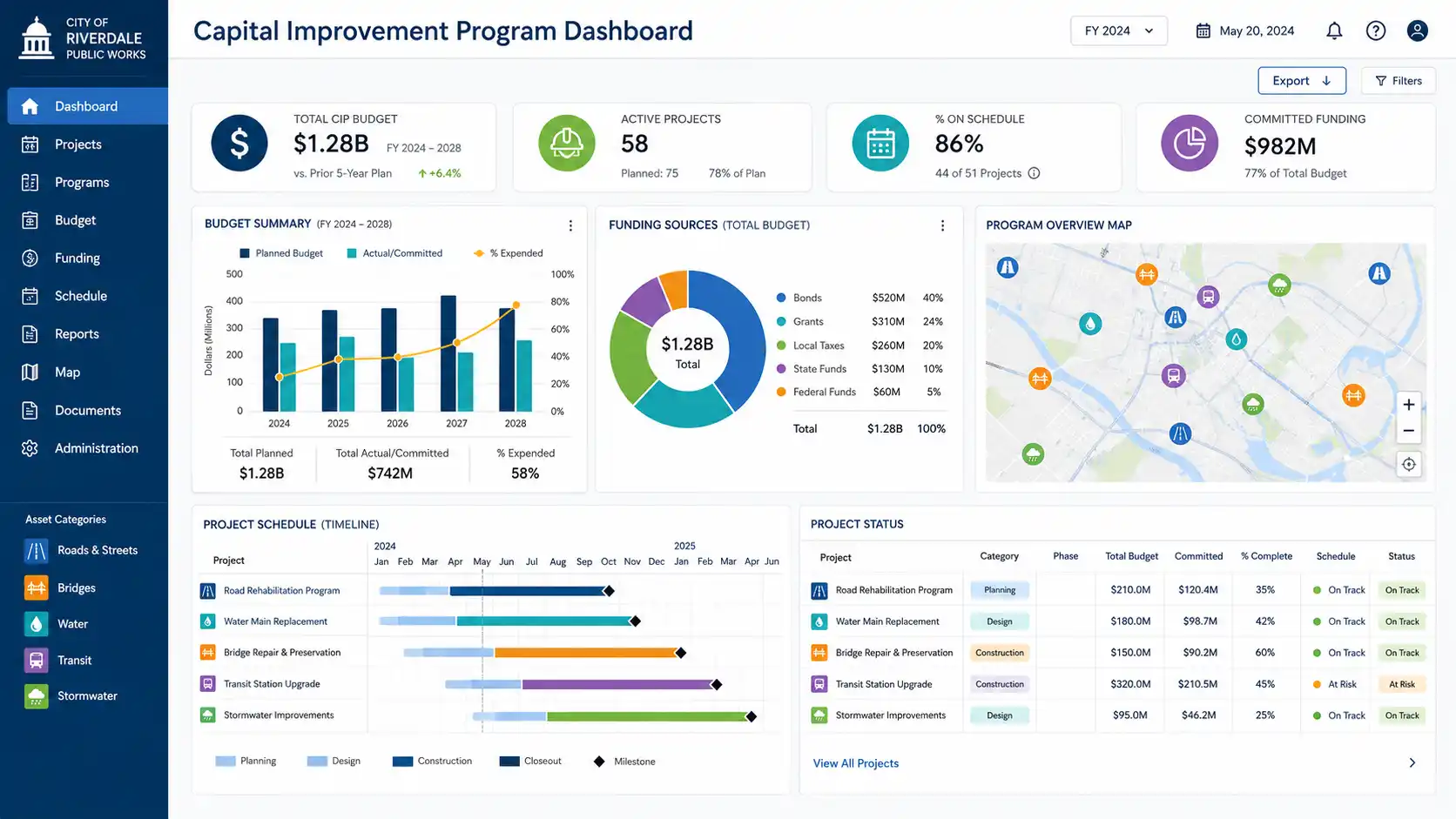
Why The Public Owner's Problem Is Structurally Different
Vendors usually sell a project management information system to agencies as a productivity tool. That framing undersells it and, worse, it pushes buyers toward the wrong product.
A contractor buys project software to finish jobs faster. An agency, by contrast, buys a PMIS because the alternative is an institution that cannot reconstruct its own decisions.
Aurigo's overview of PMIS in public infrastructure describes the category as the backbone supporting data gathering, process and reporting across the capital lifecycle.
Accurate, though generic. Three structural facts produce the requirements that actually matter.
The Money Arrives With Conditions Attached
A contractor receives a contract value. An agency instead receives appropriations that lapse, bond proceeds restricted to a stated purpose, grants governed by eligibility rules and expiry dates, and enterprise revenue tied to rate covenants.
Each dollar therefore behaves differently. So the platform has to enforce that difference on the transaction, rather than leave it to a year end reconciliation.
The Record Is A Legal Instrument
Retention schedules, public records law and the ordinary possibility of litigation turn capital program documents into evidence.
Who published what, when, to whom, and what it superseded: those facts carry consequences. Storage is not the requirement. Provenance is.
Capital Program Management Outlasts The Staff
Leadership rarely asks how the library renovation is doing. Instead they ask which of the ninety projects will miss the fiscal year, and what that does to the bond drawdown.
When a project manager retires after two decades, the system should already hold the reasoning behind a shifted alignment or a settled claim. Otherwise institutional memory lives only in people, which is a liability dressed as expertise.
The Four Ledgers A Capital Program Must Keep
Module lists make a poor evaluation tool, because every vendor's list looks the same.
Here is a sharper frame. A capital program runs four ledgers at once, and the platform earns its keep by holding them in agreement.
Why Reconciliation Is The Whole Point
A change order enters the record ledger the day somebody signs it. It reaches the commitment ledger when somebody rekeys it, hits the money ledger at the next reconciliation, and touches the time ledger only if the scheduler hears about it.
Meanwhile every number the agency reports is wrong by an unknown amount.
A PMIS earns its cost by collapsing that interval to zero. Everything else is a feature list.
The One Test To Run In Every Demo
Raise a change order during the demo. Then ask to see the effect on remaining budget, uncommitted contingency, forecast completion and the audit trail, all without leaving the system and without anyone rekeying anything.
A platform that passes is a PMIS. One that stalls is a document drive with a login.
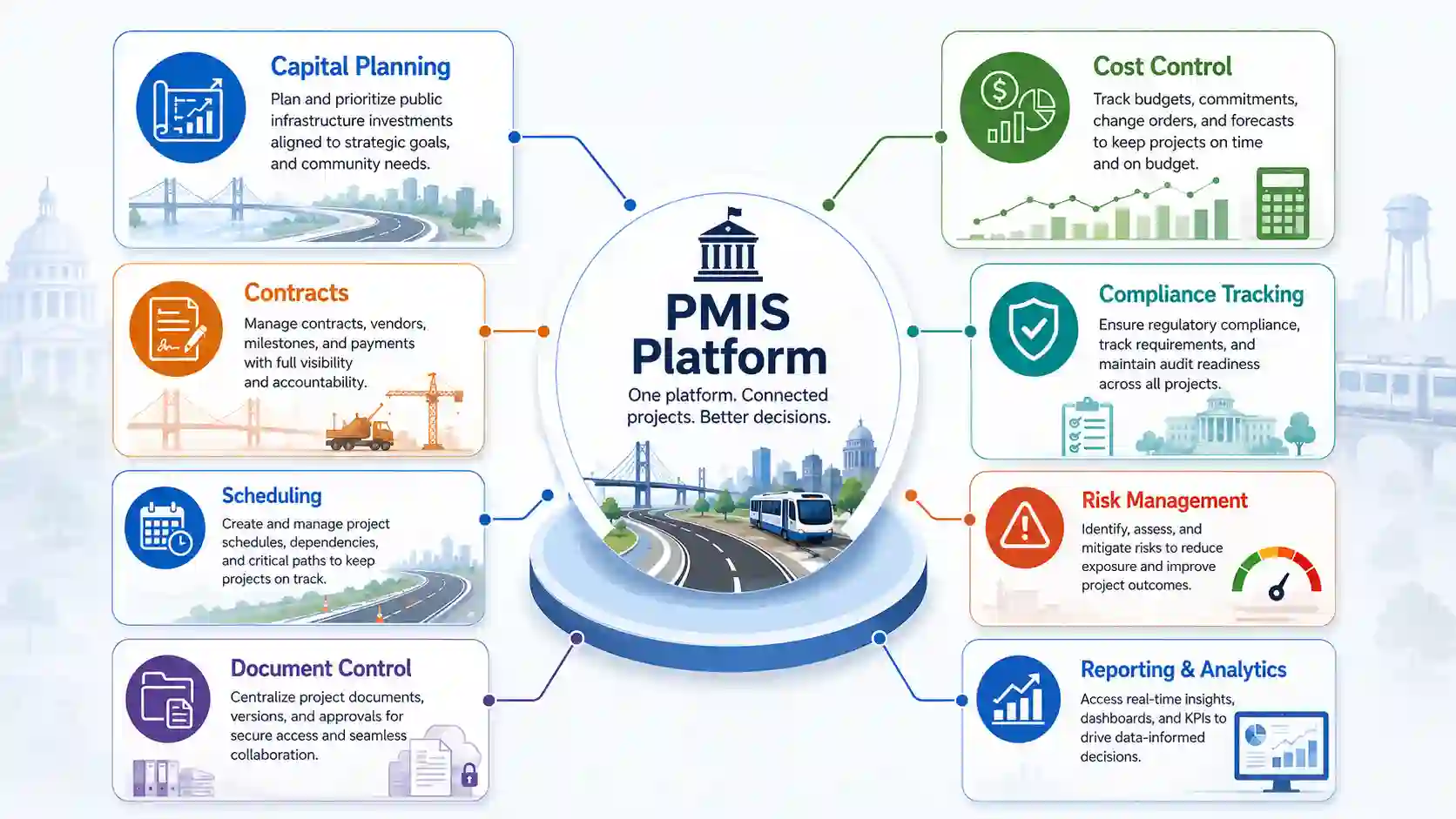
Where The PMIS Sits At Each Stage Of The Program
Walk your own lifecycle through the platform, stage by stage, and ask what the system holds at each handoff. That exercise beats any feature comparison.
Select a stage below to see what the system has to capture there.
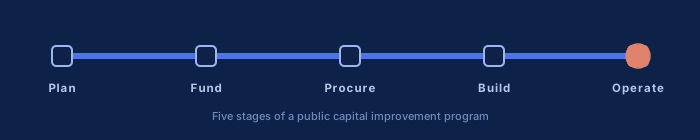
Stage 1. Plan
Needs, condition and the adopted CIP
Staff score requests against condition data, risk and policy criteria, so the adopted plan reflects need rather than whoever asked loudest.
Crucially, the PMIS keeps the scoring basis and not just the result, which is exactly what you need when somebody questions a deferred project two years later.
Stage 2. Fund
Sources loaded and tied to eligible scopes
You load appropriations, bond proceeds and grant awards with their restrictions attached.
Because the eligibility logic you set here governs every later transaction, this stage decides whether year end reconciliation becomes a formality or a fire drill.
Stage 3. Procure
Solicitation through notice to proceed
Design contracts, solicitations, bid evaluation and award each carry the competition standard their funding source demands.
Since an auditor reads this file first, build it as the process runs instead of compiling it afterwards.
Stage 4. Build
Where the four ledgers drift apart
Pay applications, RFIs, submittals, change orders, inspections and safety records all land in this stage.
Every one of them touches more than one ledger, so an unintegrated system starts producing numbers nobody trusts right about here.
Stage 5. Operate
Handover to asset management
Punch lists, warranties, as built drawings and asset records pass to operations.
Skip this and the agency pays twice: once to build the record during construction, then again to rebuild it when maintenance needs it in year eight.
The Requirement Public Owners Cannot Compromise On
If a platform gets only one thing right for a public agency, make it fund source accounting. Every other capability has a workaround, though this one does not.
Most capital improvement programs draw on a blend of sources. Moreover, each source behaves differently once money starts moving.
General Fund And Enterprise Revenue
Annual appropriations generally lapse at fiscal year end, so encumbrance timing often decides whether budget carries forward. That turns the commitment ledger into a funding question rather than a paperwork one.
Water, sewer and transit revenue then adds rate covenant obligations, which ties capital timing directly to rate setting.
Bond Proceeds
Ballot measures and ordinances restrict bond proceeds to the purposes they state.
Spend down pace also matters for arbitrage and continuing disclosure obligations. As a result, one unusually slow project carries consequences well beyond that project.
Grants And Impact Fees
Eligibility rules, match requirements, procurement standards and expiry dates all apply at once. Therefore the grantor disallows and recovers any cost that fails even one of them.
Challengers question impact fees more often than any other source, so document the link between fee collected and project funded well enough to survive a hearing.
One Invoice, Three Sets Of Rules
Splitting is the mechanic that matters here. One contractor invoice routinely funds work across several restricted sources.
So the platform has to split it on the transaction itself, and attach eligibility logic and evidence to each portion.
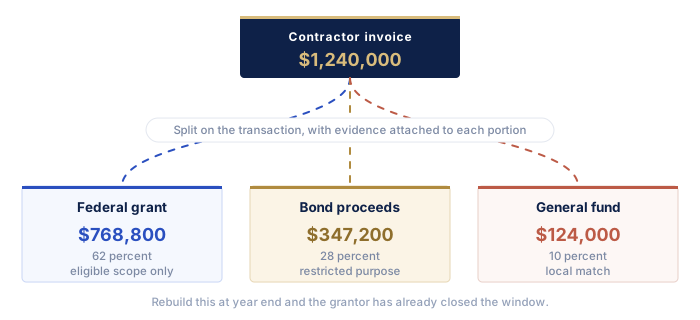
Later, when a grantor requests a reimbursement package, staff assemble it from records that already exist instead of rebuilding everything under deadline.
For the cost side mechanics inside an ERP, see our Odoo accounting and finance service.
What An Auditor Is Really Testing
Requisition through payment, with named approvers and timestamps, and no gap that needs a verbal explanation.
Each funding source brings a competition standard, and the file has to evidence it rather than assert it later.
Where one contract serves several funded scopes, write the basis for the split once and then apply it consistently.
Which specification governed on a given date? Answering that needs retention rather than replacement.
Need fund source splitting enforced at transaction level rather than reconciled at year end?
Talk to our capital delivery teamDocument Control Is Claims Defence With A Boring Name
Document control never wins a demo. Still, it settles more disputes than any other capability, because a claim is ultimately an argument about what was known, when, and by whom.
When a contractor asserts a differing site condition, the agency's position rests entirely on which records it can produce, date and prove it issued.
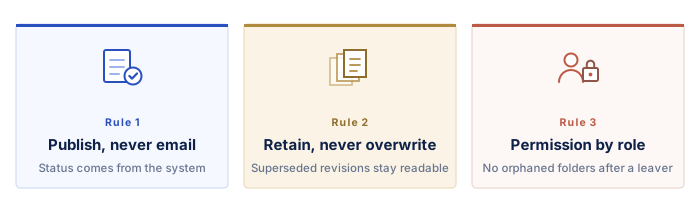
Publish, Never Email
A document becomes current when somebody publishes it in the system.
Anything that travels another way therefore carries no status, and you say so in writing at kickoff.
Retain, Never Overwrite
Keep superseded revisions reachable.
In a claim the question is never what is current. Rather, it is what was current on 14 March.
Permission By Role
Tie access to the role, so a resignation never leaves an orphaned folder nobody can open.
Otherwise that failure mode surfaces at exactly the wrong moment.
The Standards Your Retention Rules Should Point At
Policy defends itself more easily when it cites something external rather than internal habit. Three references therefore cover most of what a public capital program needs.
ISO 19650 sets out how to manage information across the lifecycle of a built asset. It also defines the container naming, status codes and approval states that make a version history intelligible to somebody who was not in the room.
In short, it turns "we keep old drawings" into a defined information management process.
ISO 15489 covers records management more broadly. Typically agencies use it as the anchor for what makes a record authentic, reliable and usable over time.
2 CFR 200.334 is the reference that bites on federally funded work. It requires you to keep financial records, supporting documents and statistical records for three years from submission of the final expenditure report.
Because the clock runs longer while litigation, a claim or an audit stays open, configure retention to that rule and not to whatever the shared drive happened to keep.
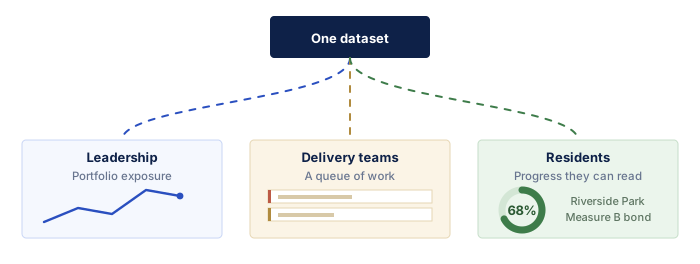
Three Audiences, One Source Of Numbers
Public capital work happens in public view. So the reporting requirement is unusual: three audiences with genuinely different needs, all of whom must read numbers that agree.
What To Measure Once The System Is Live
Six measures separate a capital program management software rollout that earns its cost from one the agency merely tolerates.
Report preparation hours usually moves first, and it is also the easiest number to put in front of a finance committee.
| Measure | Typical result | Benchmark | What it tells you |
|---|---|---|---|
| Cost predictability | ±3.1% | Target under ±5% | Adopted budget versus final cost, read across the portfolio. |
| Schedule reliability | 66% | Original baseline only | Milestones met against the baseline approved at notice to proceed. |
| Change order cycle time | 21 days | Down from 47 days | Submission to executed change, the main lever on delay claims. |
| Grant capture rate | 84% | Reimbursed vs eligible | The fastest available read on compliance quality. |
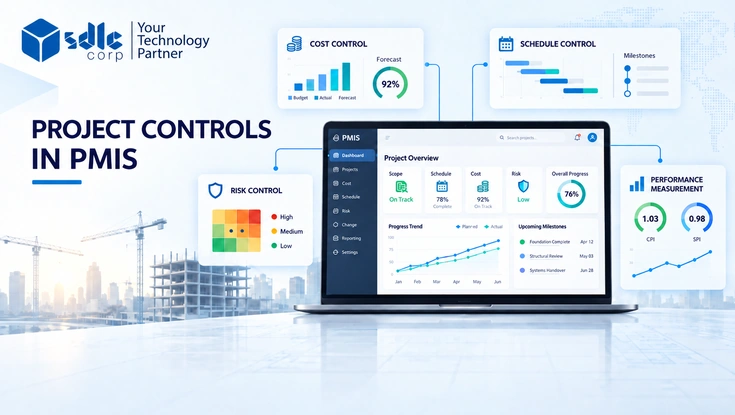
| Report preparation hours | −59% | Three days to two hours | Staff time spent assembling the monthly program report. |
| Contingency burn rate | 1.1× | Investigate above 1.3× | Contingency used against percentage complete, months before a variance report. |
PMIS Or Contractor Platform: Decide This Before The RFP
Both categories are legitimate, and both do their own job well. Trouble starts when one evaluation matrix covers both, since that usually rewards whichever product has the better field experience.
Independent commentary on PMIS platform selection draws the same line between project execution products and owner grade portfolio governance.
Contractor first platform
- Built for the general contractor and trades
- Scoped to the individual jobsite
- Tracks a single contract value
- Runs from notice to proceed through closeout
- Reports to the project team and client
- Data often ends with the contract
Owner side PMIS
- Built for the agency, program office and finance
- Scoped to the program and its portfolio
- Tracks multi source, restricted, audited money
- Runs from planning through asset life
- Reports to council, auditors, grantors and residents
- Data retained permanently
Agencies that adopt a contractor platform as their public sector project management information system usually reach the same position within two budget cycles.
Field execution improves noticeably. Meanwhile portfolio reporting and fund accounting stay in spreadsheets.
Buy, Configure Or Build
Three routes exist, and the choice turns on a question most agencies answer too generously: how unusual are our processes, really?
Route A. Buy A Proven Platform
A packaged product deploys quickly and arrives carrying sector practice, which counts for a lot when internal expertise is thin.
Fit is the trade off. Agencies with unusual fund structures or state specific procurement rules end up bending policy to match the product, which is tolerable as an exception yet corrosive as a pattern.
Route B. Configure Inside The ERP
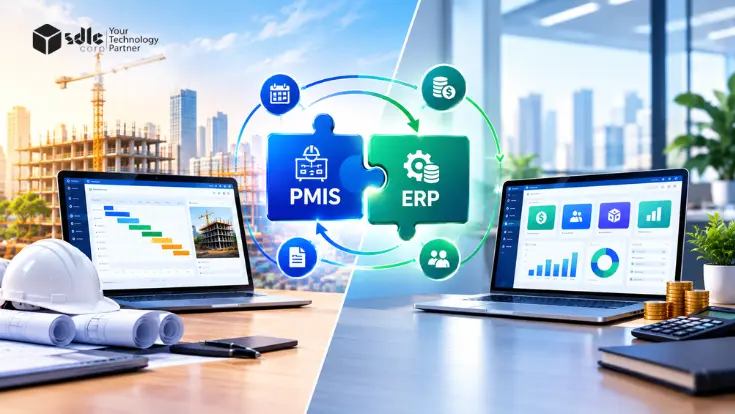
Where an ERP already runs the finance function, you add capital delivery as connected modules. That puts the money and commitment ledgers in one database by design rather than by integration.
Our Odoo services team follows this model, and the walkthrough on Odoo for Construction covers BOQ, work orders, material tracking and project costing configured inside the ERP.
Route C. Build To The Delivery Model
A bespoke platform earns its cost when the delivery model itself is the differentiator.
Joint funding arrangements no product anticipates, multi agency programs with split authority, or asset registers deep enough that integration becomes the project: those are the cases that justify building.
Once you have picked a route, the next decision is how much of the product you keep and how much you configure, requirement by requirement.
A Filter That Survives Contact With Reality
Write down the processes that make your agency genuinely different. Then strike every one that is habit rather than policy, meaning the ones nobody can tie to an ordinance, a grant condition or a delegated authority resolution.
Under four survivors, configure a proven platform. Four to eight, go ERP based. More than eight, build. Most lists shrink by half during that exercise, which is itself a useful outcome.
A Rollout That Survives Contact With Staff
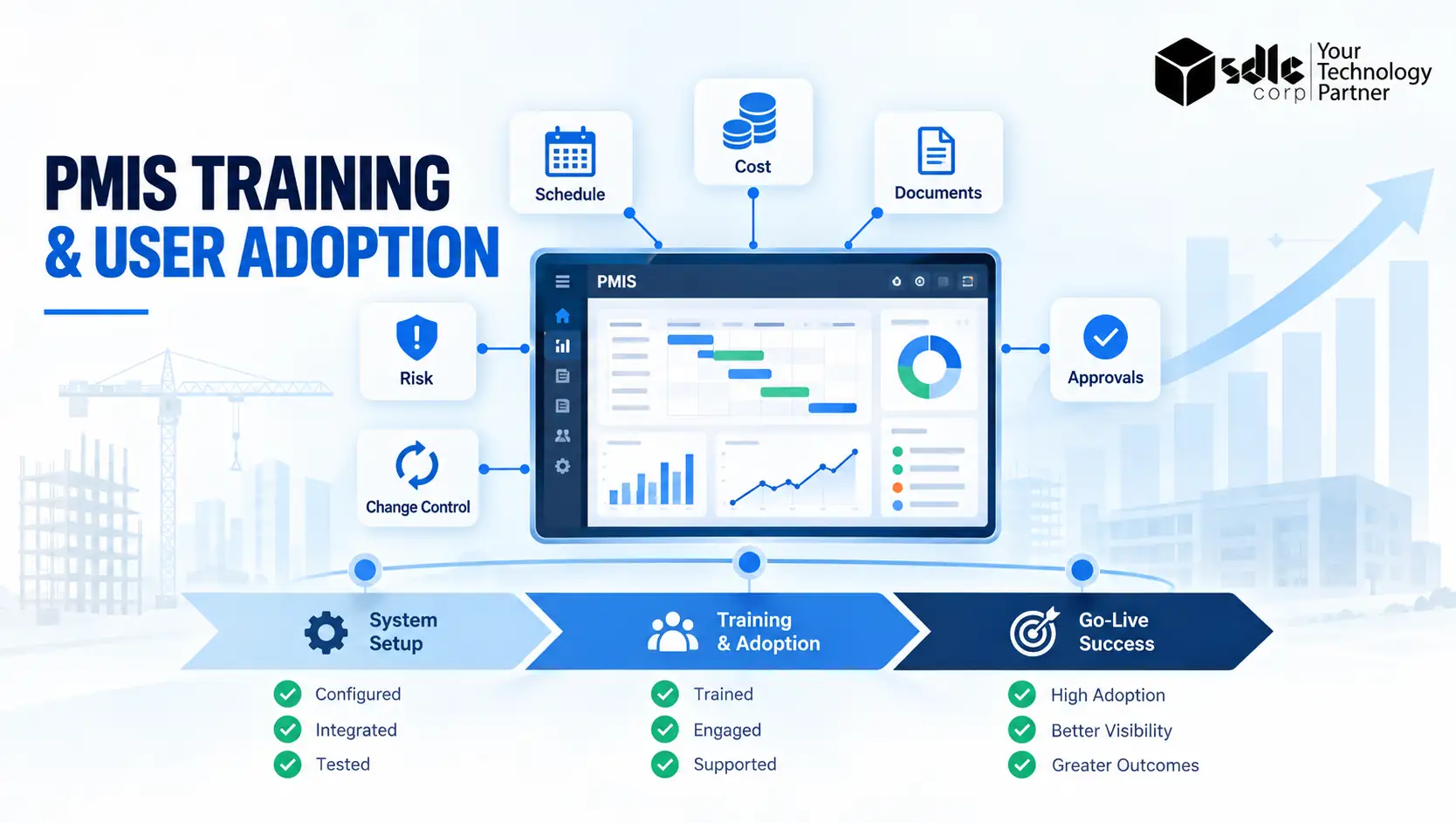
Failed implementations share a habit. Teams switch everything on for everyone at once, on a date the project plan chose rather than a date readiness earned.
Sequenced deployments succeed far more often, because each phase earns the credibility that funds the next.
Phase 1. Baseline The Program Weeks 1 to 4
Inventory every active project with its budget, funding sources, contract values and status. The point is to surface data quality problems now, while they are an inconvenience, rather than after go live when they become a credibility event.
Output: portfolio inventory and data gap listPhase 2. Fix The Process That Hurts Most Weeks 5 to 12
Pay applications and change orders usually make the right opening. Staff feel the relief within a cycle, so adoption then spreads on its own rather than by memo.
Output: first process in productionPhase 3. Bring The Money In Months 4 to 6
Configure budgets, commitments, actuals and fund source rules, then integrate with the financial system so one ledger governs both. This phase converts a document tool into a PMIS.
Output: reconciled money and commitment ledgersPhase 4. Extend To The Field Months 6 to 9
RFIs, submittals, daily reports and inspections move in next. Give contractors short, role specific training rather than a full product tour, since external users abandon anything that takes more than fifteen minutes to learn.
Output: record ledger captured at sourcePhase 5. Publish The Reporting Months 9 to 12
Release program dashboards only after the underlying data has held up for a full cycle. An executive who sees a wrong number early will distrust the platform for years, whatever it shows later.
Output: one source of numbers, three audiencesPhase 6. Close The Loop With Operations Year 2
Pass closeout records, warranties and as built drawings into asset management. Here a construction record becomes a maintenance asset, and budgets tighten around exactly this phase more often than any other.
Output: the value you actually bought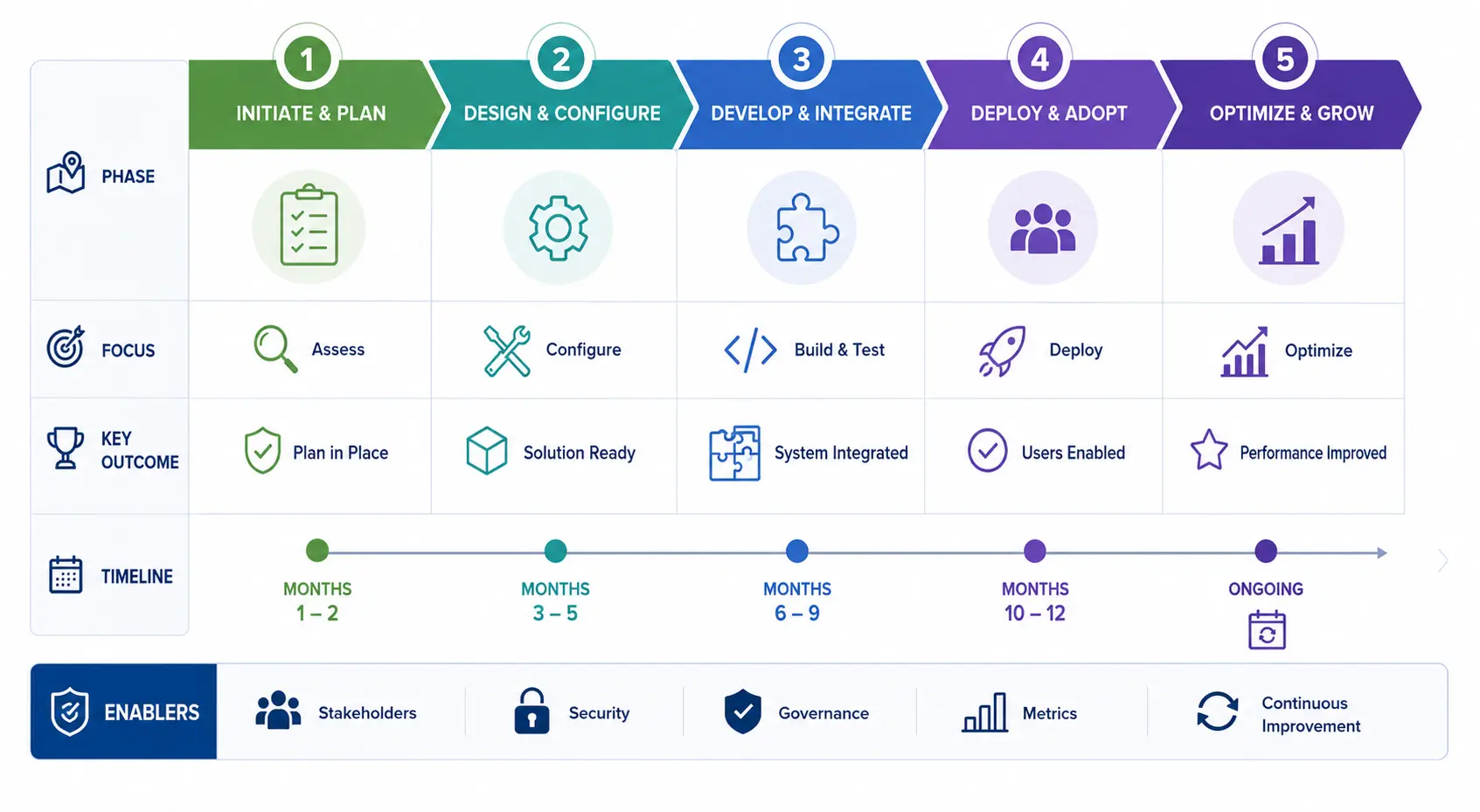
What This Looks Like At A Named Agency
Published deployments beat vendor claims, because the scope and the reasoning sit on the public record.
City of Toronto, Corporate Real Estate Management
In August 2026 the City of Toronto signed a multiyear contract for Aurigo Masterworks to run real estate capital delivery, covering portfolio oversight, cost control and reporting.
Toronto states the purpose plainly: a single source of truth for capital program performance, with visibility running from the enterprise portfolio down to individual projects.
The user list is the part worth noting. Senior leaders, internal city clients, program managers and project teams all read from the same dataset, which supports governance, financial oversight, risk management and schedule monitoring across the investment lifecycle. In other words, Toronto solved the three audience problem structurally rather than by producing three reports.
Several other North American agencies run the same platform for capital real estate, among them Philadelphia, Seattle, Sacramento and Denver, along with York Region and the Ontario Ministry of Transportation.
Reports saving more than three months a year by automating capital planning, which is the Phase 5 benefit showing up as recovered staff time.
Cites less manual data entry and higher accuracy across federal programming and reimbursement, which is the grant capture measure above.
Want your capital program benchmarked against deployments like these before you write the RFP?
Request a program reviewWhere These Programs Actually Fail
Software rarely defeats a capital program. People route around it instead, politely and without announcement, until the parallel system becomes the real one.
Four practices separate the agencies whose platforms get used.
A program manager who can change a workflow beats a steering committee that meets monthly, since an implementation is a long sequence of small decisions.
An inspector needs fifteen minutes on daily reports, not two hours across modules they will never open.
Set the date, migrate the content, then remove access. Tolerating it guarantees two versions of the truth.
When month end reporting drops from three days to two hours, say so widely, with the numbers attached.
Eight Failure Patterns Worth Naming
None of these are software problems. Rather, each one is a decision somebody made early, usually for a defensible reason at the time.
- Treating it as an IT project. A PMIS changes how an agency authorises and records work, so adoption stalls at the pilot whenever capital delivery leadership does not own it.
- Migrating dirty data. New software will not repair twenty years of inconsistent project codes, and the cleanup cost compounds with every transaction added on top.
- Configuring to the vendor's defaults. If the platform cannot express your delegated approval thresholds, somebody will keep a spreadsheet that can.
- Excluding contractors from design. External users submit most of the transactional volume, so a form they cannot complete becomes a day one bottleneck.
- Licensing breadth without training breadth. Benefit scales with processes actually in use, while unused modules stay pure cost.
- Skipping the asset handover. When closeout data stops at the project team, the agency pays twice for the same record.
- Publishing dashboards too early. You build trust in reporting over quarters, then lose it in one meeting where the number on screen is visibly wrong.
- Underfunding year two. Use reveals the real configuration requirements, so a budget ending at go live freezes the system in its least informed state.
Legibility Is The Product
A PMIS does not build roads, replace water mains or renovate schools.
What it produces instead is legibility: the ability of an institution to explain itself to the people delivering the work, the officials funding it, and the residents paying for it.
Answers In An Afternoon
- Split funding at transaction level from day one
- Published documents instead of emailing them
- Put the money in before the dashboards
- Retired the parallel spreadsheet on a named date
- Funded year two before go live
Answers In Three Weeks
- Reconciled funding splits at year end
- Kept the current drawing in an inbox
- Launched reporting on incomplete data
- Tolerated a shadow system indefinitely
- Ended the budget at go live
Return to the auditor in week three. Both agencies usually run comparable projects with comparable staff, so the difference comes down to when the record got built.
Primary Sources And Further Reading
- SmartMarket Brief on owner PMIS utilisationDodge Construction Network. The broad use versus narrow use benefit gap.
- PMIS for public transportation projectsKPMG. Adoption rates and the asset management long tail.
- PMIS in public infrastructureAurigo. Category definition across the capital lifecycle.
- City of Toronto selects Aurigo for capital program managementGlobeNewswire, August 2026. The named agency example above.
- PMIS software selection guidanceMastt. Owner grade governance versus project execution.
- ISO 19650 information management for built assetsISO. The information management standard behind document control.
- 2 CFR 200.334 retention requirements for recordsElectronic Code of Federal Regulations. Federal award record retention.
Planning A PMIS For Your Capital Program?
Fund source accounting, delegated approval workflows, document control and program reporting, configured to your delivery policy rather than a vendor's defaults.
PMIS For Public Infrastructure FAQs
PMIS stands for Project Management Information System. For a public owner it works as the system of record for a capital improvement program, since it holds budgets, funding sources, contracts, schedules, documents and compliance evidence for every project in the portfolio, and keeps those records reconciled with each other.
Feature lists overlap, though purpose does not. Construction project management software serves a contractor delivering a defined scope under one contract. A PMIS, however, serves an owner governing many projects across multiple restricted funding sources and several fiscal years, with audit, retention and public transparency obligations attached to the record itself.
Typically a phased rollout reaches useful production on the first process within three to four months, then covers the full program over nine to twelve. Data quality and change management drive that timeline far more than software configuration does. Agencies with clean project data and a decisive internal owner routinely finish in half the time of those without.
It must, so treat this as a pass or fail requirement rather than a scored one. The system needs to split costs across bond, grant and general fund sources at transaction level, apply each source's eligibility rules to its portion, and keep the supporting evidence where an auditor can find it years later.
Track portfolio level cost predictability, schedule reliability against the original approved baseline, change order cycle time, grant capture rate, contingency burn against progress, and the staff hours monthly reporting used to consume. That last measure usually moves first, and it is also the easiest one to evidence to a finance committee.
Agencies running fewer than roughly twenty concurrent projects often get better value from extending an ERP with capital delivery modules. Finance integration comes free, licence costs stay contained, and the money and commitment ledgers share a database by construction. Larger or grant heavy programs, by contrast, generally justify a dedicated platform.
Start with the financial system, without exception, because an unintegrated PMIS produces a second set of numbers and that is worse than no PMIS at all. GIS and the asset register follow closely for agencies with long lived infrastructure. Scheduling and e procurement connections usually belong in second phase work.
For federally funded work, 2 CFR 200.334 sets the baseline: keep financial records and supporting documents for three years from submission of the final expenditure report, and run the clock longer while litigation, a claim or an audit stays open. ISO 19650 then governs how you name, status and approve project information across the asset lifecycle, while ISO 15489 covers general records management. State and municipal schedules sit on top, and they are often longer.
Capital delivery or the program management office should own it, while IT supports infrastructure, security and integration. Systems that sit under IT tend to follow technical coherence rather than the way an agency actually authorises capital work, and the mismatch surfaces the first time a delegated approval threshold will not fit.