Players in iGaming move fast. They deposit, play, win, lose, and drift away within minutes. Real-time player segmentation lets an iGaming CRM group players by live behavior and act while the moment still matters, instead of reacting a day later when the player has already gone.
The scale of the problem is clear. On average, more than half of an operator’s player base has churned after 30 or more days of inactivity, according to Optimove’s industry data. For operators in the iGaming industry, where acquisition is expensive and attention is short, real-time segmentation answers this directly by turning live activity into instant, targeted action.
Key Takeaways
- Real-time means continuous: Segments update as events happen, not once every 24 hours.
- The data layer is the engine: Live events like bets, deposits, and logins feed each player profile instantly.
- At-risk and VIP detection: Operators can spot churn risk and high-value players early and act on both.
- Segment types still matter: Value, behavior, lifecycle, and RFM remain the core building blocks.
- Analytics close the loop: Measuring segments continuously keeps targeting accurate over time.
What Is Real-Time Player Segmentation?
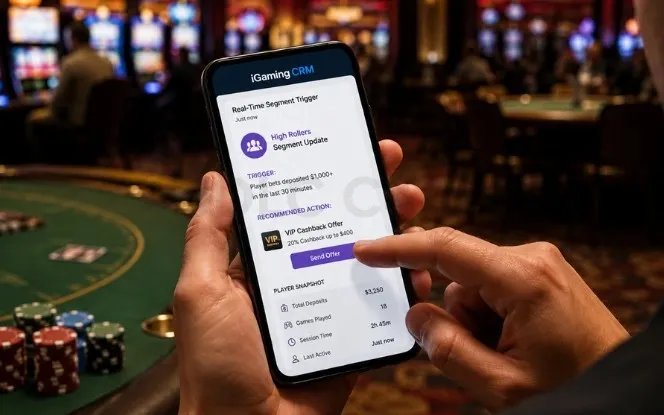
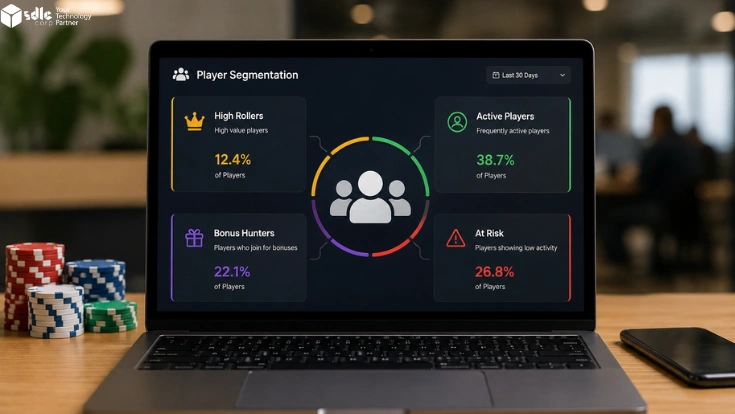
Real-time player segmentation groups players by their live behavior, such as bets placed, deposits, sessions, and lifecycle stage, and updates those groups continuously as new activity arrives. A player can move from one segment to another within seconds.
Generic CRMs struggle here because they are built around contacts and deals, not gaming events. An iGaming-native CRM understands player actions by default, which is what makes adaptive, behavior-based grouping possible in real time.
Real-Time vs Batch Segmentation
Most retention problems start with timing. A CRM that refreshes segments overnight acts on data that is already stale by the time a campaign fires.
| Factor | Batch segmentation | Real-time segmentation |
|---|---|---|
| Update frequency | Every 12 to 24 hours | Continuous, near instant |
| Reacts in-session | No | Yes |
| Best use | Reporting | Live intervention |
| Main risk | Acts on old data | Acts in the moment |
Real-time processing lets an operator respond during a session rather than after it. This is the same shift seen across real-time features in casino games, where speed directly shapes the player experience.
How Real-Time Player Segmentation Works
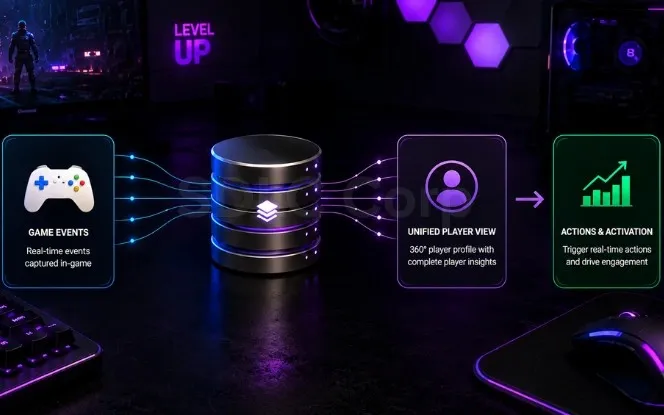
Real-time segmentation runs on a simple flow: events move into a data layer, build a single player profile, update the player’s segment, and trigger an action.
The real-time data layer:This layer captures gaming events the instant they happen, including Bet Placed, Deposit Made, First Time Deposit, Bonus Claimed, login, and session start or end. It is built on event-driven architecture, which processes activity as a live stream.
The unified player view:Every event feeds one 360 degree profile that combines gameplay, transactions, and engagement across channels.
The AI layer:Predictive scoring reads that profile to estimate churn risk and player value, which the CRM then uses to flag at-risk players and high-value VIPs.
Flagging At-Risk Players and Detecting VIPs
The real payoff of real-time segmentation is catching the right player at the right second.
The CRM defines early churn signals, such as time since last session or deposit. When a player crosses that line, they enter an at-risk segment and trigger a reactivation journey before they fully disappear. For example, a player who normally deposits every few days suddenly going quiet for over a week is an early warning worth acting on, and reaching them then works far better than a win-back email sent weeks later. The same early-signal monitoring also supports responsible gambling, since the UK Gambling Commission’s customer interaction guidance expects operators to track activity indicators and act quickly when signs of harm appear.
Instead of waiting for deposit totals to add up, the system watches behavioral signals like rising bet sizes, multiple sessions a day, and fast re-deposits. These patterns help predictive analytics flag high-value players early, so they receive premium treatment from the start.
Turn Live Player Activity Into Instant Action
See how an iGaming-native CRM builds real-time segments from live events, flags at-risk players and VIPs early, and triggers the right journey while the session is still live.
See Real-Time Segmentation in ActionCommon Player Segments
Real-time segmentation still relies on clear segment types. Most operators start with five to eight core groups and expand later.
| Segment | Based on | Example action |
|---|---|---|
| VIP / high roller | Value | Dedicated manager, exclusive offers |
| Casual | Value | Lower-stakes promotions |
| Behavioral | Game and session patterns | Tailored game recommendations |
| Lifecycle | New, active, dormant, lapsing | Stage-based messaging |
| RFM | Recency, frequency, monetary | Targeted retention by value tier |
Most operators refine these groups over time as player behavior shifts and new data comes in.
Tracking Segments With Analytics

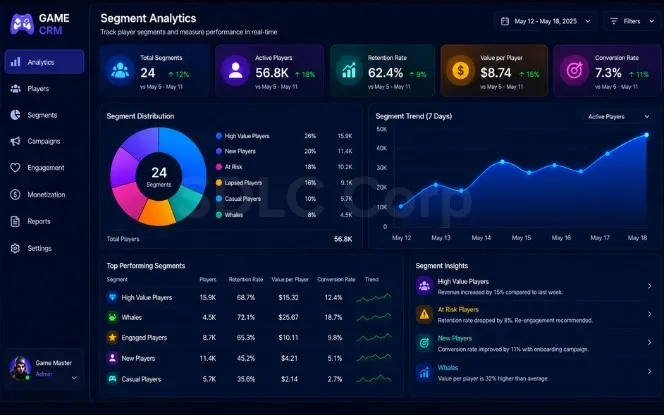
Segmentation is only useful if it stays accurate. Operators should track segment movement, retention and conversion by segment, churn rate per group, and value per player. Real-time dashboards make it possible to see a segment shift and adjust the same day, instead of waiting on delayed reports.
Clean data is the rule that holds everything together. Incomplete or inconsistent events lead to wrong segments, so reliable data capture is the foundation that keeps analytics at scale accurate.
Conclusion
Real-time player segmentation has become the line between reacting to players and reacting too late. By turning live activity into instant segments, operators can step in during the moments that decide whether a player deposits again, stays, or churns. The foundation is straightforward: a strong data layer, a unified player view, and predictive signals that flag at-risk players and VIPs the moment their behavior shifts.
For operators who want this working without months of setup, SDLC Corp builds iGaming CRM and platform solutions that connect data, segments, and triggers into one real-time system, so retention and VIP teams can act at the speed players actually move.
How SDLC Corp Helps
SDLC Corp builds iGaming platforms and CRM systems that turn live player activity into real-time segments and timely actions. The focus stays practical: connect the data layer, the player profile, and the trigger logic so retention and VIP teams can act in the moment.
In recent SDLC operator deployments, moving at-risk flagging from overnight batches to real-time shifted reactivation outreach from the next day to within the live session, so fewer players slipped past the at-risk window before a team could respond.
Operators ready to put this into practice can explore iGaming CRM software built for automated marketing, segmentation, and player engagement.
Explore iGaming CRM SoftwareFrequently Asked Questions
What is real-time player segmentation in iGaming?
It is the practice of grouping players by live behavior and updating those groups continuously, so the CRM can act during a session instead of the next day.
How is real-time segmentation different from batch segmentation?
Batch segmentation refreshes once every 12 to 24 hours, while real-time segmentation updates as events happen, which allows in-session responses.
What is a real-time data layer?
It is the part of the CRM that captures gaming events instantly, such as bets, deposits, and logins, and feeds them into each player profile as a live stream.
How does segmentation flag at-risk players?
The system sets early churn signals like time since last activity, then moves those players into an at-risk segment that triggers a reactivation journey.
How many player segments should an operator start with?
Most operators begin with five to eight core segments and add more as their data and campaigns mature.