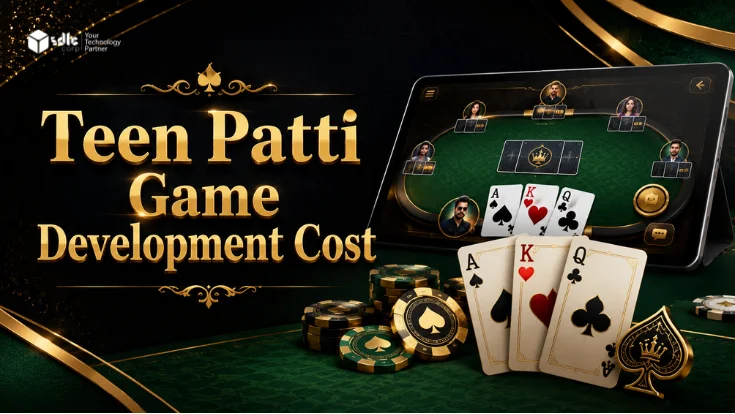
Teen Patti game development cost depends on the number of variants, licensed non-India real-money vs social casino model, multiplayer setup, platform targets, revenue model, and compliance needs. Also, a basic social casino Teen Patti app and a licensed non-India real-money multi-variant platform with RNG certification sit at very different ends of the cost range.
Players across India know Teen Patti, and developers commonly adapt it into mobile and web-based card game products. However, a production-grade platform is more complex than the game’s three-card rules suggest because it needs server-controlled card dealing, certified RNG shuffle, real-time WebSocket sync, wallet integration, and anti-fraud controls.
How Much Does Teen Patti Game Development Cost?
| Project type | Estimated range | Typical use |
|---|---|---|
| Basic practice / demo app | $8K – $18K | Single-variant, virtual chips, no real-money |
| Social casino platform | $18K – $45K | Multiplayer, chips economy, leaderboards |
| Real-money platform - non-India licensed markets only | $35K – $80K | Wallet, RNG certification, KYC/AML |
| Multi-variant tournament platform | $50K – $100K | 10+ variants, tournaments, VIP tables |
| Full white-label / operator platform | $70K – $150K+ | Multi-tenant, operator tools, custom branding |
Therefore, final cost depends on variant count, platform count, tournament features, revenue model, wallet/payment scope, and compliance needs. For broader online casino platform costs, see the online casino software development cost guide.
Important: India compliance note
India's online gaming framework prohibits online money games, related advertising, and payment facilitation. For India-facing products, the practical build direction is social casino, practice mode, or entertainment-only gameplay without cash winnings or money-equivalent rewards. Real-money Teen Patti targets licensed markets outside India. Confirm the legal position in your target jurisdiction with qualified legal counsel before finalizing any technical scope.
Estimates exclude: legal consultation, licensing fees, RNG certification lab fees, payment gateway reserves, cloud hosting after launch, app store fees, and ongoing support costs.
What Drives Teen Patti Development Scope?
Teen Patti Platform Types and Their Cost Impact
| Platform type | What it adds to scope | Cost range |
|---|---|---|
| Practice / demo | Single-player or basic multiplayer, virtual chips, no wallet | $8K – $18K |
| Social casino | Multiplayer tables, chips economy, daily bonuses, leaderboards | $18K – $45K |
| Real-money — non-India licensed markets only | RNG certification, wallet, rake, KYC/AML, compliance documentation | $35K – $80K |
| Tournament platform | Bracket engine, prize pool, scheduled events, sit-and-go tables | $50K – $100K |
| White-label / operator | Multi-tenant backend, operator admin, custom branding per tenant | $70K – $150K+ |
Teen Patti Scope Estimator: What Will Affect Your Cost?
Answer four questions to get a planning cost range and identify which decisions carry the most budget weight for your build.
Teen Patti Scope Estimator
Four questions - about 60 seconds
What type of Teen Patti platform are you building?
How many Teen Patti variants are in scope?
Which platforms need to be supported?
Are tournaments and VIP features required?
Teen Patti Rules, Hand Rankings, and Development Complexity
In the base game, players use a standard 52-card deck with no jokers. First, each player receives three cards. Then, players bet in rounds, either blind without seeing their cards or seen after viewing them. A player can fold to exit, and the round ends when all but one player folds or when two players remain and an eligible player pays for a show.
Hand rankings (highest to lowest)
| Hand | Description | Dev note |
|---|---|---|
| Trail / Trio | Three cards of the same rank (e.g. A-A-A) | Highest hand - 52 possible combinations; must be distinguished from Pair |
| Pure Sequence | Three consecutive cards of the same suit | Suit + sequence check; A-2-3 may rank highest depending on the selected ruleset |
| Sequence (Run) | Three consecutive cards of different suits | Sequence ordering must follow the selected ruleset - some treat A-2-3 as highest, others A-K-Q first. Lock this before development. |
| Color (Flush) | Three cards of the same suit, non-consecutive | Suit check; ranked by highest card, then second, then third |
| Pair | Two cards of the same rank | Ranked by pair value, then kicker |
| High Card | None of the above | Default - ranked by highest card then descending |
Hand ranking conventions - particularly whether A-2-3 ranks above A-K-Q in sequences — can vary by operator or regional ruleset. The platform should lock the selected ranking model before development begins and test all three-card combinations against that model before launch.
The hand comparison engine must handle tiebreaker logic for every hand category - particularly Color hands (compared card by card, highest first) and sequences (where A-2-3 beats K-Q-J in Pure Sequence). These edge cases must be tested against all possible three-card combinations before any real-money deployment.
Blind vs seen mechanics and their engineering impact
The blind/seen mechanic is unique to Teen Patti and adds significant game-state complexity. A blind player bets at half the stake of a seen player. When a blind player becomes seen, their minimum bet doubles. Sideshow requests - where a seen player asks to compare cards privately with the previous seen player - require a separate negotiation state machine within the betting round.
Variant rule engines
Each variant modifies the base rule set in ways that affect hand evaluation, wild card handling, and payout logic:
| Variant | Key rule change | Engineering impact |
|---|---|---|
| Classic | Standard rules, no jokers | Baseline engine |
| Joker | Random card(s) declared wild joker before deal | Wild card substitution in all hand comparisons - significant edge cases |
| Muflis | Hand rankings inverted - lowest hand wins | Inverted ranking table; all comparison logic reversed |
| AK47 | Aces, Kings, 4s, and 7s are wild jokers | Four wild card types - many edge cases in hand evaluation |
| Hukum | One suit declared trump — beats other suits in Color hands | Suit priority modifier in Color comparison logic |
| 999 | Closest to 999 wins, face cards = 0, Aces = 1 | Completely different scoring system - separate evaluation module |
| Royal | Only J, Q, K, A in the deck | Reduced deck - shuffle and dealing engine must filter cards |
Teen Patti Game Features That Increase Development Cost
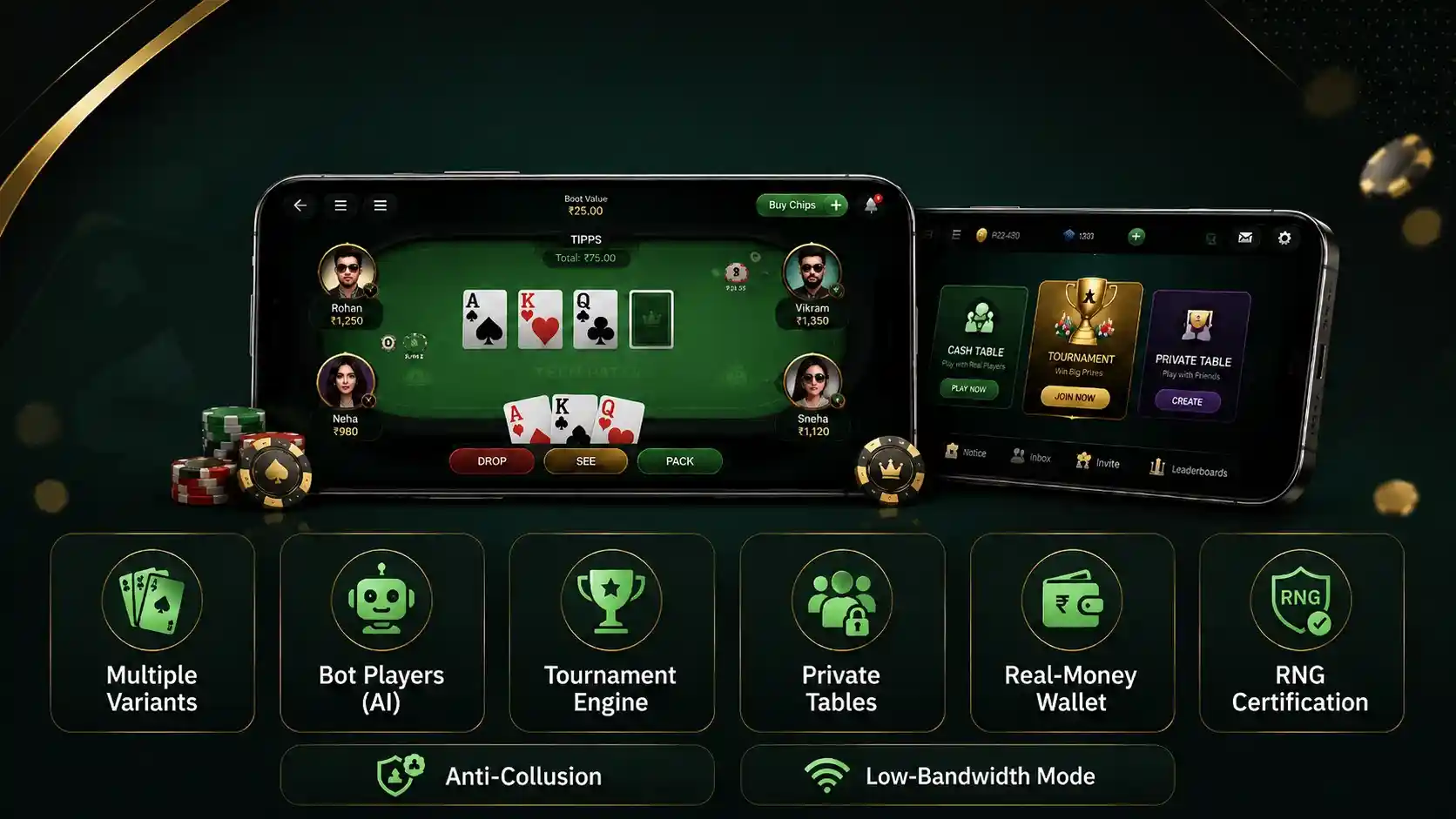
| Feature | Why it increases cost |
|---|---|
| Multiple game variants | Each variant needs its own rule engine, hand evaluator, and dedicated QA test matrix |
| Bot players (AI) | Behavioral AI for low-traffic tables - fold/call/raise decisions, blind/seen behavior, difficulty levels |
| Tournament engine | Bracket management, scheduled vs sit-and-go, prize pool calculation, elimination logic, leaderboard sync |
| Private tables | Table creation by player, invite link system, custom stake settings, access control |
| Sideshow mechanic | Request/accept/reject state machine within betting round - parallel to main game flow |
| Real-money wallet | Deposit, withdrawal, rake deduction, rollback on disconnection, daily/monthly limits |
| RNG certification | Certified shuffle implementation, tamper-resistant hand logs, replayable audit trail, and lab documentation |
| Anti-collusion system | Detection of coordinated play between accounts - requires player-behavior analysis across tables |
| Low-bandwidth mode | Optimized WebSocket payloads and compressed game-state updates - improves reliability on unstable or low-bandwidth networks |
| Multi-language support | Hindi, English, Tamil, Telugu, Bengali - UI and notification localization per language |
| Spectator mode | Read-only game-state subscription - separate stream from player state |
Teen Patti Monetization Strategies
Teen Patti monetization differs significantly between social casino and real-money models. Choosing the model early affects architecture, payment integration scope, and regulatory requirements.
Chips / Virtual Currency
- Chip packs at multiple price points
- Daily free chip bonus
- Watch-ad-for-chips option
- Chip gifting between players
VIP and Subscription
- Weekly / monthly VIP pass
- VIP-exclusive tables and variants
- Bonus chip multiplier
- Priority customer support
Cosmetics
- Avatar frames and expressions
- Card back designs
- Table themes and felt colors
- Chip set skins
Tournaments
- Entry fees (chips, or real-money only in licensed non-India markets)
- Guaranteed prize pools
- Satellite tournaments for main events
- Leaderboard prize distribution
Rake (licensed non-India real-money markets)
- Percentage of pot per hand (typically 2–5%)
- Capped rake per hand
- VIP rake-back programs
- Tournament rake on entry fees
Rewarded Ads
- Optional ads for chip top-up
- Interstitial ads between sessions
- Remove-ads purchase option
- Suitable for free-to-play builds only
Real-money rake requires payment gateway integration, KYC verification, daily/monthly transaction limits, and in many jurisdictions, a gaming license. Social casino chips purchases avoid most of these requirements but require a separate monetization strategy to sustain revenue without rake.
RNG Requirements for Teen Patti
For this reason, the server must determine card shuffle and deal order before any player receives their hand. Client-side card dealing creates an exploit risk because network inspection can reveal card values before the interface displays them. Therefore, real-money platforms need an RNG setup that is ready for certification.
- Full deck shuffled server-side before each hand
- Do not send unrevealed cards to any client - each client receives only the cards and table state they are permitted to see
- Tamper-resistant hand logs with deal order and outcomes
- Replayable audit log for dispute resolution and audit
- Bot player hands dealt from same shuffled deck - not separately generated
- RNG specification documentation for certification lab submission
Anti-collusion detection is a separate system from RNG certification but equally important for real-money Teen Patti. Players at the same table can share card information via external communication. Server-side detection of statistical collusion patterns - unusually high fold rates when a specific player bets, systematic chip transfers - requires a dedicated analytics layer.
Teen Patti Development Cost by Component
| Component | Cost range |
|---|---|
| Game design and UX | $4K – $14K |
| Card dealing and shuffle engine | $5K – $16K |
| Hand evaluation and rule engine | $6K – $20K |
| Variant rule modules (per variant) | $2K – $6K each |
| Real-time multiplayer (WebSocket) | $10K – $30K |
| Frontend - Android | $8K – $22K |
| Frontend - iOS | $6K – $18K |
| Frontend - Web/WebGL | $6K – $16K |
| Backend and session logic | $10K – $35K |
| Wallet and payment integration | $8K – $30K |
| Tournament engine | $10K – $28K |
| Bot / AI player system | $6K – $18K |
| Admin panel and operator tools | $6K – $22K |
| Anti-fraud and collusion detection | $8K – $24K |
| QA and certification | $6K – $22K |
What Increases the Budget?
- Real-money wallet and payment gateway - licensed non-India markets only
- RNG certification and documentation
- Large number of game variants (6+)
- Tournament engine with prize pool management
- Anti-collusion detection system
- Both Android and iOS native builds
- Web/WebGL platform in addition to mobile
- KYC/AML integration
- Low-bandwidth protocol for Tier-2/3 markets
- Multi-language localization
- White-label multi-tenant architecture
- Custom 3D avatar and animation pipeline
Development Timeline by Project Type
| Project type | Timeline |
|---|---|
| Basic practice / single-variant demo | 3 – 6 weeks |
| Social casino - Classic + 2–3 variants | 8 - 14 weeks |
| Social casino - full variant suite | 12 - 20 weeks |
| Real-money platform with certification - licensed non-India markets only | 16 – 28 weeks |
| Tournament platform with VIP tables | 18 – 30 weeks |
| White-label / operator platform | 20 – 36+ weeks |
Also, payment gateway approval, RNG certification, and app store eligibility can run in parallel with development, but each one can still delay launch. App store eligibility for real-money gaming depends on country, license status, geo-restriction, payment model, and current store policy. Therefore, confirm Apple and Google requirements before development starts and plan all three tracks into the timeline.
Common Teen Patti Development Mistakes
Implementing card dealing client-side. If clients receive full hand information before cards are shown, players with network inspection tools can see their own and others' cards. All card logic must run server-side with cards revealed progressively as gameplay dictates.
Building each variant as a separate codebase. Variants should share a common dealing engine, session management, and multiplayer layer - only the rule and hand-evaluation modules should diverge. Separate codebases multiply QA, maintenance, and update effort with each variant.
Ignoring bot player quality on low-traffic tables. Empty tables kill retention. Bot players that fold too predictably or never bluff are quickly identified by experienced players. Bot behavior should be configurable, less predictable, and tested against obvious exploit patterns that experienced players quickly identify.
Not handling player disconnect mid-hand. A player who disconnects during an active hand must be handled gracefully - either auto-fold after a timer or hold their position with a reconnection window. Both states need explicit logic, not a fallback.
Underestimating the sideshow state machine. The sideshow request - seen player asks to compare cards with the previous seen player - runs in parallel to the main betting round and requires accept/reject handling, timeout, and fallback. It is more complex than it appears and breaks the main game loop if not architected separately.
Not optimizing for low-bandwidth networks. Many players may use unstable, low-bandwidth, or budget-device environments, especially outside metro markets. Game-state update packets that perform well on 4G LTE can cause timeouts on slower connections. Binary WebSocket framing with compressed payloads is a meaningful retention improvement for this audience.
Adding real-money features without a compliance plan. Real-money online card games in India now face a central prohibition under the online gaming framework, along with state-level betting and gambling controls. Do not add payment rails, rake, deposits, withdrawals, or cash-prize mechanics for India-facing Teen Patti products without jurisdiction-specific legal clearance.
Finalizing variant scope after the hand-evaluation engine is built. Adding Muflis (inverted rankings) or AK47 (four wild card types) after the core engine is written requires significant rework to the hand comparison and ranking logic. Lock variant scope before development begins.
Questions to Finalize Before Requesting a Quote
- Social casino, sweepstakes, entertainment-only, or licensed non-India real-money?
- Which variants are in scope at launch?
- Which jurisdictions are targeted?
- Android only, or iOS and web as well?
- Is RNG certification required?
- Are tournaments required at launch?
- Are bot players needed for low-traffic tables?
- What monetization model — chips, rake, or both?
- Is white-label / multi-tenant required?
- What languages need to be supported?
- Is low-bandwidth optimization required?
- Who owns source code and game IP?
When to Brief a Teen Patti Development Team
Once money model, variant scope, platform targets, and monetization approach are confirmed, you have enough to receive a meaningful estimate. Engaging before these are defined produces a cost range too wide to budget from.
For a related card game guide, see the Rummy game development page - many Teen Patti platform requirements overlap with Rummy, particularly around the multiplayer engine, wallet integration, and RNG certification scope.
Technical assumptions and last reviewed
Last reviewed: May 2026
Cost methodology: Estimates assume custom development, server-controlled card dealing, real-time multiplayer, variant-specific rule logic, QA, and production deployment on a standard cloud stack.
Excluded from estimates: Legal consultation, gaming license fees, RNG certification lab fees, payment gateway reserves, cloud hosting after launch, app store fees, marketing, and post-launch support.
Compliance: India-facing products should avoid online money gaming features, cash winnings, deposits, withdrawals, rake, or money-equivalent rewards without jurisdiction-specific legal clearance. Rules are subject to change — confirm current requirements with qualified legal counsel before finalizing scope.
References: Promotion and Regulation of Online Gaming Act, 2025 — MeitY; Teen Patti rules — Pagat; Apple App Review Guidelines 5.3.4; Google Play real-money gaming policy.
Frequently Asked Questions
A basic practice or demo app starts at $8K–$18K. For a social casino with multiplayer and chips economy, the range is usually $18K–$45K. In licensed non-India real-money markets, a platform with RNG certification may cost $35K–$80K before legal, licensing, lab, payment reserve, and operating costs. Full tournament platforms with multiple variants usually cost $50K–$100K. White-label operator builds can range from $70K–$150K+. Overall, cost depends on variant count, money model, platform targets, tournament features, and compliance needs.
The five largest cost drivers are: real-money wallet integration for licensed non-India markets, RNG certification and documentation, a large number of game variants (each needing its own rule engine and QA coverage), a tournament bracket engine with prize pool management, and anti-collusion detection for real-money tables.
Classic Teen Patti is the baseline. Common variants include Joker (wild cards), Muflis (lowest hand wins), AK47 (Aces, Kings, 4s, and 7s are wild), Hukum (one suit beats others), 999 (closest to 999 score wins), and Royal (J, Q, K, A only deck). Each variant requires a separate rule engine and hand-evaluation module - they should share the dealing and multiplayer infrastructure but not the game-logic layer.
For real-money platforms in regulated markets, RNG certification is commonly required. The shuffle algorithm must be server-authoritative, tamper-resistant, and documentable for lab review. Social casino and practice builds have lighter requirements but should still use server-side card dealing to prevent client-side manipulation.
A basic single-variant demo takes 3–6 weeks. A social casino with 2–3 variants takes 8–14 weeks. A full-variant social casino runs 12–20 weeks. A real-money platform for licensed non-India markets with RNG certification usually takes 16–28 weeks, before legal approval, licensing, payment onboarding, certification review, and app store approval timelines. A white-label operator platform typically runs 20–36 weeks or more depending on feature scope and integration requirements.
Yes. Teen Patti game engines can integrate with wallet APIs, game aggregators, KYC/AML providers, CRM systems, and analytics platforms. The API contract between the game server and the platform should be agreed before backend development begins. For detail on casino platform API integration, see the online casino games API integration guide.