
Before an anchorage management system goes live, port operators must verify that its workflows perform correctly under real operating conditions. User acceptance testing (UAT) confirms whether vessel calls, anchorage allocations, approvals, integrations, exceptions, and recovery processes meet the agreed operational requirements.
A structured anchorage management system UAT checklist helps teams define test scenarios, expected outcomes, supporting evidence, and sign-off responsibilities. Testing should cover concurrent changes, restricted access, integration failures, and recovery—not only normal workflows. The final acceptance decision must document what was tested and identify unresolved conditions that could affect operational use.
Define UAT Scope, Operators, Data and Sign-Off Authority
| Element | Decide in advance | Why it matters |
|---|---|---|
| Scope | Which workflows are in and out | Prevents drift into feature review |
| Participants | Named operators and supervisors | Testing by the project team proves little |
| Environment | Which, refreshed how often | Uncontrolled concurrent changes can invalidate results |
| Data | Realistic, including awkward cases | Clean data hides the defects that matter |
| Severity model | Agreed definitions and gates | Stops negotiation during triage |
| Sign-off | Who decides, on what evidence | Avoids an ambiguous ending |
The implementation roadmap should have produced a draft of this before build finished. Criteria written after the build tend to describe what the build does.
Prepare data migration validation checks alongside operational workflow scenarios. Verify that imported vessel calls, allocation records, permissions, and configuration rules remain accurate after migration. A successful workflow test alone does not confirm that migrated data is correct.
Require Technical Evidence Before Operator Acceptance
| Test Layer | Evidence Owner | What UAT Uses |
|---|---|---|
| Interface and recovery testing | Integration lead | Tested exchange, retry and reconciliation behavior |
| Security testing | Security reviewer | Server-side authorization, isolation and privileged-access results |
| Performance testing | Performance lead | Agreed workload and environment results |
| Restore testing | Infrastructure and application recovery owners | Restored records, achieved scope and reconciliation |
| User acceptance | Named operations owner | Evidence that permitted users can complete the intended tasks |
Do not use operator UAT sessions as substitutes for these technical assessments. If mandatory technical evidence is missing or fails, UAT should not begin unless the restriction is explicitly approved, recorded, and excluded from the acceptance scope.
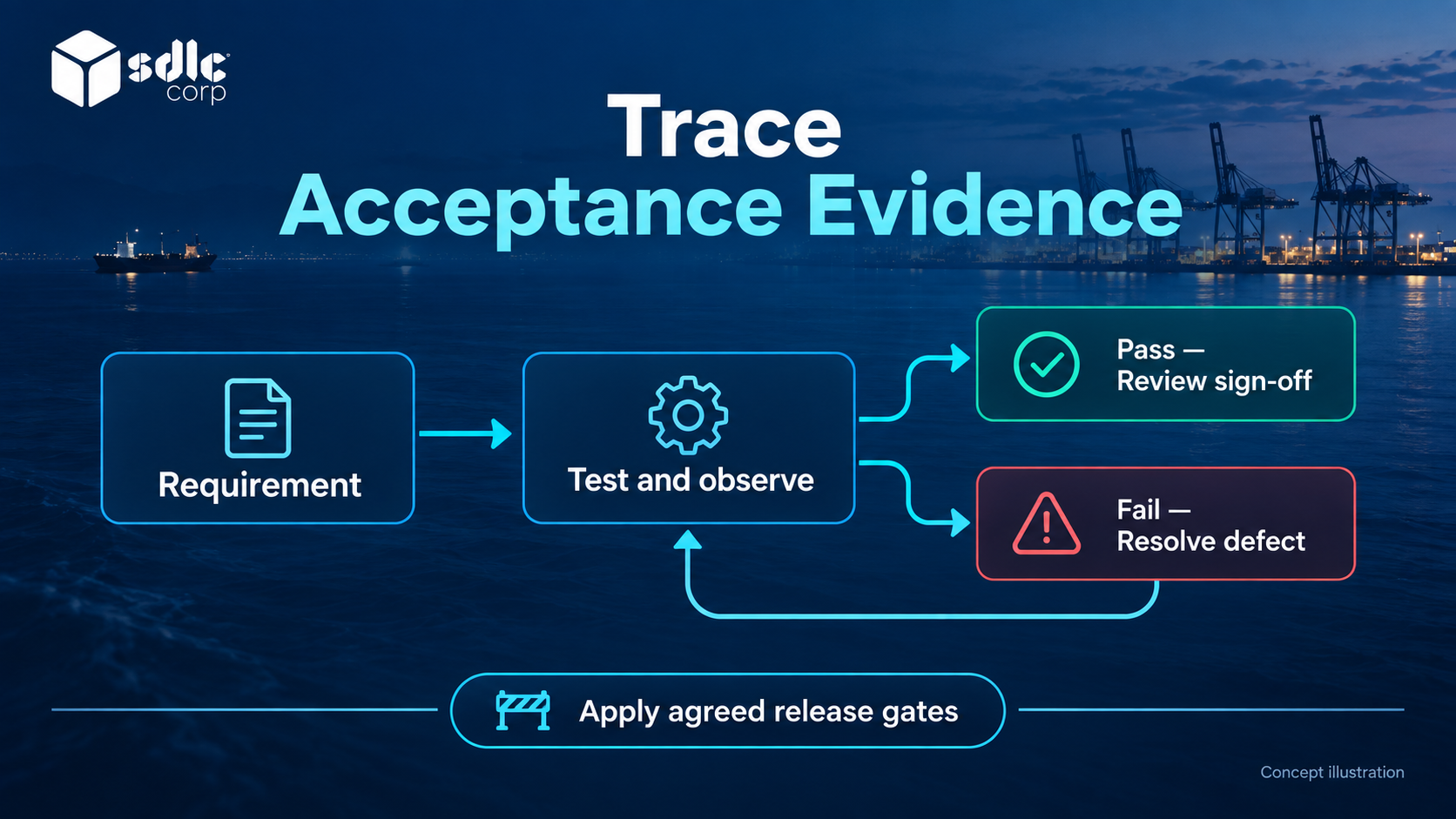
Build the scenario set from requirements with acceptance conditions, keeping each case traceable to an operating need.
Six Acceptance Cases with Observable Outcomes
Illustrative example
Run these cases in the agreed test release after the technical entry criteria pass. The operators validate the business outcome; the technical teams prepare controlled faults and supply their underlying evidence.
| Case And Precondition | User Role And Steps | Expected Result | Evidence And Sign-Off Owner |
|---|---|---|---|
| AT-01: Request Submission and Validation (no request exists) | Requester submits missing information, then corrects it | Correction creates one reviewable request | Request history; intake supervisor |
| AT-02: Role-Based Allocation Approval (a proposal awaits approval) | Operator reviews; duty approver confirms | Roles can perform only their permitted workflow actions | Screen and linked authorization evidence; operations owner |
| AT-03: Concurrent Allocation Conflict (competing proposals exist) | Two authorized approvers try the same available resource | One approval; the other sees a useful conflict and next action | Resulting records and technical concurrency evidence; allocation owner |
| AT-04: Integration Source Failure (source starts current) | Operator follows the approved procedure during controlled source loss | Staleness, affected actions and owned task are clear | Workflow record and observations; shift supervisor |
| AT-05: Recovery and Data Reconciliation (manual evidence exists during a gap) | Operator reviews returning source and resolves a staged conflict | Both sources remain visible; authorized resolution is recorded | Recovery task and history; reconciliation owner |
| AT-06: Post-Restoration Operational Validation (technical restore completed) | Operator opens restored calls and completes a permitted task | History is explainable and operating work resumes in accepted scope | Operator record plus restore report; business continuity owner |
Preserve the Limits of Sign-Off
Record the release, operating area, scenarios passed, evidence references and accepted defects. If a report label remains defective, state who accepted that condition, its effect, correction owner and deadline. Do not imply that an untested area or new interface is accepted.
Anchorage Management System UAT Checklist
Use this consolidated checklist to confirm that the required acceptance activities are completed and supported by documented evidence. Link each item to its test case, observed result, supporting record, and responsible owner.
| Acceptance Area | Validation Requirement |
|---|---|
| Test scope | Confirm approved workflows, exclusions, and acceptance criteria. |
| Environment | Verify the agreed release, integrations, and test environment. |
| Test data | Load realistic vessel calls, allocation records, and exception scenarios. |
| User roles | Confirm operator, supervisor, approver, and administrator permissions. |
| Vessel workflows | Test call creation, amendments, cancellations, and history. |
| Allocation | Validate approval, capacity restrictions, and conflicting requests. |
| Integrations | Test data exchange, unavailable interfaces, and recovery. |
| Exception handling | Verify alerts, ownership, escalation, and closure. |
| Audit records | Confirm user actions, changes, and overrides remain traceable. |
| Reporting | Reconcile operational reports with underlying records. |
| Recovery | Validate restored workflows and the resulting operational state. |
| Defect management | Record failures, retesting evidence, and accepted limitations. |
| Sign-off | Confirm the named acceptance authority and documented approval. |
Test the Core Workflows as Sequences
Check the State Left Behind by Each Action
Test a vessel call end-to-end rather than testing features in isolation. A system can pass every feature test and still be unusable as a sequence.
- Create or receive a call, find it by search, and open its history
- Submit a request with the requester recorded
- Review and approve the allocation, retaining the actor and decision evidence
- Verify the queue position and the reason for it, against the queue workflow requirements
- Confirm arrival with its source, then test amendment and release under the agreed policy
- Raise an exception, assign it, close it, and confirm it appears in the audit
Record outside steps and distinguish required communications from avoidable duplicate entry or missing capability. Evaluate the complete approved workflow, including human handoffs.
Example UAT Record: Cancellation After an Amendment
Illustrative example
| Test Field | Test Entry |
|---|---|
| Starting state | R-41 amended to revision 3; reservation RES-7 belongs only to R-41 |
| Actor and action | operator-2 submits permitted cancellation OP-9 against revision 3 |
| Expected result | R-41 becomes cancelled revision 4; RES-7 released |
| Cross record check | R-41 absent from active queue; unrelated RES-8 unchanged |
| Audit evidence | AU-9 records revision 3 to 4, operator-2, OP-9 and cancellation reason |
| Negative check | agent B direct cancellation request denied; version remains 4 |
Link each test to its requirement. Keep the observed result and supporting screenshots or logs. After a fix, rerun the sequence and check related workflows for new faults. Record a pass only when the connected records reach the expected state.
A demo or proof of concept can resolve an early buying uncertainty, but it does not replace acceptance of the delivered release.
Test Integrations Where They Fail
Integration testing during UAT should not repeat system integration testing. It should confirm that the operator experience is correct when an interface misbehaves.
- A record arriving from an integrated system and appearing correctly
- A mismatch between two sources surfaced rather than silently resolved
- An interface unavailable during an active workflow
- Recovery when it returns, including reconciliation of anything entered manually
Where sensor feeds are included in the approved scope, simulate Automatic Identification System (AIS) loss during an active allocation. Verify how operators identify and handle radar-only targets and confirm that each target displays its source. Restore the feed and test whether the system correctly reconciles recovered information with manually recorded updates. Use the radar and AIS procurement checklist to verify the relevant integration and operational requirements.
Test Permissions, Audit and Reporting
- Confirm permitted and denied workflow actions for each role, using completed security-test evidence for server-side enforcement
- An override is possible where policy allows, attributed and recorded
- Administrative and configuration changes appear in the audit with prior values
- Reports use the same state definitions as the operational screens
- A report reconciles to the underlying records for a sample period
Test reporting definitions and reconciliation before adoption so differing totals are investigated with the underlying records.
Test UAT Workloads, Small Screens and Degraded Operations
- Representative record volumes, not a demonstration dataset
- Concurrent users at the level of a busy shift
- The slowest network path an operator will actually use
- Screen sizes and devices in real use, including any control room display
- Accessibility basics: keyboard navigation, focus visibility, readable contrast
Use the World Wide Web Consortium keyboard guidance to define keyboard checks. Test whether operators can complete the relevant tasks without a pointer, and include those results in the wider accessibility assessment.
Use the accepted performance-test results to select representative operating conditions. Operators assess whether the workflow remains usable; the performance team owns load generation, measurement and bottleneck diagnosis.
Include geographic tasks: select an approved zone, inspect its restriction, review an entry or dwell alert, and follow its evidence to the call. Test stale position behavior and keyboard access to the same information. A visual map check does not verify geofence interpretation.
Triage Defects Against Agreed Severities
Agree the definitions before testing, in operational terms rather than technical ones.
Adapt these sample defect categories to the port-approved impact and acceptance policy.
| Severity | Definition | Gate |
|---|---|---|
| Critical | A mandatory operational workflow is unavailable or creates an unacceptable operational risk. | Blocks UAT sign-off. |
| Major | A significant workflow is affected, but an approved workaround may exist. | Requires formal acceptance, an owner, and a correction date. |
| Minor | Limited operational inconvenience without material impact on accepted workflows. | Record and schedule correction under the agreed policy. |
| Cosmetic | Presentation issue without a functional impact. | Record in the defect backlog. |
Record the workaround for every major defect accepted, and the date by which it will be fixed. Assign a remediation owner and retest corrected scenarios, including affected integrations and regression checks, before marking defects closed.
Define Production Readiness and Sign-Off
Use the approved production-readiness checklist before requesting UAT sign-off. Confirm that critical defects are closed and that any accepted major defects have documented workarounds, responsible owners, and correction dates. Verify migrated records, completed training, support access, and rollback procedures.
Review acceptance evidence from completed workflows, integrations, degraded operations, and recovery scenarios. Record the release version, operating locations, accepted workflows, interface scope, unresolved conditions, and the person authorized to approve each limitation.
Where a workaround is accepted, confirm that affected shift teams understand the procedure and that support personnel can identify when it is no longer effective. Set review dates for time-limited exceptions.
UAT sign-off confirms acceptance of the defined business workflows. The subsequent production go/no-go decision must also consider infrastructure readiness, approved migration, backup and rollback evidence, support coverage, access controls, and operational communications. The designated release authority must approve this separate decision.
Final Thoughts
A successful anchorage management system UAT process depends on verified operational outcomes, not the number of completed tests. Before accepting the release, confirm that critical workflows perform correctly, defects are documented, recovery scenarios are validated, and responsible authorities approve the defined operating scope. This creates a clear evidence-based foundation for production readiness.
Plan Your Anchorage Software UAT With SDLC Corp
Preparing an anchorage management system for operational acceptance? SDLC Corp can help define UAT scenarios, validate technical prerequisites, establish defect workflows, and document production-readiness evidence. Explore our software testing and QA services for your anchorage management software implementation, or discuss your testing requirements with our team.
Frequently Asked Questions
Who Should Run and Approve UAT?
Operators and supervisors should assess the tasks they own, with the project team providing environments, data and technical support. Name the acceptance authority in advance; supplier testing supports UAT but does not replace the port's decision.
What Makes a Test Result Sufficient?
Retain the test conditions, action and observed result with the relevant record or audit evidence. A screenshot of a success message alone may not establish that permissions, stored state or downstream effects are correct.
Can Open Defects Remain at Sign-Off?
Only where the approved acceptance policy permits it and the required authority accepts the documented condition. Record impact, workaround, owner and resolution date. Keep unmet mandatory conditions visible rather than treating them as routine minor defects.