

An anchorage software rollout follows dependencies as well as a calendar. Interface access, design, build work, testing, training and operational transition determine which activities can overlap and which delays move the cutover date.
Build the schedule from verified prerequisites and available people. Preserve the acceptance and transition work when a dependency slips, and state which tasks can proceed independently.
Estimate Duration From The Dependency Sequence
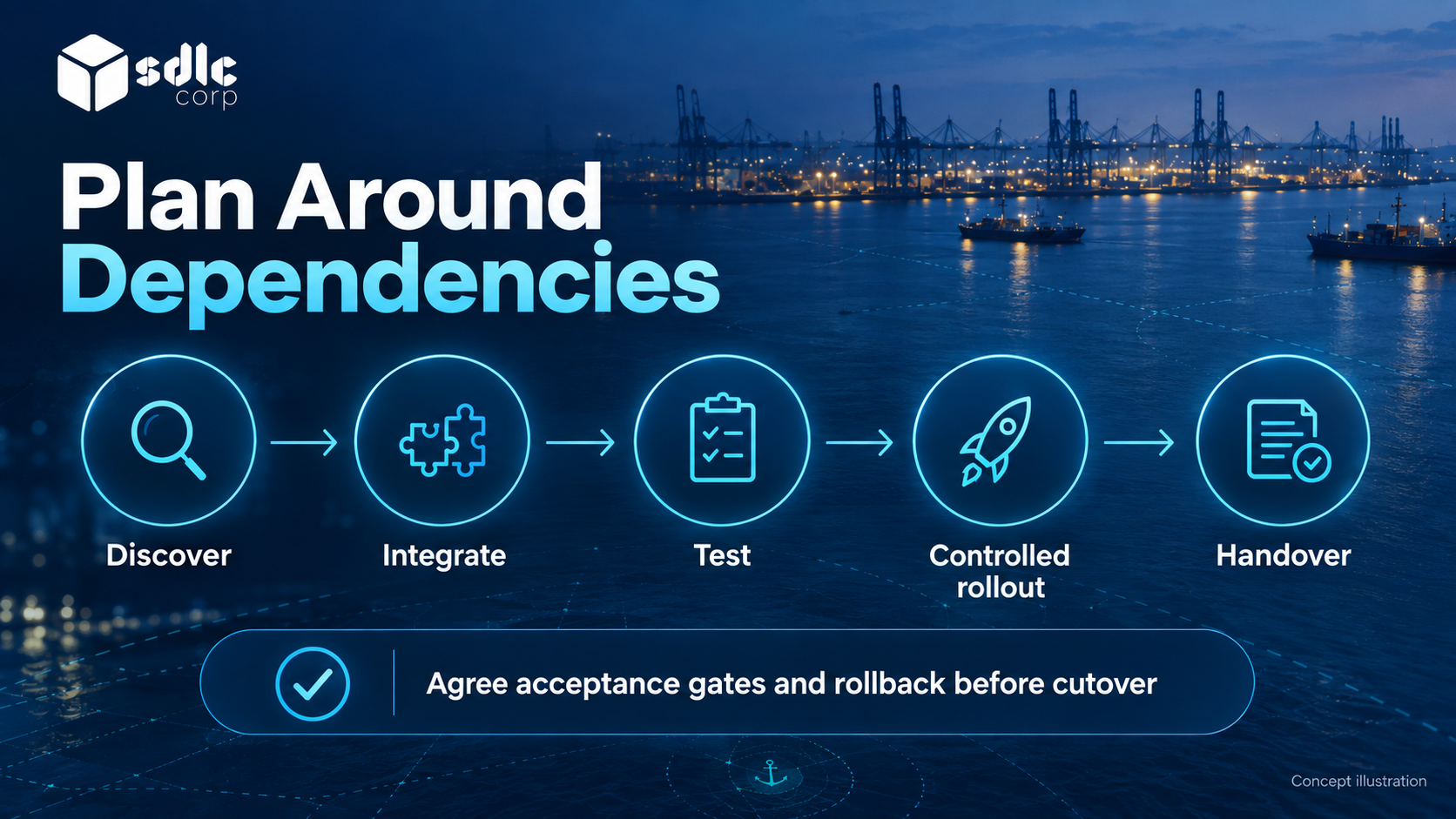
Discovery leads to interface validation and design, followed by configuration or build, integration, acceptance, parallel operation and cutover. Some tasks can overlap, but only when their required inputs are available.
For each task, record its owner, effort estimate, available people, prerequisite and exit evidence. Calculate its earliest finish from the latest prerequisite finish plus the task duration. The longest dependent sequence controls the earliest possible cutover; adding every task duration would ignore parallel work.
Compare Delivery Conditions Before Comparing Dates
| Delivery Condition | What Controls The Schedule | Evidence Needed Before Committing |
|---|---|---|
| Existing supported interfaces and bounded configuration | Access, operator availability and acceptance | Working test connection and agreed workflow |
| New adapters or substantial migration | Source-owner work, mapping and trial loads | Confirmed contract and representative data |
| Several organizations or approval boundaries | External changes, authorization and coordinated testing | Named owners and agreed dependency dates |
An interface delay moves every dependent activity that cannot proceed independently. Replan those activities explicitly and retain their required testing. A simulation may allow design work to continue, but it does not close acceptance of the actual connection.
Record The Consequence Of A Missed Dependency
| Dependency State | Planning Response | Release Consequence |
|---|---|---|
| Access confirmed and tested | Use the agreed integration estimate | Continue toward its exit criteria |
| Access promised but untested | Keep the date conditional | Do not declare the interface accepted |
| Access unavailable | Escalate, revise scope or reschedule dependent work | Retain a documented cutover decision |
Estimate a calendar only after these conditions and the available capacity are known. The sequence is reusable; a duration from another project is not a delivery commitment for this one.
Trace The Dependencies To Cutover
| Milestone | Must Follow | Can Proceed In Parallel | Exit Evidence |
|---|---|---|---|
| Workflow baseline | Named operating owners | Source inventory and access requests | Agreed normal and exception paths |
| Adapter acceptance | Supported contract, permission and usable test access | Screen design against agreed records | Normal, rejected and recovered exchanges |
| Migration rehearsal | Approved mapping and representative source extract | Operator training preparation | Reconciled records and reject treatment |
| Operational acceptance | Required technical evidence and usable test release | Support rehearsal | Complete operator scenarios with accepted defects |
| Cutover decision | Acceptance, recovery evidence and assigned support | Final communications | Authorized go/no-go with rollback conditions |
A delay on the longest unresolved dependency path moves the possible cutover date. Protect acceptance time by changing scope or the date explicitly rather than silently shortening the tests.
Anchorage Implementation Phases And Their Exit Deliverables
| Phase | Output that lets the next phase start | Common blocker |
|---|---|---|
| Discovery | Documented workflows and exception paths | Rules held only in people's heads |
| Integration assessment | Confirmed interfaces with owners and dates | Access not yet approved |
| Design and prototype | Agreed screens and data model | No decision owner named |
| Build and configure | Working increments against scenarios | Requirements still moving |
| Integration delivery | Interfaces working in a test environment | Counterparty availability |
| Migration | Data loaded and reconciled | Source quality discovered late |
| Testing | Scenarios passed, defects triaged | Acceptance criteria written late |
| Training and pilot | Operators working in the system | Pilot scope too wide |
| Cutover and hypercare | Production operation, support in place | No rollback position |
port system integration due diligence is the input to the second phase and helps identify dependencies that can affect the schedule.
Record the owner, dependency and passing evidence for each output in the scope of work before committing to a milestone date.
Discovery Must Capture The Exception Paths
The happy path is easy to document and rarely the source of trouble. Spend discovery on what operators do when something is wrong: the amendment, the override, the vessel that arrives early, the allocation released under pressure.
Capture rules that currently live in spreadsheets or in individual judgement. These are the requirements that surface after go-live as complaints that the new system cannot do what the old one did. phased port system modernization covers how to find them systematically.
Identify Whether Interface Access Controls The Delivery Date
Plan Around Evidence Of Access, Not A Promised Date
Check whether interface access controls the delivery date. Confirm essential interface constraints before committing to a design or build schedule.
- Specification, sample data, test credentials and a named owner per interface
- Commercial or network approvals identified, with an escalation route
- Counterparty effort scoped and funded, not assumed
- A fallback for each interface that cannot be confirmed in time
An interface that appears in the plan without a named owner on the other side is an assumption, and it should be shown as one.
Example: A Test Environment Is Delayed
Suppose configuration is progressing but an incumbent has not provided the interface test environment. Screen completion cannot prove the affected end-to-end workflow. Mark the dependency and the acceptance activities it blocks, then identify what can still be tested with representative data. This keeps the plan useful without presenting a simulated exchange as production readiness.
Resolve hosting and connectivity dependencies before booking interface tests. Network approvals and usable test environments can control the test start date.
Plan Migration And Acceptance Before Build Completes
Two workstreams are habitually started too late. Migration scope needs deciding during discovery: which entities, which period, at what quality, reconciled against what tolerance. Acceptance criteria need writing alongside requirements so that build has a target.
The user acceptance testing (UAT) checklist should exist in draft before build starts. Writing acceptance criteria after the system is built produces criteria the system happens to meet.
Run a small migration rehearsal while workflow design can still change. Map source fields, record rejected rows and reconcile call relationships as well as totals. Ask operators to verify sample decisions whose meaning depended on spreadsheet conventions. Give uncertain history an approved treatment rather than inventing missing approvals.
Connect the rehearsal to acceptance scenarios: a migrated active call should support its next permitted action, and archived records should remain retrievable under the agreed access rules. Record who resolves each discrepancy and which failures block cutover. This turns migration and acceptance into linked evidence streams rather than two late project tasks.
Pilot Narrowly, Then Widen
A pilot should test bounded acceptance criteria and reveal operational issues; it cannot establish performance outside the conditions actually tested. Choose a scope narrow enough that a problem is visible and recoverable: one shift pattern, one zone group, or one category of call.
Define what the pilot must demonstrate before wider rollout, including a degraded mode drill if sensor feeds are in scope. The demo and proof of concept (POC) checklist contains scenario material that can be reused here, including the source loss and recovery sequence.
Review the anchorage modernization case study as a potential implementation reference. Check the documented phase boundaries and delivery stage before using it to support a proposed rollout sequence or timeline.
Cut Over With A Rollback Position
Cutover needs a named decision owner, a go or no go checklist, and a defined rollback for each interface. Hypercare needs agreed response times and the people who built the system available, not handed over the previous week.
- Go or no go criteria agreed in advance, not decided on the day
- Parallel running exit criteria, if parallel running is used
- Rollback position per interface, tested where possible
- Hypercare duration, staffing and escalation route
- Transition to standard support with a defined handover
post launch support requirements should be agreed before cutover, not negotiated during hypercare.
Assign a sponsor, operational acceptance owner and change authority. Review dependency dates, scope changes and unresolved risks at agreed gates. Design, data preparation and interface work may overlap when prerequisites allow; the phase table does not require a strictly sequential delivery method.
Estimate The Timeline From Dependencies And Available Capacity
A credible plan states what would change the timeline: the number of interfaces and whether access is confirmed, the state of the source data, how many decision makers must agree a design, whether operators are available for testing during operational periods, and whether sensor resilience is in scope.
A usable implementation plan names dependencies, acceptance owners and cutover conditions. Review those items at each phase before widening the operational scope.
Build A Dependency Based Estimate Without Inventing A Launch Date
Break each phase into activities with an owner, effort estimate, available capacity and prerequisites. Draw the dependencies: interface testing cannot finish before usable access and sample data arrive; migration rehearsal depends on an agreed mapping and representative extract. Activities that can run together should not simply be added end-to-end.
For example, design and access approval may run in parallel, but integration testing starts only when both are ready. If access finishes later, shortening design no longer moves that test start. Add explicit time for defect correction, operator participation and a cutover decision.
Present a range with assumptions and unresolved external dates, then revise it when evidence changes. This gives a buyer a schedule they can manage instead of an unsupported number of weeks.
Conclusion
Validate the dependencies and available people behind the schedule before committing to a date. When access or another prerequisite slips, recalculate the affected sequence instead of compressing acceptance by default.
Make cutover a readiness decision supported by test results, trained shifts, support arrangements and a recovery plan. If that evidence is incomplete, record the revised transition decision and its consequences.
Discuss Rollout Planning With SDLC Corp
Discuss a dependency-based implementation plan for the anchorage management system with SDLC Corp through its software consulting services. Supply access status, migration needs and operator availability. Ask for milestones tied to prerequisites and acceptance evidence, with unresolved source-side work and cutover conditions visible, rather than treating an early calendar estimate as a confirmed delivery commitment for the whole scope.
Frequently Asked Questions
How Long Does Implementation Take?
Estimate duration from the agreed scope, available interfaces, migration, approval cycles and operating-team capacity. Build a dependency schedule and identify its controlling sequence. No fixed week count is a reliable commitment before those assumptions are confirmed.
What Happens If Interface Access Is Late?
Identify the tasks it blocks and recalculate their dependent milestones. Some work may continue with representative data, but that does not remove the need to test the real permitted connection before acceptance.
When Should Operators Be Trained?
Provide enough exposure during the pilot for operators to test the workflow and give feedback. Schedule practical training and any refresh before their shifts adopt the release, using the accepted configuration and recovery procedures.